Thank you! Your submission has been received!
Oops! Something went wrong while submitting the form.
0
0
0
0
----------
0
0
Articles
Article
Wendy’s and Denny’s: Breakfast and Late Night Dining Drives Success
Breakfast boosted visits at Denny's and Wendy's in Q1 2024.
Lila Margalit
Apr 29, 2024
3 minutes

Restaurants continue to face headwinds, from still-high food-away-from-home prices to rising labor costs. But despite these challenges, there are promising signs that the industry may be in for an upturn. And increasingly, chains are leaning into breakfast and late night offerings to maximize revenue and foster customer loyalty. 

So with Q1 2024 under our belts, we checked in with Wendy’s and Denny’s, two dining leaders with very different offerings in the breakfast space. How did they weather the first quarter of 2024 (pun intended)? And which dayparts experienced the biggest visit boosts in Q1? 

Key Takeaways

  • After dipping in January, year-over-year (YoY) visits to Wendy’s and Denny’s picked up in February and March 2024 – driving a YoY increase in quarterly visits for both chains.
  • For Wendy’s, the breakfast daypart experienced the biggest visit increase, followed by the 8:00 PM to 12:00 AM time slot.
  • Denny’s, which famously offers breakfast 24 hours a day, saw the biggest YoY visit increases midday and during the late night hours.

A Strong Start to the Year

After a tough Q4 2023 – and a January 2024 dragged down by cold and stormy weather – YoY visits to Wendy’s and Denny’s began to pick up in February and March 2024. And even accounting for January’s Arctic blast, Wendy’s and Denny’s came out ahead on a quarterly basis, with YoY visits up 0.7% and 1.0% respectively.

Monthly Visits to Wendy's and Denny's Compared to Previous Year

Wendy’s Ups its Breakfast and Nighttime Game

Wendy’s first launched its breakfast menu in March 2020, just before COVID sent the dining industry into a tailspin. But despite a rocky start, Wendy’s doubled down on the morning daypart, continually tweaking its breakfast offerings and investing ad dollars to boost breakfast sales. 

Drilling down into hourly visit data shows that this strategy is paying off. Visits to Wendy’s during the morning daypart (between 6:00 AM and 11:00 AM) jumped 9.3% in Q1 2024 compared to Q1 2023. The chain’s nighttime daypart – which the burger giant began advertising in 2023 for the first time in four years – also saw a YoY boost. Meanwhile, Wendy’s traditional lunch and dinner time slots held steady, with just minor quarterly visit gaps, indicating that the chain’s overall YoY visit growth in Q1 was driven by its breakfast and nighttime push.

Share of visits to Wendy's by Daypart & Quarterly visits, Q1 2024 compared to Q1 2023

Denny’s Anytime Breakfast Drives Lunch Time and Late Night Visits

Denny’s has always been all about breakfast. And with some 75.0% of Denny’s locations open 24/7 (even on Christmas), hungry diners frequent the chain day and night to satisfy their cravings for hash browns, eggs, pancakes, and other breakfast favorites. 

Unsurprisingly, the chain gets most of its visits in the morning and early afternoon. But in Q1 2024, it was the late night daypart that experienced the biggest YoY visit bump – perhaps driven in part by Denny’s push last year to increase the number of locations open in the wee hours. 

But Denny’s busiest time slot, between 11:00 AM and 3:00 PM, also experienced a YoY visit increase – showing that even as the chain cements its role as a go-to nighttime destination, it continues to face healthy demand during more traditional dining dayparts.

Visits to Denny's by daypart, Q1 visits compared to Q1 2023

The Most Important Meal(s) of the Day

Breakfast and late night dining offerings have emerged as important drivers of dining success. How will these dayparts continue to fare as the year wears on? And which other brands will make inroads into the breakfast and nighttime dining game?

Follow Placer.ai’s data-driven dining analyses to find out. 

Article
Warehouse Clubs: Finding the Perfect Timing
Elizabeth Lafontaine
Apr 26, 2024

At a time when retail loyalty appears to be low, warehouse clubs remain the exception. Bulk is big business in the U.S. retail market, and clubs have found a way to deliver on a combination of value, convenience and experience, and sometimes $1.50 hot dogs. The allure of the warehouse club defies some current consumer logic; U.S. households are not growing according to the U.S. Census Bureau. But, clubs also represent much of what is good in retail today: a broad combination of goods and services, inherent value and high quality private labels.

These factors have aided warehouses in growing store traffic compared to their mass merchant counterparts, particularly in the first quarter of 2024. Clubs--including BJ’s Wholesale Club, Sam’s Club and Costco Wholesale--saw visits increase by almost 8% year-over-year, almost double the combined growth of Walmart and Target during the same period. Mass merchants have been squeezed by other value sectors, clubs have been able to hold their own and continue to provide “perceived” value to shoppers, contributing to their traffic volumes.

Beneath the umbrella of growth, each chain has some surprising competitive advantages, and it’s clear that each club serves a distinct purpose to its visitors. In reviewing daily visits, Sam’s Club owns Saturdays, with 22% of visits occurring that day (as shown below), the highest percentage of visits compared to its competition. In contrast, Costco sees a higher percentage of visits on weekdays, specifically Tuesday through Thursday, compared to the other chains.

While Sam’s Club and Costco stand out in terms of their daily visits, BJ’s excels in the time of day that it attracts higher levels of visitors to its locations. BJ’s draws 7% of visits between 8:00-10:00 AM (show below), which is two points higher than Sam’s Club and more than double Costco’s percentage of visits. Not only does BJ’s attract the morning shopper, but also the afterhours customer. BJ’s over indexes in the percentage of visits between 7:00-10:00 PM, with almost 11% of visits occurring during those later hours. BJ’s locations tend to open earlier and stay open later than their Sam’s Club and Costco counterparts, which vary in operational hours for the clubs themselves outside of gas stations. This creates a distinct advantage for BJ’s, especially in areas of direct competition, as visitors looking to shop at off-hours are likely to visit BJ’s.

It’s clear that each club chain has its key day and time to attract visitors that doesn’t overlap too much with its competitors. Warehouse clubs are doing a fantastic job at meeting their consumers where they are and when they prefer to shop. Clubs benefit from increased loyalty due to membership, but it appears that visitors flock to these clubs no matter the day or time. Maybe it’s time to bring breakfast to the Costco & Sam’s Club food courts?

Article
Round1 Entertainment Expands with Spo-Cha Concept
Caroline Wu
Apr 26, 2024

Arrowhead Towne Centre in Glendale, AZ recently opened the newest family fun entertainment center with both a ROUND1 Bowling & Arcade as well as a Spo-Cha. Taking over an erstwhile Mervyn’s, the former includes eight bowling lanes, a variety of favorite games like a claw machine, and two party/karaoke rooms. Upstairs is Spo-Cha, short for Sports Challenge, which is an indoor sports complex where one pays a flat fee for 90 minutes to access activities like riding a mechanical bull, batting cages, a trampoline park, basketball, different sport courts, and billiards.

Spo-Cha is currently in five mall locations in the United States, with plans for more.  Overall foot traffic at the malls where it’s currently operational has been positive year-over-year for the month of March.

In addition to the mechanical bull, there is also a Kids Spo-Cha climbing gym and obstacle course.

Mechanical Bull 4.23.24

Source: Spo-Cha

Kids Spo-cha 4.23.24

Source: Spo-Cha

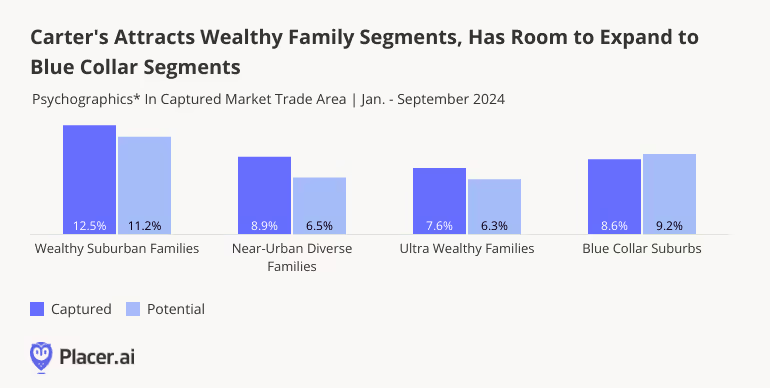
At an overall chain level, Round1 Entertainment tends to attract Near Urban Diverse Families and Wealthy Suburban Families the most.

Round1 Segments on Template

Article
Coffee Chains: Q1 2024 Update and What’s Changed Since COVID
How has the coffee space changed since the pandemic ushered in a new age of remote work that slashed commuting and office-wide coffee orders? We take a closer look at how visits to brands like Starbucks, Dunkin', and Dutch Bros. have changed since the pandemic.
Ezra Carmel
Apr 25, 2024
3 minutes

Pandemic restrictions ushered in a new age of remote work that slashed commuting and office-wide coffee orders. But the coffee space has adapted to changing consumer behavior, and category leaders – Starbucks, Dunkin’, and Dutch Bros. Coffee – have found success in the new normal. 

With Q1 2024 in the rearview mirror, we took a closer look at how visitation to the coffee space has changed since the pandemic. 

Key Takeaways

  • Since 2019, Starbucks, Dunkin’, and especially Dutch Bros. have expanded their footprints – driving their pandemic recovery.
  • Year-over-year visits to the coffee leaders are also on the rise, indicating that the space is continuing to grow. 
  • Starbucks, Dunkin’, and Dutch Bros each have a unique hourly visitation pattern, suggesting that – despite the apparent crowding in the coffee space – coffee demand is varied enough to sustain multiple major players.

Coffee’s Recovery Since COVID

Over the last few years, Starbucks, Dunkin’, and Dutch Bros have expanded their footprints, helping drive visits in a turbulent retail environment. Notably, visits to all three chains have remained above pre-pandemic levels nearly every quarter since Q2 2021, signifying a rapid and robust foot traffic recovery for the space. 

Starbucks and Dunkin’ have both implemented expansion plans recently, with Starbucks focusing on smaller-format stores and Dunkin’ going after non-traditional sites such as airports, universities, and travel plazas. The store fleet growth likely contributed to both chains’ visit increases – in Q1 2024, foot traffic to Starbucks and Dunkin’s was up 14.5% and 9.5%, respectively, compared to Q1 2019.

Baseline change in visits to Starbucks and Dunkin, Q1 2019 to Q1 2024

Meanwhile Dutch Bros.’ physical footprint has grown exponentially since 2019, and the chain is now working on developing its digital footprint, including the rollout of mobile ordering.The company’s aggressive expansion contributed to Dutch Bros.’ significantly elevated visits in Q1 2024 – 177.6% above the Q1 2019 baseline. (The chain’s considerably larger year-over-five-year visit increases compared to Starbucks and Dunkin’ can be attributed to Dutch Bros.’ substantially smaller starting footprint, so that every opening brings a larger visit boost to the chain as a whole.)

Baseline change in visits to Dutch Bros. and Breakfast/Coffee shop segment, Q1 2019 to Q1 2024

Monthly Momentum for Coffee Leaders

Zooming in on visits since the halfway point of 2023 shows that the coffee space’s post-pandemic momentum continued in recent months, with year-over-year (YoY) monthly visits to all three chains positive since the beginning of 2024. 

Dutch Bros.’ ongoing aggressive expansion once again gave the Oregon-based chain the largest year-over-year boost, and Starbucks and Dunkin’ also sustained YoY visit growth nearly every month.

Monthly visits to Starbucks, Dunkin', and Dutch Bros. compared to previous year

Each Coffee Brand Fills a Different Need

The visit growth for the three coffee leaders analyzed shows that there is enough consumer demand to support across-the-board growth in the space. And analyzing the Q1 2024 hourly visit distribution for Starbucks, Dunkin’, and Dutch Bros. reveals that visits to each chain follow a unique pattern – suggesting that every brand plays a unique role in the wider coffee landscape.

Visits to Starbucks, Dunkin', and Dutch Bros. in Q1 2024 as a % of Chain's total Visits

Dunkin’ received almost half (47.8%) of its visits before 11:00 AM, indicating that many guests visit Dunkin’ primarily for coffee or other breakfast fare. Starbucks’s guests tended to visit a little later in the day – with 38.5% of Starbucks visits taking place between 11:00 AM and 3:59 PM – so many consumers may be visiting the Seattle-based chain for a midday pick-me-up. Meanwhile, Dutch Bros. saw the largest share of late afternoon and evening visits (between 4:00 and 10:59 PM) relative to the other two chains – perhaps thanks to the chain’s wide variety of non-caffeinated beverages.  

The variance in the hourly visit distribution between the three chains shows that the coffee space is big enough for multiple players and bodes well for the three chains’ performance in 2024.

For more data-driven pick-me-ups, visit Placer.ai.

This blog includes data from Placer.ai Data Version 2.0, which implements improvements to our extrapolation capabilities, adds short visit monitoring, and enhances visit detection.

Article
Checking in with RBI and YUM!
Restaurant Brands International and Yum! Brands own and operate some of the biggest brands in the QSR and Fast Casual space. How are players like Burger King and Taco Bell performing in 2024? We find out.
Lila Margalit
Apr 24, 2024
4 minutes

Amid the economic headwinds that plagued the wider dining industry in 2022 and 2023, the QSR and Fast Casual segments offered price-conscious consumers places to treat themselves to affordable indulgences and grab quick meals on the go. 

Many of the major chains in this space – including Burger King, Popeyes, Pizza Hut, Taco Bell, and KFC – are brands owned by Restaurant Brands International (RBI) or Yum! Brands. How are these players faring in 2024? 

We dove into the data to find out.

Key Takeaways

  • RBI’s Popeyes and Tim Hortons experienced positive quarterly visit growth in Q1 2024, 
  • Quarterly traffic numbers for RBI’s Burger King held steady, even as rightsizing efforts boosted the chain’s average number of visits per venue. Firehouse Subs, for its part,  was significantly impacted by January’s inclement weather – but rallied in February and March with YoY visit growth.
  • YUM! Brand’s Pizza Hut and Taco Bell also enjoyed positive visit growth in Q1 2024.
  • Both RBI and YUM! Brands are finding success with promotions and limited time offerings: Pizza Hut drew huge numbers of fans on Super Bowl Sunday, while Firehouse Subs drove visits with its leap day special.

RBI Chains Enjoy Mostly Positive Visit Growth

Restaurant Brands International, Inc. owns three leading QSR banners – Burger King, Popeyes Louisiana Kitchen, and Tim Hortons – as well as Fast Casual chain Firehouse Subs. And since December 2023, all four chains have experienced mainly-positive year-over-year monthly (YoY) foot traffic growth – with the stark exception of January 2024, when unusually cold weather caused overall dining visits to dip.

The January Arctic Blast did not impact all RBI brands equally: Coffee favorite Tim Horton managed to maintain positive visit growth throughout the first month of the year, perhaps thanks to the chain’s emphasis on hot drinks. On the other hand, YoY visits to Firehouse Subs dropped 8.8% in January 2024 – so although the traffic picked back up in February and March, the brand still finished out Q1 2024 with a minor YoY quarterly visit gap.

Popeyes, for its part, enjoyed a 4.4% quarterly visit bump in Q1 2024, fueled in part by the chain’s fleet expansion. And though Burger King ended the quarter with just a slight overall quarterly visit increase (0.3%), this is likely a reflection of the chain’s rightsizing efforts: In Q1 2024, the average number of visits to each of the chain’s venues increased by 4.3%.

Monthly visits to RBI brands compared to previous year

YUM! Brand’s Largest Banners Poised to Thrive

Yum! Brands also owns three major fast food chains – Pizza Hut, Taco Bell, and KFC – in addition to Fast Casual The Habit Burger Grill. And though KFC – which has been focusing on international expansion – maintained a Q1 2024 YoY visit gap, quarterly visits to YUM!’s two biggest QSR banners, Pizza Hut and Taco Bell, were up 4.3% and 3.8%, respectively.

Monthly visits to Pizza Hut and Taco Bell compared to previous year

Making the Most of Super Bowl and Leap Day

Neither RBI nor YUM! banners are resting on their laurels. Banners at both companies are finding creative ways to drive business, leaning into limited time offers (LTOs) to help customers mark special occasions.

RBI’s Firehouse Subs celebrated leap day – Thursday, February 29th, 2024 – with a special 2-for-1 LTO for customers whose names start with the letters L, E, A, or P. The day of the promotion was the restaurant’s single busiest Thursday between March 2023 and March 2024: Visits were up 21.5% compared to an average Thursday, and about 6.0% compared to an average Friday or Saturday (Firehouse Sub’s two busiest days of the week).

Super Bowl Sunday came this year just two days after National Pizza Day – and YUM!’s Pizza Hut enticed hungry viewers with crowd-pleasing limited time menu offerings. Although many football fans likely ordered their grub online, February 11th, 2024 was still the chain’s busiest day of the past year – with visits up 47.5% compared to a daily average. In the Las Vegas-Henderson-Paradise, NV CBSA, which hosted Super Bowl LVIII, Pizza Hut’s big-day visit spike was an even more impressive 74.1%. 

Visits to Pizza Hut, Firehouse Subs on Super Bowl Sunday and Leap Day compared to relevant monthly visit average

Final Thoughts

Inflation may have cooled, but food-away-from-home prices remain high – and are likely to continue to increase this year. Against this backdrop, companies like RBI and YUM! that offer hungry consumers affordable ways to fill up and have fun appear poised for success. 

Follow Placer.ai for more data-driven dining insights.

This blog includes data from Placer.ai Data Version 2.0, which implements improvements to our extrapolation capabilities, adds short visit monitoring, and enhances visit detection. ‍

Article
Chipotle & McDonald's Serving Up Success
With the first quarter of the year behind us, we take a look at how McDonald's and Chipotle are doing, and take a look at how McDonald's new beverage concept, CosMc, is performing.
Bracha Arnold
Apr 23, 2024
3 minutes

McDonald’s and Chipotle are two of the biggest names in the QSR and fast-casual space, with thousands of restaurants to their names and millions of visitors monthly. With Q1 2024 behind us, how are the two chains performing? And what can visitation patterns to McDonald’s new beverage concept, CosMc, tell us about the new chain? 

We dove into the foot traffic data to find out.

Key Takeaways:

  • McDonald’s year-over-year visit and visit per location numbers continued to grow.
  • McDonald’s new beverage chain CosMc’s is seeing strong afternoon visitation patterns. 
  • Chipotle saw strong monthly visit growth and outperformed the wider Fast-Casual segment.

Golden Arches Growth: McDonald’s Outperforms QSR

Foot traffic to McDonald’s has remained consistently strong over the past year, with the chain generally outperforming the wider Quick-Service Restaurant (QSR) and posting positive visit growth almost every month.

As the chain continues to roll out new concepts, like its Krispy Kreme partnership or revamped menu, visits may keep trending in their positive direction.

Monthly visits to McDonald's, QSR segment compared to previous year

CosMc’s: Out of This World 

McDonald’s isn’t limiting its innovation to in-store partnerships and menu tweaks. The company recently launched its first spin-off restaurant, CosMc's, in December 2023 in the Chicago suburb of Bolingbrook, Illinois, and plans to open at least ten stores by the end of the year. CosMc is named after a lesser-known McDonald's character and aims to compete with beverage and coffee-focused chains while meeting the growing demand for an afternoon pick-me-up.

Hourly visit distribution to CosMc, Q1 2024

Comparing the Q1 2024 hourly visit distribution for the first CosMc location with that of nearby (within one mile) McDonald’s, Dunkin', and Starbucks locations reveals significant differences in visitation patterns between the concepts. CosMc received the smallest share of 7:00 to 10:59 AM visits – even less than the nearby McDonald’s – while the nearby Dunkin’ and Starbucks received the largest share of morning visits. But CosMc’s saw the largest share of late afternoon and evening visits – 40.2% of CosMc’s visits were between 4:00 and 7:59 PM, compared to 36.4%, 24.7%, and 18.3% for McDonald’s, Dunkin’, Starbucks, respectively. It seems, then, that CosMc’s is creating its own niche: Instead of competing to provide guests with their morning caffeine fix in the already crowded coffee space, the new brand is using its beverage-forward menu and playful snacks to attract guests with the promise of an afternoon pick-me-up. 

Since its launch, CosMc has opened three new locations in Texas and plans to continue rolling out the concept across the country. With a strong reception at its first few locations, CosMc is well-positioned to continue capturing afternoon beverage visits. 

Chipotle: Exceeding The Wider Industry 

Tex-Mex powerhouse Chipotle has also experienced strong foot traffic growth throughout the past twelve months, with the chain outperforming the wider Fast-Casual segment in every month analyzed. Some of the visit increase is likely due to Chipotle’s expansion, and the growth is not likely to slow down any time soon –  the company plans to add around 300  new locations in 2024.

With the Fast-Casual segment expected to continue growing in the coming year – and with Chipotle’s record of staying ahead of the curve – the fast casual leader is well-positioned to continue driving visits to its restaurants.

Monthly visits to Chipotle compared to previous year

Dishing It Out

Despite industry challenges, McDonald's and Chipotle continue to drive visits and innovate in the QSR and fast-casual dining spaces, and CosMc's is making progress in the competitive QSR beverage space.

Will these dining destinations continue on their upward streaks?

To keep up with these and other data-driven dining insights, visit Placer.ai

This blog includes data from Placer.ai Data Version 2.0, which implements improvements to our extrapolation capabilities, adds short visit monitoring, and enhances visit detection. 

Reports
INSIDER
Specialty and Value Chains Transform Grocery in 2024
Specialty and value grocery chains have emerged as top performers in Q3 2024. What insights can location analytics provide about this trend? We dove into the data to find out.
November 7, 2024
8 minutes

Overview

The grocery industry has navigated unprecedented challenges in recent years – from pandemic-driven shifts in consumer behavior and supply chain disruptions to rising costs, labor shortages, and increased operational demands. In the face of these hurdles, the category has been pushed to innovate, adapting everything from product selections to shopping formats to meet changing consumer expectations.  

But within the grocery industry, some segments resonate particularly strongly with the 2024 consumer. This white paper dives into the data to explore two segments that have been leading category-wide visit growth for some time: specialty and fresh format stores, which focus on produce, organic foods, and culturally specific items (think Trader Joe’s, Sprouts Farmers Market, and H Mart, to name a few), and value grocery chains like Aldi, WinCo Foods, and Grocery Outlet Bargain Market.  Location analytics show shoppers are increasingly drawn to these two grocery store types, a shift that has the potential to reshape the grocery landscape.

How did value and specialty grocery chains perform in Q3 2024 in comparison to traditional supermarkets like Kroger, Albertsons, and H-E-B? How does visitor behavior vary between the three grocery segments, and what differences can be observed in the demographic and psychographic make-ups of their trade areas? The report explores these questions and more below. 

Grocery’s Continued Resilience

The grocery industry has performed well over the past few months, with steady weekly year-over-year (YoY) visit increases throughout Q3 2024. During the week of July 1st, the segment saw a 4.6% YoY foot traffic boost, likely driven by shoppers loading up on ingredients for Independence Day barbecues and picnics. And after tapering somewhat in early August, visits picked up again in September, with YoY increases ranging from 2.0% to  2.9% throughout the month. This positive growth is a good sign for the segment – which has experienced more than its fair share of challenges over the past few years. 

Non-Traditional Grocery Chains Propel Industry Growth in 2024

Though the grocery category as a whole is thriving, a closer look at different segments within the industry reveals that some are seeing more significant growth than others. 

Indeed, digging deeper into grocery visits throughout Q3 2024 reveals that much of the industry’s growth is being driven by specialty and fresh format stores and value grocery chains. The two segments offer markedly different shopping experiences: Specialty chains tend to emphasize harder-to-find ingredients and fresh produce – sometimes even at higher price points than traditional grocery stores – while value grocery stores focus on affordability. But both categories are experiencing outsize visit growth in 2024, highlighting consumers’ dual interest in both quality and value. 

In July and August 2024, traditional supermarkets, specialty grocers, and value chains all experienced positive YoY visit growth. But while traditional grocery stores saw a 3.1% increase in July and just a 0.9% uptick in August, value and specialty chains saw YoY growth ranging from 4.7% to 7.7% during the two months. In September 2024, YoY visits to traditional grocery stores fell by 0.5%, while value and specialty chains saw 5.0% and 5.2% increases, respectively. For today’s consumer, it seems, savings are key – but specialty offerings also resonate strongly. 

Shoppers Go the Extra Mile for Specialty Finds

Traveling Further to Specialty Grocery Stores

Today’s grocery shoppers are increasingly embracing specialty grocery options – and analyzing consumer driving habits to grocery stores shows that they are willing to go the extra mile to reach them. 

Breaking down grocery visits by distance traveled reveals that just 18.5% of visits to specialty and fresh format grocery chains came from less than one mile away in Q3 2024 – compared to 23.9% for traditional grocery stores and 23.2% for value chains. Similarly, 31.3% of visits to specialty and fresh format grocery stores originated from one to three miles away, compared to 34.7% and 34.5% for the other analyzed segments. 

On the flip side, some 26.4% of visits to specialty and fresh format stores were made by people traveling at least seven miles to do their shopping – compared to 22.7% and 21.4% for traditional and value chains, respectively. Specialty grocery operators can account for this difference, locating stores in areas accessible to geographically dispersed audiences eager to shop their unique offerings. 

Longer Drives Each Year

And a look at changes in visitor behavior at three key specialty chains – Trader Joe’s, Sprouts Farmers Market, and Great Wall Supermarket – shows that even as these brands expand their footprints, customers are increasingly willing to travel the distance to visit them. Between 2019 and 2024, all three chains saw a marked increase in the share of visitors traveling over seven miles to shop their offerings. .

Asian grocery chain Great Wall Supermarket, a relatively small regional chain with some 22 locations across eight states, saw the most significant increase in visits from afar over the analyzed period. In Q3 2024, 32.3% of visits to the chain originated from seven or more miles away, up from 28.3% in Q3 2019. Ranked America’s Best Supermarket by Newsweek in 2024, the chain’s wide selection of everything from seafood to fresh produce has made it a hit among Asian food aficionados – and as the supermarket’s reputation grows, so does its draw among customers living further away from its venues.

Consumer favorite Trader Joe’s and organic grocery chain Sprouts Farmers Market also grew their shares of long-distance visits between 2019 and 2024  –  no small feat for the two chains, given their expansion over the past several years. 

This travel distance snapshot serves as a reminder of the unique role played by specialty grocery stores that offer their customers unique shopping experiences, premium or organic products, and culturally specific items.  Shoppers will go out of their way to travel to these stores – and even as they expand and become more readily accessible, their growing popularity makes them ever-more attractive destinations for customers coming from further away.  

Cost-Conscious Consumers Take Their Time at Value Grocers

While visitors to specialty grocery chains often travel long distances for unique offerings, cost-conscious consumers at value stores exhibit other behaviors that differentiate them from traditional and specialty grocery shoppers. 

In Search of Savings

The rising cost of living has pushed the discount retail segment into overdrive – and value grocery chains are also benefiting. The category has flourished in recent years, with many bargain-oriented grocery chains adding new stores at a rapid clip to meet burgeoning consumer demand. 

Like visitors to specialty grocery chains, value grocery shoppers demonstrate segment-specific behaviors that reflect their preferences and habits. And perhaps most strikingly, foot traffic data reveals that these shoppers tend to stay longer in-store than visitors to traditional and specialty grocery chains.

In Q3 2024, 26.5% of visits to value grocery chains lasted longer than 30 minutes, compared to 23.4% for traditional grocery chains and 23.7% for specialty and fresh format chains. This suggests that these stores attract shoppers who take their time and carefully consider price points, looking for the best value for their dollar – a need that the chains they frequent seem to be meeting. 

Given the tremendous success of the value grocery space in recent years, it may come as no surprise that some traditional supermarkets are getting in on the action by opening or expanding discount banners of their own. How do such off-shoot banners impact these grocers’ reach? 

H-E-B’s Value Banner Draws Parents – Balancing Visit Frequency with Duration

Cult-favorite Texas grocery chain H-E-B opened the first branch of its value banner, Joe V’s Smart Shop, in 2010. The discount arm currently includes 11 stores – mainly in the Houston area – with several new stores opening, or in planning stages, in Dallas.

And foot traffic data shows that Joe V's attracts mission-driven shoppers who make less frequent but significantly longer trips than visitors to traditional grocery stores. In Q3 2024, the average visit duration at Joe V’s was 37.8 minutes, compared to just 26.8 minutes at H-E-B –  a full 11 minute difference.  At the same time, while 38.5% of Q3 visits to H-E-B were made by customers frequenting the chain, on average, at least four times a month, just 11.8% of visits to Joe V’s were made by visitors reaching that threshold. 

Joe V’s is also more likely than H-E-B to attract parental households, with 36.8% of its captured market made up of households with children – significantly higher than H-E-B’s 32.0%. 

Together, these data points paint a picture of the average Joe V’s shopper: cost-conscious, likely to have children, and inclined to carefully plan shopping trips to maximize savings and cut down on grocery runs. This suggests that they are mission-driven and focused on stocking up rather than running out to grab ingredients as the need arises. 

Hy-Vee Reaches Broader Customer Base With Dollar Fresh

Major grocery store operators often operate a variety of store types at different price points to appeal to as many shoppers as possible, and Hy-Vee is no exception. The regional grocery favorite launched a discount chain, Dollar Fresh, in 2018 and currently operates 25 stores under that banner, aiming to attract middle-class, cost-conscious shoppers.

Using Experian’s Mosaic dataset to analyze Dollar Fresh’s trade area reveals that the chain’s captured market features significantly higher shares of lower-middle-class family consumers than its potential one – highlighting its special draw for these shoppers. (A chain’s potential market is obtained by weighting each Census Block Group (CBG) in its trade area according to population size, thus reflecting the overall makeup of the chain’s trade area. A business’ captured market, on the other hand, is obtained by weighting each CBG according to its share of visits to the chain in question – and thus represents the profile of its actual visitor base. Comparing a chain’s captured market to its potential one can serve as a helpful gauge of the brand’s success at attracting key audience segments.)

In Q3 2024, the “Pastoral Pride” family segment represented 11.4% of Dollar Fresh’s captured market, compared to just 5.3% of its potential market. This over-representation of lower-middle-class consumers from small towns in Dollar Fresh’s captured market indicates that the chain is especially effective at drawing customers that belong to this segment. Though Hy-Vee’s captured market also boasted a higher share of this demographic than its potential one in Q3, the difference was much smaller – and the chain’s overall reach among these consumers was more limited.

In contrast, Hy-Vee excels at attracting “Flourishing Families” – affluent, middle-aged families and couples – who made up 10.3% of the supermarket’s captured market in Q3 2024. Dollar Fresh’s captured market, on the other hand, featured a smaller share of this segment than its potential one – showing that the discount chain is of less interest to these consumers. So while Hy-Vee tends to appeal to higher-income families with more spending flexibility, value-conscious shoppers have been making their way to Dollar Fresh. 

This audience segmentation analysis shows how value offerings help grocery chains attract wider audiences – and highlights the advantage of operating multiple store types to appeal to a broader range of shoppers.

Grocery Stores at a Crossroads

People will always need access to a variety of fresh foods – ensuring that grocery stores and supermarkets continue to play a vital role in in the retail landscape. And while the category as a whole has continued to thrive even in today’s challenging environment, specialty and value grocery chains resonate particularly strongly with the 2024 consumer. As grocery retailers diversify their formats, those aligning with consumer preferences for affordability, uniqueness, and quality are well-positioned for continued growth.

INSIDER
Report
Meet You at the Mall: Malls' Summer Draw
We dove into the data to see how malls have been performing in 2024 – and explore factors driving mall foot traffic during peak summer months
October 11, 2024
8 min read

Malls have come a long way since their introduction to the world in the 1950s. These gleaming retail hubs promised shoppers a taste of the American dream, offering a third place for teens, families, and everyone in between to shop, socialize, and hang out. 

And though malls have faced challenges in recent years, as e-commerce and pandemic-induced store closures led to shifts in consumer habits, the outlook is brightening. Malls have embraced innovation, incorporating enhanced entertainment, dining, and experiential offerings that attract a diverse range of visitors and redefine their purpose.

This white paper takes a look at the recent location intelligence metrics to gain an understanding of the changes taking place at malls across the country – including both indoor malls and open-air shopping centers. The report explores questions like: Why do malls experience foot traffic bumps during the summer months? How much of an impact do movie theaters have on mall visits, and what can mall operators learn from the Mall of America and American Dream malls’ focus on experiential entertainment?

2024’s Summer Peak at the Mall

Mall visitation is highly seasonal, with strikingly consistent monthly visitation patterns. Each year, visits decline somewhat in February, pick up in March, and begin to trend upward again in May – before peaking again in August. Then, after a slower September and October, foot traffic skyrockets during the holiday season, spiking dramatically in December. 

And while these trends follow similar patterns every year, comparing monthly visits throughout 2019, 2023, and 2024 (YTD) to each year’s own January baseline shows that this seasonality is growing more pronounced - especially for indoor malls.

Following a lackluster 2023, visits to both indoor malls and open-air shopping centers peaked higher in March 2024 than in 2019. And this summer, indoor malls in particular saw a much larger visit boost than in previous years. In August 2024, for example, visits to indoor malls were 27.3% higher than in January 2024 – a substantially higher baseline jump than that seen either in August 2019 (17.0%) or in August 2023 (12.0%). And though open-air shopping centers experienced a smaller summer visit boost, they too saw a bigger bump this year than in 2019 or in 2023. 

Summer Of Shopping

But malls aren’t just seeing larger visit spikes this year relative to their January baselines – they are also drawing bigger crowds than they did in 2023.

Between June and August 2024, indoor malls and open-air shopping centers both experienced year-over-year (YoY) visit growth. Indoor malls saw the largest YoY foot traffic boost (3.7%) – perhaps owing in part to 2024’s record-breaking heat, which led many patrons to seek refuge in air conditioned spaces. Still, open-air shopping centers, which feature plenty of air conditioned stores and restaurants, also enjoyed a YoY visit boost of 2.8% during the analyzed period. 

Malls’ strong summer baseline and YoY foot traffic growth built upon the strong performance seen during most of 2024 so far, leading to the question: What is driving malls’ positive momentum? We delve into some of the factors propelling these changes below.

Blockbuster Attractions Bring Audiences 

One offering that continues to play a significant role in driving foot traffic to malls is on-site movie theaters. Summer blockbuster releases, in particular, help attract crowds to theaters, in turn boosting overall visits to malls. 

Much like malls, movie theaters have also proven their resilience over the past few years. While pundits fretted about the theater’s impending death, production houses were busy releasing blockbuster after blockbuster and shattering box-office records at an impressive clip. And while 2023 was certainly a banner year for blockbuster summer releases, 2024 has had its fair share of stunning box-office successes, leading to major visit boosts at theaters across the country. 

Analyzing visits to malls with and without movie theaters highlights the impact of these summer Hollywood hits. Between June and August 2024, malls with theaters saw bigger visit boosts compared to a monthly year-to-date (YTD) average than malls without – an effect observed both for indoor malls and for open-air shopping centers.

For both mall types, the gap between centers with and without movie theaters was most pronounced in July 2024, likely owing to the release of Inside Out 2 in mid-June as well as the July releases of Deadpool & Wolverine and Twister. But in June and August 2024, too, centers with movie theaters sustained particularly impressive visit boosts – a solid sign that movie theaters and malls remain a winning combination.  

Movies at the Mall: An Evening Affair

Malls with movie theaters also drew higher shares of evening visits (7:00 PM - 10:00 PM) this summer than those without. Between June and August 2024, for example, evening outings accounted for 22.9% of visits to open-air shopping centers with movie theaters – compared to 18.2% of visits to centers without theaters. Indoor malls with theaters also saw a larger share of evening visits than those without – 18.1% compared to 15.0%. 

This increase in evening traffic is likely driven by major summer movie releases and the flexibility of summer schedules, with many visitors – including families – taking advantage of late-night outings without the concern of early wakeup calls. These summer visitation trends benefit both theaters and malls, opening up opportunities for increased sales through concessions, promotions, and evening deals that attract a more relaxed and engaged crowd.

Families Lead the Summer Mall Surge

Analyzing the demographics of malls’ captured markets also reveals that centers with movie theaters are more likely to attract certain family-oriented segments than those without. (A mall’s captured market consists of the mall’s trade areas – the census block groups (CBGs) feeding visitors to the mall – weighted according to each CBG’s actual share of visits to the mall.)

Between June and August 2024, for example, 14.2% of the captured markets of open-air shopping centers with movie theaters were made up of “Wealthy Suburban Families” – compared to 9.7% for open-air shopping centers without theaters.  

Indoor malls saw a similar pattern with regard to “Near-Urban Diverse Families”: Middle class families living in and around cities made up 9.0% of the captured markets of indoor malls with movie theaters, compared to 7.1% of the captured markets of those without. 

This increase in foot traffic from middle-class and wealthy family segments can be a boon for malls and retail tenants – driving up food court profits and bolstering sales at stores with kid-friendly offerings. 

Malls as the Main Attraction

Willing to Travel: Malls Draw Summer Visits From Afar

Malls have long positioned themselves as destinations for summer entertainment as well as retail therapy, holding – in addition to back to school sales – events like Fourth of July celebrations and even indoor basketball and arena football games. And during the summer months, malls attract visitors from further away.

Between June and August 2024, indoor malls drew 18.2% of visitors from 30+ miles away – compared to just 16.7% during the first five months of the year. Similarly, open-air shopping centers drew 19.6% of visits from 30+ miles away during the summer, compared to 17.1% between January and May. 

Extended daylight hours, summer trips away from home, and more free time are likely among the contributors to the summer draw for long-distance mall visitors. But in addition to their classic offerings – from movie theaters to stores and food courts – malls have also invested in other kinds of unique experiences to attract visitors. This next section takes a look at two mega-malls winning at the visitation game, to see what sets them apart.

Mall Of America: Experiential Exuberance

The Minneapolis-based Mall of America opened in 1992, redefining the limits of what a mall could offer. The mall boasts hundreds of stores, games, rides, and more – and is constantly expanding its attractions, cementing its status as a top destination for retail and entertainment. 

Between June and August 2024, Mall of America experienced a 13.8% YoY visit increase, far outperforming the 3.7% visit boost seen by the wider indoor mall space. And as a major tourist attraction – the mall hosted a series of Olympic-themed events throughout the summer – it also drew 41.6% of visits from 30+ miles away. This share  of distant visitors was significantly higher than that seen at the mall during the first five months of 2024, and more than double the segment-wide summer average of 18.2%.

The Mall of America also seems to be attracting more upper-middle-class families during the summer than other indoor malls: Between June and August 2024, some 18.0% of Mall of America’s captured market consisted of  “Upper Suburban Diverse Family Households”  – a segment including upper-middle-class suburbanites – compared to just 11.1% for the wider indoor mall segment. The increased presence of these families at the Mall of America may be driven by the variety of events offered during the summer.

American Dream Mall:  ArenaBowl Draws Crowds

In 2019, the American Dream Mall in New Jersey opened and became the second-largest mall in the country. Since the mall opened its doors, it has also focused on blending retail and entertainment to draw in as wide a range of visitors as possible – and summer 2024 was no exception. 

The mall hosted the Arena Football League Championship, ArenaBowl XXXIII, on Friday, July 19th. The event successfully attracted a higher share of visitors traveling from 30+ miles away compared to the average summer Friday – 35.4% compared to 25.7%. 

Visits to the mall on the day of the championship were also 13.6% higher than the Friday visit average for the period between June and August 2024, showcasing the mall’s ability to draw in crowds by hosting major events.

Summer Rush Recap: Mall Visitation in Focus

Malls – both indoor and open-air – continue to evolve while playing a central role in the American retail landscape. Increasingly, malls are emerging as destinations for more than just shopping – especially during the summer – driving up foot traffic and attracting visitors from near and far. And while much is often said about the impact of holiday seasons on mall foot traffic, summer months offer another opportunity to boost mall visits. Malls that can curate experiences that resonate with their clientele can hope to see foot traffic growth – in the summer months and beyond.

INSIDER
Report
Hudson Yards: The On-Site Workforce of Manhattan's New Hub
Dive into the data to explore shifting work patterns among Manhattan’s on-site employees and examine emerging trends in the fast-growing Hudson Yards neighborhood.
October 8, 2024
4 minutes

New York City is one of the world’s leading commercial centers – and Manhattan, home to some of the nation's most prominent corporations, is at its epicenter. Manhattan’s substantial in-office workforce has helped make New York a post-pandemic office recovery leader, outpacing most other major U.S. hubs. And the plethora of healthcare, service, and other on-site workers that keep the island humming along also contribute to its thriving employment landscape.

Using the latest location analytics, this report examines the shifting dynamics of the many on-site workers employed in Manhattan and the up-and-coming Hudson Yards neighborhood. Where does today’s Manhattan workforce come from? How often do on-site employees visit Hudson Yards? And how has the share of young professionals across Manhattan’s different districts shifted since the pandemic? 

Read on to find out. 

The Beat of the Borough

Return of the Commuter 

The rise in work-from-home (WFH) trends during the pandemic and the persistence of hybrid work have changed the face of commuting in Manhattan. 

In Q2 2019, nearly 60% of employee visits to Manhattan originated off the island. But in Q2 2021, that share fell to just 43.9% – likely due to many commuters avoiding public transportation and practicing social distancing during COVID.

Since Q2 2022, however, the share of employee visits to Manhattan from outside the borough has rebounded – steadily approaching, but not yet reaching, pre-pandemic levels. By Q2 2024, 54.7% of employee visits to Manhattan originated from elsewhere – likely a reflection of the Big Apple’s accelerated RTO that is drawing in-office workers back into the city. 

Unsurprisingly, some nearby boroughs – including Queens and the Bronx – have seen their share of Manhattan worker visits bounce back to what they were in 2019, while further-away areas of New York and New Jersey continue to lag behind. But Q2 2024 also saw an increase in the share of Manhattan workers commuting from other states – both compared to 2023 and compared to 2019 – perhaps reflecting the rise of super commuting

Spotlight on Hudson Yards

A Hyper-Hybrid Environment

Commuting into Manhattan is on the rise – but how often are employees making the trip? Diving into the data for employees based in Hudson Yards – Manhattan’s newest retail, office, and residential hub, which was officially opened to the public in March 2019 – reveals that the local workforce favors fewer in-person work days than in the past.

In August 2019, before the pandemic, 60.2% of Hudson Yards-based employees visited the neighborhood at least fifteen times. But by August 2021, the neighborhood’s share of near-full-time on-site workers had begun to drop – and it has declined ever since. In August 2024, only 22.6% of local workers visited the neighborhood 15+ times throughout the month. Meanwhile, the share of Hudson Yards-based employees making an appearance between five and nine times during the month emerged as the most common visit frequency by August 2022 – and has continued to increase since. In August 2024, 25.0% of employees visited the neighborhood less than five times a month, 32.5% visited between five and nine times, and 19.2% visited between 10 and 14 times.  

Like other workers throughout Manhattan, Hudson Yards employees seem to have fully embraced the new hybrid normal – coming into the office between one and four times a week. 

New Buildings Worth The Commute

But not all employment centers in the Hudson Yards neighborhood see the same patterns of on-site work. Some of the newest office buildings in the area appear to attract employees more frequently and from further away than other properties.

Of the Hudson Yards properties analyzed, Two Manhattan West, which was completed this year, attracted the largest share of frequent, long-distance commuters in August 2024 (15.3%) – defined as employees visiting 10+ times per month from at least 30 miles away. And The Spiral, which opened last year, drew the second-largest share of such on-site workers (12.3%). 

Employees in these skyscrapers may prioritize in-person work – or have been encouraged by their employers to return to the office – more than their counterparts in other Hudson Yards buildings. Employees may also choose to come in more frequently to enjoy these properties’ newer and more advanced amenities. And service and shift workers at these properties may also be coming in more frequently to support the buildings’ elevated occupancy.

Hudson Yards Young

Diving deeper into the segmentation of on-site employees in the Hudson Yards district provides further insight into this unique on-site workforce. 

Analysis of POIs corresponding to several commercial and office hubs in the borough reveals that between August 2019 and August 2024, Hudson Yards’ captured market had the fastest-growing share of employees belonging to STI: Landscape's “Apprentices” segment, which encompasses young, highly-paid professionals in urban settings.

Companies looking to attract young talent have already noticed that these young professionals are receptive to Hudson Yards’ vibrant atmosphere and collaborative spaces, and describe this as a key factor in their choice to lease local offices.

At Work In Manhattan: A Mix Of Old And New

Manhattan is a bastion of commerce, and its strong on-site workforce has helped lead the nation’s post-pandemic office recovery. But the dynamics of the many Manhattan-based workers continues to shift. And as new commercial and residential hubs emerge on the island, workplace trends and the characteristics of employees are almost certain to evolve with them.

Loading results...
We couldn't find anything matching your search.
Browse one of our topic pages to help find what you're looking for.
For more in-depth analyses on a variety of subjects, explore Reports.
The Anchor Logo
INSIDER
Stay Anchored: Subscribe to Insider & Unlock more Foot Traffic Insights
Gain insider insights with our in-depth analytics crafted by industry experts
— giving you the knowledge and edge to stay ahead.
Subscribe