.svg)





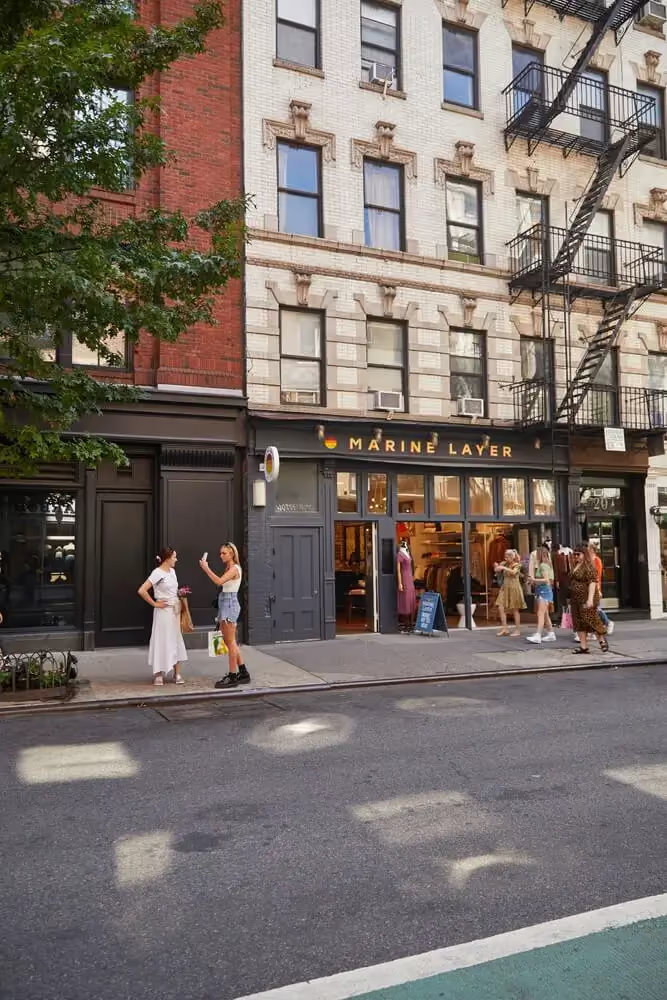
Who wouldn’t want weekends to last seven days? That’s the thinking behind Marine Layer’s eco-friendly and “absurdly soft” tees. This San Francisco-based company, founded in 2009, has its beginnings in a shirt thrown away by a girlfriend. One man’s trash is another man’s treasure, and from that action sprouted the seeds for founder Mike Natenshon as he set on his quest to create the ultimate soft-on-day-1 shirt. Forty-five stores later, Marine Layer has spread across the nation, timed perfectly with our desire for coziness after extended time at home made comfy clothing a must.
One of the higher-trafficked outdoor Marine Layer locations is at Ponce City Market in Atlanta. This shopping center boasts other in-demand brands like Lululemon, Reformation, and Buck Mason. Another popular location resides at 12South, a Nashville neighborhood spanning a half mile that includes walkable local businesses, bars, and bakeries. White Bison Coffee and Five Daughters Bakery are places to stop in for a bite while shopping. And in Boulder, Pearl St is another pedestrian-friendly venue for shoppers.
It’s clear that certain segments are attracted to Marine Layer’s offer - most notably Young Professionals in Atlanta and Boulder, who make up a quarter of the customers, as well as Ultra Wealthy Families across the board, particularly in Nashville where they comprise a fifth. There are a few clientele differences, such as the fact that Marine Layer draws Urban Low Income in Atlanta and more Sunset Boomers in Boulder.
Looking at the potential market for these three areas, we see some interesting patterns arise via Spatial.ai Followgraph. For instance, all three markets overindex in following the musical Hamilton, fitness brand Peloton, outdoor sporting goods store REI, and the confection Moon Pie. Regarding fashion brands, Tory Burch, J. Crew, Lululemon, Vineyard Vines, and Patagonia are popular too.
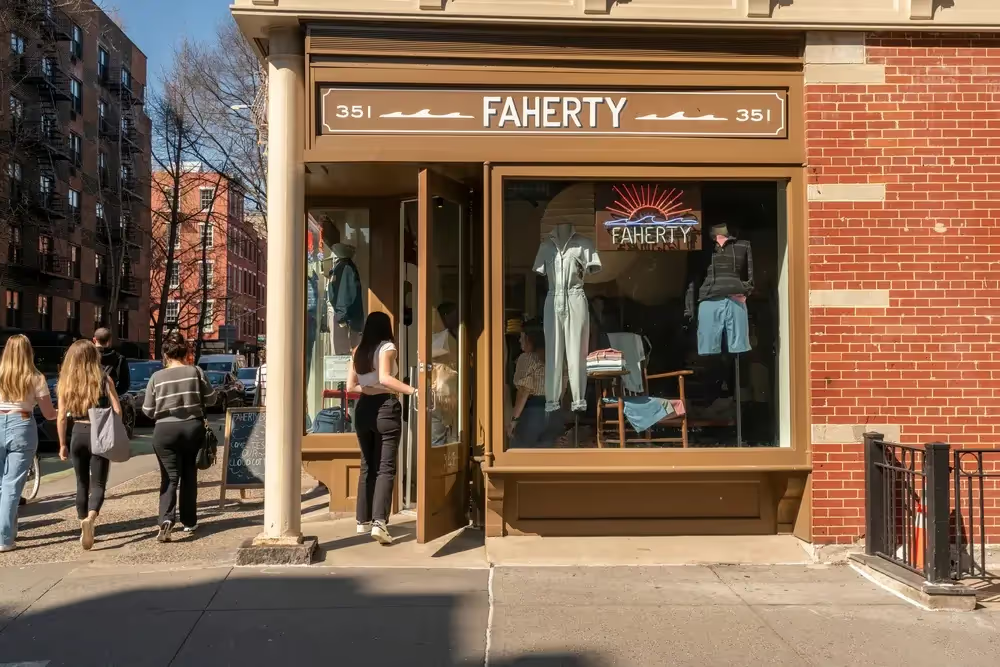
Faherty is a brand that has been around for 10 years but that we’ve seen accelerating its physical store footprint in the last few years. Evoking chill surf trips, family bonfires, and hikes in the great outdoors, this American brand invites you to cozy up in its sweaters, spend a Saturday riding the waves, or just all-out enjoy family time and making memories. Its locations span from east coast to west coast, with popular locations in Panama City Beach, New York City, Austin, Manhattan Beach, among others.
The appeal of this brand is such that it finds itself on the beach, in urban high streets, and suburban locations, indicating that it’s really more about the vibe. Not only that, the segments are quite varied in terms of who is shopping at Faherty (using PersonaLive segments). In Panama City Beach, we see largely Ultra Wealthy Families, Sunset Boomers, and Young Professionals. Meanwhile, in SoHo, Educated Urbanites and Young Urban Singles make up the lion’s share of the trade area. The Austin shopper profile is more similar to the Panama City Beach one, with the addition of Educated Urbanites as well. This intergenerational appeal is possibly rooted in the ethos of the brand with its focus on family, friends, and enjoying life’s moments.
One thing that these shoppers do have in common? High household incomes. Most of these shoppers come from households earning $150K+, with particularly high earners hailing from Greenwich, CT.
While the customers from Florida, New York, and Texas are geographically dispersed, they do share some commonalities: an above average propensity to be bubbly drinkers and wine drinkers, clearly in line with the brand’s positioning of celebratory moments. Customers in these three markets also consider themselves “Pilates People”, “Joggers,” and “Fitness Fans.” You will find Faherty devotees from all three of these markets at the spa, at the museum, or enjoying book clubs. And largely in keeping with Faherty’s sustainability promise, many of their customers consider themselves Environmental Activists.
In the spring of 2023, the surgeon general released an alarming report about the epidemic of loneliness in the US, which has negative implications on our physical, social, and emotional health such as “a 29% increased risk of heart disease, a 32% increased risk of stroke, and a 50% increased risk of developing dementia for older adults. Additionally, lacking social connection increases risk of premature death by more than 60%.” Among his six recommendations to combat this, the number one idea was to “Strengthen Social Infrastructure: Connections are not just influenced by individual interactions, but by the physical elements of a community (parks, libraries, playgrounds) and the programs and policies in place. To strengthen social infrastructure, communities must design environments that promote connection, establish and scale community connection programs, and invest in institutions that bring people together.” We’ve written at length about how malls are becoming one of the old-but-new gathering places for Gen Z and how pickleball is a new craze that has been bringing people together. Let’s take a look now at how some parks and recreation centers serve their communities as well as the vision for one mall redeveloper, who held town halls and numerous local meetings in order to understand the needs of the community.
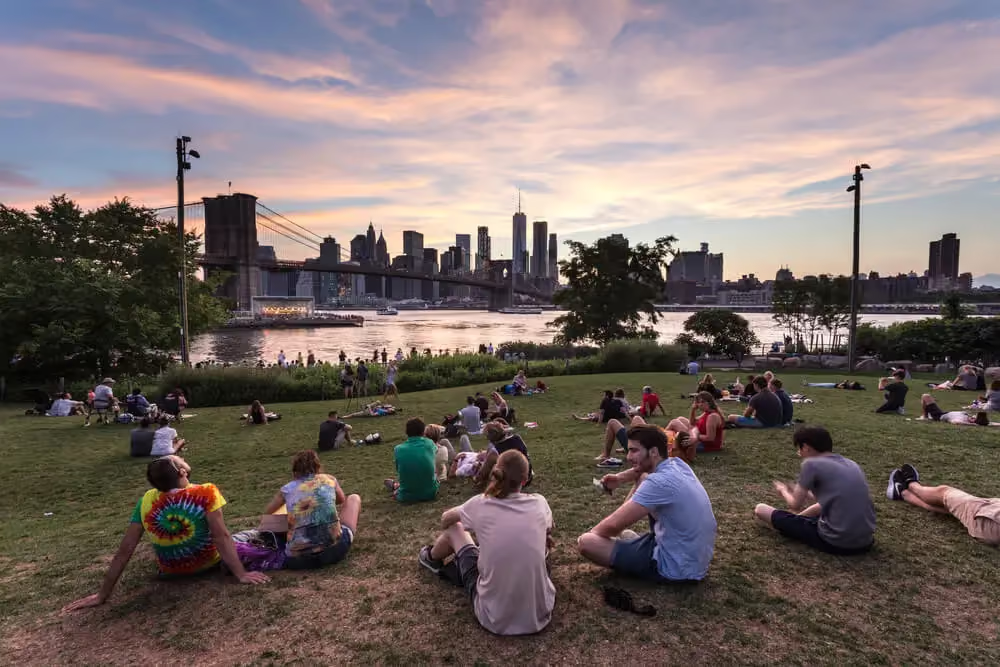
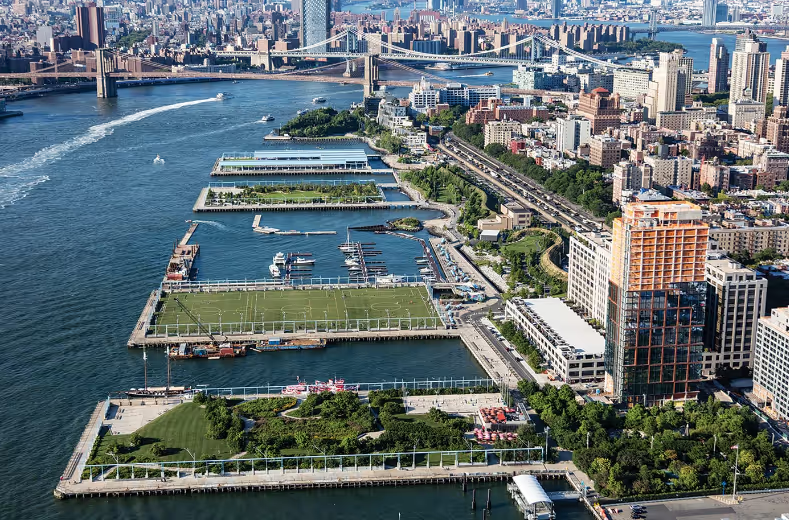
First up is Brooklyn Bridge Park. This 85- acre park resides on the Brooklyn side of the East River in New York City. It has revitalized 1.3 miles of Brooklyn’s post-industrial waterfront. Among its many offerings are playgrounds, athletic fields, a roller-skating rink, fitness equipment, kayak and canoe launch sites, and basketball, bocce, handball, and beach volleyball courts.
There’s certainly a seasonal element to park visitation, with visits increasing into the spring and peaking in the summer.
Late afternoon into the evening tends to be when most people visit the park.
It appears most visitors enjoy their park outing with hamburgers, some shopping, pizza, and ice cream with Shake Shack the top destination before and after visiting.
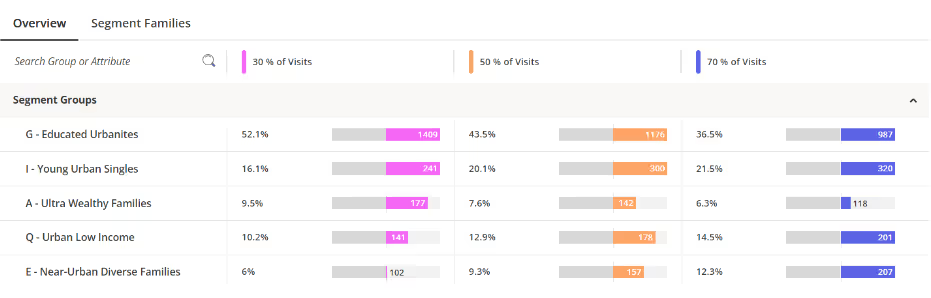
While Educated Urbanites and Young Urban Singles make up the majority of segments, the park attracts a broad range of additional segments, ranging from Ultra Wealthy Families to Urban Low Income. Another fun fact about this park is that it is financially self-sustaining, due to the fact that 10% of the parkland was set aside for development, which sustains 90% of the park’s operating budget.
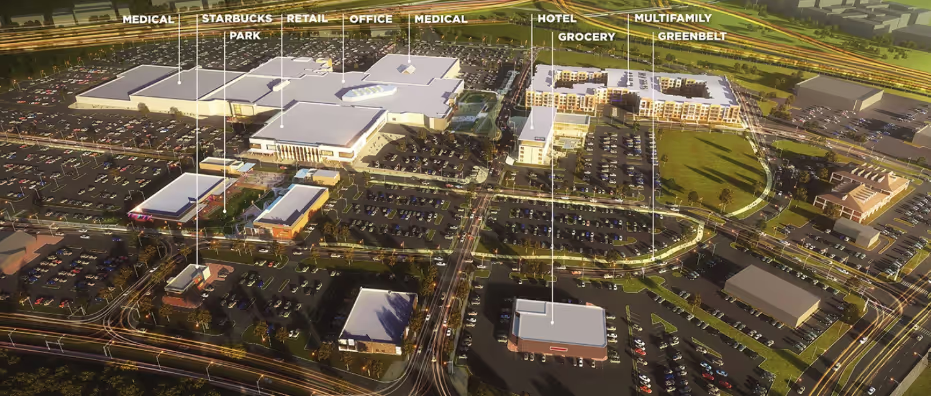
Speaking of Brooklyn, we now turn our attention to a Dallas-based developer, Peter Brodsky, who originally hails from Brooklyn. He purchased the Redbird Mall in South Dallas in 2015 and incorporated much community feedback to understand what the residents in the area wanted, such as jobs, health care, grocers, restaurants, and a Starbucks. It’s currently under development as The Shops at RedBird, and incorporating trends we’ve highlighted in previous Anchor articles, such as mixed-use, with a new apartment complex on the grounds of an ex-parking lot; a Courtyard Marriott hotel to follow; two health care providers--Parkland and UT Southwestern-- taking over Dillard’s and Sears further reinforcing our bullishness on malls and healthcare; and on the second floor a call center operator that employs two thousand workers with plans for more. Below, we show a birds-eye view plan for this exciting new development. Plus, there is a one-acre lawn for community events.
Like almost all malls, these shops saw a dip during the pandemic, but since then traffic has perked up.
When we look at year-over-year change from the surrounding zip codes, we see a fair amount of growth coming from the south and the farther western direction.
Using Jan 1, 2023 as a baseline, the overall shopping center as well as some of the major tenants like Starbucks, Burlington, and Foot Locker show a positive trend.
In fact, among all the Starbucks stores that Placer tracks, this Starbucks location at Redbird ranks #5 in traffic for the year 2023.
In more exciting news, there are also plans for a Tom Thumb grocery to open up at this shopping center. We will keep an eye on this development for sure as more tenants and office/residence/hospitality opens up.
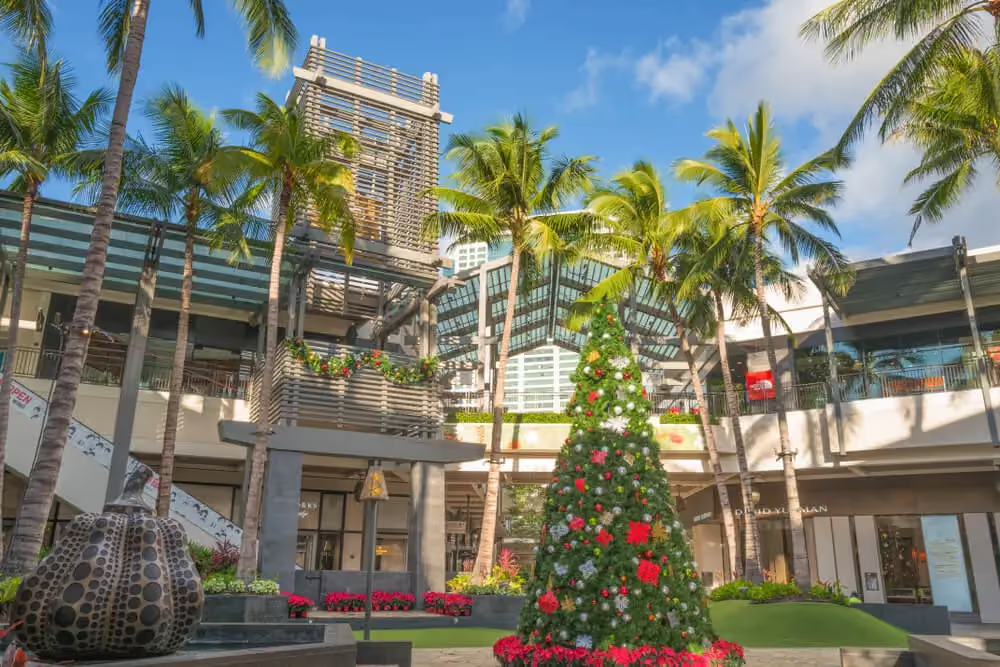
While brutally cold weather blasts much of the continental U.S. this week--including the Midwest, Deep South, and Montana--one might just dream about moving to the balmy shores of Hawaii, where temperatures have been hovering in the high 70s of late. Besides being home to the Ala Moana Center, the most-visited open-air shopping center in the US over the holidays, there is also constant redevelopment and improvement occurring on the island of Oahu.
For instance, the International Market Place on Kalakaua Ave, once known for decades as a touristy collection of kiosks, has upped its game and now boasts a Tesla showroom and a Balenciaga store at its entrance. Were it not for the commanding Banyan Tree that has been preserved, one would hardly recognize this iteration of the shopping venue compared to 10 years ago. Since it re-opened in early 2017, traffic has steadily been climbing. Hawaii tourism was hit hard by COVID in Spring 2020, but by July 2021 we begin to see a marked increase, to be repeated and exceeded in subsequent Julys as well. The summer of 2023 boasts a record in traffic originating from domestic visitors for the International Market Place.
Just down the street is the Royal Hawaiian Center, which encompasses three separate buildings that are connected by skywalks. Since its opening in 1980, it too has seen numerous changes, though its commitment to sharing the spirit of Aloha remains the same. The food options are extensive and come from all corners of the globe, such as Wolfgang’s Steakhouse, Tsurutontan Udon Noodle, Tim Ho Wan dim sum, and Wicked Maine Lobster. There was a massive spike in visitation in July 2021, which has since decreased a bit, but is still above pre-COVID levels.
There are definitely some unique, only-in-Hawaii treats, such as the shaka waffle ice cream cone at Kokoro Cafe at the Royal Hawaiian Center.

The other notable shift at the Royal Hawaiian Center is the bountiful array of luxury shopping available. From Hermes to Fendi, Harry Winston to Tiffany, designer showcases beckon from the street as well as from the interior corridors.
Grocery anchors proved to be a saving grace for many a shopping center during COVID. With apparel and dining shut down and only essential retailers allowed to open, many centers suddenly found that having a superstore/mass merchant like Walmart or Target, a warehouse like Costco or Sam’s Club, or a grocery store on the premises helped to steady some of the waves of traffic fluctuations. Whether it was as part of a specific center or more broadly adding grocery-anchored centers to a portfolio, REITs started looking more closely at the role of grocery in their centers. Indeed, we have written about the inclusion of specialty grocery stores and ethnic grocery stores in shopping centers being even rather quotidian these days. We’ve also written about the redevelopment of shopping centers that include food halls as part of their renaissance.
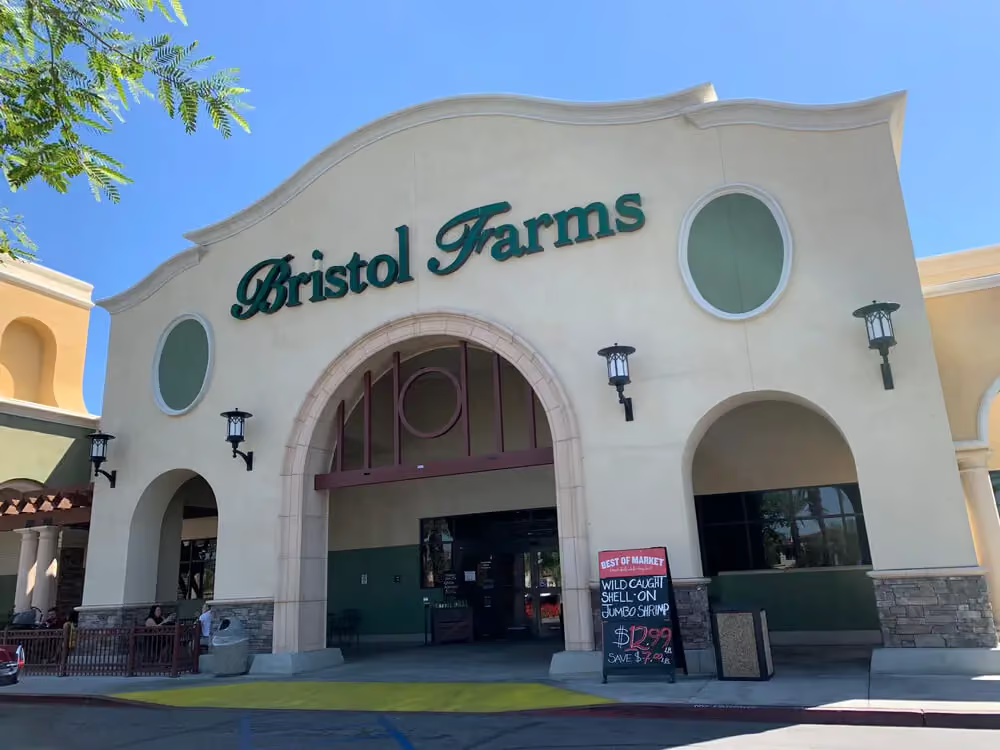
So it was rather surprising that Bristol Farms’ concept Newfound Market, which opened at the Irvine Spectrum in March 2022, recently announced that it is closing. The initial concept was to be “very much about experience…diving in deep on food and beverage…curated, yet everyday.” It was to feature seven of Bristol Farms’ own chef-created restaurant brands.
We take a look at some Placer statistics to see what might have accounted for reduced traffic for what sounded like an amazing concept. As a control, we compared the Bristol Farms in Irvine to one in nearby Newport Beach. We see that when Newfound Market first opened, it had nearly twice the traffic of the one in Newport Beach. This could be due to overall excitement about the chef-driven concepts, wanting to check out a new grocery store, or other factors. However, traffic for Newfound Market began dwindling in Fall 2022, and fell even further in Fall 2023, likely leading to its closure.
If we look at variance, we see that during the same time period, traffic grew for Irvine Spectrum Center as a whole (note it was one of our spectacular callouts for holiday shopping 2023 in terms of year-over-year growth), and traffic was fairly steady for the Newport Beach branch of the Bristol Farms.
How much did the number of Newfound Market shoppers change over time? We compared the Bristol Farms Newfound Market Shopper from Apr.-Dec. 2022 with that of the shopper from Apr.-Dec. 2023. During that time, there were over 150K fewer visits and around 100K fewer visitors. Visit frequency also decreased from 1.54 to 1.4 (below).
There was a slight dip in the average household income of the visitor.
There was a marked decrease in the proportion of Ultra Wealthy Families coming in 2023, and somewhat of a decrease of Wealthy Suburban Families.
Interestingly, the trade area has expanded from 2022 to 2023, as shown by the increase in red dots from further afield.
And indeed, Placer analysis reveals that the trade area increased by 28 square miles. On one hand, this is a plus, showing that there is a magnetic draw to a wider audience. On the other hand, given that most grocery stores live on weekly visits from a much tighter trade area, this could indicate that a trip to Irvine Spectrum and/or the Bristol Farms Newfound Market began to fall under the umbrella of a “destination” visit, rather than a regular “essential” visit. Over time, those locals who associate the Irvine Spectrum more with a Ferris Wheel might not have grocery shopping there as top-of-mind, and those who come from further away have already tried out the food hall.
The average visit frequency to Bristol Farms Newfound market was 1.54 from Apr.-Dec. 2022 and 1.40 from Apr.-Dec. 2023. In contrast, the average visit frequency to the top four most-trafficked Bristol Farms was closer to 3-4 visits, a rate more than double. Most telling is when we look at the bar chart below and see that the number of one-time visitors versus 30+ time visitors at Newfound Market is almost in direct contrast to its four other peers, who have a much higher proportion of their visits in the 10+ range.
This by no means negates the fact that grocery stores and food halls can be wonderful additions to shopping centers. For instance, 99 Ranch opened at Westfield Oakridge around the same time period (March 2022) and to date it has proven to have a steady stream of traffic. Keep in mind that Oakridge is more of your neighborhood mall with typical mall retailers, hence more likely to be part of a weekly or monthly routine.
Comparing year-over-year variance, the 99 Ranch at Oakridge has also overindexed on a percentage basis compared to the overall mall. The grocery store draws from a trade area of 58 square miles, with an average of 2.86 visits.

With sales of mountain passes up and eager skiers and snowboarders ready to hit the slopes, let’s take a look at how Backcountry has been performing of late. This brand may be familiar to many, as it has been an online retailer for the past 27 years. Lately, though, the retailer has made a foray into brick-and-mortar stores in areas where they have a strong concentration of online customers, with the store count currently up to 9 nationwide.
The Palo Alto store opened in Spring 2023. Visitation trendlines show that this store at the Stanford Shopping Center has jumped to be neck-and-neck with the Seattle store in Dec 2023.
The majority of Backcountry shoppers come from very high-income households, such as Ultra Wealthy Families, Educated Urbanites, and Sunset Boomers (using PersonaLive data for select store trade areas).
Backcountry opened its first physical store downstairs from its corporate headquarters in Park City, UT in 2021. The impetus for opening a brick-and-mortar store was to “deepen connections with its customers.” In addition to the Palo Alto store, Backcountry also opened its first east coast outpost on 14th St in Washington DC during spring 2023, one of the hot retail corridors we wrote about. The newest entrant is a 23,000 square-foot flagship location open at the Grove in Los Angeles in July, which will provide gear for all sorts of popular outdoor activities, such as hiking, camping, water sports, running and climbing.

Introduction
2024 has been another challenging year for retailers. Still-high prices and an uncertain economic climate led many shoppers to trade down and cut back on unnecessary indulgences. Value took center stage, as cautious consumers sought to stretch their dollars as far as possible.
But price wasn’t the only factor driving consumer behavior in 2024. This past year saw the rise of a variety of retail and dining trends, some seemingly at odds with one another. Shoppers curbed discretionary spending, but made room in their budgets for “essential non-essentials” like gym memberships and other wellness offerings. Consumers placed a high premium on speed and convenience, while at the same time demonstrating a willingness to go out of their way for quality or value finds. And even amidst concern about the economy, shoppers were ready to pony up for specialty items, legacy brands, and fun experiences – as long as they didn’t break the bank.
How did these currents – likely to continue shaping the retail landscape into 2025 – impact leading brands and categories? We dove into the data to find out.
Conventional Value Reaching Its Ceiling
Bifurcation has emerged as a foundational principle in retail over the past few years: Consumers are increasingly gravitating toward either luxury or value offerings and away from the ‘middle.’ Add extended economic uncertainty along with rapid expansions and product diversification from top value-oriented retailers, and you have an explosion of visits in the value lane.
But we are seeing a ceiling to that growth – especially in the discount & dollar store space. Throughout 2023 and the first part of 2024, visits to discount & dollar stores increased steadily. But no category can sustain uninterrupted visit growth forever. Since April 2024, year–over-year (YoY) foot traffic to the segment has begun to slow, with September 2024 showing just a modest 0.8% YoY visit increase.
Discount & dollar stores, which attract lower-income shoppers compared to both grocery stores and superstores, have also begun lagging behind these segments in visit-per-location growth. In Q3, the average number of visits to each discount and dollar store location remained essentially flat compared to 2023 (+0.2%), while visits per location to superstores and grocery stores grew by 2.8% and 1.0%, respectively. As 2024 draws to a close, it is the latter segments, which appeal to shoppers with incomes closer to the nationwide median of $76.1K, which are seeing better YoY performance.
The deceleration doesn’t mean that discount retailers are facing existential risk – discount & dollar stores are still extremely strong and well-positioned with focused offerings that resonate with consumers. The visitation data does suggest, however, that future growth may need to focus on initiatives other large-scale fleet expansions. Some of these efforts will involve moving upmarket (see pOpShelf), some will focus on fleet optimization, and others may include new offerings and channels.
Return of the middle anyone?
Innovative and Disruptive Value Shake Up Retail and Dining
Still, in an environment where consumers have been facing the compounded effects of rising prices, value remains paramount for many shoppers. And brands that have found ways to let customers have their cake and eat it too – enjoy specialty offerings and elevated experiences without breaking the bank – have emerged as major visit winners this year.
Trader Joe’s Drives Visits With Private Label Innovation
Trader Joe’s, in particular, has stood out as one of the leading retail brands for innovative value in 2024, a trend that is expected to continue into 2025.
Trader Joe’s dedicated fan base is positively addicted to the chain’s broad range of high-quality specialty items. But by maintaining a much higher private label mix than most grocers – approximately 80%, compared to an industry average of 25% to 30% – the retailer is also able to keep its pricing competitive. Trader Joe’s cultivates consumer excitement by constantly innovating its product line – there are even websites dedicated to showcasing the chain’s new offerings each season. In turn, Trader Joe’s enjoys much higher visits per square foot than the rest of the grocery category: Over the past twelve months, Trader Joe’s drew a median 56 visits per square foot – compared to 23 for H-E-B, the second-strongest performer.
Chili’s Beats QSR at its Own Game
Casual dining chain Chili’s has also been a standout on the disruptive value front this past year – offering consumers a full-service dining experience at a quick-service price point.
Chili’s launched its Big Smasher Burger on April 29th, 2024, adding the item to its popular ‘3 for Me’ offering, which includes an appetizer, entrée, and drink for just $10.99 – lower than than the average ticket at many quick-service restaurant chains. The innovative promotion, which has been further expanded since, continues to drive impressive visitation trends. With food-away-from-home inflation continuing to decelerate, this strategy of offering deep discounts is likely to continue to be a key story in 2025.
The Convenience Myth
Convenience is king, right?
Well, probably not. If convenience truly were king, visitors would orient themselves to making fewer, longer visits to retailers – to minimize the inconvenience of frequent grocery trips and spend less time on the road. But analyzing the data suggests that, while consumers may want to save time, it is not always their chief concern.
Looking at the superstore and grocery segments (among others) reveals that the proportion of visitors spending under 30 minutes at the grocery store is actually increasing – from 73.3% in Q3 2019 to 76.6% in Q3 2024. This indicates that shoppers are increasingly willing to make shorter trips to the store to pick up just a few items.
At the same time, more consumers than ever are willing to travel farther to visit specialty grocery chains in the search of specific products that make the visit worthwhile.
Cross visitation between chains is also increasing – suggesting that shoppers are willing to make multiple trips to find the products they want – at the right price point. Between Q3 2023 and Q3 2024, the share of traditional grocery store visitors who also visited a Costco at least three times during the quarter grew across chains.
Does this mean convenience doesn’t matter? Of course not. Does it indicate that value, quality and a love of specific products are becoming just as, if not more, important to shoppers? Yes.
The implications here are very significant. If consumers are willing to go out of their way for the right products at the right price points – even at the expense of convenience – then the retailers able to leverage these ‘visit drivers’ will be best positioned to grow their reach considerably. The willingness of consumers to forego convenience considerations when the incentives are right also reinforces the ever-growing importance of the in-store experience.
So while convenience may still be within the royal family, the role of king is up for grabs.
Serving Diners Quicker With Automatization
Chipotle Draws Crowds With Autocado
Convenience may not be everything, but the drive for quicker service has emerged as more important than ever in the restaurant space. Diners want their fast food… well, as fast as possible. And to meet this demand, quick-service restaurants (QSRs) and fast-casual chains have been integrating more technology into their operations. Chipotle has been a leader in this regard, unveiling the “Autocado” robot at a Huntington Beach, California location last month. The robot can peel, pit, and chop avocados in record time, a major benefit for the Tex-Mex chain.
And the Autocado seems to be paying off. The Huntington Beach location drew 10.0% more visits compared to the average Chipotle location in the Los Angeles-Long Beach-Anaheim metro area in Q3 2024. Visitors are visiting more frequently and getting their food more quickly – 43.9% of visits at this location lasted 10 minutes or less, compared to 37.5% at other stores in the CBSA.
Are diners flocking to this Chipotle location to watch the future of avocado chopping in action, or are they enticed by shorter wait times? Time will tell. But with workers able to focus on other aspects of food preparation and customer service, the innovation appears to be resonating with diners.
McDonald’s Leans into Automation in Texas
McDonald’s, too, has leaned into new technologies to streamline its service. The chain debuted its first (almost) fully automated, takeaway-only restaurant in White Settlement, TX in 2022 – where orders are placed at kiosks or on app, and then delivered to customers by robots. (The food is still prepared by humans.) Unsurprisingly, the restaurant drives faster visits than other local McDonald’s locations – in Q3 2023, 79.7% of visits to the chain lasted less than 10 minutes, compared to 68.5% for other McDonald’s in the Dallas-Fort Worth-Arlington, TX CBSA. But crucially, the automated location is also busier than other area McDonald’s, garnering 16.8% more visits in Q3 than the chain’s CBSA-wide average. And the location draws a higher share of late-night visits than other area McDonald’s – customers on the hunt for a late-night snack might be drawn to a restaurant that offers quick, interaction-free service.
Evolving Retail Formats - Finding the Right Fit
Changing store formats is another key trend shaping retail in 2024. Whether by reducing box sizes to cut costs, make stores more accessible, or serve smaller growth markets – or by going big with one-stop shops, retailers are reimagining store design. And the moves are resonating with consumers, driving visits while at the same improving efficiency.
Macy’s Draws Local Weekday Visitors With Small-Format Stores
Macy’s, Inc. is one retailer that is leading the small-format charge this year. In February 2024, Macy’s announced its “Bold New Chapter” – a turnaround plan including the downsizing of its traditional eponymous department store fleet and a pivot towards smaller-format Macy’s locations. Macy’s has also continued to expand its highly-curated, small-format Bloomie’s concept, which features a mix of established and trendy pop-up brands tailored to local preferences.
And the data shows that this shift towards small format may be helping Macy’s drive visits with more accessible and targeted offerings that consumers can enjoy as they go about their daily routines: In Q3 2024, Macy’s small-format stores drew a higher share of weekday visitors and of local customers (i.e. those coming from less than seven miles away) than Macy’s traditional stores.
Harbor Freight Tools and Ace Hardware Serve Smaller Growth Markets With Less Square Footage
Small-format stores are also making inroads in the home improvement category. The past few years have seen consumers across the U.S. migrating to smaller suburban and rural markets – and retailers like Harbor Freight Tools and Ace Hardware are harnessing their small-format advantage to accommodate these customers while keeping costs low.
Harbor Freight tools and Ace Hardware’s trade areas have a high degree of overlap with some of the highest growth markets in the U.S., many of which have populations under 200K. And while it can be difficult to justify opening a Home Depot or Lowe’s in these hubs – both chains average more than 100,000 square feet per store – Harbor Freight Tools and Ace Hardware’s smaller boxes, generally under 20,000 square feet, are a perfect fit.
This has allowed both chains to tap into the smaller markets which are attracting growing shares of the population. And so while Home Depot and Lowe’s have seen moderate visits declines on a YoY basis, Harbor Freight and Ace Hardware have seen consistent YoY visit boosts since Q1 2024 – outperforming the wider category since early 2023.
Hy-Vee Bucks the Trend by Going Big
Are smaller stores a better bet across the board? At the end of the day, the success of smaller-format stores depends largely on the category. For retail segments that have seen visit trends slow since the pandemic – home furnishings and consumer electronics, for example – smaller-format stores offer brands a more economical way to serve their customers. Retailers have also used smaller-format stores to better curate their merchandise assortments for their most loyal customers, helping to drive improved visit frequency.
That said, a handful of retailers, such as Hy-Vee, have recently bucked the trend of smaller-format stores. These large-format stores are often designed as destination locations – Hy-Vee’s larger-format locations usually offer a full suite of amenities beyond groceries, such as a food hall, eyewear kiosk, beauty department, and candy shop. Rather than focusing on smaller markets, these stores aim to attract visitors from surrounding areas.
Visit data for Hy-Vee’s large-format store in Gretna, Nebraska indicates that this location sees a higher percentage of weekend visits than other area locations – 37.7% compared to 33.1% for the chain’s Omaha CBSA average – as well as more visits lasting over 30 minutes (32.9% compared to 21.9% for the metro area as a whole). For these shoppers, large-format, one-stop shops offer a convenient – and perhaps more exciting – alternative to traditionally sized grocery stores. The success of the large-format stores is another sign that though convenience isn’t everything in 2024, it certainly resonates – especially when paired with added-value offerings.
A Resurgence of Legacy Brands
Many retail brands have entrenched themselves in American culture and become an extension of consumers' identities. And while some of these previously ubiquitous brands have disappeared over the years as the retail industry evolved, others have transformed to keep pace with changing consumer needs – and some have even come back from the brink of extinction. And the quest for value notwithstanding, 2024 has also seen the resurgence of many of these (decidedly non-off-price) legacy brands.
In apparel specifically, Gap and Abercrombie & Fitch – two brands that dominated the cultural zeitgeist of the 1990s and early 2000s before seeing their popularity decline somewhat in the late aughts and 2010s – may be staging a comeback. Bed Bath & Beyond, a leader in the home goods category, is also making a play at returning to physical retail through partnerships.
Anthropologie, another legacy player in women’s fashion and home goods, is also on the rise. Anthropologie’s distinctive aesthetic resonates deeply with consumers – especially women millennials aged 30 to 45. And by capturing the hearts of its customers, the retailer stands as a beacon for retailers that can hedge against promotional activity and still drive foot traffic growth.
And visits to the chain have been rising steadily. In Q4 2023, the chain experienced a bigger holiday season foot traffic spike than pre-pandemic, drawing more overall visits than in Q4 2019. And in Q3 2024, visits were higher than in Q3 2023.
Meeting the Evolving Needs of Millennials
And speaking of the 35 to 40 set – the generation that all retailers are courting? Millennials. Does that sound familiar? Yes, because this is the same generational cohort that retailers tried to target a decade ago. As millennials have aged into the family-formation stage of life, their retail needs have evolved, and the industry is now primed to meet them.
Sam’s Club Draws Value-Conscious Singles and Starters
From the revival of nostalgic brands like the Limited Too launch at Kohl’s to warehouse clubs expanding memberships to younger consumers as they move to suburban and rural communities, there are myriad examples of retailers reaching out to this cohort. And Sam’s Club offers a prime example of this trend.
Over the past few years, millennials and Gen-Zers have emerged as major drivers of membership growth at Sam’s Club, drawn to the retailer’s value offerings and digital upgrades – like the club’s Scan & Go technology. Over the same period, Sam’s Club has grown the share of “Singles and Starters” households in its captured market from 6% above the national benchmark in Q3 2019 to 15% in Q3 2024. And with plans to involve customers in co-creating products for its private-label brand, Sam’s Club may continue to grow its market share among this value-conscious – but also discerning and optimistic – demographic.
Taco Bell Brings in Crowds With Value Nostalgia Menu
Millennials are also now old enough to wax nostalgic about their youth – and brands are paying attention. This summer, Taco Bell leaned into nostalgia with a promotion bringing back iconic menu items from the 60s, 70s, 80s, and 90s – all priced under $3. The promotion, which soft-launched at three Southern California locations in August, was so successful that the company is now offering the specials nationwide. The three locations that trialed the “Decades Menu” saw significant boosts in visits during the promotional period compared to their daily averages for August. And people came from far and wide to sample the offerings – with a higher proportion of visitors traveling over seven miles to reach the stores while the items were available.
What Lies Ahead?
Hot on the heels of a tumultuous 2023, 2024’s retail environment has certainly kept retailers on their toes. While embracing innovative value has helped some chains thrive, other previously ascendant value segments, including discount & dollar stores, may have reached their growth ceilings. Consumers clearly care about convenience – but are willing to make multiple grocery stops to find what they need. At the same time, legacy brands are plotting their comeback, while others are harnessing the power of nostalgia to drive millennials – and other consumers – through their doors.