.png)
.png)

.png)
.png)

Darden Restaurants, Inc. operates a portfolio that includes some of the biggest names in full-service dining, including Olive Garden, LongHorn Steakhouse, Cheddar’s Scratch Kitchen, Yard House, Ruth’s Chris Steak House, Bahama Breeze, and Eddie V’s Prime Seafood.
How are these restaurants performing as Q3 2024 approaches? We took a closer look at the location analytics to find out which restaurant chains are thriving in today’s challenging economic climate.
Darden’s three largest restaurant chains – Olive Garden, LongHorn Steakhouse, and Cheddar’s Scratch Kitchen – are some of the best-known names in casual, full-service dining. These chains have a strong presence across the country and have experienced mainly positive YoY foot traffic this year so far.
Although foot traffic was lower YoY in January and April 2024, these dips can be attributed to external factors, such as January’s inclement weather and an April calendar shift (i.e. the timing of Easter, as well as the extra Saturday in April 2023). And in May the three chains quickly rebounded, ending the month with respective YoY visit increases of 2.4%, 6.4%, and 2.3%.

Darden operates various smaller brands offering different dining styles and price points, ranging from upscale options like Eddie V’s and Ruth’s Chris Steakhouse to more casual spots like Bahama Breeze and Yard House. These smaller chains also experienced strong visitation patterns in early 2024 – with May YoY visits up between 3.9% and 8.5%.

Darden’s strong February and May showings were likely fueled, in part, by two distinctly important days on the Darden restaurant calendar: Valentine’s Day and Mother’s Day.
In absolute terms, Olive Garden – Darden’s largest chain by far – drew the most visits on both holidays as compared to a January 1, 2024 baseline, claiming the top spot this year as America’s favorite Mother’s Day destination. But on a relative basis, Darden’s premium brands Eddie V’s and Ruth Chris experienced the biggest visit spikes, as people splurged on celebratory outings. And laid-back chain Bahama Breeze saw a sustained visit boost from Valentine’s Day through Mother’s Day, likely owing to its strong presence in Florida – making it an attractive destination for the snowbirds and vacationers who visit the state during the winter.
And surprisingly, even casual dining venue Yard House – known for its beer and sports atmosphere rather than romantic setting – experienced a Valentine’s Day visit boost. This suggests that there is a tangible benefit from these holidays across a wide range of dining styles – and restaurant operators can use these insights to encourage visits on such occasions.

Darden continues to attract customers to its restaurants in spite of a challenging economy by offering a variety of dining choices and capitalizing on popular dining-out occasions such as Mother’s Day and Valentine’s Day.
Will the company’s visit growth continue to trend upward as 2024 wears on?
Follow Placer.ai for the latest data-driven dining insights.

After a frigid start to the year, how have retail and dining foot traffic fared in the subsequent months? We dove into the data to find out.
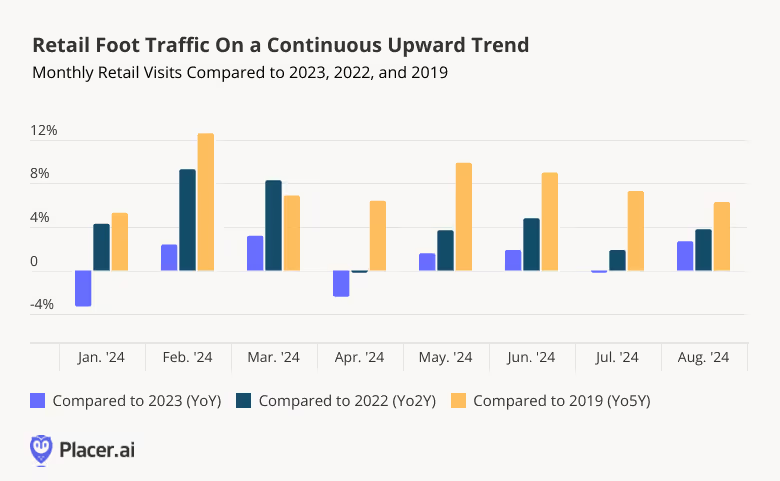
Last year was all about experiences. But in 2024, consumer demand is once again striking a balance between “fun and stuff.” Though both retail and dining foot traffic were weighed down by January 2024’s extreme temperatures, the two categories bounced back in February, going on to see consistently positive YoY foot traffic growth through May.
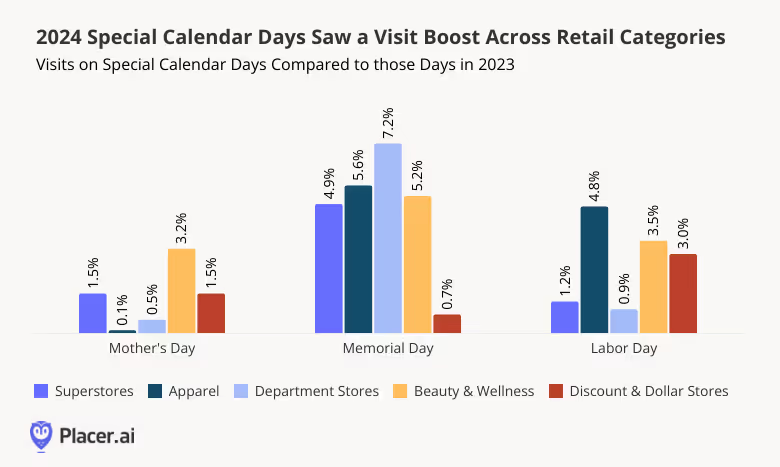
May 2024’s strong showing was likely driven in part by impressive visit boosts on two important calendar highlights: Mother’s Day weekend and Memorial Day weekend. On both of these occasions, retail and dining foot traffic outperformed 2023 levels, a further sign of consumer resilience this year.

And drilling down deeper into data shows that some of this dining growth is being driven by full-service restaurants – another sign that the segment may be experiencing a comeback.
For quite some time, casual dining concepts – including both fast-casual & QSR – have had the upper hand among dining formats, as consumers sought inexpensive ways to splurge and cut back on full-service indulgences. But FSR has begun to rally, with experiential concepts, eatertainment, and breakfast-first chains driving significant traffic.
And location analytics points to a much more level playing field this year, with FSR YoY visit growth outperforming fast-casual & QSR in both March and in May. May’s visit boost in particular was likely aided by holiday visits – on both Mother’s Day and Memorial Day, full-service restaurants drew outsize crowds eager to enjoy nice meals out with friends and family.

A look at statewide visit data for both fast-casual & QSR and for full-service chains during the past three months – comparing March to May 2024 to the equivalent period of last year – shows both segments doing remarkably well throughout most of the U.S.
In the fast-casual & QSR space, all 50 states enjoyed positive YoY visit growth over the past three months – led by North Dakota (6.8%), New Hampshire (5.3%), Minnesota (5.1%), New Mexico (4.3%), and Rhode Island (4.2%). And in FSR, 42 states enjoyed positive growth – with some of the same states, including Rhode Island, New Hampshire, and New Mexico, claiming top spots.

Will full service continue its turnaround in the second half of 2024 and can fast-casual & QSR maintain its strength? How will overall retail traffic fare during the summer months and critical back-to-school season?
Visit Placer.ai to find out.

Hilton Hotels & Resorts and InterContinental Hotels Group (IHG) are two of the biggest names in lodging. The two companies operate a wide range of hotel brands, ranging from luxury chains to budget options. And falling in the middle of this range are two midscale hotel chains: TRU by Hilton and avid Hotels, operated by IHG.
What can foot traffic and demographic data reveal about the preferences of visitors to these chains? We took a closer look.
TRU by Hilton and avid Hotels both opened their first locations in 2017, with the goal of offering travelers modern and comfortable accommodations while eschewing the amenities typically associated with more luxurious hotel categories. By streamlining services, these hotels can appeal to a diverse range of travelers while maintaining a lower price point.
The two hotel chains have expanded since their openings, with TRU operating 279 locations and avid operating 70 nationwide as of May 2024. And this expansion seems to be paying off for both brands, helping drive YoY monthly visit increases. Since June 2023, visits to the two chains have been consistently elevated YoY, save for a few minor visit lags at TRU.
Hilton and IHG both hope to continue expanding their midscale hotel concepts, with projects in the pipeline for 2024 and beyond. And diving into the demographics can help the hotels identify their strengths and plan out marketing strategies more effectively.

Analyzing the psychographic makeup of TRU and avid’s trade areas by layering Spatial.ai’s PersonaLive dataset onto the two chains’ captured markets reveals that despite their budget offerings, both hotels appeal to economically diverse audiences.
Between June 2023 and May 2024, TRU and avid both attracted visitors from areas with higher-than-average shares of both “Ultra Wealthy Families” and “Blue Collar Suburbs.” The chains’ ability to appeal to both groups shows that their no-frills offerings are appreciated not just by the most price-conscious customers, but also by those with more room in their budgets to splurge.

Still, TRU drew a greater share of visitors over the analyzed period from areas over-indexed for “Ultra Wealthy Families'' – while avid drew slightly more customers from areas over-indexed for “Blue Collar Suburbs.” And diving deeper into the demographic and psychographic characteristics of TRU’s and avid’s captured markets shows that though both chains have broad appeal, there are some differences between their customer bases.
The median household income (HHI) of TRU’s captured market stood at $79.4K during the analyzed period – above the nationwide median – while that of avid remained slightly below it. And while avid’s captured market included a higher-than-average share of “Young Urban Singles” (also from Spatial.ai’s PersonaLive dataset), TRU was more likely to attract “Suburban Boomers.” So while TRU draws a wealthier and more settled clientele, avid tends to attract younger, less established guests.
These differences serve as a reminder of the differences that exist even within similar accommodation categories, and may help the two chains when deciding how to market to their respective customer bases.

Both TRU and avid seem similar enough on paper – two midscale hotel chains, geared towards a traveler that prioritizes value and convenience. And while both chains attract a wide range of households to their venues, TRU tends to see a more affluent, established visitor, while avid seems to attract more guests who are starting out in life.
For more data-driven travel & leisure insights, visit Placer.ai.

With sales exceeding $148 billion in 2023, The Kroger Co. is a leading player in the grocery store space. In addition to its flagship eponymous brand, the company owns a variety of regional banners, including (among others) Fred Meyer, Harris Teeter, Ralphs, Smith’s Food and Drug, Fry’s Food Stores, King Soopers, and Food 4 Less.
We dove into the data to see how key Kroger chains are faring in 2024 – and to explore the different audiences served by the company’s varied portfolio.
With some 1255 locations across 19 states, Kroger is The Kroger Co.’s largest grocery banner by far. And between January and May 2024, visits to the chain accounted for 47.6% of overall foot traffic to the company’s grocery portfolio. The remaining 52.4% of visits went to The Kroger Co.’s smaller banners – with Fred Meyer, Ralphs, and Harris Teeter leading the charge.

And drilling down deeper into the regional distribution of the company’s various grocery banners shows that each chain serves a different area of the country.
Kroger’s eponymous banner holds sway throughout much of the Midwest and South – while Harris Teeter serves shoppers in Maryland, Florida, and the Carolinas. Meanwhile, Fred Meyer, Smith’s, Ralphs, Fry’s, and King Soopers dominate the Western United States. And throughout some parts of the Midwest, Kroger draws consumers with a variety of smaller banners.
Like that of Albertsons, Kroger Co.’s strategy of acquiring and maintaining regional brands has allowed the company to expand its footprint across the country – while catering to the needs and preferences of local shoppers. Indeed, Kroger’s footprint now extends across three of the four U.S. regions – the West, South, and Midwest – with only the Northeast lacking a Kroger Co. presence.

A look at recent visitation trends for Kroger Co.’s largest banners – i.e. those with at least 100 locations – shows that all experienced positive YoY visit growth in Q1 2024. The most impressive foot traffic bumps were seen by Mountain region banners Smith’s and King Soopers, followed by value-oriented Food 4 Less, and the South Atlantic-focused Harris Teeter.
On a monthly basis, too, The Kroger Co.’s major Banners saw nearly uniform YoY visit growth between January and May 2024.

Analyzing demographic differences among the trade areas of Kroger’s different chains shows how the company leverages its portfolio of banners to serve distinct customer bases.
Virginia, for example, is served by two Kroger Co. banners – Kroger and Harris Teeter. And while the former draws shoppers from areas with a median HHI below the statewide baseline of $87.2K, the latter – with somewhat more upscale, pricier offerings – attracts a much more affluent audience. Similar differences can be observed in Wisconsin – where Pick ‘n Save and Metro Market serve different demographics.
By offering a diverse spectrum of shopping experiences, The Kroger Co. strategically positions itself to maximize market penetration and appeal to a broad range of consumers.

The Kroger Co. entered 2024 with a bang. With its extensive reach and adaptive approach, can the grocery leader maintain its positive momentum throughout the rest of the year?
Visit our blog at Placer.ai to find out.

Post-March Madness, many of the NCAA women’s basketball players went on to the WNBA. Caitlin Clark to the Indiana Fever, Cameron Brink to the LA Sparks, and Angel Reese to the Chicago Sky were some of the most hotly anticipated draft picks. The newfound appetite for the WNBA is real. Take Gainbridge Fieldhouse in Indianapolis as an example. Just comparing the time period of April 30-May 31, 2023 vs April 30-May 31, 2024, there is a stark contrast in the number of attendees to home games. In just five games, attendance to this year’s Fever games has already surpassed that of the entire 2023 season.

The trade area draw is also something to note as the area from which 70% of visits originated practically doubled from May 2023 (blue) to May 2024 (red), showing the magnetic effect a star player can have.

This heightened interest is great news for concepts like The Sports Bra, a bar and restaurant based in Portland, Oregon. It’s 100% dedicated to women’s sports so you can be sure to catch your favorite female player on the screen. Since opening in the spring of 2022, it’s had steady business, and odds are with all the women’s sports to watch, there should be a busy summer ahead.

In addition, might the added exposure bring new fans to brands such as Wilson Sporting Goods, which signed Caitlin Clark? This familiar brand opened its first West Coast brick and mortar store on Santa Monica’s Third Street Promenade just about a year ago. Meanwhile, Angel Reese has signed on some big brands such as Reebok, Raising Cane’s and AirBnB. Former Stanford Cardinal and now LA Sparks superstar Cameron Brink is one of the faces of New Balance, and has starred in an ad with Shohei Otani and Coco Gauff.

Over Memorial Day Weekend, Wayfair opened its highly anticipated addition to the world of physical retail, something we've been waiting for since the company's large-format store plan first came into view in early 2022. Technically, Wayfair’s new mega-store, sized at 150,000 square feet in Wilmette, Illinois, isn’t its first foray into brick-and-mortar, but it is certainly its splashiest. In an era when many home furnishing retailers are going small, early indications from Placer show that betting big has yielded success in attracting visitors, but questions about the longevity of success and health of the broader home industry remain.
This week, we had a chance to visit the store ourselves, and it's immediately evident how much attention was put into the store. Most visitors enter through the "Market Square", which feature unique housewares, locally-relevant products, and seasonal merchandise. Above the Market Square is a large video board that showcases certain products and other digital media assets which help set the tone for the shopping experience.


According to the retailer, its first namesake location brings a new shopping experience to consumers and features its first food service offering, The Porch (below).

The store also features an expanded selection and one-on-one personal design services, which can be seen in store layout below. The new location clearly took learnings from other Wayfair-owned brands like Joss & Main or All Modern, each of which have also opened physical stores.

The Wilmette large format store opened on May 23, just in time for Memorial Day Weekend foot traffic, and the location greatly benefitted from the timing. According to Placer’s early reads from May 18-June 1, 2024, Wayfair’s visits accounted for almost half of the visits to Edens Plaza (below), the shopping center in which it’s located. Beyond that, during its opening weekend from May 23-27, it drove 60% of visits to the plaza. The shopping center is located right off the Edens expressway, and the store is visible from the road, which helping to draw the attention of travelers.

Wayfair’s debut is a clear victory for the shopping center, with the store’s first few weeks helping to attract new visitors to the center. Comparing the two week period before the store opening to the two weeks of its opening using Spatial.ai’s PersonaLive segments, the percentage of visits coming from trade areas from Ultra Wealthy Families--the typical center visitors--actually decreased from 45% to 32%. However, there was a large increase in the percentage of visits by Educated Urbanites and Young Professionals. Buzzworthy openings help to revitalize shopping centers and Wayfair’s initial success will hopefully provide some meaningful shifts in visitors beyond the first few weeks.

Home furnishing retailers, in particular, have made experiences and expanded service offerings a cornerstone of their strategies to foster a captive consumer audience and increase dwell time, and hopefully conversion. Looking at local home furnishing experiential retail locations in the Metro Chicago area, Wayfair’s opening splash is even more apparent with its two story, expansive footprint. Compared to the closest IKEA store (Schaumburg), Wayfair Wilmette's visits were 12% higher during its initial two-week period and saw 19% more visits than IKEA during the highest traffic day of opening weekend. The trade area of the two retailers, even in the first two weeks, starts to tell the story of the visiting consumer; Wayfair drove more visits despite having a smaller trade area than IKEA and more overlapping territory, and primarily pulled its visitors from the northern Chicago suburbs.

Wayfair’s early indicators of traffic highlight a combination of the right concept, the right consumer, and the right location. It will be fascinating to watch the long-term visit trends for Wayfair, especially compared to other large-scale regional furniture retailers. Despite many home furnishing retailers looking to smaller formats for growth, if Wayfair’s location sustains its traffic growth, larger-format stores may become an attractive solution for shopping centers to revitalize themselves.

The holiday shopping season traditionally stretches from Black Friday to New Years Eve: Shoppers looking to snag deals, purchase gifts, or enhance their celebrations drive visit spikes at retailers across the country. And although many consumers expressed concern over high prices impacting their holiday budget, spending in 2024 actually increased compared to 2023, with brick-and-mortar stores playing a key role in last year’s holiday season.
So where were the largest holiday spikes? How did last year’s calendar configuration impact retail traffic? Which segment came out ahead – and how did dining fit into the mix? Most importantly – what can we learn from the 2024 holiday season to prepare for 2025?
The holiday shopping season is the busiest time of the year for many retail categories. Between Black Friday and December 31st 2024, daily visits to brick-and-mortar stores increased 12.7%, on average, compared to the rest of the year.
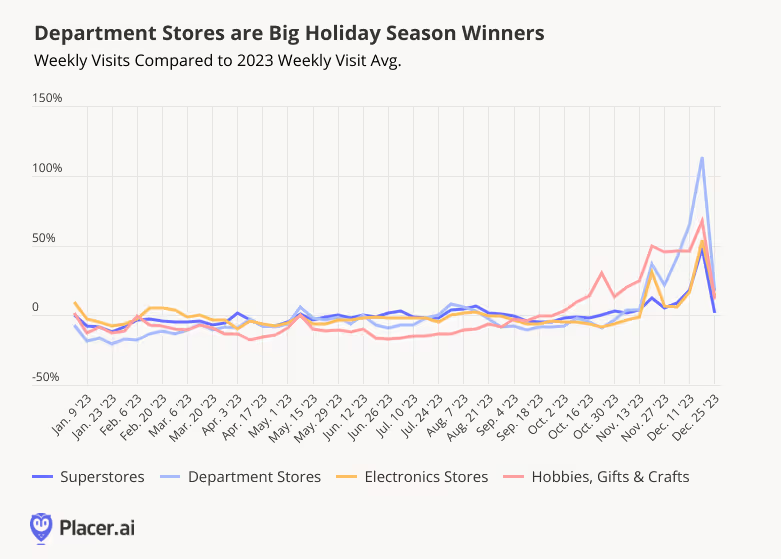
Department stores led the pack, with visits to the segment 102.1% higher than the pre-holiday season average – likely aided by strong Black Friday performances. Other favorite gifting categories, including beauty & self care (72.7%), hobbies, gifts & crafts (60.9%), recreational & sporting goods (55.5%), clothing (41.8%), and electronics stores (32.7%) also received significant traffic boosts. Shopping centers benefited as well with a 24.8% increase in daily visits over the holiday season. Retailers in these segments can capitalize on their holiday popularity and stand out amidst the crowd by promoting their brand early and ensuring their staffing and inventory can accommodate the season’s traffic increases.
The holidays are also a time for entertainment – and purchasing gifts for hosts – which likely helped drive the 48.4% and 41.7% traffic increases at liquor stores and at furniture & home furnishings retailers, respectively. Superstores and discount & dollar stores – with their selection of affordable giftable products and entertainment essentials – also saw holiday-driven visit bumps of 21.2% and 20.2%, respectively. Retailers may choose to highlight seasonal items and hosting-friendly products to increase these traffic bumps in 2025.
Pet stores & services received a smaller (10.0%) bump than the wider retail average – indicating that, although some shoppers buy gifts for their fur babies, pets may not be at the top of most Americans’ gift lists. And visits to the home improvement segment were essentially on par with the pre-holiday period – indicating that the holidays are not the time for extensive home renovation projects. But home improvement chains looking to get in on the holiday action might consider promoting decorations and smaller giftable items in December.
And despite the grocery frenzy of Turkey Wednesday and Christmas Eve Eve, the Grocery segment received a relatively minor holiday boost of 5.0% – perhaps due to holiday travelers skipping their weekly grocery haul. Grocers who lean into prepared foods or pre-packaged meal kits might get an additional bump.
Although the holidays drive retail visit surges across the country, some regions see a bigger traffic bump than others.
In December 2024, almost all 50 states (with the exception of Wyoming ) received a holiday-driven retail traffic boost ranging from a 3.3% (Montana) to a 16.8% (New Hampshire). On a regional basis, the South received the largest increase: The West South Central, East South Central, and South Atlantic divisions received a collective 12.2% increase in daily visits between Black Friday and New Years Eve compared to the pre-Black Friday daily average. (Washington, D.C. saw a slight visit decline of 0.4%, likely due to the many residents leaving the capital for the holiday break.) Retailers in this region may choose to increase staffing and inventory ahead of the 2025 holiday season to handle the increased demand.
Meanwhile, the Midwest region had the smallest holiday-driven traffic spike (9.2%) – despite starting the season ahead of the pack, with the highest Black Friday weekend visit boost. This suggests that Midwestern retailers may have more success with early promotions than with last-minute discounts.
While the holiday season drove an overall retail visit boost nationwide, diving deeper into the data reveals that different retail segments peak at different points of the holiday season.
Most categories – especially the ones that tend to offer steep post-Thanksgiving discounts, such as recreational & sporting goods, department stores, electronics stores, and beauty retailers – received the biggest visit spikes on Black Friday. Retailers in these categories may benefit from promotional campaigns ahead of Thanksgiving to cater to early shoppers and maximize their performance on their busiest day.
Other segments that carry more affordable gifts, stocking stuffers, and food items gained momentum as Christmas approached – with superstores visits spiking on December 23rd and discount & dollar stores peaking on December 24th. These retailers may get even larger end-of-year visit bumps by offering discounts and bundles to last-minute shoppers.
The grocery segment received its largest boost ahead of Thanksgiving, with visits also surging on the days before Christmas as home cooks picked up supplies for the holiday dinner. Grocers who can save their shoppers time during this busy period by offering curbside pickup, pre-prepped ingredients or meal kits, and other conveniences may see particularly strong performances in 2025.
Calendar shifts also play an important role in shaping holiday shopping patterns. Last year, Super Saturday and “Christmas Eve Eve” – each a significant milestone in its own right – coincided on December 23rd, 2023 to create a supercharged shopping event that generated massive visit spikes at retailers across categories.
But in 2024, when the milestones occurred separately, important differences emerged between retailers. Gift-shopping destinations like Macy’s, Nordstrom, and Best Buy saw bigger visit spikes on Super Saturday, while retailers like Target, Walmart, and Costco – carrying both gifts and food items – saw visits surge higher on December 23rd. Dollar Tree, a prime destination for affordable stocking stuffers, also experienced a more pronounced visit spike on Super Saturday.
Predictably, this year’s pre-Christmas milestones generally drove smaller individual visit spikes, as shoppers spread their errands across a longer period. But the stand-alone Super Saturday on December 21st 2024 also allowed consumers to prioritize gift-shopping on Saturday and shop for groceries and last minute stocking stuffers on December 23rd – benefiting certain retailers.
Nordstrom, for instance, saw visits soar to 215.9% above the chain’s 2024 daily average on December 21, 2024 – surpassing the 196.2% increase recorded on December 23, 2023. Macy’s also experienced a slightly higher Super Saturday visit boost this year. Next year, retailers can expect another spread-out pre-Christmas shopping period, with Super Saturday falling on December 20th, 2025 – five days before the holiday. Gift-focused retailers can leverage this timing by ramping up promotions in the run-up to Super Saturday – or by enhancing offerings on December 23rd to capture more late-season shoppers.
Big box retailers like Target, Walmart, and Costco, conversely, can double down on December 23rd or amplify earlier deals to capture a larger share of Super Saturday traffic. And retailers across categories can benefit from the more extended last-minute shopping period by implementing multi-day sales and promotions that encourage repeat visits and drive traffic throughout the week.
Turkey Wednesday – the day before Thanksgiving – is traditionally the grocery sector’s time to shine. And this year didn’t disappoint: On November 27th, 2024, visits to traditional grocery mainstays like Kroger, Safeway, and H-E-B shot up by a remarkable 66.9% to 79.2% compared to the 2024 daily average. And on December 23rd, foot traffic to the chains rose once again, though somewhat more moderately, as shoppers geared up for Christmas celebrations.
But the holiday season stock-up, it turns out, is about more than just food. Whether to help smooth out the rough edges of family interactions or to take celebrations to the next level, consumers also make pre-holiday runs to liquor stores. On Turkey Wednesday, leading spirit purveyors outperformed traditional grocery stores with epic 140.1% to 236.5% visit spikes. And the day before Christmas Eve was an even bigger milestone for the segment, with foot traffic skyrocketing by a staggering 153.6% to 283.8% above daily averages.
Ethnic supermarkets – chains like El Super and Vallarta Supermarket – also thrived on these traditional pre-holiday grocery store milestones. But like liquor stores, they saw bigger visit spikes on December 23rd, as customers likely sought out ingredients for their festive holiday dinners.
Grocery stores seeking to maximize the power of these pre-holiday milestones in 2025 could enhance their liquor selections and launch targeted promotions in the lead-up to both Thanksgiving and Christmas.
Dining venues are also impacted by the rhythms of the holiday season – but each segment within the dining industry follows its own unique seasonal trajectory.
Visits to the fast-casual, coffee, and fine-dining segments increased the week before Thanksgiving, with fast-casual and coffee visits peaking on Wednesday and fine-dining peaking on Thanksgiving day. Both coffee and fine-dining chains also received a small traffic bump on Black Friday, with coffee traffic likely aided by consumers looking to refuel during their shopping.
But beginning in mid-December, the fine-dining category pulled ahead of the other dining segments, picking up steam as the month wore on before peaking on December 23rd and 24th. And while traffic predictably declined on Christmas Day, the drop was less pronounced than for the other analyzed segments. Fine dining then resumed its strong showing on December 26th, maintaining elevated visits through the following days, potentially reflecting its appeal as a festive holiday dining destination for families.
Coffee chains and fast-casual restaurants also enjoyed moderately elevated December traffic, with smaller visit spikes on December 23rd. Traffic to both segments then slowed during the holiday – though coffee chains continued to see higher-than-average foot traffic on Christmas Eve – before tapering off as the month drew to a close.
Looking ahead to 2025, each dining segment can take steps to maximize its holiday impact. Fine dining chains can attract more special-occasion celebrants with unique holiday-themed menu items – paired with targeted promotions that make its premium offerings more accessible to families. Meanwhile, fast-casual and coffee chains can capitalize on high-traffic days like December 23rd by catering to the needs of busy holiday shoppers – extending operating hours and offering streamlined ordering and pickup options.
The 2024 holiday season proved strong for most retail categories, with each retail category displaying a different holiday visit pattern. This year’s calendar layout also presented a unique advantage, with a longer stretch between Super Saturday and Christmas compared to last year.
By analyzing 2024 holiday regional visit trends, understanding the role that each year’s specific calendar configuration plays in shaping consumer behavior, and identifying the unique retail milestones for each chain and category, retail and dining stakeholders can refine their strategies and make the most of the 2025 holiday season.

Placer.ai observes a panel of mobile devices in order to extrapolate and generate visitation insights for a variety of locations across the U.S. This panel covers only visitors from within the United States and does not represent or take into account international visitors.
Professional sports are big business – the industry is valued at nearly $1 billion in the United States alone. And beyond the economic impact of actual ticket sales and stadium and sponsorship gains, major sporting events can have significant impacts on local industries such as tourism, dining, and hospitality. Cities hosting sports events tend to see influxes of visitors who boost tourism, spend money at restaurants and hotels, and create ripple effects that benefit entire local economies.
The 2024 Copa América, typically held in South America but hosted in the United States this year, provides a prime example of the effect sports tourism can have on local economies. The games kicked off in Atlanta, Georgia on June 20th, 2024, before moving on to other host cities and boosting hospitality traffic along the way.
This white paper dives into the data to see how the games impacted hotel visits in cities across America – and especially in Atlanta. The report uncovers the hotel tiers and brands that saw the largest visit boosts and explores visitor demographics to better understand the audiences drawn to the event.
The Copa América took place in June and July 2024, with fourteen cities – mainly across the Sunbelt – hosting games. Thousands of fans attended each event, driving up demand in local hotel markets.
Arlington, TX, saw the largest hotel visit bump during the week it hosted the games, with hospitality traffic up 23.0% compared to the metro area's weekly January to September 2024 visit average. Orlando, FL, too, enjoyed a significant visit spike (22.1%), followed by Kansas City, KS-MO (17.4%).
The Atlanta metropolitan area, for its part, also saw a significant 11.0% increase in hotel visits during its hosting week compared to the city’s weekly visit average.
The Copa América games attracted fans from across the country – from as far away as Washington State and New Hampshire, as well as from neighboring states like Florida. On the day the tournament began, 26.1% of the domestic visitors to Atlanta’s Mercedes-Benz Stadium came from over 250 miles away, up from an average of 19.7% during the rest of the year (January to September 2024). These out-of-towners likely had a significant impact on Atlanta’s local economy – through spending on accommodations, dining, and entertainment.
During the week of the Copa América game, all of the analyzed hotel types in Atlanta received a visit bump. And while some of these visits were likely unrelated to the game, the massive scale of the event means that a significant share of the visit growth was likely driven by out-of-town soccer fans. Analyzing these patterns Atlanta can provide valuable insights for hospitality stakeholders looking to attract attendees of major sporting events.
Upper Midscale hotels saw the biggest boost during the week of the event, with visits 20.8% higher than the weekly visit average between January and September 2024. Midscale and Upscale hotels also experienced significant visit increases of 15.8% and 14.0%, respectively. During the same period, visits to Luxury hotels grew by 9.0% and Economy Hotel visits rose by 7.0% compared to the January to September 2024 weekly average. Meanwhile Upper Upscale Hotels received the smallest boost, with visits up by 2.9%.
Judging by these travel patterns, it appears that most Copa América spectators prefer to stay at Midscale, Upper Midscale, or Upscale hotels during the trip.
While Upper Midscale Hotels in the Atlanta-Sandy Springs-Alpharetta metro area generally experienced the biggest visit boost during the Copa América, visit performance varied somewhat from chain to chain. TownePlace Suites and Fairfield Inn, both Upper Midscale Marriott properties, saw increases of 27.5% and 25.3%, respectively, compared to their January to September 2024 weekly averages. Other chains in the tier also enjoyed visit boosts – visits to Home2 Suites by Hilton and Hampton Inn – both Hilton chains – jumped by 17.3% and 17.4%, respectively, during the same period.
The popularity of these Upper Midscale hotels may be driven by a multitude of factors. Some, like TownePlace Suites and Home2 Suites offer kitchenettes, something that may appeal to visitors looking to save by preparing their own meals. Others, such as Fairfield Inn and Hampton Inn which offer more locations closer to the stadium may attract visitors that prioritize convenience.
Layering the STI: PopStats dataset onto Placer.ai’s captured market can provide insights into Copa América attendees by revealing the demographic attributes of census block groups (CBGs) contributing visitors to the Mercedes-Benz Stadium. (The CBGs feeding visitors to a chain or venue, weighted to reflect the share of visitors from each one, are collectively referred to as the business’ captured market.)
During the Copa América opener,Mercedes-Benz Stadium drew visitors from CBGs with a median household income (HHI) of $90.0K – well above the national median of $76.1K and similar to the median HHI during the Taylor Swift concert ($90.6K). The stadium’s trade area median HHI was even higher during the Super Bowl ($117.9K).
This visitor profile suggests that Copa América attendees – along with guests of other major cultural and sporting events – often have the means to splurge on comfortable, mid-range hotels for their stays. As Atlanta gears up to host the College Football National Championship in January 2025, the 62nd Super Bowl in February 2028, and the MLB All Star Game in July 2025, along with a host of smaller-scale events – the city can draw on historical data from past events, including the Copa América, to better understand the needs and preferences of stadium visitors and plan accordingly.
And although Upper Upscale hotels generally experienced relatively subdued growth during the Atlanta Copa América opener, some Upper Upscale properties – including Marriott’s Autograph Collection Twelve Downtown, saw visits jump. Visits to the hotel were up 19.7% during the week of the Copa América compared to the January to September 2024 weekly average.
The Twelve Downtown has become a popular lodging choice for major events in the city, likely due to its proximity to Mercedes-Benz Stadium. (The hotel is located just over a mile away from the stadium). During the Super Bowl LIII five years ago, the Twelve Downtown drew 27.9% more visits than its weekly average for January to September 2019. And during the 2023 Taylor Swift concert, the hotel saw a 25.5% visit bump.
A closer look at the median HHI of the hotel’s captured market during the three periods reveals that, despite each event attracting visitors from varying income brackets, the median HHI of visitors to the Twelve Downtown remained stable. Visitors to the hotel between January and September 2024 came from trade areas where the median HHI was $76.2K, not far off from the median HHI during the 2019 Super Bowl ($75.4K), Taylor Swift’s 2023 concert ($80.6K) and the Copa América ($76.7K).
This stability suggests that, regardless of the event, hotels attract a specific visitor base. And understanding the similarities within the demographic profiles of likely hotel visitors during different events will be key for hotels at all levels seeking to capitalize on the economic opportunities created by major local events.
The Mountain region offers employment opportunities, affordable housing, outdoors recreation, and a relatively low cost of living – which could explain why these states are emerging as major domestic migration hubs. Idaho, Nevada and Wyoming in particular have consistently attracted inbound domestic migration in recent years, as Americans continue leaving higher density regions in search of greener – and calmer – pastures.
This report uses various datasets from the Placer.ai Migration Trends Report to analyze domestic migration to Idaho, Nevada, and Wyoming. Where are people coming from? And how is recent migration impacting local population centers in these states? Keep reading to find out.
Idaho emerged as a domestic migration hotspot over the pandemic, as many Americans freed from the obligation of in-person work relocated to the Gem State. Between June 2020 and June 2024, Idaho saw positive net migration of 4.7%, more than any other state in the U.S. (This metric measures the number of people moving to a state minus the number of people leaving – expressed as a percentage of the state’s total population.) And between 2023 and 2024, Idaho remained the nation’s top domestic migration performer (see map above).
Diving into the data reveals that though people moved to Idaho from across the U.S., most of Idaho’s influx over the past four years came from neighboring West Coast and Mountain States – especially California. Former residents of the Golden State accounted for a whopping 58.1% of inbound migrants to Idaho over the analyzed period.
California’s position as the top feeder of relocators to Idaho during the analyzed period may come as no surprise, given the state’s recent population outflow and the many former California residents who have settled in the Mountain region. But Washington, Oregon, and Nevada – where inbound and outbound migration remained relatively even in recent years – have also been seeing shifts to Idaho.
Idaho has a lower tax burden, robust employment opportunities, and greater overall affordability than its top four feeder states. So some of the recent relocators likely moved to the Gem State to enjoy better economic opportunities while staying relatively close to their states of origin. And these recent Idahoans may be reshaping Idaho’s demographic and economic landscape in the process.
Most inbound migration to Idaho is concentrated in the state’s metro areas, with Boise – the capital of Idaho and the major city closest to California – consistently absorbing the highest share of net inbound migration.
But recently, other CBSAs have emerged as key destinations for new Idahoans. The location of two emerging domestic relocation hubs in particular suggests that many new Idaho residents may be looking to stay close to their areas of origin: Coeur d’Alene, located near the border with Washington, attracts its largest contingent of new residents from the Spokane, WA metro area, while Twin Falls’ top feeder area is the Elko CBSA in northern Nevada.
Twin Falls in southern Idaho has a strong job market – and has received a substantial share of inbound domestic migration over the past three years. Coeur d’Alene is also flush with economic opportunities, and after declining steadily for several years, the share of relocators heading to the metro area increased to 20.7% between June 2023 and 2024.
The chart above also reveals that the share of inbound migration heading to Boise declined slightly between June 2023 and June 2024 – following a period of consistent growth between June 2020 and June 2023 – even as the share of migration to Coeur d’Alene ballooned. This may mean that, although the state’s largest metro area may have reached its saturation point, other areas in the state are still primed to receive inbound migration.
While Nevada is losing some of its population to nearby Idaho, the Silver State is also gaining new residents of its own: Between September 2020 and September 2024, the Silver State experienced positive net migration of 3.3%. And the data indicates that many new Nevadans are choosing to settle in the state's rapidly growing suburban centers.
Zooming into the Las Vegas-Henderson CBSA reveals that much of the growth is concentrated outside the main city of Las Vegas. Instead, the more suburban cities of Enterprise, Henderson, and North Las Vegas received the largest migration bump – with Henderson and North Las Vegas’ population now surpassing that of Reno. And while year-over-year migration trends suggest that the growth is beginning to stabilize, Enterprise and Henderson are still growing significantly faster than the CBSA as a whole – indicating that the suburbs continue to draw Nevada newcomers.
Analyzing the inbound domestic migration to Enterprise – one of the fastest growing areas in the country – may shed light on the aspects of suburban Las Vegas that are driving population growth.
Many new Enterprise residents moved to the city from elsewhere in Nevada, while most out-of-state newcomers came from California or Hawaii – mirroring the migration patterns for Nevada as a whole. And according to the Niche Neighborhood Grades dataset, Enterprise is a good fit for retirees and young professionals alike, with the city ranking higher than its feeder areas with regard to a range of factors – from jobs and commute to weather.
Like with migration to the rest of the Mountain region, domestic migration to Nevada – particularly to suburban areas like Enterprise and Henderson – is likely driven by newcomers looking for more economic opportunities along with higher quality of life.
Wyoming – currently the least populous state in the country – is another Mountain region state where inbound migration is driving up the population numbers. But in the Cowboy State, urban areas – as opposed to suburban ones – seem to be the main magnets for population growth.
The Cheyenne, Wyoming CBSA – home to Wyoming’s capital – is the largest metro area in the state. And analyzing the CBSA’s population trends over the past six years reveals a recent shift in Wyoming’s inbound migration patterns.
Cheyenne’s population is mostly suburban, and the CBSA’s suburban areas remain popular with newcomers – suburban Cheyenne has also seen steady population growth since January 2018. But when the CBSA became a popular relocation destination over the pandemic, many newcomers to the Cheyenne region chose to move to metro area’s more rural areas: By April 2022, Cheyenne’s rural population had jumped by 10.8% compared to a January 2018 baseline, compared to a 5.9% and 3.9% increase in the CBSA’s suburban and urban populations, respectively.
As the country opened back up, however, the number of rural Cheyenne residents dropped back down – and by September 2024, Cheyenne’s rural population was only 0.1% bigger than it had been in January 2018. The population growth in suburban Cheyenne also slowed down, with the September 2024 suburban population numbers more or less on par with the April 2022 figures.
Now, Cheyenne’s urban areas have overtaken both rural and suburban areas in terms of population growth: In September 2024, Cheyenne’s urban population was 9.4% bigger than in January 2018, compared to 5.2% and 0.1% growth for the suburban and urban areas, respectively.
Despite the growth in Cheyenne’s urban population, the suburbs still remain the most populous – as of September 2024, 71.2% of the CBSA’s population resided in suburban areas. But the continued growth of Cheyenne’s urban population may reflect a rising demand among Wyomingites for amenities and economic opportunities unavailable elsewhere in the state, mirroring the trend in Idaho’s urban CBSAs such as Boise and Coeur d'Alene.
Cheyenne’s urban growth could be partially due to shifts in migration patterns. At the height of the pandemic, most newcomers to Cheyenne were coming from out of state, perhaps drawn by the quiet and spaciousness of rural Wyoming. But since 2022, the share of migration to Cheyenne from within Wyoming has grown – coinciding with the population increase in its urban areas and suggesting that Cheyenne's amenities are attracting more residents statewide.
This growing intra-state migration to Cheyenne’s urban areas underscores the city’s evolving role as a hub within Wyoming, appealing not just to newcomers from outside the state but increasingly to Wyoming residents seeking the benefits of a more urban lifestyle relative to the rest of the state.
The Mountain States are solidifying their status as key migration hubs in the U.S., driven by economic opportunities, affordable living, and lifestyle appeal. Between September 2023 and September 2024, Idaho, Nevada, and Wyoming all experienced significant population growth due to inbound domestic migration. In Idaho, newcomers from neighboring states are boosting the population of the Gem State’s major metro areas. Meanwhile the Cheyenne, Wyoming, CBSA is emerging as a focal point for intra-state migration, with urban Cheyenne seeing particularly pronounced growth. And in Nevada, suburban hubs like Henderson and Enterprise are welcoming new arrivals seeking a balance of suburban comfort and economic potential. With the cost of living continuing to increase – and the Mountain region offering something for everyone through its various states – Idaho, Nevada, and Wyoming are likely to remain top migration destinations in 2025 and beyond.