.png)
.png)

.png)
.png)

When I first started Omni Talk back in 2017, I used to borrow liberally from the great Peter King and his Monday Morning Quarterback Series. In fact, one of the first articles I ever wrote – 10 Things I Think I Think I Love and Don’t Love about Walmart Right Now – was an outright homage to the man.
The double use of “I Think” is unparalleled. It is pure genius. How the man came up with it, I will never know. It is the perfect mix of WTF and stop you in your tracks syntax because this article looks like it is going to be interesting.
All of which is why I am going back to my roots and imitating “The King” once again for my new column called, All The Things I Think I Think About Retail Over The Last Quarter.
I am sure Mr. King never envisioned that his wise words about the gridiron every Monday morning would still inspire a now pushing-50 retail pundit to wax poetically about the state of retail but here I am, 8 years later, doing just that.
So away we go!
Ashley Buchanan, the former Michaels CEO, is the right man for the job at Kohl’s. Buchanan did a wonderful job instilling an omnichannel foundation at Michaels and has a background rooted in innovation and digital from previous stints at Walmart and Sam’s Club. In fact, I said on a recent podcast that Target would have been wise to look at him to succeed Brian Cornell.
But I do not envy Buchanan.
Not. One. Bit.
Turning Kohl’s around is going to be tough. Buchanan inherits 12 consecutive quarters of comparable sales declines, alongside store traffic trends that read like the opening of a John Carpenter movie.
In its most recent quarter, comparable sales at Kohl’s were a negative 6.7%, and Kohl’s also said that it expects 2025 revenue to fall in the range of 5% to 7%. Frightening indeed. Let’s just hope Buchanan doesn’t already feel like Jamie Lee Curtis trapped in a closet trying to fight her way out with coat hangers.
It is no wonder that Buchanan has already instituted page one of every new CEO’s playbook – i.e. laying off 10% of your corporate workforce – because, lord knows, he is going to need the wiggle room (and as many coat hangers as he can get his hands on).
Costco shareholders overwhelmingly (approximately 98% of them) voted down a measure in late January that urged Costco to assess the risk associated with its DEI practices. Costco’s leadership came out strongly against the measure, arguing that its “commitment to an enterprise rooted in respect and inclusion is appropriate and necessary."
Or said another way, Costco held to a position that many others, including Walmart, Target, and Tractor Supply Company, have not.
In my retail experience, the general impact of taking a strong position on something like this publicly is felt near the beginning of such an announcement and then the impact gradually settles over time.
If that were the case, Costco would have felt the impact in February, but Costco’s recently announced results indicate otherwise.
In its most recent quarter, which ended on January 31, 2025, Costco’s U.S. comparable sales increased 8.7% excluding impacts from gas deflation, while in February, its comparable sales held strong at 8.6%, also excluding any impacts from gas.
I’m no mathematician but that is hardly a dip.
Costco is still experiencing year-over-year traffic patterns, particularly into February (more on that later), of which other retailers can only dream; its U.S. membership renewal rate sits right around 93%; and its Kirkland signature brand appears to be a great hedge against inflation in that it, according to Costco CFO Gary Millerchip, “continues to grow at a faster pace than our business as a whole.”
The Costco executive team also did not mention word one of any DEI impact on its financial results within its last earnings call, something of which Costco no doubt would be conscious of given the current legal and political climate.
No, for all intents and purposes, at least initially, Costco appears to be holding strong to its principles and doing just fine.
Under CEO Jack Sinclair, Sprouts has done a masterful job rightsizing its store prototype, bringing differentiation back to its assortment, and playing on the post-pandemic trend of consumers having a willingness to make that extra trip, as long as it is convenient for them (see below).
Sprouts also has a load of dry powder in its keg. For example, Sprouts still does not have a loyalty program (something it plans to launch in Q3 of this year) and only operates in 24 states.
Or, put mildly, that right sized prototype that has been doing so well? The one driving an 11.5% comp in Sprouts’ most recent quarter?
It still has a lot more room to grow.
Macy’s new CEO Tony Spring loves to talk about the results Macy’s is seeing out of its “First 50” locations, i.e. the 50 locations Macy’s has designated to trial new innovations to improve its overall business. Examples of these innovations include things like: enhanced staffing in certain areas of the stores, modernized visual presentations, enhanced merchandising, or aka all the garden variety things anyone who has been around retail longer than three minutes would expect to see within a test of this kind.
In January, Macy’s reported that its First 50 stores delivered a +1.9% sales comp in Q3 2024, outpacing other Macy's stores by 4.1%, and that it planned to expand its First 50 initiative to another 75 stores over the course of 2025.
All sounds great, right?
Not to me it doesn’t.
First off, in its most recent quarter (Q4 2024), the spread between the First 50 stores and the rest of the Macy’s chain appears to have slipped. Executives reported a 1.2% comp in the First 50 stores against a 0.9% comp decline in its Macy’s nameplate stores. In isolation, this performance might look good on paper, but looking at it against the trend line, one could argue that the First 50 stores performed relatively worse in Q4 than the rest of the chain. The chain’s performance picked up, while the First 50’s fell off.
Second, and perhaps more importantly, I have been around retail long enough to know that one should take the results of tests like these with a fine grain of salt. Many factors can impact the performance of 50 stores, particularly when a new CEO has just taken the helm. The least of which is that everyone in the entire Macy’s organization knows the importance of these stores and, therefore, is likely extra committed to making sure they succeed. As the focus wears off, tests like these usually revert back to the mean.
And, the mean, which looks somewhere in the range of just shy of a -0.9% (at best) to a -6.0% comp (at worst) across the last two quarters, won’t keep the Macy’s Day parade balloons afloat come Thanksgiving time.
Fortunately, Bloomingdale’s is not Macy’s and vice versa. I say that because Bloomingdale’s, unlike Macy’s, could be onto something with its small format strategy.
According to Macy’s website, Bloomingdale’s has 33 full-sized U.S. store locations compared to Macy’s 479.
That is quite the delta.
So much so, that one has to wonder if, similar to Sprouts above, small format Bloomie’s stores throughout the country (of which there are three currently in the U.S.) could become a significant growth vehicle for Bloomingdale’s.
I am on record as saying that when there are already 479 larger-sized Macy’s stores, the last thing anyone needs is a smaller Macy’s. That same logic, however, cannot be applied to Bloomingdale’s because only 33 Bloomingdale’s stores actually exist. The majority of the country has no idea what a Bloomingdale’s experience is like, let alone how to compare shopping at a bigger one versus a smaller one. Consumers generally prefer shopping at a store with a greater selection unless, of course, their next best option is no selection at all.
The data from the three smaller format Bloomie’s stores appears to prove this logic out (see below):
Year-over-year visit growth to Boomie’s stores across six of the last nine quarters has outpaced the general department store industry by a wide margin.
Granted, it is still only three stores, but the logic of the strategy is sound, provided Macy’s can operate these smaller Bloomie’s stores profitably (which is still a big unknown – and an issue that also plays into the Macy’s First 50 stores outlined above).
Target, my alma mater, so to speak, has been stuck in neutral since even before the pandemic began.
I don’t know when or why it happened but, at some point, Target became myopic in its strategy, failing to look beyond its vaunted “owned brands” for growth. While others, like Walmart, were evolving with the times, Target stood flat footed and failed to adapt its Expect More, Pay Less brand promise to the needs of its 21st century, digital-first consumer.
Make no mistake: Target’s former beachheads are now all under siege.
Its higher income demographic shoppers are moving to Walmart because of Walmart’s much stronger competitive positioning of Walmart+; fast fashion players like Shein and Temu are stealing share in apparel; the club channel is more formidable than ever; and Wayfair (more on that in a minute) is now the go-to online source for home furnishings. Taken together, it all means less trips into a Target store over the long-term.
A lot less trips.
But that is just the digital impact. Merchandising execution and in-stocks continue to plague the retailer as well, with many people both in and outside of the organization asking if it isn’t time for Target to return to office, similar to Walmart, Amazon and many others before them.
Something is causing the temperature of Target’s porridge to feel just not quite right (see traffic patterns below). Could it be that the goldilocks shine of CEO Brian Cornell’s strategy to wait by the wayside as other retailers started going out of business is starting to wear off?
Cornell, himself, in Target’s most recent earnings call, lauded the $30 billion of additional revenue Target has gained since 2019, but how much of that was pure inflation and inertia given the bankruptcies of Toys R Us, Bed Bath & Beyond, Party City, and many, many more?
A new alarming feature is what appears to be a precipitous decline in February, corroborated by what Target CFO Brian Lee called “soft” topline performance for the month in the aforementioned earnings call.
Target did not mention its recent DEI rollback as a possible rationale for its slow February, citing instead things like “extreme cold” and “flood and fires,” but the prospect of a 40-day boycott in response to the rollback sure as heck won’t make things any easier.
Target has its work cut out for it, to say the least. Its new $15 billion growth plan is potentially a step in the right direction. However, I worry that, when one looks under the covers of that plan, all he or she will find is the same owned brand gobbledygook that Target has espoused ever since Cornell took over.
And that owned brand well, in relation to the competitive issues outlined above, is done and dried up.
Wayfair announced in January 2025 that it was planning to exit Germany. According to Retail Dive, Wayfair said that it “plans to reinvest cost savings from backing out of Germany into expanding its physical retail footprint.”
After many (what some might call, or at least I would) failed attempts at smaller physical store concepts, Wayfair opened a 150,000 square foot mega store just outside of Chicago. From the looks of the data below, this larger store concept, one of which I have also been a big fan of for sometime now, appears to be showing encouraging signs.
Moreover, the home furnishings industry also appears to be on a bit of a rebound. Traffic to home furnishings players appears to be picking up (see below) and Home Depot just posted its first positive comp quarter after eight consecutive quarterly declines.
Wayfair’s CEO Niraj Shah is as shrewd as they come, and he may just be betting on stores right as a big tailwind is ready to hit his back.
Is it a coincidence then that Wayfair just announced the launch of its second large format store in Atlanta?
I think I think not.
New CEO Brian Niccol took the helm in September of last year and wasted no time in establishing his priorities. Put simply, Niccol wanted to reignite the “third place” atmosphere of Starbucks and ensure that all in-store customers get served their orders in under four minutes or less.
Early results look promising.
While Starbucks’ same-store sales did decline by 4% during the last quarter, this figure still beat Wall Street estimates, which, according to CNBC, had predicted a 5.5% drop.
Traffic data also supports Niccol’s moves (see below).
Lord knows, it’s early here, too, and the February traffic decline is definitely something to watch. But, given that Niccol has only been in his role since September, these results at least have the aroma of an early turnaround.
Unless of course, you are a regular Frappaccino drinker – because then you are probably pissed.
For the past six years, Sam’s Club has sat atop my list as the most innovative retailer in America not named Amazon. It is an award well-deserved for a number of reasons.
First, Sam’s Club has been on a winning streak. In its most recent quarter, Sam’s Club delivered a 6.8% sales comp, excluding fuel.
Second, Sam’s Club has seen explosive growth in digital both online and in-store. E-commerce sales were up over 24% in the last quarter, and the use of its scan and go shopping app hit an all-time high during the same period. This last statistic might not sound like much, but the Sam’s Club executives I have interviewed on multiple occasions have all told me that 1 in 3 shoppers regularly use their scan and go app.
1 in 3!
I am going to go out on a limb here but my guess is that Costco’s mobile app usage is nowhere near that high, particularly in-store.
Third, Sam’s Club is also winning with young people. Sam's Club has reported record highs in membership numbers and renewal rates, with particularly strong growth among Gen Z (63% over two years) and millennials (14% over two years).
The combination of a digital-first shopping experience and a growing percentage of younger people shopping in its stores means that Sam’s Club is positioned to create the most one-to-one personalized shopping experience out there.
Retail media anyone?
I say that in jest but the profit-enhancing effects of retail media are real (see Walmart), and Sam’s Club has created a visual menu board to serve up advertisements to one-third of its shoppers right as they are standing at the shelf. Can Costco or anyone else for that matter do that?
Not nearly to the same degree.
Concluding Thoughts
There you have it. All the things I think I think about retail over the last quarter, and in no particular order of importance.
So, I ask you in closing – what do you think of what I think?

McDonald's and Chipotle, two of the most significant players in the quick-service and fast-casual dining sectors, are maintaining a promising trajectory despite the current economic uncertainty. With the first quarter of 2025 concluded, we examined their recent visit patterns and explored some of the strategies these two dining giants are employing to drive visits.
Although the visit gap to McDonald’s widened slightly – from -1.7% year-over-year (YoY) in Q4 2024 to -2.6% in Q1 2025 – traffic to the chain still remains close to last year's levels, suggesting that its value proposition continues to resonate strongly with its customer base even during times of economic uncertainty.
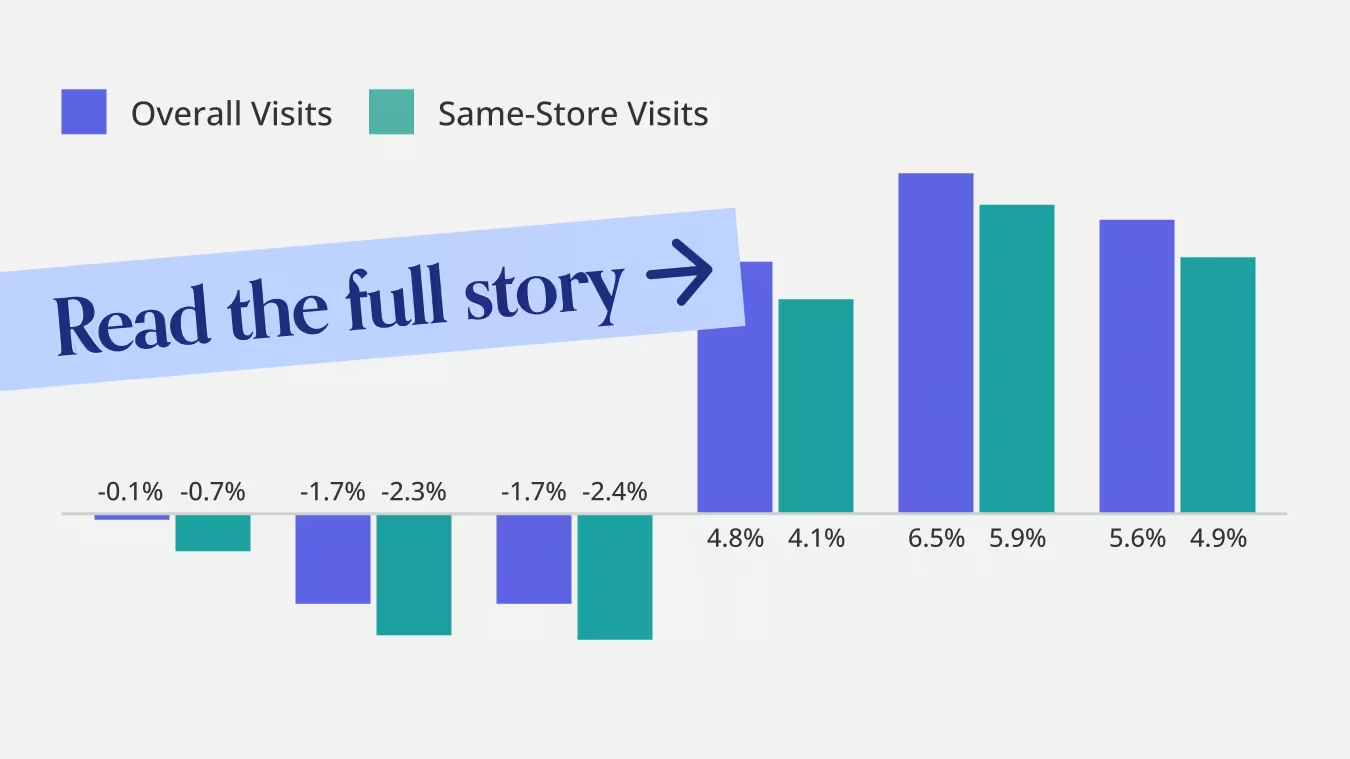
Meanwhile, Chipotle continues to see YoY visit growth, with YoY foot traffic to the chain rising by 4.5% in Q1 2025.
Some of the company’s strength may be attributed to its strategic fleet expansions, particularly in smaller markets. Moving forward, Chipotle has set its sights on opening roughly 350 new locations throughout 2025, with a focus on drive-through – another major growth driver for the chain.
A Minecraft Movie debuted on April 3rd, 2025, and McDonald’s, perhaps recalling the success of its Adult Happy Meal promotion, participated in the movie rollout by offering a Minecraft Movie special. The meal, which includes Minecraft-themed collectibles, is available for a limited time, creating a sense of urgency for diners – something that McDonald’s has used in the past to great success.
The impact of the special was already evident in the first week following the release. Visits to McDonald’s on Tuesday, April 1st – when the special launched – were 12.2% higher than the year-to-date (YTD) average Tuesday visit count for 2025. And the launch provides a continued boost to the chain, with visits on the following two Tuesdays elevated by 9.5% and 7.4%, respectively, relative to the YTD Tuesday visit average.
Chipotle, too, has leveraged limited-time offers and specials to great success, with chicken-focused promotions like 2024’s Chicken al Pastor and, more recently, the introduction of a Honey Chicken special driving visits to the chain.
Visits to Chipotle jumped by 6.3% above the YTD weekly visit average during the week of March 10th, 2025, when the special launched, and remained elevated through the rest of the month. While visit numbers had been trending slightly upward towards the end of February, the launch of the Honey Chicken special seems to have driven a sustained visit surge. Burrito Day provided another visit boost to the chain, with Thursday visits on April 3rd – the day of the launch – elevated by 13.0% relative to the YTD Thursday visit average.
McDonald’s and Chipotle are maintaining their position in a challenging market, driving visits through carefully considered expansion, specials, and promotions.
Will these visits continue to hold pace as Q2 gets underway?
Visit Placer.ai for the latest data-driven dining insights.

Los Angeles is famous for its film and music industry, but the city also boasts several world-class museums that educate and entertain local visitors and tourists alike. We dove into the data for several of LA’s top museums in order to examine the visitation patterns and demographics of museum goers in the City of Angels.
Analyzing monthly visits to the top LA museums over the past 12 months reveals that although most receive a visit boost in the spring and summer, each institution has a unique seasonal visit pattern.
The California Science Center and La Brea Tar Pits and Museum received the largest July visit surges, likely due to heavy traffic from young families on vacation. Meanwhile, The Petersen Automotive Museum received the largest December visit spike, perhaps due to a boost from private holiday events. And The Museum of Contemporary Art appears to have maintained a steady flow of visitors – experiencing a relatively muted summer uptick, but relatively robust visits in the fall.
Diving further into the data reveals that LA museums are particularly popular with hyper-local visitors and with out-of-towners: Every museum analyzed received large shares of visitors from less than 30 and/or from more than 250 miles away, with fewer visitors coming from 30-250 miles.
The California Science Center received the greatest share of visitors residing less than 30 miles (60.7%) from the museum, perhaps due to its popularity with educational groups and its location in bustling Exposition Park.
Griffith Observatory, with views of the Hollywood sign and Los Angeles's urban landscape, was highly popular with out-of-town visitors – 48.7% of guests resided at least 250 miles away. And as a unique active fossil excavation site, La Brea Tar Pits and Museum was also favored by out-of-town visitors (42.9% of guests came from 250+ miles away).
The relatively high shares of out-of-town visitors at most LA museums analyzed highlights the role that tourists play in supporting LA’s cultural institutions. And diving into the median HHI in the museums’ captured market reveals that these out-of-towners may represent a particularly desirable audience.
In general, the museums analyzed tend to attract a relatively wealthy audience. In 2024, the median household income (HHI) in all the analyzed museums’ captured market trade areas was higher than the median HHI nationwide ($79.6K/year) – perhaps due to California’s relatively high median HHI of $99.3K/year. Most museums also drove traffic from regions with a higher median HHI than the state benchmark – likely due to the relative affluence of the Los Angeles area. The Getty and The Museum of Contemporary Art’s captured trade areas had the highest median HHIs, at $107.2K/year and $103.7K/year, respectively.
But when analyzing only out-of-town visitors (who traveled 250 miles or more), the median HHIs of the captured trade areas increased – indicating that out-of-town museum guests were more affluent than local ones. This suggests that tickets to special exhibitions could be set at higher price points during peak seasons when more out-of-town guests are anticipated.
Though there are similarities between the behavior and demographics of visitors to LA’s museums, they each experience somewhat distinct seasonal visit patterns and attract diverse audiences. With the busiest museum season ramping up, cultural institutions stand to gain from understanding the changing characteristics of their guests.
For more insights, visit Placer.ai.

Marketers, retailers, and category managers spend a lot of time trying to analyze the retail preferences of Gen Z shoppers. Meanwhile, Gen X and Baby Boomers are seldom considered, even though almost 40% of American adults are aged 55 or older. We analyzed the latest data to better understand these frequently overlooked consumer segments.
Although the overwhelming majority of older Americans spend several hours a day online and over half of American seniors own a smartphone, the data indicates many consumers aged 55+ are still more comfortable shopping in-store.
Comparing the age distribution among adult visitors to Walmart’s website with the age distribution in Walmart’s offline trade area shows that older consumers (aged 55+) are overrepresented in the retailer’s offline trade area relative to its online visitor base.
Offline shopping offers a range of benefits, from personalized service to the ability to physically examine products and the convenience of walking out with the purchased items. Retailers looking to increase their penetration with older audience segments might consider investing in brick-and-mortar stores that give older consumers the shopping experience that best fits their needs.
For retailers looking to reach Gen X and Baby Boomers, merely building brick-and-mortar channels may not be enough – brands should also ensure that the in-store experience is optimized for older audiences. And the first step may be ensuring that staffing and opening hours are adapted to the shopping habits of older Americans.
Analyzing the hourly visit distribution at L.L. Bean and Ocean State Job Lot – two chains particularly popular with a variety of older audiences – suggests that Gen X and Baby Boomer shoppers may prefer visiting stores earlier in the day: Visits between the hours of 9 AM and 2 PM accounted for a much larger share of visits to both chains when compared to visitation behavior for the wider category. So retailers seeking to attract Gen X and Baby Boomers may consider earlier opening hours and robust staffing during the late morning and early afternoon.
At the same time, while many older consumers do exhibit some commonalities – such as a preference for offline shopping or for earlier-in-the-day store visits – it is important to remember that older shoppers are not a monolith. Like other age-based market segments, the label of “older consumer” lumps together a variety of customer types from various socioeconomic backgrounds representing a wide array of values and interests. Retailers looking to cater to this demographic should also consider the particular characteristics of their target audience beyond the general attributes common to many older consumers.
The chart below shows the share of various “Boomer” segments (from the Spatial.ai: PersonaLive dataset) in the trade areas of seven apparel retailers popular with older consumers. All these segments – Sunset Boomers, Suburban Boomers, and Budget Boomers – consist of consumers aged 65-74, but their living arrangements and household income levels vary. And as the chart shows, each Boomer segment exhibits unique brand affinities.
Sunset Boomers – the most affluent segment – were significantly overrepresented in the captured markets Talbots, Anthropologie, Vineyard Vines, and Chico’s. Suburban Boomers – middle-class older consumers – were also slightly overrepresented in Talbots, Vineyard Vines, and Chico’s captured market, but were underrepresented for Anthropologie and significantly overrepresented at Boscov’s. And Budget Boomers – older consumers with household incomes of $35K to $50K – were overrepresented in Bealls and Cato’s captured market even though these retailers did not seem particularly popular with the other two Boomer segments.
To effectively target older consumers, retailers should assess how their products and services align with the unique tastes and spending abilities of each Boomer and Gen X sub-segment.
Older consumers make up a significant share of U.S. shoppers, even though this demographic is not always top of mind for marketers and retailers. By embracing the continued importance of physical stores and adapting to the specific shopping behaviors of Baby Boomers and Gen X consumers, retailers can cultivate stronger engagement with these segments. Ultimately, though, success with this audience will hinge on recognizing the heterogeneity of older shoppers and tailoring strategies accordingly.
For more data-driven retail insights, visit placer.ai/anchor.

After leap year comparison induced year-over-year (YoY) declines in February 2025, foot traffic to the Placer 100 Index for Retail & Dining stabilized in March 2025 to just -0.3% below 2024 levels – an impressive performance considering the severe weather that impacted large parts of the country.
State-level analysis of March 2025 visits to the Placer 100 Index reveals that massive storms indeed contributed significantly to regional foot traffic declines. States that bore the brunt of inclement weather in March 2025 – particularly in the Southeastern and Central United States – appeared to experience the steepest YoY visit gaps.
Despite the extreme climate conditions, some chains managed to plow ahead, enjoying visit growth in March 2025. Once again, Chili’s Grill & Bar held on to the top spot in the Placer 100 Index for YoY visits (22.6%) and visits per location (23.4%) growth, likely due to continued success in the areas of value and virality. Meanwhile, three fitness chains made the top 10 in YoY visits – Crunch Fitness (22.5%), LA Fitness (10.0%), and Planet Fitness (9.7%), at least in part due to continuing expansions of their respective footprints.
Expansion is perhaps only one driving factor behind the success of Crunch Fitness, Planet Fitness, and LA Fitness in March 2025. The beginning of the year is generally busy for fitness chains as many consumers adopt new years’ resolutions to get in shape, even if many abandon their pursuit down the line. But the data suggests that Crunch Fitness, Planet Fitness, and LA Fitness experienced visit growth in March in part due to a sustained increase in visitor frequency.
All three chains saw an increase in the share of visitors visiting 8 or more times in March 2025 compared to 2024, indicating that the chains are driving more traffic from fitness-invested visitors. And these fitness buffs, who attend the gym quite often, are perhaps less likely to give up on their fitness goals during the year, which bodes well for the fitness chains’ chances to sustain members and elevated traffic in the months ahead.
The Placer 100 Index for March 2025 demonstrates the effect of harsh winter conditions on retail and dining visits. Still, the strong performance of several chains highlights the consumer trends and brand strategies that can drive growth.
For more insights anchored in location analytics, visit Placer.ai/anchor.

It’s hard to imagine, but we’ve eclipsed the five year anniversary of the onset of the pandemic lockdowns across the U.S., when the retail industry was transformed overnight. By April 2020, thousands of stores had closed and uncertainty loomed. At the time, it felt like the potential end of physical retail that the industry had been ruminating over for years.
Five years later, the industry looks mostly like it did at the beginning of 2020. Online shopping did not kill physical retail, and although e-commerce adoption has substantially increased since pre-pandemic – fueled by the spike in new online shoppers in 2020 – the vast majority of retail transactions (over 80%) still occur in brick-and-mortar locations.
At the same time, while the retail industry looks similar to itself structurally, there have been numerous changes at the category level. Many large ticket purchases like consumer electronics and home furnishings that experienced a pull forward in demand during the pandemic waned over the past few years. Visits to apparel retailers and department stores looked, for a while, like they would never recover. And as people emerged from their homes or found their way to TikTok, beauty became the in-demand category that spread like wildfire. Grocery shopping went from a mundane chore to a form of consumer escapism in 2020; in many ways, that behavior has stuck for shoppers as they now frequent more grocery chains in their journey.
We’ve also observed some fundamental changes across U.S. consumers; more workers still work from home than before the pandemic, although return to office numbers keep rising. And many city dwellers who migrated during the peak pandemic period still remain in more suburban and rural areas.
So what have the past five years taught us about U.S. shoppers? First, we’ve learned that consumers are much more resilient than we give them credit for as they demonstrated a remarkable ability to both adapt to unprecedented circumstances and return to their former shopping habits once the situation normalized. Second, consumers are very cyclical in their behaviors and interests – five years after the pandemic’s start, many of the categories that suffered are coming back into their own. And, as consumers face different types of economic uncertainty, we should be optimistic that they can weather different types of storms. But perhaps the key lesson from the past five years has been that brick-and-mortar stores serve a distinct purpose to both retailers and shoppers – and that physical commerce is definitively here to stay.
Looking at the Placer 100 Retail and Dining Index reveals that visits to retail and dining locations not only rebounded from the pandemic, but have surpassed pre-pandemic levels. There are a few underlying causes that could have contributed to these changes: store and unit openings, a higher frequency in visits to certain categories, and increased consumer demand.
At the same time, dwell times across the macro retail industry have shifted since the pandemic as consumers are generally spending less time in stores than they did in 2019. There could be a few reasons contributing to this decrease: a higher adoption of e-commerce as a research tool before visiting a store, a higher utilization of BOPIS and curbside offerings, or more frequent visits leading to shorter individual trips but longer overall time in store. Last year (2024) also saw a higher share of weekday visits compared to the pre-pandemic period, where more consumers shopped on the weekend.
From a consumer perspective, as we wrote about recently, higher income households are more important to the retail industry than prior to the pandemic – even though they account for fewer visits overall. Meanwhile, lower income households are visiting retailers more frequently, especially in essential categories, as they look to combat inflationary pressures that exploded since the pandemic.
What did the pandemic reveal about essential retail categories? For many consumers, these segments got them through the peak pandemic time period as discretionary retail locations remained closed. Grocery stores, pharmacies, and superstores provided a sense of normalcy for shoppers as visiting a store became much more than a weekly errand. Today’s shoppers mirror many of those behaviors; they visit these types of retailers more frequently and don’t balk at making an extra trip for that “must-have” item from a specific chain.
Looking at the relative share of visits by category shows that dollar and discount stores gained the most visit share compared to the pre-pandemic trends. These chains have invested heavily in fresh food items and assortment expansion to become more of a destination for shoppers, especially those who are more price sensitive. So while visitation growth to dollar store chains did stagnate in 2024, even as retailers continued to expand store fleets, the leading players in this category have already entrenched themselves deeper into consumers' shopping journey compared to the pre-pandemic period.
Similarly, value based grocers and warehouse clubs have become more frequent stops in consumer daily routines, even if their share of visitation hasn’t risen dramatically. These chains have benefitted from changes in consumer behavior over the past five years: Warehouse clubs were well positioned for consumers who migrated from urban to suburban environments, and value grocery stores such as Aldi and Trader Joe’s became a safe haven for consumers trying to combat inflationary pressures as the country emerged from the pandemic.
The one sector that hasn’t fared as well? The drugstore channel. The increase in visitation during the vaccine roll out period didn’t result in long term sustained traffic, and drugstores with their expansive store fleet have struggled to find their true value proposition as competition from wellness chains (such as GNC & Vitamin Shoppe), beauty retailers, and superstores grew. Drug-based retailers are still working to right size business today, as further constrained shoppers look elsewhere.
Essential retail players have had to contend with ever-evolving consumer needs in the post-pandemic period and continue to play a key role in the return for normalcy. Some sectors have fared better than others, but those that have emerged as winners looked to stay in lock step with their consumers on their journey. Retailers realized that they didn’t have to be the best at everything – experience, convenience, value, and assortment – but they needed to lean into their speciality to be successful.
On the other end of the retail spectrum, discretionary categories have faced headwinds as consumers exited the peak pandemic period. The peak pandemic years (2020 and 2021) were banner years for retail segments that cater to shoppers’ “wants”. But as the need to self-soothe with goods waned and inflationary pressures rose, consumers walked away from many of the retailers who had benefited from their behavioral changes. (The declines in foot traffic in these categories likely also reflected some of the shift to online channels, as most of these retailers were forced to shut their doors during the early days of COVID.)
It’s been a long road to recovery for discretionary businesses, but we began to see some renewed signs of life over the past year. These retailers must remain vigilant in their quest for relevance with shoppers; high levels of uncertainty, debts, and increasing focus on value all still present headwinds for the retail industry – particularly those who focus on satisfying desires instead of needs.
In reviewing the visitation growth since 2022, discretionary retail could be broken into two performance categories: beauty and everything else. As we’ve written previously, the beauty industry was able to ride the wave of post-lockdown consumer behaviors, including the need to replace outdated products that hadn’t been worn while spending more time at home. At the same time, consumers also became more enamored with mass beauty brands, or those sold at drugstores or mass merchants at lower price points. The success of these brands and retailers that harnessed the power of consumer choice, like Ulta Beauty, intersected with a strong consumer desire for value. And although 2024 was a year of reckoning for the beauty industry as the consumer shifts towards other priorities, the category’s strong success during the early post-pandemic period cannot be overstated.
The performance of other discretionary segments has been more mixed. Categories that saw meteoric growth during the pandemic lockdowns – such as home furnishings, home improvement and consumer electronics – failed to sustain momentum. Apparel trends, like the rise of athleisure, had helped drive continued demand to retail chains and department stores even without the need for traditional clothing, and as life got back to normal and these trends faded, retailers saw year-over-year declines in visitation.
But the 2024 data began the slow rebound of some of these categories, particularly in home and apparel. Home furnishings, home improvement, and consumer electronics may continue to see a rebound in 2025 as we enter a new replacement cycle and those who purchased these categories during the pandemic look to refresh their homes and upgrade their technology. Apparel’s rebound can be attributed to a resurgence of national brands as increased use of semaglutide medications and an interest in healthy living drive shoppers to revamp their wardrobes.
The one area of discretionary retail that outperformed its competitors and continues to shine? The off-price channel has had an extraordinary few years of visitation growth since the onset of the pandemic. Off-price retailers have enticed consumers with the perfect blend of value orientation, in-store experience, and immediacy that drive repeat visitation and keep shoppers engaged. The success of off-price retail also underscores the continued importance of physical retailers, despite the initial changes in behavior during the pandemic. This sector of discretionary retail is probably best positioned to handle the potential economic uncertainty of 2025 and beyond.
Overall, the discretionary side of the retail industry has begun to recover from its challenging few years of visitation, but 2025 does pose uncertainty that could impact consumers’ disposable income levels. Retailers that cater to consumers’ “wants” must work even harder to stay on their customers’ radar and entice shoppers to come into physical retail locations instead of shopping online or via social media platforms. As mentioned earlier, high income shoppers are going to become even more valuable to this sector of retail as it tries to maintain momentum.
The retail industry has undergone a tremendous transformation over the past five years. But while so much has evolved, there is still a lot of opportunity for the industry to be more agile in its ability to satisfy consumer demands. Despite the early days of store closures during the pandemic, physical retail not only bounced back, but has flourished. Retailers continue to focus on upgrading store fleets and opening new stores. Stores have moved away from being experiential to trying to just provide a good shopper experience. Retail’s reality is that consumers still face many challenges ahead, especially economic uncertainty. But, the pandemic highlighted the resilience of both retailers and shoppers to support one another, which will hopefully continue into the future of retail.

The New York office scene is buzzing once again, as companies from JPMorgan to Meta double down on return-to-office (RTO) mandates. But just how did New York office foot traffic fare in 2024? How did Big Apple office foot traffic compare to that of other major business hubs nationwide? And how is New York’s office recovery impacting post-COVID trends like the TGIF work week? Are office visits still concentrated mid-week, or are people coming in more on Fridays and Mondays? And how has Manhattan’s RTO affected local commuting patterns?
We dove into the data to find out.
In 2024, New York City cemented its position as the nationwide leader in office recovery. Thanks in part to remote work crackdowns by banking behemoths like Goldman Sachs, Morgan Stanley, and JPMorgan, visits to NYC office buildings in 2024 were just 13.1% below pre-pandemic (2019) levels.
For comparison, Miami’s office foot traffic remained 16.2% below pre-pandemic levels, while Atlanta, Washington D.C., and Boston saw significantly larger gaps at 28.6%, 37.8%, and 43.9%, respectively.
Perhaps unsurprisingly given the Big Apple’s robust year-over-five-year (Yo5Y) recovery, the pace of year-over-year (YoY) visit growth to NYC office buildings was somewhat slower in 2024 than in other major East Coast business centers. Still, New York’s YoY office recovery rate of 12.4% outpaced the nationwide baseline, and came in just slightly below Washington, D.C.’s 15.2% and Atlanta’s 14.6%.
Interestingly, New York’s return to office has not led to a significant retreat from the TGIF work week that emerged during COVID. In 2024, just 11.9% of weekday (Monday to Friday) visits to NYC offices took place on Fridays – only slightly more than the 11.5% recorded in 2023 and significantly below the pre-pandemic baseline of 17.2%.
Meanwhile, Monday has quietly regained its footing as the dreaded start of the New York work week. After dropping significantly in 2022 and 2023, the share of weekday office visits taking place on Mondays rebounded to 18.2% in 2024 – just slightly below 2019’s 19.5%. Still, Tuesday remained the Big Apple’s busiest in-office day of the week last year, accounting for nearly a quarter (24.6%) of weekday NYC office foot traffic.
And diving into Yo5Y data for each day of the work week shows just how much New York’s overall recovery is driven by mid-week visits – and especially Tuesday ones. In 2024, Friday visits to NYC office buildings were down 40.2% compared to 2019. But on Tuesdays, visits were essentially on par with pre-pandemic levels (-0.3%), even as nationwide office visits remained 24.6% below 2019.
Another post-COVID trend that has shown staying power in New York is the growing share of office visits coming from employees who live nearby. As hybrid schedules become the norm, it seems that those commuting more frequently are often just a short subway ride -or even a stroll- away.
The share of NYC office workers coming from less than five miles away, for example, has risen steadily since COVID, reaching 46.0% in 2024. Over the same period, the share of workers coming from 5-10 miles, 10-15 miles, or 25+ miles away has declined.
Looking at commuting trends across the East Coast helps put New York City’s shift into perspective. In 2019, NYC’s share of nearby commuters was on par with Washington, D.C. and slightly below Boston. But while both cities experienced moderate increases in local commuters between 2019 and 2024, New York pulled ahead, outpacing all other analyzed cities in its share of nearby office workers last year.
Miami and Atlanta – two other standout cities in office recovery – also saw significant growth in the percentage of short-distance commuters over the past five years. This trend underscores a broader shift: As hybrid work reshapes commuting habits, employees across multiple markets are more likely to go into the office if they live nearby, reducing reliance on long-haul commutes.
As the nation’s office recovery leader, New York offers a glimpse into what other cities can expect as office visitation rates continue to improve. Even at just 13.1% below pre-pandemic levels, NYC office visit levels continue to rise. And as recovery nears completion, trends that took hold during COVID remain firmly entrenched.

The full-service dining segment has experienced its fair share of challenges over the past few years, with pandemic-era closures, rising food and labor costs, and cutbacks in discretionary spending contributing to visit lags. In 2024, visits were down 0.2% year over year (YoY) and remained 8.4% below 2019 levels – a reflection of the significant number of venues that permanently closed over COVID and a testament to the industry's ongoing struggle to regain its pre-pandemic footing.
Yet, even in a difficult environment, some full-service restaurant (FSR) chains are thriving. These brands aren’t waiting for the industry to rebound – they're becoming trendsetters in their own right, proving that stand-out strategy is everything in a challenging market.
This white paper explores brands that are harnessing three key differentiators – fixed-price value offerings, elevated social experiences, and a laser focus on product – to drive full-service dining success in 2025.
One of the most defining trends over the past few years has been the unrelenting march of price increases. And as consumers continue to seek out ways to save, some chains are staying ahead of the pack with fixed-price value offerings that help diners squeeze out the very best bang for their buck.
Golden Corral, the all-you-can-eat buffet chain that lets kids under three eat for free, is one FSR that is benefiting from consumers’ current value orientation. Despite closing several locations in 2024, overall visits to the chain still tracked closely with 2023 levels, declining by just 0.5% – while the average number visits to each Golden Corral restaurant grew 3.8% YoY.
Golden Corral’s value proposition is resonating strongly with budget-conscious Americans eager to enjoy a wide variety of comfort foods at an affordable price. The chain’s visitors tend to come from trade areas with lower median household incomes (HHIs) than traditional full-service restaurant (FSR) diners. And these patrons are willing to travel to enjoy the chain’s value buffet offerings, many of which are situated in rural areas and may require a longer drive. In 2024, 25.2% of Golden Corral’s diners came from over 30 miles away – compared to just 19.2% for the wider FSR segment.
Golden Corral’s continued flourishing proves that in an era of rising costs, diners are willing to go the extra mile (literally) for a restaurant that delivers both quality and affordability.
Children’s party space and eatertainment destination Chuck E. Cheese has had a transformative few years. Following the retirement of its iconic animatronic band, the chain shifted its focus to a new membership model, announcing a revamped Summer of Fun pass in May 2024 – including unlimited visits over a two-month period, steep discounts on food, and up to 250 games per day. The pass proved incredibly popular, with YoY visits surging by 15.6% in May 2024, when the offer launched – a sharp turnaround from the YoY visit declines of the previous months. Recognizing the strong demand, Chuck E. Cheese extended the program year-round – and the strategy has paid off as YoY visits remained positive through the end of 2024.
A closer look at the data suggests that parents are making full use of their unlimited passes: The share of weekday visits was higher in H2 2024 than in H2 2023, likely due to families using their passes for weekday entertainment rather than reserving visits for weekends and special occasions.
At the same time, the share of repeat visitors – those frequenting the chain at least twice a month – also grew. Although these repeat visitors may not purchase additional gameplay beyond the flat fee, their more frequent on-site presence likely translates into increased sales of pizza and other menu items.
While value has been a major motivator for restaurant-goers in recent years, low prices aren’t the only drivers of FSR success. Brands offering unique experiences aimed at maximizing social interaction are also seeing outsized gains.
Though many of these more innovative venues tend to be on the more expensive side, they draw enthusiastic crowds willing to pony up for concepts that combine good food with fun social occasions. And some of the more successful ones bolster perceived value through offerings like fixed-price menus or club memberships.
Korean cuisine has been on the rise in recent years, with restaurants like Bonchon Chicken and GEN Korean BBQ House making significant waves in the dining space. Another chain drawing attention is KPOT Korean BBQ and Hot Pot, which began modestly in 2018 and has since expanded to over 150 locations nationwide.
Diners at KPOT can customize their meals by selecting from a variety of proteins, broths, sauces, and side dishes, known as banchan, while barbecuing or cooking in a hotpot at their table and sipping on the drinks from the menu’s extensive selection. And though pricier than Golden Corral, KPOT also offers an all-you-can-eat experience that lets customers squeeze the most value out of their indulgence.
Location intelligence shows that KPOT’s experiential dining model is resonating with customers: Since Q4 2019, the average number of visits to each KPOT location has risen steadily – even as the chain has grown its footprint – while the average dwell time has also increased. Indeed, rather than a quick dining stop, KPOT has become a destination for guests to linger, enjoying both food and drinks – and an interactive and social experience.
By positioning themselves as gathering places for fine wine aficionados, wine-club-focused concepts such as Postino WineCafe and Cooper’s Hawk Winery are also benefiting from today’s consumers’ emphasis on social experiences. The two upscale dining destinations offer club memberships that combine periodic wine releases with a variety of perks.
And the data suggests that the model is strongly resonating with diners. Both Postino and Cooper’s Hawk have grown their footprints over the past year, driving substantial YoY chain-wide visit increases while average visits per location grew as well – showing that the expansions and experiential offerings are meeting robust demand.
And analyzing the two chains’ captured markets shows that the wine club model enjoys broad appeal across a variety of audience segments.
Unsurprisingly, both wine clubs’ visitor bases include higher-than-average shares of affluent consumers with money to spend, including Experian: Mosaic’s “Power Elite”, “Booming with Confidence”, and “Flourishing Families” segments (the nation’s wealthiest families, as well as affluent suburban and middle-aged households). But the two chains also attract younger, more budget-conscious consumers – Postino, which has many downtown locations, is popular among “Singles and Starters”, while Cooper’s Hawk is popular among “Promising Families” - i.e. young couples with children.
The success of the two brands across various segments underscores the impact of a distinctive experience – especially when paired with a loyalty-boosting membership – in attracting today’s consumers.
Value offerings and unique experiences have the power to drive restaurant visits – but ultimately, a good meal in an inviting atmosphere is a draw in and of itself, as is shown by the success of First Watch and Firebirds Wood Fired Grill.
Breakfast-only restaurant First Watch excels at ambiance and menu innovation, changing up its offerings five times a year and striving to maintain a neighborhood feel at each of its locations.
First Watch has made a point of leaning into its strengths, eschewing discounts in favor of a consistently elevated dining experience and doubling down its strongest day part (weekend brunch), rather than trying to artificially drive up interest at other times.
And the strategy appears to be working: In 2024, visits to First Watch increased 6.6% YoY – with Saturdays and Sundays between 11:00 A.M. and 1:00 P.M. remaining its busiest dayparts by far. Visitors to First Watch also tend to linger over their meals more than at other breakfast chains – in 2024, the restaurant experienced an average dwell time of 54.9 minutes, significantly longer than the 48.7-minute average at other breakfast-focused restaurants.
By focusing on what matters most to its diners – innovative and exciting food and a welcoming atmosphere that allows patrons to enjoy their meals at a leisurely pace – First Watch is continuing to flourish.
Another chain that is growing its footprint and its audience on the strength of a menu and ambiance-focused approach is Firebirds Wood Fired Grill. The chain, known for its “polished casual” vibe and bold, unique flavors, added several new restaurants last year, leading to a 6.5% increase in overall visits. Over the same period, the average number of visits to each Firebirds location held steady – showing that the new restaurants aren’t cannibalizing existing business.
The chain’s success may rest, in part, on its locating its venues in areas rife with enthusiastic foodies. Data from Spatial.ai’s FollowGraph shows that in 2024, Firebird’s trade areas had significantly higher shares of “BBQ Lovers”, “Gourmet Burger Lovers,” and “Foodies” than the nationwide average. This suggests that Firebirds is attracting diners who prioritize the experience of eating – key for a chain that prides itself on putting good food first. The chain is also known for its welcoming decor and design – another aspect that may lead to its strong visit success.
Necessity often serves as the mother of invention, and challenging economic periods continue to spark new trends and innovations in the dining scene. From a heightened focus on value – drawing families and lower-HHI consumers willing to travel for a good deal – to the growing appeal of social dining and the timeless draw of good food – new trends are emerging to meet changing consumer expectations.

Stadiums and arenas – and the communities they call home – have a stake in cultivating engaged team fanbases eager to participate in live events. And venues and teams can employ a variety of strategies to strengthen their connection with fans and draw crowds to the stands.
In this report, we leverage location analytics and audience segmentation to uncover some of the ways that sports franchises and venues are driving engagement – attracting visitors from farther away and appealing to fans more likely to splurge on stadium fare. How does the signing of a star athlete impact arena visitor profiles? What happens to stadium visitation trends when a team’s performance improves dramatically? And how can teams and venues tailor their offerings to more effectively cater to visitor preferences?
We dove into the data to find out.
In sports, the signing of a star athlete can have a ripple effect across the organization, hometown, and league. In addition to driving up overall attendance at games, star power can impact everything from visit frequency to audience profile – and the buying power of stadium attendees.
Lionel Messi’s move to Inter Miami CF after decades of European play brought a foot traffic boost to Chase Stadium (formerly DRV PNK Stadium). But it also shifted the demographics of stadium visitors and increased the distance they traveled to attend a game.
At Inter Miami’s 2022 and 2023 home openers without Messi (he joined the team mid-season in 2023), only 6.4% and 5.3% of visitors to Chase Stadium came from over 250 miles away. But for the 2024 home opener with Messi on the squad, 31.3% of stadium visitors traveled more than 250 miles to attend.
The demographics of visitors at the home opener also changed with Messi on the team. Trade area data combined with the Spatial.ai: PersonaLive dataset reveals that the 2024 home opener received a smaller share of households in the “Near-Urban Diverse Families” (11.2%) and “Young Urban Singles” (7.2%) segments than the two previous years. Meanwhile, shares of “Sunset Boomers” (13.0%) and “Ultra Wealthy Families” (20.1%) increased, indicating that Messi brought an older and more affluent demographic of visitors to the stadium compared to previous years. Messi’s arrival has generated increased revenue for Inter Miami CF, Major League Soccer, and Apple TV+, which has exclusive streaming rights for MLS games. And an influx of affluent out-of-town visitors also has the potential to drive positive outcomes for tourism and employment in the Miami area.
Caitlin Clark’s WNBA debut was another star-powered game changer – this time for women’s basketball. After dazzling the sports world during her college basketball career, Caitlin Clark was drafted first overall to the Indiana Fever before the 2024 WNBA season. The superstar’s arrival has had a staggering economic impact on the city of Indianapolis and the Fever franchise, highlighting the benefit of a top athlete within the local community. However, Clark’s stardom also had a far-reaching impact on the league as a whole, adding tremendous value to the WNBA. Trade area analysis reveals that several WNBA arenas saw an uptick in visitor affluence when hosting the Fever with Clark in the lineup – likely driven in part by the elevated ticket prices associated with her appearances.
When the Minnesota Lynx hosted the Fever on July 14th, 2024, for example, the median HHI of Target Center’s captured market shot up to just over $93K/year, well above the median HHIs for the games immediately before and after that event. (A venue’s captured market refers to the census block groups (CBGs) from which it draws its visitors, weighted to reflect the share of visits from each one – and thus reflects the profile of the venue’s visitor base.) Similarly, the Fever’s away game against the Connecticut Sun on May 14th, 2024 at Mohegan Sun Arena drove a higher audience median HHI ($103.6K/year) than either of the Sun’s next two home games.
Having a superstar on the roster can drive positive outcomes locally and league-wide – but overall team success is the ultimate goal for any franchise. So it may come as no surprise that stadiums and arenas can drive engagement when their home teams perform well on the field or court. And teams that reverse their fortunes often spark even greater excitement, boosting visitor loyalty, visit duration, and other key metrics.
The Baltimore Orioles had one of the worst records in baseball just a few years ago. But since 2022, the team has flipped the script – stringing together winning seasons and postseason berths. And location intelligence shows that as the team finds success, fans are becoming more engaged with their hometown stadium.
During the 2019 regular season, one of the worst for the club in recent history, stadium attendance suffered, with only 8.3% of visitors to Oriole Park at Camden Yards visiting the stadium at least three times. But during the 2024 regular season, Oriole Park’s share of repeat visitors (those who visited at least three times) was almost double 2019 levels (16.3%) – consistent with a sharp increase in sales of multi-game ticket packages.
In addition to attending games more often, visitors to Oriole Park also appear to be spending more time at the ballpark. During the 2019 regular season, visitors spent an average of 150 minutes at the stadium, but in 2024, the average time at the park increased to 178 minutes – potentially boosting ancillary spending and in-stadium advertising exposure. The increased dwell time of visitors is particularly noteworthy when considering that MLB’s rule changes have significantly shortened average game time.
The more engaged fandom engendered by team success not only impacts stadium visitor behavior, but also has the potential to drive revenue. The Orioles added 20 new corporate sponsors before the 2024 season, likely due to the attention garnered by the well-performing club.
The NFL’s Detroit Lions provide another example of team success that has driven visitor engagement. As the franchise has improved its record in recent years, the trade area size of its stadium – Ford Field – has also increased, indicating elevated attendance from fans living further away.
The Lions finished the regular season with losing records from 2019 to 2021, but finished over .500 in 2022 (9-8), 2023 (12-5), and 2024 (15-2). And with the team’s increasing wins each consecutive season, the size of its stadium's trade area has also increased steadily – reaching 81.3% above 2019 levels in 2024.
This underscores just how much team success matters to fans, who may be more inclined to travel longer distances if they believe their team is likely to win. Ultimately, broader fan engagement across a wider trade area also increases a team’s growth potential beyond in-stadium attendance – driving merchandise sales, increasing viewership, and benefitting both the team and the league as a whole.
While stadium attendance and visitor behavior is often correlated to the performance of the sports teams that play in the arena, sporting venues can also drive fan engagement in ways that aren’t solely tied to team success or big-name athletes. By adapting their concessions and venue operations to visitor preferences, stadiums and arenas can better serve their audiences and strengthen their community presence.
Consumers have been feeling the pinch of rising food costs for quite some time, but at least one NBA team has responded to make concessions at the game more affordable for fans. In December 2024, the Phoenix Suns announced a $2 value menu for all home games at Footprint Center – delivering steep discounts on hot dogs, water, soda, and snacks.
Location analytics suggest that since the value menu launch, more fans who would have otherwise waited until after leaving the venue to grab a bite are now enjoying food and drinks inside the arena. Analysis of five Suns home games just before the value menu launch – between November 26th and December 15th, 2024 – reveals that between 7.0% and 9.3% of stadium visitors visited a dining establishment after leaving the arena. But following the value menu launch before the December 19th, 2024 home game, post-game dining decreased to under 6.0% through the end of the year.
Suns owner Mat Ishbia’s announcement of the new menu called out the need for affordable food options for families at Suns games. As the season progresses, the new menu may drive a larger share of family households to Suns games, which could provide opportunities for advertisers and other stadium partners.
Consumers in Washington – and especially Seattle – are known for their affinity for plant-based diets and environmentally-friendly lifestyles. And that goes for local football fans as well: Audience segmentation provided by the AGS: Behavior & Attitudes dataset combined with trade area data reveals that during September to December 2024, households within Lumen Field’s potential visitor base were 36% more likely to be “Environmentally Conscious Buyers” and “Environmental Contributors” and 39% more likely to be “Vegans” compared to the nationwide average. By contrast, across all NFL stadiums, potential visiting households were 2%, 1%, and 3% less likely, respectively, to belong to these segments.
And Lumen Field has been actively catering to these consumer preferences. The stadium, which has been experimenting with plant-based culinary options for quite some time, was recently recognized as one of the most vegan-friendly stadiums in the NFL. And in December 2024, Lumen became the second stadium in the league to achieve TRUE precertification for its efforts to become a zero-waste venue.
By remaining aligned with its visitor base – including both football fans and people that visit the stadium for other events – Lumen Field encourages visitors to feel at home at their local stadium. And fans may be more connected to their team knowing the club shares their values and respects their lifestyle.
Stadiums and arenas can leverage a variety of strategies to engage visitors in attendance as well as wider audiences. Signing a star athlete, putting together a winning club, or adapting to local preferences are just some of the ways that sports franchises and athletic venues can find success.