Thank you! Your submission has been received!
Oops! Something went wrong while submitting the form.
0
0
0
0
----------
0
0
Articles
Article
Gap & Ulta Traffic Rebound After Tough Start to 2025
Visits to Gap banners and Ulta were mixed in Q1 2025. While some chains - like Athleta - enjoyed visit growth, others experienced more challenges. Still, pockets of optimism could be seen - visits per location showed growth, suggesting strengthening consumer engagement.
Shira Petrack
May 23, 2025
3 minutes

Difficult February Drags Gap Traffic Down in Q1 2025

Overall visits to Gap Banners declined 3.8% in Q1 2025 compared to the same period in 2024, with average visits per location falling 4.2%. The company’s performance appears to have been impacted by a particularly challenging February, when the absence of a leap year day and severe weather events led to a 10.2% drop in overall visits and an 11.0% decrease in average visits per venue compared to February 2024. 

The company’s traffic was also somewhat weighed down by Banana Republic’s performance, which posted the largest year-over-year (YoY) declines of all Gap banners during the analyzed period. Meanwhile, the Athleta banner – which struggled somewhat in 2024 – returned to modest growth in Q1 2025, with overall visits up 0.4% and average visits per location up 1.1% YoY.    

Signs of Growth in April 2025

Gap’s performance improved significantly in April, with the Gap and Old Navy banners seeing YoY increases in both overall visits and average visits per venue. Old Navy in particular saw its overall traffic jump 10.2% and average visits per location increase by 9.1% compared to April 2024 – likely boosted by a tariff-driven pull-forward in consumer demand.

Average visits per venue also increased at Banana Republic and Athleta – although both banners saw minor YoY declines in overall traffic. The positive April data may indicate that the company is gaining traction and could suggest a more robust year ahead. 

Ulta’s Budding Recovery 

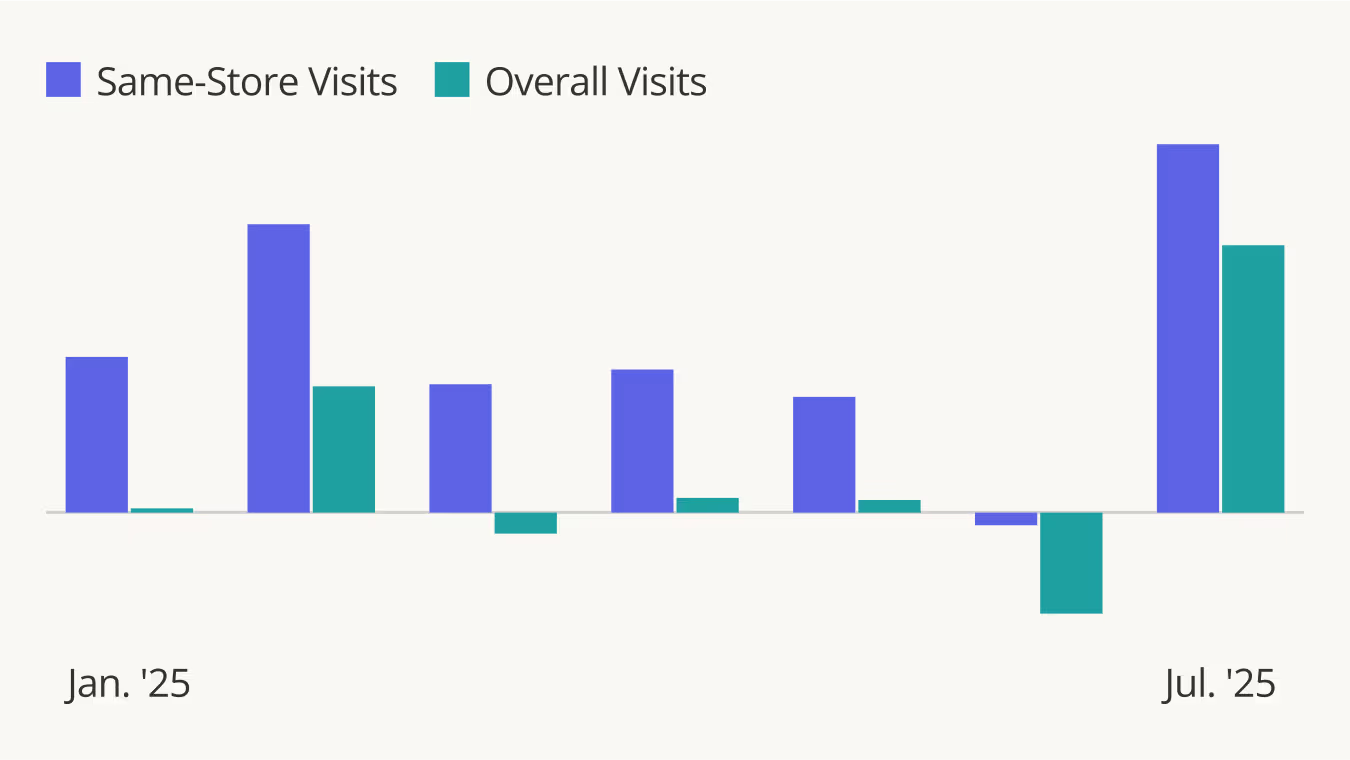
Ulta saw YoY declines of 3.7% in total visits and 7.1% in average visits per venue in Q1 2025, driven in part by difficult comparisons to a strong Q1 2024. Like Gap, the company’s February performance likely hurt its Q1 performance, with February traffic down 7.4% and average visits per venue down 10.7% compared to February 2024. But Ulta’s visit metrics improved in March 2025, with visits just 1.0% lower than in March 2024, and average visits per venue metrics narrowing to a 4.3% decline. 

By April 2025, overall visits were up 0.4% YoY, and visits per venue down just 2.8% – suggesting that Ulta, like Gap, is now on a potential upward trajectory. 

While Q1 2025 presented challenges for both Gap and Ulta, the rebound in April traffic offers a hopeful indication of strengthening consumer engagement. Will the companies maintain their momentum, or was the April rally the result of a temporary pull-forward of demand? 

Keep up with The Anchor to find out. 

Article
Who Attended the 2025 Kentucky Derby?
In early May 2025, horse racing fans were treated to the 151st Run for the Roses at Churchill Downs in Louisville, KY, with thoroughbred Sovereignty coming out the winner. We took a closer look at the location analytics and psychographic characteristics of visitors to find out who attends the Kentucky Derby. 
Ezra Carmel
May 22, 2025
4 minutes

In early May 2025, horse racing fans were treated to the 151st Run for the Roses at Churchill Downs in Louisville, KY, with thoroughbred Sovereignty coming out the winner. And while all eyes were on the horses, (and maybe the hats,) we dove into the location analytics and psychographic characteristics of visitors to find out who attends the Kentucky Derby. 

Large Purse: An Upscale, Urban Event

Analysis of Churchill Downs’ captured trade area over the last twelve months reveals that the racetrack tends to drive traffic from an affluent visitor base. Between May 2024 and April 2025 the dominant trade area audience segment was “Ultra Wealthy Families” (13.2%) – the Spatial.ai: Personalive grouping for the nation’s wealthiest households. This share of this segment within the racetrack’s trade area was well above the nationwide benchmark, more so than any other leading segment.

But digging deeper reveals Churchill Downs’ trade area contained significant shares of several suburban and rural segments as well, highlighting the non-urban quality of the racetrack’s visitors. The presence of large shares of “Wealthy Suburban Families” (12.1%) and “Upper Suburban Diverse Families” (11.4%) segments reflects a significant affluent suburban audience, while above-average shares of the “Rural Average Income” (8.6%) and “Rural High Income” (7.4%) segments indicates robust visitation from rural households with a range of incomes. 

But on Kentucky Derby raceday in 2025, Churchill Downs’ audience changed significantly. The share of “Ultra Wealthy Families” within the venue’s trade area jumped to 20.1%, indicating that the race drove traffic from an even more affluent audience than usual, likely due to the many celebrities and other affluent guests descending on the event. Meanwhile, the share of the “Young Professionals” segment – singles still in school or starting their careers in white-collar and technical jobs – also increased (from 6.0% to 10.3%), perhaps indicating that the Kentucky Derby succeeded in attracting younger urban audiences looking for recreation and a cultural experience. 

Still, non-urbanized audience segments remained well-represented within the race’s trade area (only the share of “Rural Average Income” households slipped below the segment’s nationwide benchmark), indicating that the event maintained much of Churchill Down’s typical spectator base.

Post Positions: Guests From Near and Far

Analysis of the 2025 Kentucky Derby’s physical trade area, which reflects the regions from which Churchill Downs Racetrack received visitors on the day, provides further insight into the event’s attendees. 

The map below shows that the event drew spectators from the country’s major metro areas – and from some of the wealthiest – including New York City, Los Angeles, San Francisco, and Miami. And some of these visitors may have come to Louisville for an extended stay – taking advantage of multiple Derby Week events and parties – contributing to a significant economic boost for the region. 

Analyzing visitors’ area of origin also revealed robust visitation from Louisville and Lexington, KY, and both urban and non-urban areas in the East North Central region as a whole, as diverse local racing fans appeared to take advantage of their proximity to the most exciting two minutes in sports.

The Homestretch

The Kentucky Derby is just the first event of thoroughbred racing’s Triple Crown, which continues with the fast approaching Preakness Stakes and Belmont Stakes. 

What will audiences to these high-stakes races and other upcoming sporting events look like? 

Visit Placer.ai to find out. 

Article
Can Chili’s Repeat its 2024 Success in 2025? 
Chili's enjoyed unprecedented foot traffic success throughout 2024 - and early signs suggest that this momentum is continuing into 2025. We take a look at some of the location analytics for the chain to measure its performance thus far into the year.
R.J. Hottovy
May 21, 2025
3 minutes

Chili’s Strength is Continuing in 2025 

In a year marked by shifting consumer habits and mounting challenges across the restaurant industry, Chili’s emerged as one of the breakout success stories of 2024 – and early signs suggest the momentum could continue into 2025

Although many casual dining chains have struggled in recent years, Chili’s is standing out with strong year-over-year visitation growth, boosted by compelling value promotions, operational improvements, and a renewed focus on customer loyalty. The brand’s ability to balance affordability with innovation has resonated with price-conscious diners, helping it outperform both its casual dining peers and broader industry benchmarks. As economic uncertainty persists, Chili’s strategic approach may serve as a blueprint for how full-service restaurants can thrive in today’s competitive landscape.

Chili’s Success Leading to Increased Market Share 

According to our visitation data, Chili's share of the overall category has increased from approximately 6% to around 8%, a substantial jump. This growth is especially notable given that Chili’s U.S. restaurant count actually declined over the past year, from 1,230 locations in December 2023 to 1,209 as of December 2024.

Attracting Diners From QSR and FSR Competitors 

Who is Chili’s taking visit share from? Essentially, everyone. Our data indicates that in Q1 2025, a meaningfully larger percentage of visitors from most leading quick-service and full-service chains also visited Chili’s, compared to Q1 2024. Admittedly, this increase in cross-visitation is partly because there are more Chili’s visitors than ever before – but the data also highlights Chili’s growing momentum, as the chain has succeeded in pulling traffic from both casual and quick-service competitors.

Chili’s Positioned to Solidify its Status as the Restaurant Industry's Standout Performer 

Chili's undeniably carved out a remarkable success story in 2024, and the compelling early 2025 data suggests the brand is strongly positioned to continue its impressive trajectory. The ability to significantly grow its market share and draw customers from a wide array of competitors speaks volumes about the effectiveness of its value promotions, operational improvements, and customer loyalty strategies. 

Chili’s continues to demonstrate a potent combination of broad appeal and deepening customer engagement. While the full narrative of 2025 for the restaurant industry continues to unfold, Chili's appears to be on track to replicate its 2024 success and could very well solidify its status as the restaurant industry's standout performer for a second consecutive year.

For more data-driven dining insights, visit placer.ai/anchor

Article
Dollar Stores: Stability in The New Year
We take a closer look at the foot traffic to the two biggest players in the discount and dollar store space – Dollar General and Dollar Tree – to understand where the two brands stand. 
Bracha Arnold
May 20, 2025
3 minutes

Dollar Tree and Dollar General have been major foot traffic winners in recent years, attracting an ever-increasing customer base to their dramatically expanded store counts. And while this growth hasn’t been without its setbacks – like the sale of Family Dollar and recently announced store closures – the segment’s overall strength suggests that there is still room for these chains to continue growing.

We take a closer look at the foot traffic to the two biggest players in the space – Dollar General and Dollar Tree – to understand where the two brands stand. 

Dollar General Keeps Things Elevated

Dollar General, one of the largest retailers in the United States, demonstrated a robust start to the year. Overall visits were up by 1.9% YoY in Q1 2025, while average visits per location held steady.

Diving into the monthly visit data offers insight into the slight dips in per-location visits – and potential trends for the chain heading into the second quarter. Dollar General got a strong start to the year, with both overall visits and visits per location elevated in January 2025. However, February’s inclement weather along with the comparison to last year’s leap year drove YoY visits down in February – but by March, foot traffic to the chain had mostly recovered. 

By April 2025, YoY visits and visits per location were up 6.5% and 5.4%, respectively – perhaps due to pull-forward of demand ahead of tariffs, but also suggesting a strong start to Q2 2025. Indeed, the company has announced plans to open an additional 725 stores in 2025 – an ambitious goal for a company in a solid position.

pOpshelf Pops Back

Dollar General also operates pOpshelf, a smaller chain offering items at a slightly elevated price point compared to the company’s flagship Dollar General banner. And while pOpshelf will be rightsizing in 2025, with 45 store closures planned, Dollar General continues to build out this higher-priced brand concept, expanding its product offerings to reach a wider range of customers.

This investment in both the pOpshelf and Dollar General concepts suggests that the company is well-positioned to capture a wider customer base across a range of discount retail styles. 

Dollar Tree Growth

Dollar Tree, the second-largest discount retailer in the country, has experienced similar visitation patterns to Dollar General. The company, which recently announced the sale of its Family Dollar banner, saw Q1 2025 visits to the Dollar Tree banner increase by 4.8% YoY, while visits per location dipped slightly.

But, like Dollar General, Dollar Tree experienced strong monthly visit growth in April 2025, with visits and visits per location elevated year-over-year by a significant 21.2% and 16.1%, respectively, likely due in part to the pull-forward of demand but also highlighting Dollar Tree’s fundamental strength.

Dollar Tree is aiming to continue this momentum, with a goal of opening around 300 stores by the end of the year and actively expanding its “3.0 Model.” This new store format is designed to offer shoppers a more comfortable experience and includes the addition of extended freezer and refrigerator offerings – suggesting that Dollar Tree may be looking to more directly compete with Dollar General’s grocery offerings.

Final Thoughts 

Discount and dollar stores definitively proved their staying power over the past few years. The segment continues to adapt to a rapidly changing economic environment and the shifting needs of consumers – whether by building out extended grocery options or offering discount products across a wider price range. 

Will discount stores continue to hold onto their dominance in Q2 and beyond? 

Visit Placer.ai/anchor for the latest data-driven retail insights. 

Article
Broad Pickins’ for Big Chicken
Big Chicken's moment in the spotlight has been building for the past few years. The surge in chicken offerings has spurred considerable traffic in the fast-casual and quick-service dining sectors.With the year’s midpoint quickly approaching, we took a look at some of the most popular players in the game to see how visits are performing. 
Bracha Arnold
May 19, 2025
4 minutes

Big Chicken's moment in the spotlight has been building for the past few years. The surge in chicken offerings – from Chili’s popular sandwich to the expansion of local and international chicken chains and McDonald’s recently launched McCrispy strips – has spurred considerable traffic in the fast-casual and quick-service dining sectors.

With the year’s midpoint quickly approaching, we took a look at some of the most popular players in the game to see how visits are performing. 

Finger-Lickin’ Good Foot Traffic

Chicken is the most popular protein in America, so it’s no surprise that chicken-centric restaurants are thriving. Still, even within this favorable dining landscape, recent years have seen chains like Dave’s Hot Chicken and Raising Cane’s significantly outpace other dining concepts in terms of growth.

Visits to chicken restaurants Huey Magoo’s, Super Chix, Dave’s Hot Chicken, and Raising Cane’s showed impressive year-over-year (YoY) growth in Q1 2025. Dave’s Hot Chicken, recently acquired in a $1 billion deal, experienced the most significant YoY visit growth – 67.2% in Q4 2024 and 60.0% in Q1 2025, followed by Super Chix (26.9% and 19.7%, respectively), with Raising Cane’s and Huey Magoo’s following closely. In contrast, overall fast-casual restaurants saw much more muted growth – and quick-service visits declined slightly in both quarters.

Some of the visit growth is driven by expansions – all of the analyzed chicken chains are growing their footprint to meet growing demand. And most brands are either growing or seeing only minor declines in their average visits per location numbers – suggesting that demand is keeping up with supply. 

In terms of performance, Dave’s and Raising Cane’s also saw the most year-over-year growth in average visits per location in Q1 2025, up 11.6% and 3.6%, respectively. While Huey Magoo’s and Super Chix experienced a slight slowdown in visits per location, their numbers tracked closely with those of previous years and the wider fast-casual and quick-service dining segments.

Weekly Visits Take Wing

Overall, weekly visits in April generally maintained their upward trend. Although the week of April 14th saw a slight dip in visits for Huey Magoo’s and Raising Cane’s, both chains quickly returned to growth in subsequent weeks.

And once again, Dave’s Hot Chicken continued to drive the most significant visit increases, with weekly visits surging by 55.1% during the week of April 28th.

Strength in the Suburbs

Each of the analyzed chains has its own unique draw. Huey Magoo’s fans call the chain the “Filet Mignon of Chicken,” while Dave’s Hot Chicken is known for its meticulous, chef-driven approach to fried chicken. Still, diving into the geographic segmentation data for each chain highlights a common thread uniting them: their strength in the suburbs and mid-sized cities.

In Q1 2025, all four chains saw significant shares of visitors originating from the “Suburban Periphery” and “Metro Cities” – defined by the Esri: Tapestry Segmentation dataset as commuter-oriented suburbs and mid-sized cities. However, despite these similarities across major geographic segments, visitors to these chains had their own distinctions as well. Notably, Huey Magoo’s drew 15.4% of its visitors from “Rural” areas, while only 1.9% and 4.4% of Dave’s Hot Chicken and Raising Cane’s Chicken Fingers visitors, respectively, came from those areas.

This highlights that while a significant portion of visitors to these chicken chains come from relatively similar areas, enough distinctions remain within their customer bases to allow for individual brand differentiation.

The Chicken Rush Is On

Chicken chains continue to be one of the most exciting dining categories to watch. As the chains continue to spread their wings, will visits continue to fly with them? Or will the cluck stop?

Visit Placer.ai to keep up with the latest data-driven dining insights.

Article
How Did Consumers Celebrate Mother's Day 2025?
Find out which retail categories got the biggest visit boosts from Mother's Day 2025.
Shira Petrack
May 16, 2025
1 minute

Analyzing location intelligence for Saturday, May 10th (the day before Mother’s Day) and on Sunday, May 11th (Mother’s Day) can reveal how some consumers chose to celebrate the occasion. 

Full-service restaurants – including breakfast-first casual dining chains such as IHOP and Waffle House – saw significant visit spikes on Mother’s Day, with traffic also rising on Saturday (almost 10% up compared to the average Saturday to date). In fact, Mother’s Day and the day before Mother’s Day were the busiest Sunday and Saturday in 2025 so far, respectively. Coffee chains also received a boost – both before Mother’s day and an even larger spike on Mother’s Day itself. 

May 10th and 11th were also the most visited Saturdays and Sundays in 2025 so far at greeting card retailers – both specialized stores like Hallmark and chains with a large greeting card selection such as CVS and Walgreens. Finally, Ulta also received a boost – likely from shoppers looking for the perfect Mother’s Day gift. 

For more data-driven consumer insights, visit placer.ai/anchor

Reports
INSIDER
Report
Blueprint for Recovery: Lessons From New York’s Office Comeback
Dive into the data to see how New York office visitation patterns evolved in 2024 - and uncover trends shaping Big Apple work routines heading into 2025.
February 27, 2025

Wall Street Wakeup

The New York office scene is buzzing once again, as companies from JPMorgan to Meta double down on return-to-office (RTO) mandates. But just how did New York office foot traffic fare in 2024? How did Big Apple office foot traffic compare to that of other major business hubs nationwide? And how is New York’s office recovery impacting post-COVID trends like the TGIF work week? Are office visits still concentrated mid-week, or are people coming in more on Fridays and Mondays? And how has Manhattan’s RTO affected local commuting patterns? 

We dove into the data to find out. 

Nationwide Recovery Leader

In 2024, New York City cemented its position as the nationwide leader in office recovery. Thanks in part to remote work crackdowns by banking behemoths like Goldman Sachs, Morgan Stanley, and JPMorgan, visits to NYC office buildings in 2024 were just 13.1% below pre-pandemic (2019) levels.

For comparison, Miami’s office foot traffic remained 16.2% below pre-pandemic levels, while Atlanta, Washington D.C., and Boston saw significantly larger gaps at 28.6%, 37.8%, and 43.9%, respectively.

No Slowing in Sight

Perhaps unsurprisingly given the Big Apple’s robust year-over-five-year (Yo5Y) recovery, the pace of year-over-year (YoY) visit growth to NYC office buildings was somewhat slower in 2024 than in other major East Coast business centers. Still, New York’s YoY office recovery rate of 12.4% outpaced the nationwide baseline, and came in just slightly below Washington, D.C.’s 15.2% and Atlanta’s 14.6%. 

Fridays Fizzle, Mondays Rebound, Tuesdays Surge

Interestingly, New York’s return to office has not led to a significant retreat from the TGIF work week that emerged during COVID. In 2024, just 11.9% of weekday (Monday to Friday) visits to NYC offices took place on Fridays – only slightly more than the 11.5% recorded in 2023 and significantly below the pre-pandemic baseline of 17.2%.

Meanwhile, Monday has quietly regained its footing as the dreaded start of the New York work week. After dropping significantly in 2022 and 2023, the share of weekday office visits taking place on Mondays rebounded to 18.2% in 2024 – just slightly below 2019’s 19.5%. Still, Tuesday remained the Big Apple’s busiest in-office day of the week last year, accounting for nearly a quarter (24.6%) of weekday NYC office foot traffic.

Tuesday Recovery (Nearly) Complete

And diving into Yo5Y data for each day of the work week shows just how much New York’s overall recovery is driven by mid-week visits – and especially Tuesday ones. In 2024, Friday visits to NYC office buildings were down 40.2% compared to 2019. But on Tuesdays, visits were essentially on par with pre-pandemic levels (-0.3%), even as nationwide office visits remained 24.6% below 2019.

The Office Next Door

Another post-COVID trend that has shown staying power in New York is the growing share of office visits coming from employees who live nearby. As hybrid schedules become the norm, it seems that those commuting more frequently are often just a short subway ride -or even a stroll- away.

A Steadily Growing Share of Nearby Workers

The share of NYC office workers coming from less than five miles away, for example, has risen steadily since COVID, reaching 46.0% in 2024. Over the same period, the share of workers coming from 5-10 miles, 10-15 miles, or 25+ miles away has declined.

Outpacing Other Markets in Short Commutes

Looking at commuting trends across the East Coast helps put New York City’s shift into perspective. In 2019, NYC’s share of nearby commuters was on par with Washington, D.C. and slightly below Boston. But while both cities experienced moderate increases in local commuters between 2019 and 2024, New York pulled ahead, outpacing all other analyzed cities in its share of nearby office workers last year.

Miami and Atlanta – two other standout cities in office recovery – also saw significant growth in the percentage of short-distance commuters over the past five years. This trend underscores a broader shift: As hybrid work reshapes commuting habits, employees across multiple markets are more likely to go into the office if they live nearby, reducing reliance on long-haul commutes.

A Big Apple Bellweather

As the nation’s office recovery leader, New York offers a glimpse into what other cities can expect as office visitation rates continue to improve. Even at just 13.1% below pre-pandemic levels, NYC office visit levels continue to rise. And as recovery nears completion, trends that took hold during COVID remain firmly entrenched.

INSIDER
Report
3 Strategies for Full-Service Success in 2025
Dive into the data to uncover strategies helping full-service restaurant chains succeed in what remains a challenging environment.
February 20, 2025

Strategy is Everything

The full-service dining segment has experienced its fair share of challenges over the past few years, with pandemic-era closures, rising food and labor costs, and cutbacks in discretionary spending contributing to visit lags. In 2024, visits were down 0.2% year over year (YoY) and remained 8.4% below 2019 levels – a reflection of the significant number of venues that permanently closed over COVID and a testament to the industry's ongoing struggle to regain its pre-pandemic footing.

Yet, even in a difficult environment, some full-service restaurant (FSR) chains are thriving. These brands aren’t waiting for the industry to rebound – they're becoming trendsetters in their own right, proving that stand-out strategy is everything in a challenging market. 

This white paper explores brands that are harnessing three key differentiators – fixed-price value offerings, elevated social experiences, and a laser focus on product – to drive full-service dining success in 2025. 

Fixed-Price Value Models 

One of the most defining trends over the past few years has been the unrelenting march of price increases. And as consumers continue to seek out ways to save, some chains are staying ahead of the pack with fixed-price value offerings that help diners squeeze out the very best bang for their buck. 

A Golden Opportunity: All You Can Eat at Golden Corral 

Golden Corral, the all-you-can-eat buffet chain that lets kids under three eat for free, is one FSR that is benefiting from consumers’ current value orientation. Despite closing several locations in 2024, overall visits to the chain still tracked closely with 2023 levels, declining by just 0.5% – while the average number visits to each Golden Corral restaurant grew 3.8% YoY. 

Golden Corral’s value proposition is resonating strongly with budget-conscious Americans eager to enjoy a wide variety of comfort foods at an affordable price. The chain’s visitors tend to come from trade areas with lower median household incomes (HHIs) than traditional full-service restaurant (FSR) diners. And these patrons are willing to travel to enjoy the chain’s value buffet offerings, many of which are situated in rural areas and may require a longer drive. In 2024, 25.2% of Golden Corral’s diners came from over 30 miles away – compared to just 19.2% for the wider FSR segment.

Golden Corral’s continued flourishing proves that in an era of rising costs, diners are willing to go the extra mile (literally) for a restaurant that delivers both quality and affordability.

(Nearly) All-You-Can-Play at Chuck E. Cheese  

Children’s party space and eatertainment destination Chuck E. Cheese has had a transformative few years. Following the retirement of its iconic animatronic band, the chain shifted its focus to a new membership model, announcing a revamped Summer of Fun pass in May 2024 – including unlimited visits over a two-month period, steep discounts on food, and up to 250 games per day. The pass proved incredibly popular, with YoY visits surging by 15.6% in May 2024, when the offer launched – a sharp turnaround from the YoY visit declines of the previous months. Recognizing the strong demand, Chuck E. Cheese extended the program year-round – and the strategy has paid off as YoY visits remained positive through the end of 2024.

Fun With Repeat Visitors

A closer look at the data suggests that parents are making full use of their unlimited passes: The share of weekday visits was higher in H2 2024 than in H2 2023, likely due to families using their passes for weekday entertainment rather than reserving visits for weekends and special occasions. 

At the same time, the share of repeat visitors – those frequenting the chain at least twice a month – also grew. Although these repeat visitors may not purchase additional gameplay beyond the flat fee, their more frequent on-site presence likely translates into increased sales of pizza and other menu items.

Next-Level Social Experiences

While value has been a major motivator for restaurant-goers in recent years, low prices aren’t the only drivers of FSR success. Brands offering unique experiences aimed at maximizing social interaction are also seeing outsized gains. 

Though many of these more innovative venues tend to be on the more expensive side, they draw enthusiastic crowds willing to pony up for concepts that combine good food with fun social occasions.  And some of the more successful ones bolster perceived value through offerings like fixed-price menus or club memberships.  

KPOT: Food, Friends, and Fun

Korean cuisine has  been on the rise in recent years, with restaurants like Bonchon Chicken and GEN Korean BBQ House making significant waves in the dining space. Another chain drawing attention is KPOT Korean BBQ and Hot Pot, which began modestly in 2018 and has since expanded to over 150 locations nationwide. 

Diners at KPOT can customize their meals by selecting from a variety of proteins, broths, sauces, and side dishes, known as banchan, while barbecuing or cooking in a hotpot at their table and sipping on the drinks from the menu’s extensive selection. And though pricier than Golden Corral, KPOT also offers an all-you-can-eat experience that lets customers squeeze the most value out of their indulgence. 

Location intelligence shows that KPOT’s experiential dining model is resonating with customers: Since Q4 2019, the average number of visits to each KPOT location has risen steadily – even as the chain has grown its footprint – while the average dwell time has also increased. Indeed, rather than a quick dining stop, KPOT has become a destination for guests to linger, enjoying both food and drinks – and an interactive and social experience.

Wine-Not Have a Drink 

By positioning themselves as gathering places for fine wine aficionados, wine-club-focused concepts such as Postino WineCafe and Cooper’s Hawk Winery are also benefiting from today’s consumers’ emphasis on social experiences. The two upscale dining destinations offer club memberships that combine periodic wine releases with a variety of perks. 

And the data suggests that the model is strongly resonating with diners. Both Postino and Cooper’s Hawk have grown their footprints over the past year, driving substantial YoY chain-wide visit increases while average visits per location grew as well – showing that the expansions and experiential offerings are meeting robust demand. 

And analyzing the two chains’ captured markets shows that the wine club model enjoys broad appeal across a variety of audience segments.

Unsurprisingly, both wine clubs’ visitor bases include higher-than-average shares of affluent consumers with money to spend, including Experian: Mosaic’s “Power Elite”, “Booming with Confidence”, and “Flourishing Families” segments (the nation’s wealthiest families, as well as affluent suburban and middle-aged households). But the two chains also attract younger, more budget-conscious consumers – Postino, which has many downtown locations, is popular among “Singles and Starters”, while Cooper’s Hawk is popular among “Promising Families” - i.e. young couples with children. 

The success of the two brands across various segments underscores the impact of a distinctive experience – especially when paired with a loyalty-boosting membership – in attracting today’s consumers.

Laser Focus on Food and Ambiance

Value offerings and unique experiences have the power to drive restaurant visits – but ultimately, a good meal in an inviting atmosphere is a draw in and of itself, as is shown by the success of First Watch and Firebirds Wood Fired Grill.

Seasonal Menus, Leisurely Brunches

Breakfast-only restaurant First Watch excels at ambiance and menu innovation,  changing up its offerings five times a year and striving to maintain a neighborhood feel at each of its locations.

First Watch has made a point of leaning into its strengths, eschewing discounts in favor of a consistently elevated dining experience and doubling down its strongest day part (weekend brunch), rather than trying to artificially drive up interest at other times. 

And the strategy appears to be working: In 2024, visits to First Watch increased 6.6% YoY – with Saturdays and Sundays between 11:00 A.M. and 1:00 P.M. remaining its busiest dayparts by far. Visitors to First Watch also tend to linger over their meals more than at other breakfast chains – in 2024, the restaurant experienced an average dwell time of 54.9 minutes, significantly longer than the 48.7-minute average at other breakfast-focused restaurants.

By focusing on what matters most to its diners – innovative and exciting food and a welcoming atmosphere that allows patrons to enjoy their meals at a leisurely pace – First Watch is continuing to flourish.

Firing Up Interest In Dining Out

Another chain that is growing its footprint and its audience on the strength of a menu and ambiance-focused approach is Firebirds Wood Fired Grill. The chain, known for its “polished casual” vibe and bold, unique flavors, added several new restaurants last year, leading to a 6.5% increase in overall visits. Over the same period, the average number of visits to each Firebirds location held steady – showing that the new restaurants aren’t cannibalizing existing business. 

The chain’s success may rest, in part, on its locating its venues in areas rife with enthusiastic foodies. Data from Spatial.ai’s FollowGraph shows that in 2024, Firebird’s trade areas had significantly higher shares of  “BBQ Lovers”, “Gourmet Burger Lovers,” and “Foodies”  than the nationwide average. This suggests that Firebirds is attracting diners who prioritize the experience of eating – key for a chain that prides itself on putting good food first. The chain is also known for its welcoming decor and design – another aspect that may lead to its strong visit success.

Put That On Your Plate

Necessity often serves as the mother of invention, and challenging economic periods continue to spark new trends and innovations in the dining scene. From a heightened focus on value – drawing families and lower-HHI consumers willing to travel for a good deal – to the growing appeal of social dining and the timeless draw of good food – new trends are emerging to meet changing consumer expectations.

INSIDER
Report
How Stadiums and Arenas Engage Fans
Dive into the data to explore how sports venues drive fan engagement with superstar athletes, winning teams, and audience-centric initiatives.
February 3, 2025
8 minutes

Stadiums and arenas – and the communities they call home – have a stake in cultivating engaged team fanbases eager to participate in live events. And venues and teams can employ a variety of strategies to strengthen their connection with fans and draw crowds to the stands. 

In this report, we leverage location analytics and audience segmentation to uncover some of the ways that sports franchises and venues are driving engagement – attracting visitors from farther away and appealing to fans more likely to splurge on stadium fare. How does the signing of a star athlete impact arena visitor profiles? What happens to stadium visitation trends when a team’s performance improves dramatically? And how can teams and venues tailor their offerings to more effectively cater to visitor preferences? 

We dove into the data to find out.

Superstars on the Squad

In sports, the signing of a star athlete can have a ripple effect across the organization, hometown, and league. In addition to driving up overall attendance at games, star power can impact everything from visit frequency to audience profile – and the buying power of stadium attendees. 

Lionel Messi: A Footballer’s Foot Traffic Impact

Lionel Messi’s move to Inter Miami CF after decades of European play brought a foot traffic boost to Chase Stadium (formerly DRV PNK Stadium). But it also shifted the demographics of stadium visitors and increased the distance they traveled to attend a game.

At Inter Miami’s 2022 and 2023 home openers without Messi (he joined the team mid-season in 2023), only 6.4% and 5.3% of visitors to Chase Stadium came from over 250 miles away. But for the 2024 home opener with Messi on the squad, 31.3% of stadium visitors traveled more than 250 miles to attend. 

The demographics of visitors at the home opener also changed with Messi on the team. Trade area data combined with the Spatial.ai: PersonaLive dataset reveals that the 2024 home opener received a smaller share of households in the “Near-Urban Diverse Families” (11.2%) and “Young Urban Singles” (7.2%) segments than the two previous years. Meanwhile, shares of “Sunset Boomers” (13.0%) and “Ultra Wealthy Families” (20.1%) increased, indicating that Messi brought an older and more affluent demographic of visitors to the stadium compared to previous years. Messi’s arrival has generated increased revenue for Inter Miami CF, Major League Soccer, and Apple TV+, which has exclusive streaming rights for MLS games. And an influx of affluent out-of-town visitors also has the potential to drive positive outcomes for tourism and employment in the Miami area.

Caitlin Clark: The WNBA Catches Superstar Fever 

Caitlin Clark’s WNBA debut was another star-powered game changer – this time for women’s basketball. After dazzling the sports world during her college basketball career, Caitlin Clark was drafted first overall to the Indiana Fever before the 2024 WNBA season. The superstar’s arrival has had a staggering economic impact on the city of Indianapolis and the Fever franchise, highlighting the benefit of a top athlete within the local community. However, Clark’s stardom also had a far-reaching impact on the league as a whole, adding tremendous value to the WNBA. Trade area analysis reveals that several WNBA arenas saw an uptick in visitor affluence when hosting the Fever with Clark in the lineup – likely driven in part by the elevated ticket prices associated with her appearances.

When the Minnesota Lynx hosted the Fever on July 14th, 2024, for example, the median HHI of Target Center’s captured market shot up to just over $93K/year, well above the median HHIs for the games immediately before and after that event. (A venue’s captured market refers to the census block groups (CBGs) from which it draws its visitors, weighted to reflect the share of visits from each one – and thus reflects the profile of the venue’s visitor base.)  Similarly, the Fever’s away game against the Connecticut Sun on May 14th, 2024 at Mohegan Sun Arena drove a higher audience median HHI ($103.6K/year) than either of the Sun’s next two home games.

Teams for the Win

Having a superstar on the roster can drive positive outcomes locally and league-wide – but overall team success is the ultimate goal for any franchise. So it may come as no surprise that stadiums and arenas can drive engagement when their home teams perform well on the field or court. And teams that reverse their fortunes often spark even greater excitement, boosting visitor loyalty, visit duration, and other key metrics.

Baltimore Orioles: Fans Flock to On-Field Success

The Baltimore Orioles had one of the worst records in baseball just a few years ago. But since 2022, the team has flipped the script – stringing together winning seasons and postseason berths. And location intelligence shows that as the team finds success, fans are becoming more engaged with their hometown stadium. 

During the 2019 regular season, one of the worst for the club in recent history, stadium attendance suffered, with only 8.3% of visitors to Oriole Park at Camden Yards visiting the stadium at least three times. But during the 2024 regular season, Oriole Park’s share of repeat visitors (those who visited at least three times) was almost double 2019 levels (16.3%) – consistent with a sharp increase in sales of multi-game ticket packages.

In addition to attending games more often, visitors to Oriole Park also appear to be spending more time at the ballpark. During the 2019 regular season, visitors spent an average of 150 minutes at the stadium, but in 2024, the average time at the park increased to 178 minutes – potentially boosting ancillary spending and in-stadium advertising exposure. The increased dwell time of visitors is particularly noteworthy when considering that MLB’s rule changes have significantly shortened average game time.  

The more engaged fandom engendered by team success not only impacts stadium visitor behavior, but also has the potential to drive revenue. The Orioles added 20 new corporate sponsors before the 2024 season, likely due to the attention garnered by the well-performing club.

Detroit Lions: The Pride of the Region

The NFL’s Detroit Lions provide another example of team success that has driven visitor engagement. As the franchise has improved its record in recent years, the trade area size of its stadium – Ford Field – has also increased, indicating elevated attendance from fans living further away. 

The Lions finished the regular season with losing records from 2019 to 2021, but finished over .500 in 2022 (9-8), 2023 (12-5), and 2024 (15-2). And with the team’s increasing wins each consecutive season, the size of its stadium's trade area has also increased steadily – reaching 81.3% above 2019 levels in 2024. 

This underscores just how much team success matters to fans, who may be more inclined to travel longer distances if they believe their team is likely to win. Ultimately, broader fan engagement across a wider trade area also increases a team’s growth potential beyond in-stadium attendance – driving merchandise sales, increasing viewership, and benefitting both the team and the league as a whole. 

Catering to Hometown Audiences

While stadium attendance and visitor behavior is often correlated to the performance of the sports teams that play in the arena, sporting venues can also drive fan engagement in ways that aren’t solely tied to team success or big-name athletes. By adapting their concessions and venue operations to visitor preferences, stadiums and arenas can better serve their audiences and strengthen their community presence. 

Phoenix Suns: The Dawn of Value Dining

Consumers have been feeling the pinch of rising food costs for quite some time, but at least one NBA team has responded to make concessions at the game more affordable for fans. In December 2024, the Phoenix Suns announced a $2 value menu for all home games at Footprint Center – delivering steep discounts on hot dogs, water, soda, and snacks. 

Location analytics suggest that since the value menu launch, more fans who would have otherwise waited until after leaving the venue to grab a bite are now enjoying food and drinks inside the arena. Analysis of five Suns home games just before the value menu launch – between November 26th and December 15th, 2024 – reveals that between 7.0% and 9.3% of stadium visitors visited a dining establishment after leaving the arena. But following the value menu launch before the December 19th, 2024 home game, post-game dining decreased to under 6.0% through the end of the year. 

Suns owner Mat Ishbia’s announcement of the new menu called out the need for affordable food options for families at Suns games. As the season progresses, the new menu may drive a larger share of family households to Suns games, which could provide opportunities for advertisers and other stadium partners. 

Lumen Field, Seattle, WA: Hawkish About the Environment

Consumers in Washington – and especially Seattle – are known for their affinity for plant-based diets and environmentally-friendly lifestyles. And that goes for local football fans as well: Audience segmentation provided by the AGS: Behavior & Attitudes dataset combined with trade area data reveals that during September to December 2024, households within Lumen Field’s potential visitor base were 36% more likely to be “Environmentally Conscious Buyers” and “Environmental Contributors” and 39% more likely to be “Vegans” compared to the nationwide average. By contrast, across all NFL stadiums, potential visiting households were 2%, 1%, and 3% less likely, respectively, to belong to these segments.

And Lumen Field has been actively catering to these consumer preferences. The stadium, which has been experimenting with plant-based culinary options for quite some time, was recently recognized as one of the most vegan-friendly stadiums in the NFL. And in December 2024, Lumen became the second stadium in the league to achieve TRUE precertification for its efforts to become a zero-waste venue.

By remaining aligned with its visitor base – including both football fans and people that visit the stadium for other events – Lumen Field encourages visitors to feel at home at their local stadium. And fans may be more connected to their team knowing the club shares their values and respects their lifestyle. 

Winners All Around

Stadiums and arenas can leverage a variety of strategies to engage visitors in attendance as well as wider audiences. Signing a star athlete, putting together a winning club, or adapting to local preferences are just some of the ways that sports franchises and athletic venues can find success. 

Loading results...
We couldn't find anything matching your search.
Browse one of our topic pages to help find what you're looking for.
For more in-depth analyses on a variety of subjects, explore Reports.
The Anchor Logo
INSIDER
Stay Anchored: Subscribe to Insider & Unlock more Foot Traffic Insights
Gain insider insights with our in-depth analytics crafted by industry experts
— giving you the knowledge and edge to stay ahead.
Subscribe