.png)
.png)

.png)
.png)

The Lollapalooza festival, held annually in Chicago's Grant Park, is one of the world's most iconic music events. We dove into the location intelligence data to explore how the festival impacts tourism to the Windy City – and understand the characteristics and preferences of the audience that flocks to the city each year.
The festival acts as a powerful magnet for tourists, particularly those from nearby regions. During Lollapalooza, the number of domestic tourists to Chicago (i.e., out-of-market visitors traveling more than 50 miles) surged by 180.7% compared to an average Thursday through Sunday – and by 43.8% compared to the already-busy summer period of June and July.
But a closer look at the data reveals that the greatest increase came from visitors living 50 to 100 miles away, with a massive 343.3% increase over the 12-month average. In contrast, the smallest increase stemmed from long-distance travelers journeying 250 miles or more, with visits up just 145.7% from the average. This strong local pull shows that Lollapalooza is a regional tourism powerhouse, driving an incredible surge in visits from a concentrated market that views the festival as a premiere, must-attend event.
This substantial influx of tourists also brought a more affluent crowd than usual. Summer – peak Chicago tourist season – attracts a slightly wealthier crowd than the rest of the year. But the median household income (HHI) of visitors’ home areas hit $89.7K during Lollapalooza, a clear jump from both the June-July average of $83.9K and the 12-month average of $82.5K.
The festival’s audience is also more diverse than its reputation might suggest. The share of “Young Professionals” in the visitor mix rose to 16.6% during Lollapalooza, up from 14.5% during the summer, while the share of “Ultra Wealthy Families” climbed to 7.6% from 6.4% and the share of “Sunset Boomers” rose to 5.1% from 4.7%. The increase in these segments shows the festival’s broad appeal, attracting not just young people but also older, established, and affluent families.
In addition to being wealthier, Lollapalooza attendees had a distinctly different lifestyle profile. Compared to both the 12-month and summer averages, visitors were more likely to be married couples and to enjoy wine and good coffee. Notably, the share of visitors who worked from home increased to 18.7% during the festival, compared to a 17.0% summertime benchmark. These lifestyle markers signal a premium, high-value consumer that presents an ideal audience for local businesses and sponsors looking to create targeted on-site experiences, from specialized pop-up cafes to wine-tasting events.
Overall, these findings highlight Lollapalooza’s potent role in supercharging Chicago’s tourism sector. Beyond the simple boost in overall visitor numbers, the festival draws a more affluent and distinctive demographic than the typical summer crowd – making it a powerful economic engine for the city.
For more data-driven insights, visit placer.ai/anchor.

For many Americans, Walmart functions as a grocer and essential-goods provider. Target’s competitive advantage, meanwhile, lies in higher-margin discretionary categories – stylish home goods, affordable fashion, and exclusive brand collaborations. In the face of ongoing macroeconomic pressures, both retailers are adopting elements of each other’s approaches: Walmart is seeking to elevate its image and expand discretionary offerings through a rebrand, while Target is ramping up its focus on essentials. But Q2 2025 location intelligence data reveals that the two brands’ immediate challenges remain distinctly different.
Walmart has been thriving in recent months, exceeding analyst expectations with solid sales growth driven largely by a profitable e-commerce segment. Last quarter (ending April 30th, 2025), Walmart U.S. posted comparable sales growth (excluding fuel) of +4.5%, with e-commerce contributing approximately 3.5 percentage points to that growth. And in June 2025, the company built on this momentum with the debut of its “Walmart, Who Knew” campaign – part of a strategic rebranding highlighting expanded, premium product offerings alongside enhanced e-commerce capabilities – such as one-hour express delivery and an online marketplace of over half a billion items.
Against this backdrop, Walmart’s stable YoY foot traffic – hovering between +0.8% and -1.6% monthly May through July – is a powerful signal of its continued strength. The data validates the company’s omnichannel strategy, indicating an ability to grow its digital business without materially sacrificing its foundational in-store visitor base.
In contrast, Target has faced meaningful challenges, with YoY same-store visit gaps ranging from 2.2% to 9.7% since February 2025. Like Walmart, Target’s online growth has been a bright spot – last quarter, the company reported a 4.7% increase in digital comp sales, aided by more than 35% growth in same-day delivery. But this was not enough to offset a 5.7% decline in in-store comp sales. And though consumer reactions to Target’s recent policy updates do appear to have contributed to the retailer’s softening YoY performance, persistent challenges point to a more fundamental shift in consumer preferences amid discretionary cutbacks.
Both Walmart and Target are borrowing elements of each other’s playbooks. But consumer visitation data shows that while Walmart and Target can learn from each other, they service fundamentally different shopping missions.
Walmart’s vast scale and extensive grocery selection make it a prime destination for habitual, necessity-driven shopping. Between May and July 2025, about 34.0% of shoppers visited Walmart at least four times a month. Target’s 14% frequent visitor share, on the other hand, reflects its role as a more occasional destination centered on discovery-led shopping experiences – such as its successful Kate Spade collaboration, hailed by the company as the most successful design collab in a decade. While strengthening essentials plays to the current economic climate and likely contributed to the modest increase in Target’s frequent visitors over the past year, the retailer’s future success depends on sharpening – not blurring – its core strengths.
Walmart’s foot traffic stability combined with proven ecommerce growth positions it well to continue outperforming, especially as consumer caution favors essentials and convenience. Furthermore, the retailer’s rebranding and push into broader, discretionary categories may help attract higher-income consumers who are trading down.
Target, for its part, faces a more difficult strategic balancing act in the months ahead. Augmenting its offerings with compelling essentials will be critical. But as demonstrated by the strong performance of retailers like Five Below and T.J. Maxx, there still exists a healthy market for discretionary treasure hunting. Ultimately, Target’s ability to reignite growth will depend on its success in rejuvenating its competitive edge in the discretionary market – a task likely to be further complicated by anticipated tariffs.
For more data-driven retail insights, follow Placer.ai/anchor.

The office recovery is back in full swing. Major employers such as Samsung, Google, and Starbucks have tightened return-to-office (RTO) policies in recent months. And though hybrid work remains prevalent across industries, Q2 2025 saw a majority of Fortune 100 employees subject to full-time in-office mandates – up from just 5.0% in Q2 2023.
In June, accumulating RTO mandates helped shrink the post-pandemic office visit gap to 27.4% compared to the same period in 2019. And July 2025 set a new record for office attendance, with visits down just 21.8% relative to July 2019 (both Julys had 22 working days) – making it the single busiest in-office month since COVID.
Stark regional differences remain, however, between major business hubs nationwide. New York City, where many employees are subject to the stricter in-office requirements of the finance world, saw positive (+1.3%) year-over-six-year (Yo6Y) office foot traffic growth in July 2025 – a first since Placer.ai began tracking these trends. Miami, which has developed a thriving financial sector of its own, followed closely behind, effectively closing its visit gap with a 0.1% lag.
Atlanta and Dallas also made considerable headway – both markets saw visit gaps dip below 20% compared to 2019. Meanwhile, Denver – an emerging hub for tech startups and one of the most remote-friendly labor markets in the U.S. – took up the rear, while San Francisco inched up two notches in the rankings, beating out both Denver and Los Angeles.
Indeed, San Francisco appears to be in the midst of a major revival, with rising rents, improving public sentiment, and waves of new restaurant, retail, and small business openings breathing fresh life into a city once dismissed as stuck in a “doom loop”. And in July 2025, the City by the Bay once again topped the year-over-year (YoY) office recovery charts, outpacing all other analyzed hubs with remarkable 21.6% visit growth – more tangible evidence of the progress San Francisco continues to make.
If past experience is any guide, the road to office recovery will continue to be anything but linear. RTO policies remain far from uniform, and hybrid work continues to serve as a key baseline for many organizations. Still, July 2025 seems to mark a meaningful RTO tipping point, with numerous markets making substantial progress toward pre‐COVID office foot traffic levels.
Follow Placer.ai/anchor for more office visitation insights.

Same-store visit growth at TJX chains in recent months exceeded the company's official guidance of 2-3% same-store sales growth for Q2 FY26 (May 4 - August 2, 2025), aligning with analyst expectations for an earnings beat.
The largest growth in same-store visits went to HomeGoods, which continues to be a key growth engine for TJX, with its outperformance stemming from a multi-faceted competitive edge. Its consistent lead over the core apparel banners, T.J. Maxx and Marshalls, may be due to its more defensible position in the less-crowded off-price home category. And when compared to its sister brand, Homesense, HomeGoods' superior performance may be attributed to its significant brand maturity and a merchandise mix centered on higher-frequency, smaller-ticket items. This positions the banner effectively to capture discretionary spending from consumers seeking affordable indulgences in the current economic environment.
All banners experienced YoY growth in overall traffic, but the strongest growth went to the latest newest additions to the company's U.S. portfolio – Homesense and Sierra, suggesting that both brands have a long runway for unit potential.
Sierra is engineered to capture a significant share of the lucrative outdoor and active lifestyle market, a space that critically lacks a dominant, national, off-price competitor, giving it a clearer and more defensible runway for explosive growth. In contrast, while Homesense plays the vital role of deepening TJX's penetration in the home category with larger-scale items like furniture, it enters a more contested field and must contend with established competition from other discount and value-oriented furniture retailers.
Both expansions are ultimately underpinned by TJX's core competency: leveraging its world-class buying organization and real estate expertise to dominate new off-price segments and capture a larger share of total consumer discretionary spending.
This push into new product categories is happening in parallel with a push into new markets. Year-over-year analysis reveals TJX has systematically expanded its rural and semi-rural household penetration across all banners – aligning with management's stated focus on "smaller markets and smaller footprint stores" as identified growth opportunities. With TJX planning around 130 net new stores in 2025, this rural expansion strategy provides a credible pathway for continued domestic growth in an increasingly competitive retail landscape.
For more data-driven retail insights, visit placer.ai/anchor.
The information, data, analyses and opinions presented herein do not constitute investment advice; are provided solely for informational purposes and therefore are not an offer to buy or sell a security; and are not warranted to be correct, complete or accurate. By means of this publication, Placer Labs Inc. (“Placer”) is not rendering accounting, business, financial, investment, legal, tax or other professional advice or services. This publication is not a substitute for such professional advice or services, nor should it be used as a basis for any decision or action that may affect your business. Before making any decision or taking any action that may affect your business, you should consult a qualified professional advisor.
Placer shall not be responsible for any loss sustained by any person who relies on this publication. The opinions and data presented are as of the date written and are subject to change without notice. The information contained herein is the proprietary property of Placer and may not be reproduced, in whole or in part, or used in any manner, without the prior written consent of Placer.

As the U.S. economy enters the second half of 2025, evidence is mounting that consumers are pulling back on discretionary purchases. This possibility was something we recently discussed when highlighting the divergence between industrial and retail activity. While last week's Amazon Prime Day and other sales events drove a temporary surge in visits for big-ticket and back-to-school items, persistent macroeconomic uncertainty and the first real impacts of tariff-related price increases appear to be taking a toll on consumer confidence. With sentiment remaining fragile, households are becoming more selective, prioritizing essential spending while cutting back on discretionary purchases and travel.
Recently, Placer’s analyst team looked at visitation trends for airports, but we’re also seeing a slowdown in car travel based on visitation data to gas stations. After a sluggish February, foot traffic to gas stations and convenience stores has continued to show year-over-year declines through the spring and into the summer. This trend points to more than just fluctuating fuel prices; it reflects a conscious pullback by consumers who appear to be consolidating trips and reducing non-essential driving. This financial anxiety is causing many to shorten or delay vacation plans, resulting in weaker foot traffic at airports and fewer long-distance road trips.
Our analysis confirms that the traditional summer vacation is being reshaped by this economic uncertainty. Using our new Markets data, we’ve seen a decrease in the average miles traveled during the first half of 2025 for roughly two-thirds of the top 25 most populated markets in the U.S.
This has led to a rise in shorter "micro-cations" rather than extended, long-haul journeys. Consequently, while people are still traveling, the overall distance covered per trip has decreased, a sentiment that also extends to air travel, where a slowdown in both leisure and corporate bookings reflects a broad pullback on expensive, long-distance commitments in favor of more predictable, regional getaways.
As we move through July, the consumer narrative for the second half of 2025 is being defined by a strategic retreat in discretionary spending, particularly travel. While major sales events can still create temporary bursts of activity, the underlying trend shows a more cautious consumer responding to economic pressures by reducing non-essential driving, shortening vacation distances, and opting for more budget-friendly "micro-cations." This shift away from long-haul travel, visible in both gas station and airport traffic data, signals a significant recalibration of household budgets that will likely shape the broader retail and travel landscape for the remainder of the year.

Mall visit trends improved slightly in July 2025. Indoor mall traffic grew 1.3% year-over-year, reversing June's visit declines. This growth highlights indoor malls' rebound and suggests that enclosed shopping centers continue to attract consumers seeking climate-controlled comfort during peak summer heat.
Meanwhile, open-air shopping centers and outlet malls narrowed their visit gaps, with visits to open-air shopping centers almost on par with July 2024 levels and visits to outlet malls just 2.1% lower than this time last year.
Diving into the weekly data reveals a more complex picture. While mid-July visits were generally up relative to 2024 – perhaps boosted by the various July sales events – traffic across all three formats softened towards the end of the month. This may suggest that these major promotional events may be pulling demand forward rather than generating sustained, incremental traffic and highlights the challenge of converting a promotional 'sugar rush' into lasting momentum.
Boise Towne Square significantly outpaced the broader Placer.ai Indoor Mall Index in July, posting 12.2% year-over-year growth versus the national average of 1.3% – extending the Idaho mall's exceptional performance streak throughout 2025. And remarkably, Boise Towne Square has also consistently surpassed its pre-pandemic visit level every month of 2025 so far.
While multiple factors likely contribute to this strength, a major traffic driver has been the new In-N-Out location that opened in the mall in late October 2024. Since the opening, visits to Boise Towne Square have steadily increased, and other tenants – including other dining establishments – have also benefited from sustained visit improvements across the entire mall.
This demonstrates the powerful halo effect that a high-draw non-traditional anchor tenant can create for an entire shopping center.
To check out retail foot traffic trends for yourself, try Placer.ai's free industry trends tool.

The full-service dining segment has experienced its fair share of challenges over the past few years, with pandemic-era closures, rising food and labor costs, and cutbacks in discretionary spending contributing to visit lags. In 2024, visits were down 0.2% year over year (YoY) and remained 8.4% below 2019 levels – a reflection of the significant number of venues that permanently closed over COVID and a testament to the industry's ongoing struggle to regain its pre-pandemic footing.
Yet, even in a difficult environment, some full-service restaurant (FSR) chains are thriving. These brands aren’t waiting for the industry to rebound – they're becoming trendsetters in their own right, proving that stand-out strategy is everything in a challenging market.
This white paper explores brands that are harnessing three key differentiators – fixed-price value offerings, elevated social experiences, and a laser focus on product – to drive full-service dining success in 2025.
One of the most defining trends over the past few years has been the unrelenting march of price increases. And as consumers continue to seek out ways to save, some chains are staying ahead of the pack with fixed-price value offerings that help diners squeeze out the very best bang for their buck.
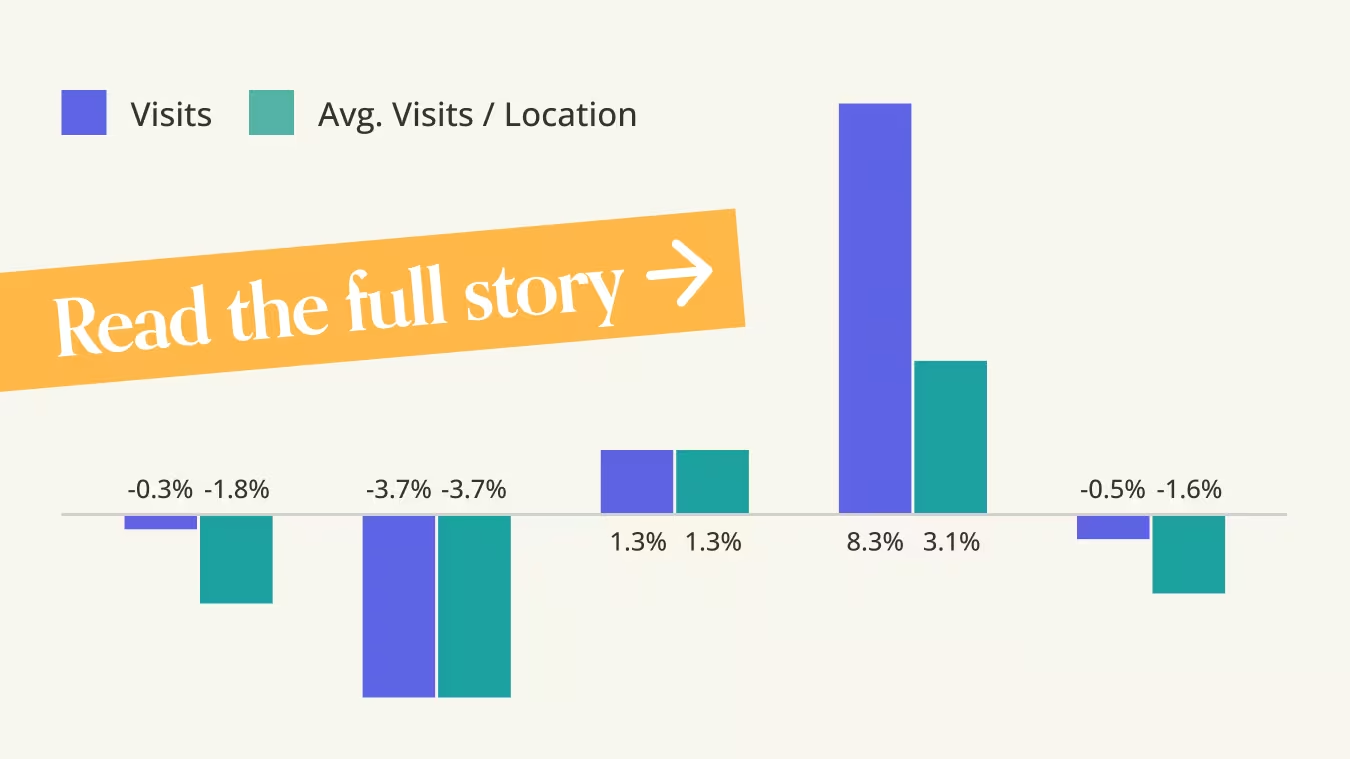
Golden Corral, the all-you-can-eat buffet chain that lets kids under three eat for free, is one FSR that is benefiting from consumers’ current value orientation. Despite closing several locations in 2024, overall visits to the chain still tracked closely with 2023 levels, declining by just 0.5% – while the average number visits to each Golden Corral restaurant grew 3.8% YoY.
Golden Corral’s value proposition is resonating strongly with budget-conscious Americans eager to enjoy a wide variety of comfort foods at an affordable price. The chain’s visitors tend to come from trade areas with lower median household incomes (HHIs) than traditional full-service restaurant (FSR) diners. And these patrons are willing to travel to enjoy the chain’s value buffet offerings, many of which are situated in rural areas and may require a longer drive. In 2024, 25.2% of Golden Corral’s diners came from over 30 miles away – compared to just 19.2% for the wider FSR segment.
Golden Corral’s continued flourishing proves that in an era of rising costs, diners are willing to go the extra mile (literally) for a restaurant that delivers both quality and affordability.
Children’s party space and eatertainment destination Chuck E. Cheese has had a transformative few years. Following the retirement of its iconic animatronic band, the chain shifted its focus to a new membership model, announcing a revamped Summer of Fun pass in May 2024 – including unlimited visits over a two-month period, steep discounts on food, and up to 250 games per day. The pass proved incredibly popular, with YoY visits surging by 15.6% in May 2024, when the offer launched – a sharp turnaround from the YoY visit declines of the previous months. Recognizing the strong demand, Chuck E. Cheese extended the program year-round – and the strategy has paid off as YoY visits remained positive through the end of 2024.
A closer look at the data suggests that parents are making full use of their unlimited passes: The share of weekday visits was higher in H2 2024 than in H2 2023, likely due to families using their passes for weekday entertainment rather than reserving visits for weekends and special occasions.
At the same time, the share of repeat visitors – those frequenting the chain at least twice a month – also grew. Although these repeat visitors may not purchase additional gameplay beyond the flat fee, their more frequent on-site presence likely translates into increased sales of pizza and other menu items.
While value has been a major motivator for restaurant-goers in recent years, low prices aren’t the only drivers of FSR success. Brands offering unique experiences aimed at maximizing social interaction are also seeing outsized gains.
Though many of these more innovative venues tend to be on the more expensive side, they draw enthusiastic crowds willing to pony up for concepts that combine good food with fun social occasions. And some of the more successful ones bolster perceived value through offerings like fixed-price menus or club memberships.
Korean cuisine has been on the rise in recent years, with restaurants like Bonchon Chicken and GEN Korean BBQ House making significant waves in the dining space. Another chain drawing attention is KPOT Korean BBQ and Hot Pot, which began modestly in 2018 and has since expanded to over 150 locations nationwide.
Diners at KPOT can customize their meals by selecting from a variety of proteins, broths, sauces, and side dishes, known as banchan, while barbecuing or cooking in a hotpot at their table and sipping on the drinks from the menu’s extensive selection. And though pricier than Golden Corral, KPOT also offers an all-you-can-eat experience that lets customers squeeze the most value out of their indulgence.
Location intelligence shows that KPOT’s experiential dining model is resonating with customers: Since Q4 2019, the average number of visits to each KPOT location has risen steadily – even as the chain has grown its footprint – while the average dwell time has also increased. Indeed, rather than a quick dining stop, KPOT has become a destination for guests to linger, enjoying both food and drinks – and an interactive and social experience.
By positioning themselves as gathering places for fine wine aficionados, wine-club-focused concepts such as Postino WineCafe and Cooper’s Hawk Winery are also benefiting from today’s consumers’ emphasis on social experiences. The two upscale dining destinations offer club memberships that combine periodic wine releases with a variety of perks.
And the data suggests that the model is strongly resonating with diners. Both Postino and Cooper’s Hawk have grown their footprints over the past year, driving substantial YoY chain-wide visit increases while average visits per location grew as well – showing that the expansions and experiential offerings are meeting robust demand.
And analyzing the two chains’ captured markets shows that the wine club model enjoys broad appeal across a variety of audience segments.
Unsurprisingly, both wine clubs’ visitor bases include higher-than-average shares of affluent consumers with money to spend, including Experian: Mosaic’s “Power Elite”, “Booming with Confidence”, and “Flourishing Families” segments (the nation’s wealthiest families, as well as affluent suburban and middle-aged households). But the two chains also attract younger, more budget-conscious consumers – Postino, which has many downtown locations, is popular among “Singles and Starters”, while Cooper’s Hawk is popular among “Promising Families” - i.e. young couples with children.
The success of the two brands across various segments underscores the impact of a distinctive experience – especially when paired with a loyalty-boosting membership – in attracting today’s consumers.
Value offerings and unique experiences have the power to drive restaurant visits – but ultimately, a good meal in an inviting atmosphere is a draw in and of itself, as is shown by the success of First Watch and Firebirds Wood Fired Grill.
Breakfast-only restaurant First Watch excels at ambiance and menu innovation, changing up its offerings five times a year and striving to maintain a neighborhood feel at each of its locations.
First Watch has made a point of leaning into its strengths, eschewing discounts in favor of a consistently elevated dining experience and doubling down its strongest day part (weekend brunch), rather than trying to artificially drive up interest at other times.
And the strategy appears to be working: In 2024, visits to First Watch increased 6.6% YoY – with Saturdays and Sundays between 11:00 A.M. and 1:00 P.M. remaining its busiest dayparts by far. Visitors to First Watch also tend to linger over their meals more than at other breakfast chains – in 2024, the restaurant experienced an average dwell time of 54.9 minutes, significantly longer than the 48.7-minute average at other breakfast-focused restaurants.
By focusing on what matters most to its diners – innovative and exciting food and a welcoming atmosphere that allows patrons to enjoy their meals at a leisurely pace – First Watch is continuing to flourish.
Another chain that is growing its footprint and its audience on the strength of a menu and ambiance-focused approach is Firebirds Wood Fired Grill. The chain, known for its “polished casual” vibe and bold, unique flavors, added several new restaurants last year, leading to a 6.5% increase in overall visits. Over the same period, the average number of visits to each Firebirds location held steady – showing that the new restaurants aren’t cannibalizing existing business.
The chain’s success may rest, in part, on its locating its venues in areas rife with enthusiastic foodies. Data from Spatial.ai’s FollowGraph shows that in 2024, Firebird’s trade areas had significantly higher shares of “BBQ Lovers”, “Gourmet Burger Lovers,” and “Foodies” than the nationwide average. This suggests that Firebirds is attracting diners who prioritize the experience of eating – key for a chain that prides itself on putting good food first. The chain is also known for its welcoming decor and design – another aspect that may lead to its strong visit success.
Necessity often serves as the mother of invention, and challenging economic periods continue to spark new trends and innovations in the dining scene. From a heightened focus on value – drawing families and lower-HHI consumers willing to travel for a good deal – to the growing appeal of social dining and the timeless draw of good food – new trends are emerging to meet changing consumer expectations.

Stadiums and arenas – and the communities they call home – have a stake in cultivating engaged team fanbases eager to participate in live events. And venues and teams can employ a variety of strategies to strengthen their connection with fans and draw crowds to the stands.
In this report, we leverage location analytics and audience segmentation to uncover some of the ways that sports franchises and venues are driving engagement – attracting visitors from farther away and appealing to fans more likely to splurge on stadium fare. How does the signing of a star athlete impact arena visitor profiles? What happens to stadium visitation trends when a team’s performance improves dramatically? And how can teams and venues tailor their offerings to more effectively cater to visitor preferences?
We dove into the data to find out.
In sports, the signing of a star athlete can have a ripple effect across the organization, hometown, and league. In addition to driving up overall attendance at games, star power can impact everything from visit frequency to audience profile – and the buying power of stadium attendees.
Lionel Messi’s move to Inter Miami CF after decades of European play brought a foot traffic boost to Chase Stadium (formerly DRV PNK Stadium). But it also shifted the demographics of stadium visitors and increased the distance they traveled to attend a game.
At Inter Miami’s 2022 and 2023 home openers without Messi (he joined the team mid-season in 2023), only 6.4% and 5.3% of visitors to Chase Stadium came from over 250 miles away. But for the 2024 home opener with Messi on the squad, 31.3% of stadium visitors traveled more than 250 miles to attend.
The demographics of visitors at the home opener also changed with Messi on the team. Trade area data combined with the Spatial.ai: PersonaLive dataset reveals that the 2024 home opener received a smaller share of households in the “Near-Urban Diverse Families” (11.2%) and “Young Urban Singles” (7.2%) segments than the two previous years. Meanwhile, shares of “Sunset Boomers” (13.0%) and “Ultra Wealthy Families” (20.1%) increased, indicating that Messi brought an older and more affluent demographic of visitors to the stadium compared to previous years. Messi’s arrival has generated increased revenue for Inter Miami CF, Major League Soccer, and Apple TV+, which has exclusive streaming rights for MLS games. And an influx of affluent out-of-town visitors also has the potential to drive positive outcomes for tourism and employment in the Miami area.
Caitlin Clark’s WNBA debut was another star-powered game changer – this time for women’s basketball. After dazzling the sports world during her college basketball career, Caitlin Clark was drafted first overall to the Indiana Fever before the 2024 WNBA season. The superstar’s arrival has had a staggering economic impact on the city of Indianapolis and the Fever franchise, highlighting the benefit of a top athlete within the local community. However, Clark’s stardom also had a far-reaching impact on the league as a whole, adding tremendous value to the WNBA. Trade area analysis reveals that several WNBA arenas saw an uptick in visitor affluence when hosting the Fever with Clark in the lineup – likely driven in part by the elevated ticket prices associated with her appearances.
When the Minnesota Lynx hosted the Fever on July 14th, 2024, for example, the median HHI of Target Center’s captured market shot up to just over $93K/year, well above the median HHIs for the games immediately before and after that event. (A venue’s captured market refers to the census block groups (CBGs) from which it draws its visitors, weighted to reflect the share of visits from each one – and thus reflects the profile of the venue’s visitor base.) Similarly, the Fever’s away game against the Connecticut Sun on May 14th, 2024 at Mohegan Sun Arena drove a higher audience median HHI ($103.6K/year) than either of the Sun’s next two home games.
Having a superstar on the roster can drive positive outcomes locally and league-wide – but overall team success is the ultimate goal for any franchise. So it may come as no surprise that stadiums and arenas can drive engagement when their home teams perform well on the field or court. And teams that reverse their fortunes often spark even greater excitement, boosting visitor loyalty, visit duration, and other key metrics.
The Baltimore Orioles had one of the worst records in baseball just a few years ago. But since 2022, the team has flipped the script – stringing together winning seasons and postseason berths. And location intelligence shows that as the team finds success, fans are becoming more engaged with their hometown stadium.
During the 2019 regular season, one of the worst for the club in recent history, stadium attendance suffered, with only 8.3% of visitors to Oriole Park at Camden Yards visiting the stadium at least three times. But during the 2024 regular season, Oriole Park’s share of repeat visitors (those who visited at least three times) was almost double 2019 levels (16.3%) – consistent with a sharp increase in sales of multi-game ticket packages.
In addition to attending games more often, visitors to Oriole Park also appear to be spending more time at the ballpark. During the 2019 regular season, visitors spent an average of 150 minutes at the stadium, but in 2024, the average time at the park increased to 178 minutes – potentially boosting ancillary spending and in-stadium advertising exposure. The increased dwell time of visitors is particularly noteworthy when considering that MLB’s rule changes have significantly shortened average game time.
The more engaged fandom engendered by team success not only impacts stadium visitor behavior, but also has the potential to drive revenue. The Orioles added 20 new corporate sponsors before the 2024 season, likely due to the attention garnered by the well-performing club.
The NFL’s Detroit Lions provide another example of team success that has driven visitor engagement. As the franchise has improved its record in recent years, the trade area size of its stadium – Ford Field – has also increased, indicating elevated attendance from fans living further away.
The Lions finished the regular season with losing records from 2019 to 2021, but finished over .500 in 2022 (9-8), 2023 (12-5), and 2024 (15-2). And with the team’s increasing wins each consecutive season, the size of its stadium's trade area has also increased steadily – reaching 81.3% above 2019 levels in 2024.
This underscores just how much team success matters to fans, who may be more inclined to travel longer distances if they believe their team is likely to win. Ultimately, broader fan engagement across a wider trade area also increases a team’s growth potential beyond in-stadium attendance – driving merchandise sales, increasing viewership, and benefitting both the team and the league as a whole.
While stadium attendance and visitor behavior is often correlated to the performance of the sports teams that play in the arena, sporting venues can also drive fan engagement in ways that aren’t solely tied to team success or big-name athletes. By adapting their concessions and venue operations to visitor preferences, stadiums and arenas can better serve their audiences and strengthen their community presence.
Consumers have been feeling the pinch of rising food costs for quite some time, but at least one NBA team has responded to make concessions at the game more affordable for fans. In December 2024, the Phoenix Suns announced a $2 value menu for all home games at Footprint Center – delivering steep discounts on hot dogs, water, soda, and snacks.
Location analytics suggest that since the value menu launch, more fans who would have otherwise waited until after leaving the venue to grab a bite are now enjoying food and drinks inside the arena. Analysis of five Suns home games just before the value menu launch – between November 26th and December 15th, 2024 – reveals that between 7.0% and 9.3% of stadium visitors visited a dining establishment after leaving the arena. But following the value menu launch before the December 19th, 2024 home game, post-game dining decreased to under 6.0% through the end of the year.
Suns owner Mat Ishbia’s announcement of the new menu called out the need for affordable food options for families at Suns games. As the season progresses, the new menu may drive a larger share of family households to Suns games, which could provide opportunities for advertisers and other stadium partners.
Consumers in Washington – and especially Seattle – are known for their affinity for plant-based diets and environmentally-friendly lifestyles. And that goes for local football fans as well: Audience segmentation provided by the AGS: Behavior & Attitudes dataset combined with trade area data reveals that during September to December 2024, households within Lumen Field’s potential visitor base were 36% more likely to be “Environmentally Conscious Buyers” and “Environmental Contributors” and 39% more likely to be “Vegans” compared to the nationwide average. By contrast, across all NFL stadiums, potential visiting households were 2%, 1%, and 3% less likely, respectively, to belong to these segments.
And Lumen Field has been actively catering to these consumer preferences. The stadium, which has been experimenting with plant-based culinary options for quite some time, was recently recognized as one of the most vegan-friendly stadiums in the NFL. And in December 2024, Lumen became the second stadium in the league to achieve TRUE precertification for its efforts to become a zero-waste venue.
By remaining aligned with its visitor base – including both football fans and people that visit the stadium for other events – Lumen Field encourages visitors to feel at home at their local stadium. And fans may be more connected to their team knowing the club shares their values and respects their lifestyle.
Stadiums and arenas can leverage a variety of strategies to engage visitors in attendance as well as wider audiences. Signing a star athlete, putting together a winning club, or adapting to local preferences are just some of the ways that sports franchises and athletic venues can find success.

Starbucks. Amazon. Barclays. AT&T. UPS. These are just some of the major corporations that have made waves in recent months with return-to-office (RTO) mandates requiring employees to show up in person more often – some of them five days a week.
But how are crackdowns like these taking shape on the ground? Is the office recovery still underway, or has it run its course? And how are evolving in-office work patterns impacting commuting hubs and dining trends? This white paper dives into the data to assess the state of office recovery in 2024 – and to explore what lies ahead for the sector in 2025.
In 2024, office foot traffic continued its slow upward climb, with visits to the Placer.ai Office Index down just 34.3% compared to 2019. (In other words, visits to the Placer.ai Office Index were 65.7% of their pre-COVID levels). And zooming in on year-over-year (YoY) trends reveals that office visits grew by 10.0% in 2024 compared to 2023 – showing that employee (and manager) pushback notwithstanding, the RTO is still very much taking place.
Indeed, diving into quarterly office visit fluctuations since Q4 2019 shows that office visits have been on a slow, steady upward trajectory since Q2 2020, following – at least since 2022 – a fairly consistent seasonal pattern. In Q1, Q2, and Q3 of each year, office visit levels increased steadily before dipping in holiday-heavy Q4 – only to recover to an even higher start-of-year baseline in the following Q1.
Between Q1 and Q3 2022, for example, the post pandemic office visit gap (compared to a Q4 2019 baseline) narrowed from 63.1% to 47.5%. It then widened temporarily in Q4 before reaching a new low – 41.4% – in Q1 2023. The same pattern repeated itself in both 2023 and 2024. So even though Q4 2024 saw a predictable visit decline, the first quarter of Q1 2025 may well set a new RTO record – especially given the slew of strict RTO mandates set to take effect in Q1 at companies like AT&T and Amazon.
Despite the ongoing recovery, the TGIF work week – which sees remote-capable employees concentrating office visits midweek and working remotely on Fridays – remains more firmly entrenched than ever.
In 2024, just 12.3% of office visits took place on Fridays – less than in 2022 (13.3%) and on par with 2023 (12.4%). Though Fridays were always popular vacation days – after all, why not take a long weekend if you can – this shift represents a significant departure from the pre-COVID norm, which saw Fridays accounting for 17.3% of weekday office visits.
Unsurprisingly, Tuesdays and Wednesdays remained the busiest in-office days of the week, followed by Thursdays. And Mondays saw a slight resurgence in visit share – up to 17.9% from 16.9% in 2023 – suggesting that as the RTO progresses, Manic Mondays are once again on the agenda.
Indeed, a closer look at year-over-five-year (Yo5Y) visit trends throughout the work week shows that on Tuesdays and Wednesdays, 2024 office foot traffic was down just 24.3% and 26.9%, respectively, compared to 2019 levels. The Thursday visit gap registered at 30.3%, while the Monday gap came in at 40.5%.
But on Fridays, offices were less than half as busy as they were in 2019 – with foot traffic down a substantial 53.2% compared to 2019.
Before COVID, long commutes on crowded subways, trains, and buses were a mainstay of the nine-to-five grind. But the rise of remote and hybrid work put a dent in rush hour traffic – leading to a substantial slowdown in the utilization of public transportation. As the office recovery continues to pick up steam, examining foot traffic patterns at major ground transportation commuting hubs, such as Penn Station in New York or Union Station in Washington, D.C., offers additional insight into the state of RTO.
Rush hour, for one thing – especially in the mornings – isn’t quite what it used to be. In 2024, overall visits to ground transportation hubs were down 25.0% compared to 2019. But during morning rush hour – weekdays between 6:00 AM and 9:00 AM – visits were down between 44.6% and 53.0%, with Fridays (53.0%) and Mondays (49.7%) seeing the steepest drops. Even as people return to the office, it seems, many may be coming in later – leaning into their biological clocks and getting more sleep. And with today’s office-goers less likely to be suburban commuters than in the past (see below), hubs like Penn Station aren’t as bustling first thing in the morning as they were pre-pandemic.
Evening rush hour, meanwhile, has been quicker to bounce back, with 2024 visit gaps ranging from 36.4% on Fridays to 30.0% on Tuesdays and Wednesdays. Office-goers likely form a smaller part of the late afternoon and evening rush hour crowd, which may include more travelers heading to a variety of places. And commuters going to work later in the day – including “coffee badgers” – may still be apt to head home between four and seven.
The drop in early-morning public transportation traffic may also be due to a shift in the geographical distribution of would-be commuters. Data from Placer.ai’s RTO dashboard shows that visits originating from areas closer to office locations have recovered faster than visits from farther away – indicating that people living closer to work are more likely to be back at their desks.
And analyzing the captured markets of major ground transportation hubs shows that the share of households from “Principal Urban Centers” (the most densely populated neighborhoods of the largest cities) rose substantially over the past five years. At the same time, the share of households from the “Suburban Periphery” dropped from 39.1% in 2019 to 32.7% in 2024. (A location’s captured market refers to the census block groups (CBGs) from which it draws its visitors, weighted to reflect the share of visits from each one – and thus reflects the profile of the location’s visitor base.)
This shift in the profile of public transportation consumers may explain the relatively slow recovery of morning transportation visits: City dwellers , who seem to be coming into the office more frequently than suburbanites, may not need to get as early a start to make it in on time.
While the RTO debate is often framed around employer and worker interests, what happens in the office doesn’t stay in the office. Office attendance levels leave their mark on everything from local real estate markets to nationwide relocation patterns. And industries from apparel to dining have undergone significant shifts in the face of evolving work routines.
Within the dining space, for example, fast-casual chains have always been workplace favorites. Offering quick, healthy, and inexpensive lunch options, these restaurants appeal to busy office workers seeking to fuel up during a long day at their desks.
Traditionally, the category has drawn a significant share of its traffic from workplaces. And after dropping during COVID, the share of visits to leading fast-casual brands coming from workplaces is once again on the rise.
In 2019, for example, 17.3% of visits to Chipotle came directly from workplaces, a share that fell to just 11.6% in 2022. But each year since, the share has increased – reaching 16.0% in 2024. Similar patterns have emerged at other segment leaders, including Jersey Mike’s Subs, Panda Express, and Five Guys. So as people increasingly go back to the office, they are also returning to their favorite lunch spots.
For many Americans, coffee is an integral part of the working day. So it may come as no surprise that shifting work routines are also reflected in visit patterns at leading coffee chains.
In 2019, 27.5% of visits to Dunkin’ and 20.1% of visits to Starbucks were immediately followed by a workplace visit, as many employees grabbed a cup of Joe on the way to work or popped out of the office for a midday coffee break. In the wake of COVID, this share dropped for both coffee leaders. But since 2022, it has been steadily rebounding – another sign of how the RTO is shaping consumer behavior beyond the office.
Five years after the pandemic upended work routines and supercharged the soft pants revolution, the office recovery story is still being written. Workplace attendance is still on the rise, and restaurants and coffee chains are in the process of reclaiming their roles as office mainstays. Still, office visit data and foot traffic patterns at commuting hubs show that the TGIF work week is holding firm – and that people aren’t coming in as early or from as far away as they used to. As new office mandates take effect in 2025, the office recovery and its ripple effects will remain a story to watch.