.png)
.png)

.png)
.png)


Midway through 2024, foot traffic to Lowe’s and Home Depot – the leaders in the home improvement space – is climbing. What’s driving these retailers’ recent visit growth? We dove into the data to find out.
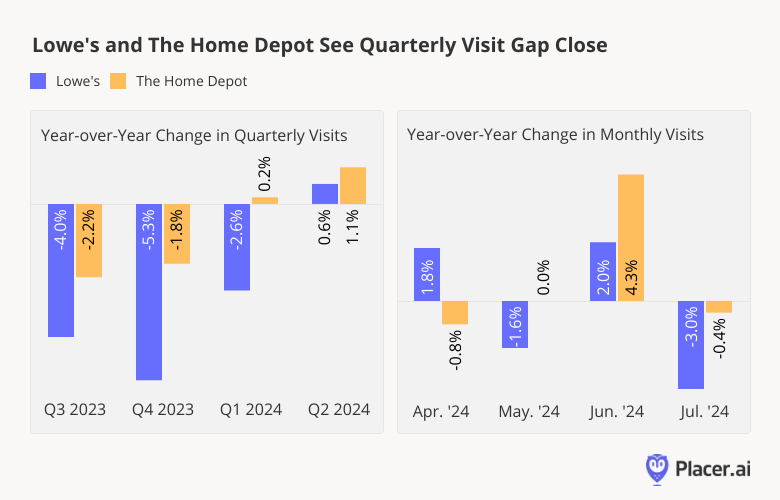
After a meteoric rise in foot traffic during the pandemic, the home improvement segment has experienced a turbulent few years – one of the primary reasons being a cool housing market that has curbed demand for projects. But after a significant period of consistent YoY visit gaps, visits to Lowe’s and Home Depot in 2024 appear to be matching and even slightly surpassing 2023 levels.
Between Q3 2023 and Q2 2024, Lowe’s and Home Depot both saw their YoY visit gaps gradually narrow and then close – finishing out Q2 with modest YoY gains. This turnaround may have been partly due to modest lifts in new home sales at the start of 2024 compared to 2023 – spurring an uptick in home improvement projects in the following months.
And though YoY visits to both retailers experienced a decline in July 2024 – perhaps due to May and June’s YoY declines in new and existing home sales – recent indications that the housing market may be heating up may bode well for the home improvement category in the second half of 2024 and beyond.

In addition to an increase in YoY visits, the resurgence of cross-shopping behavior between Home Depot and Lowe’s further suggests that a turnaround may be unfolding in the home improvement space. Location analytics shows that during recent home improvement booms, cross shopping between the two retailers was common, perhaps as judicious consumers taking on large projects looked to explore their options.
In Q2 of 2020 and 2021 – periods of strong foot traffic for both retailers – a large share of Lowe’s visitors also visited Home Depot. And although Lowe’s maintains a smaller retail footprint than Home Depot, many of Home Depot’s visitors visited a Lowe’s store as well.
But in the years that followed, economic headwinds led many consumers to defer their projects, and cross-shopping behavior began to moderate. In Q2 2023, only 48.8% of visitors to Lowe’s also visited Home Depot, and just 44.8% of Home Depot’s visitors visited Lowe’s.
However, in Q2 2024, consumers’ home improvement cross-shopping showed signs of a potential change of course. During the period, cross shopping between the brands climbed to 51.5% for Lowe’s and 45.7% for Home Depot. A return to in-store comparison shopping could mean that consumers are again taking on higher-stakes home improvement projects, which justify a visit to both retailers.

After an extended period of YoY visit gaps, foot traffic to the home improvement leaders is on the rise. Will Lowe’s and Home Depot continue to build on these positive visitation trends?
Visit Placer.ai to find out.

With H2 2024 underway, we took a look at the foot traffic performance of superstores Walmart and Target, and membership warehouse clubs BJ’s Wholesale Club, Sam’s Club, and Costco. How did foot traffic compare to 2023’s visitation patterns? And what special events helped propel visits?
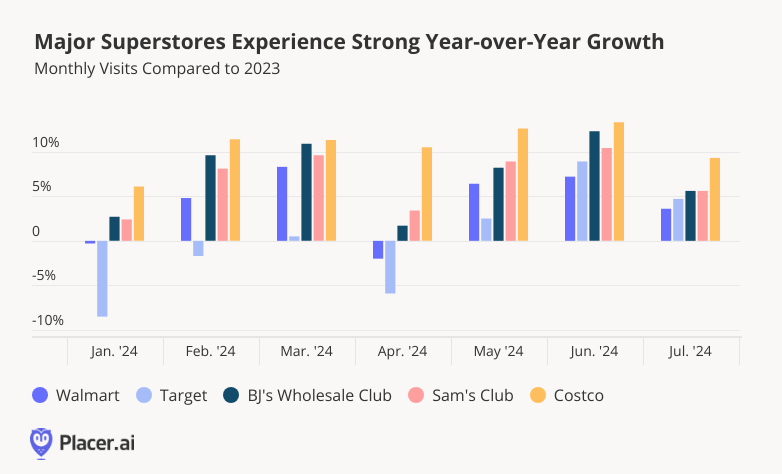
Superstores have been thriving – with YoY visits to retail giants Walmart and Target elevated consistently since May 2024. And though Target had a slower start to the year, YoY foot traffic to the chain picked up in Q2, and the retailer has been flourishing since. (Target and Walmart's April 2024 YoY foot traffic drops are likely attributable in part to calendar shifts: April 2023 had one more weekend than April 2024 – and one of them was Easter.)
Membership warehouse clubs have been faring even better, with Costco leading the pack in Q2. BJ’s and Sam’s Club also experienced strong visit growth, with July visits elevated by 5.6% YoY for both brands.

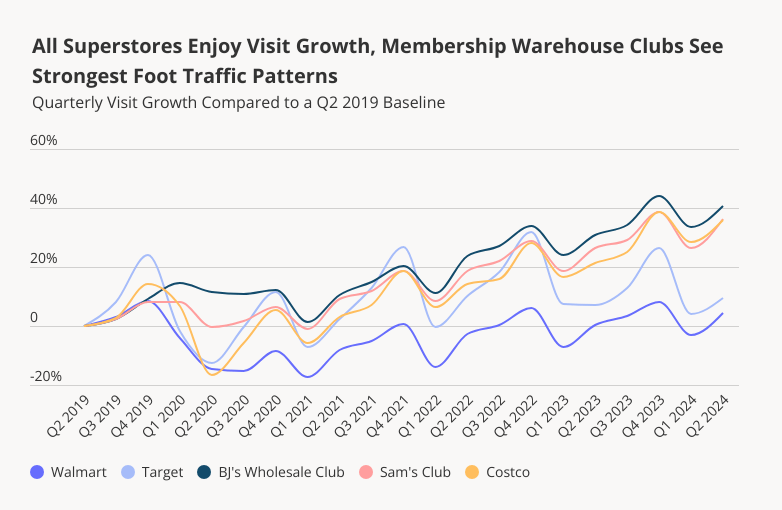
A closer look at the baseline change in quarterly visits since Q2 2019 further highlights the strong positioning of superstores and wholesale clubs in 2024. All five retailers drew more visits in Q2 2024 than they did pre-pandemic (Q2 2019).
But these visit increases have not been equally distributed across the retailers: While all of them experienced growth relative to a Q2 2019 baseline, membership warehouse visits have been outpacing those of superstores on a consistent basis since Q1 2023. As prime destinations for inexpensive, bulk buying, the segment has likely been buoyed by families and younger consumers seeking ways to save money on groceries and other basics amid high prices.

But superstores have also been having a moment. And one factor which may have contributed to Target’s Q2 2024 turnaround is its doubling down on loyalty: In April 2024, the chain revamped its Target Circle Rewards, adding, among other things, a new paid tier called Target Circle 360.
A key benefit of Target’s loyalty program, which is free to join for the regular tiers, is access to deep discounts during Target Circle Week. This year, the big sales event took place between July 7th and 13th – and examining foot traffic trends to the chain reveals that the promotion fueled a major visit boost: During the week of July 8th, weekly visits to Target were the highest they’ve been since the start of the year, and 6.8% higher than 2024’s weekly visit average. This year’s Circle Week visits also outperformed last year’s by 8.7%.
This demonstrates how the revamped loyalty program and exclusive sales events are successfully driving more customers to Target stores. And other retailers are taking note, with Walmart debuting its own major summer sales events and Costco and Sam’s Club battling it out for the most affordable prices – a major win for shoppers nationwide.

Superstores enjoyed elevated visitation patterns in Q2 2024. Will the superstore and wholesale club price wars continue? And with back-to-school shopping well underway, and the holiday shopping season quickly approaching, how will these retailers continue to perform?
Visit Placer.ai to keep up with the latest data-driven retail news.

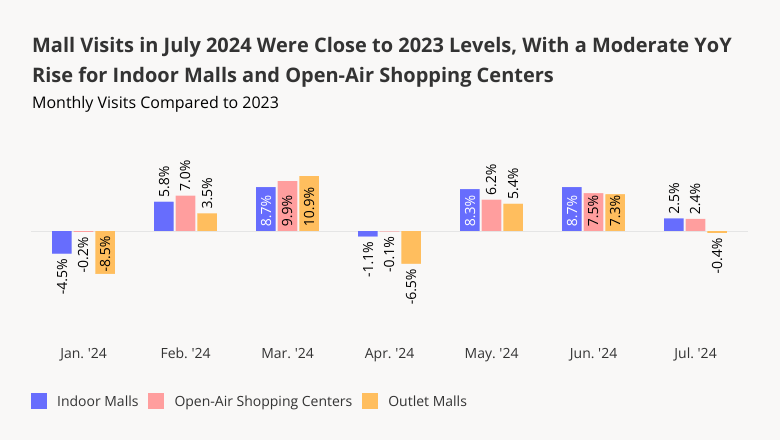
Summer is underway, and malls are still bustling. In July 2024, visits to indoor malls and open-air shopping centers were up 2.5% and 2.4%, respectively, compared to the equivalent period of 2023. Though these year-over-year (YoY) increases were more moderate than the significant jumps observed in May and June, they underscore the segment’s continued solid positioning. Outlet malls, for their parts, saw a slight 0.4% decline in mall visits compared to July 2023.
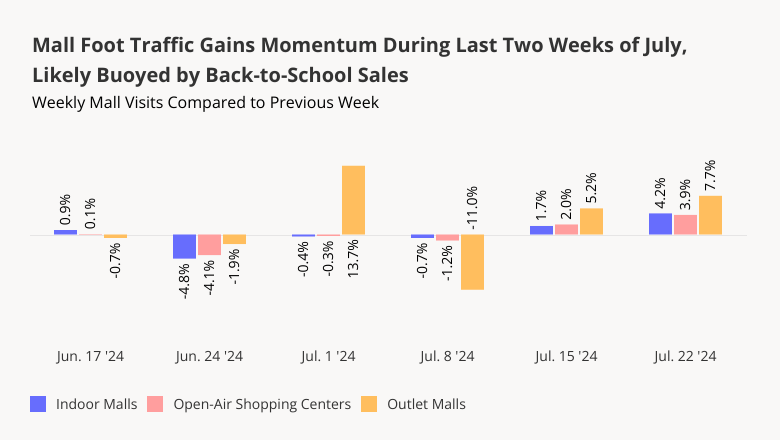
At first glance, July’s softer numbers – particularly for outlet malls – may appear to herald the start of a retail and mall visit summer slow-down. But zooming into weekly visit data offers further context that can shed light on what may lie ahead in the coming months.

Analyzing week-over-week (WoW) visit trends shows that during the last two weeks of June and the first two weeks of July, all three mall indexes saw visits either decline or hold steady from week to week. The one notable exception was outlet malls – which experienced an impressive and sudden 13.7% WoW surge in visits to outlet malls during the first week of July, driven by the segment's exceptional Independence Day draw. Outlet malls’ subsequent WoW visit drop also reflects this exceptional Fourth of July peak.
The final two weeks of July showed a change in visit trajectory, with all three mall segments experiencing growing WoW visit gains as traffic picked up towards the end of the month. This upward trend can likely be attributed to the back-to-school season getting into full swing, with sales typically running from mid to late July through August and into mid-September.
Here too, the late July WoW visit gains were strongest for outlet malls – perhaps showcasing consumers' prioritization of budget shopping ahead of the new school year.

The Placer.ai Mall Index has frequently highlighted the power of special calendar milestones to drive significant shopping center visit spikes. And Independence Day is no exception.
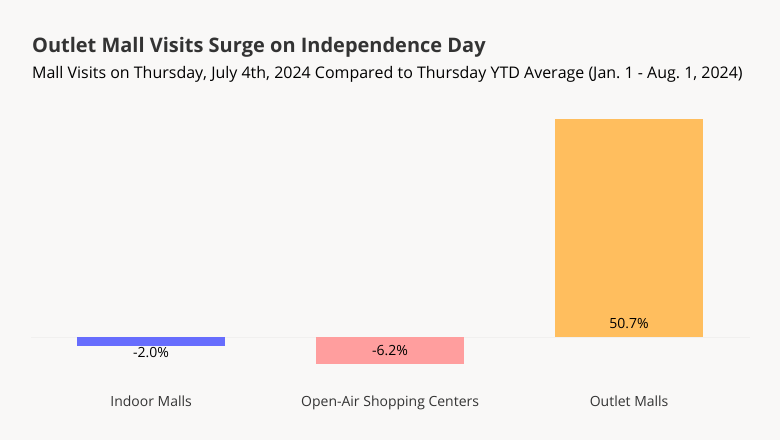
On July 4th, shoppers nationwide flock to stores for holiday deals, often after enjoying hotdogs, hamburgers, and other festive treats. But though all three mall types have shops that are open on the holiday, it is outlet malls that really draw the crowds. On July 4th, 2024, visits to outlet malls shot up 50.7% compared to an average YTD Thursday. Foot traffic to indoor malls and open-air shopping centers, on the other hand, remained below levels usually seen on Thursdays.
Between Fourth of July sales and a long, summer holiday weekend, many consumers chose to spend their time off this year driving out to outlet malls and browsing their offerings to find the best deals.

Between the Fourth of July and back-to-school shopping, July was yet another busy month across shopping malls nationwide. But how will malls continue to fare in August as school goes back into session and summer vacationers go back to work?
Follow our blog at Placer.ai to find out.

Employers from local governments to major corporations are tightening their return-to-office (RTO) policies – cracking down on practices like coffee-badging and requiring employees to relocate closer to the workplace. Last month, the Placer.ai Nationwide Office Building Index showed that offices throughout much of the U.S. were the busiest they’d been since the pandemic. But what happened in July 2024?
We dove into the data to find out.
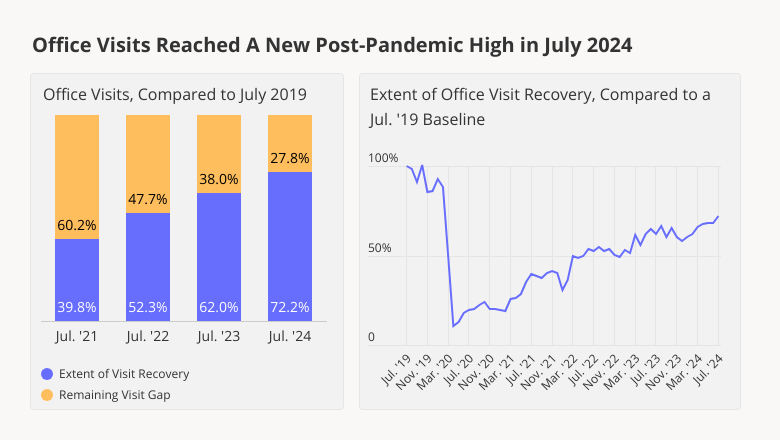
In July 2024, visits to office buildings nationwide were down just 27.8% compared to July 2019 – outpacing even June 2024’s impressive showing. Stated differently, July 2024 office building foot traffic reached 72.2% of July 2019 levels – and the highest it’s been since the pandemic. So even if some RTO mandates are intended to encourage “voluntary turnover” – i.e. make some workers quit – stricter face time policies are also having an appreciable impact on the ground.

Drilling down into the data for major cities nationwide shows that, once again, Miami and New York led the regional recovery pack in July – with visits to offices in both cities reaching about 90% of July 2019 levels. For both cities, as well as Atlanta, Boston, Chicago, Denver, Los Angeles, and San Francisco, July 2024 was the single busiest in-office month since 2020. And though Dallas and Washington, D.C. experienced busier months earlier in the year, both hubs outperformed the nationwide baseline in July – with local offices recouping 76.9% and 73.9%, respectively, of July 2019 office foot traffic.
Houston office visits, for their part, continued to be weighed down by stormy weather – with flooding and power outages in the wake of hurricane Beryl keeping many local residents hunkered down at home.

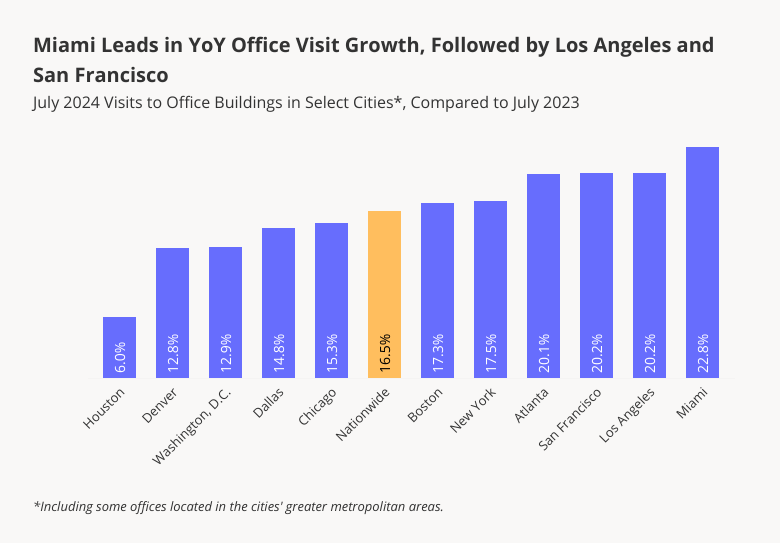
Despite these differences, all 11 analyzed cities experienced year-over-year (YoY) visit growth in July 2024 – further evidence that the office recovery remains very much underway. Miami led with 22.8% YoY visit growth, followed by West Coast hubs San Francisco and Los Angeles. And though hurricane-hit Houston unsurprisingly lagged behind other cities, it too saw YoY growth.

“Hushed hybrid” trends notwithstanding, offices were busier in July 2024 than during any other month since the pandemic. How much longer will the RTO continue to accelerate?
Follow Placer.ai’s data-driven office recovery analyses to find out.

After theaters were dominated by Barbenheimer in 2023, 2024 is shaping up to be another record-breaking year, with several big-name releases. We took a closer look at visitation patterns at major movie theater chains – AMC Theatres, Regal Cinemas, and Cinemark – to analyze how foot traffic has been impacted by the highly anticipated summer releases of Deadpool & Wolverine and Twisters.
Last year was one of the most exciting ones in recent memory for cinema, with multiple films breaking box-office records and driving foot traffic at movie theaters across the country. But 2024 has had plenty of tricks up its cinematic sleeve, and several summer releases have been meeting the high bar set by Barbenheimer. Inside Out 2, released nationwide on June 14th 2024, kickstarted the summer with a major movie-goer visit boost– and Deadpool & Wolverine, released on July 26, 2024 brought out even bigger crowds.
Indeed, the superhero crossover movie Deadpool & Wolverine is set to be one of the best-performing films of 2024. During the week of July 22nd, 2024 – when Deadpool & Wolverine was released – visits to movie leaders AMC Theatres, Regal Cinemas, and Cinemark jumped by 132.7% to 140.5% compared to a YTD weekly average. Twisters, released on July 19th, also drove impressive visit boosts ranging from 39.8% to 48.3% during the week of July 15th.

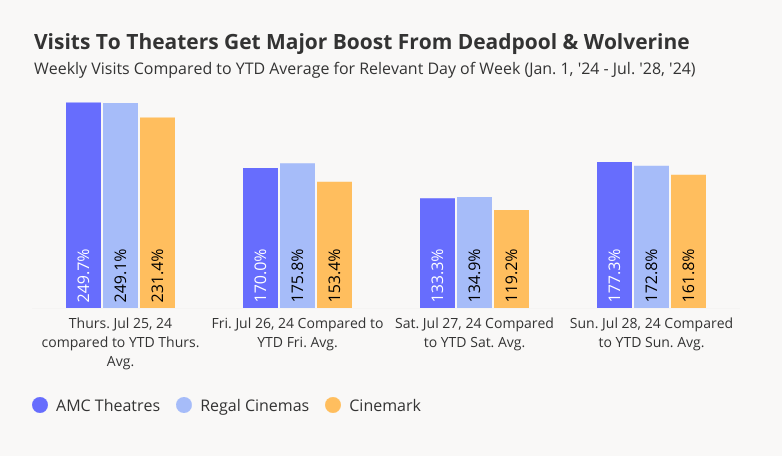
Early screenings have always been a big driver of visits for those lucky enough to grab tickets. And on the day before Deadpool & Wolverine’s big July 26th release, movie theaters already started filling up. On Thursday, July 25th, 2024, visits to AMC, Regal, and Cinemark were up a whopping 231.4% to 249.7% compared to a YTD Thursday average. And Friday, Saturday, and Sunday continued to see visit numbers significantly higher than the YTD visit averages for those days of the week, confirming the movie’s ability to drive visits to theaters. (In absolute terms, Saturday, July 27th was the cinema leaders’ busiest day of the year so far – but since Saturdays tend to be busier than Thursdays, the relative visit spike was somewhat smaller).

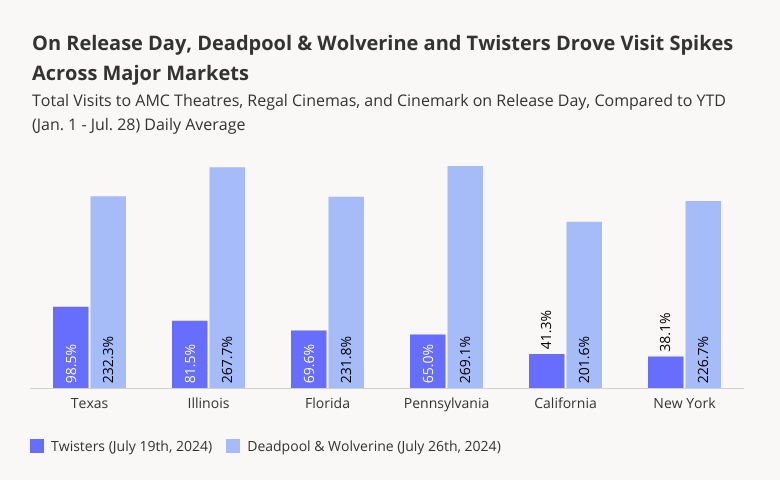
Drilling down into the data for major markets shows that though Deadpool & Wolverine was the runaway hit of the summer, Twisters also drove significant visit spikes throughout the country. And of the major markets, some of Twisters’ biggest visit boosts took place in states with plenty of hands-on tornado experience – like Texas, where July 19th visits to AMC, Regal, and Cinemark (combined) were up 98.5% compared to a YTD daily average.

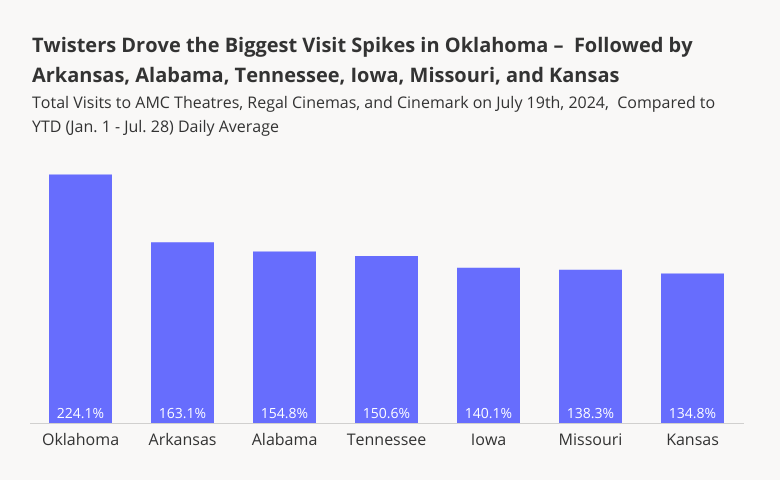
Indeed, looking at the states where Twisters drove the biggest visit spikes shows that many of the top performers were in tornado-prone areas. Oklahoma – where much of the movie was filmed – saw the most impressive Twisters foot traffic bump, with visits to leading cinemas up 224.1% on July 19th, 2024 compared to a YTD daily average. And the tornado-focused thriller also drew outsize crowds in other states where the theme of the movie was more likely than average to resonate with local audiences’ personal experiences – including Arkansas, Alabama, Tennessee, Iowa, Missouri, and Kansas.

Blockbuster releases like Deadpool & Wolverine, Twisters, and Inside Out 2 highlight the enduring appeal of out-of-home entertainment, and proves that movie theaters are as relevant as ever.
With more highly-anticipated releases still yet to come in 2024, can movie theaters across the country continue to break visit records?
Visit Placer.ai to stay on top of the latest data-driven leisure and entertainment stories.

Ahead of Toyota’s August 1st earnings call, we dove into the data to explore Q2 2024 visitation patterns at Toyota dealerships nationwide. How did year-over-year (YoY) foot traffic to Toyota showrooms perform in Q2 2024 – and what happened in June 2024, when the CDK Global outage caused paralysis across the industry? Who are the customers driving growth for Toyota – and what lies in store for the brand in the months ahead?
We dove into the data to find out.
During the second quarter of 2024, Toyota subsidiary TMNA (Toyota Motor North America, Inc.) reported a remarkable 9.2% year-over-year (YoY) increase in U.S. Toyota vehicle sales, buoyed by rising demand for hybrid cars. (The company also owns the luxury Lexus line).
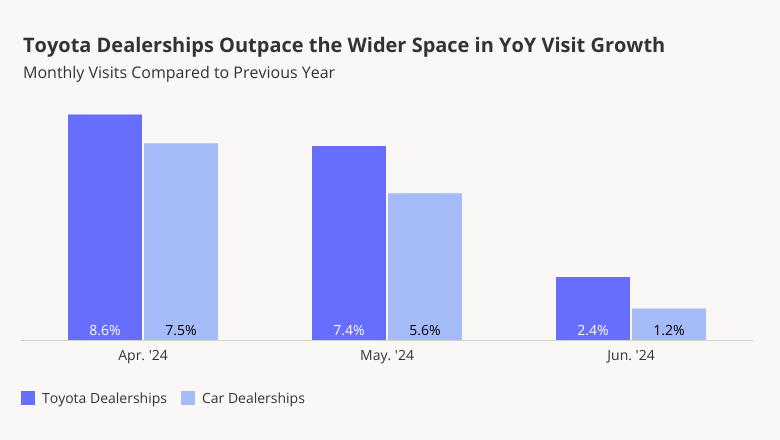
And foot traffic data shows that U.S. Toyota dealerships have indeed been significantly busier in Q2 2024 than in Q2 2023, outperforming the wider space. Apart from the regular portion of repair and maintenance visits, the auto brand’s YoY visit growth also reflects an increase in interested buyers. In April and May 2024, Toyota dealerships saw respective YoY visit boosts of 8.6% and 7.4%. And though the pace of YoY foot traffic growth to dealerships dropped in June 2024 – likely due in part to the CDK outage – the brand appears poised for continued visit success throughout the rest of the year.

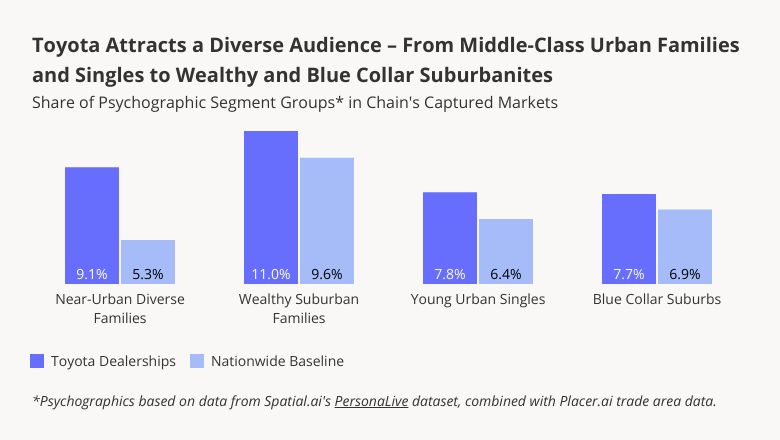
Toyota’s outsize success is likely due, in part, to its broad appeal – amongst everyone from price-conscious families seeking to maximize reliability and fuel efficiency to more affluent consumers that place a high premium on style. Toyota’s Certified Used Vehicles offering also draws in customers looking for trustworthy, pre-owned cars.
Analyzing Toyota dealerships’ captured markets with psychographics from Spatial.ai’s PersonaLive shows that their trade areas are economically diverse. Toyota attracts customers from areas with higher-than-average shares of both middle and working-class families, as well as more affluent ones. And Young Urban Singles are also more likely than average to visit Toyota dealerships.

Still, in Q2 2024, Toyota dealerships attracted a slightly more affluent consumer than average. The median household income (HHI) of the dealerships’ captured markets was $77.0K, just above the nationwide baseline of $76.1K. And looking at changes in Toyota’s audience over time also shows that the median HHI of its customer base has increased steadily over the past few years – rebounding to, and even exceeding, pre-pandemic levels. In the face of high interest rates, consumers with less room in their budgets may be cutting back on visits to car dealerships. And Toyota’s hybrid first strategy may also be increasing its appeal among more affluent car owners, who are more likely to purchase hybrid vehicles.

Will Toyota continue to thrive in the months ahead? And how will its customer base continue to evolve as inflation stabilizes and interest rates eventually come down?
Follow Placer.ai’s data-driven retail analyses to find out.
1) Broad-based growth: All four grocery formats grew year-over-year in Q2 2025, with traditional grocers posting their first rebound since early 2024.
2) Value grocers slow: After leading during the 2022–24 trade-down wave, value grocer growth has decelerated as that shift matures.
3) Fresh formats surge: Now the fastest-growing segment, fueled by affluent shoppers seeking health, wellness, and convenience.
4) Bifurcation widens: Growth concentrated at both the low-income (value) and high-income (fresh) ends, highlighting polarized spending.
5) Shopping missions diverge: Short trips are rising, supporting fresh formats, while traditional grocers retain loyal stock-up customers and value chains capture fill-in trips through private labels.
6) Traditional grocers adapt: H-E-B and Harris Teeter outperformed by tailoring strategies to their core geographies and demographics.Bifurcation of Consumer Spending Help Fresh Format Lead Grocery Growth
Grocery traffic across all four major categories – value grocers, fresh format, traditional grocery, ethnic grocers – was up year over year in Q2 2025 as shoppers continue to engage with a wide range of grocery formats. Traditional grocery posted its first YoY traffic increase since Q1 2024, while ethnic grocers maintained their steady pattern of modest but consistent gains.
Value grocers, which dominated growth through most of 2024 as shoppers prioritized affordability, continued to expand but have now ceded leadership to fresh-format grocers. Rising food costs between 2022 and 2024 drove many consumers to chains like Aldi and Lidl, but much of this “trade-down” movement has already occurred. Although price sensitivity still shapes consumer choices – keeping the value segment on an upward trajectory – its growth momentum has slowed, making it less of a driver for the overall sector.
Fresh-format grocers have now taken the lead, posting the strongest YoY traffic gains of any category in 2025. This segment, anchored by players like Sprouts, appeals to the highest-income households of the four categories, signaling a growing influence of affluent shoppers on the competitive grocery landscape. Despite accounting for just 7.0% of total grocery visits in H1 2025, the segment’s rapid gains point to a broader shift: premium brands emphasizing health and wellness are emerging as the primary engine of growth in the grocery sector.
The fact that value grocers and fresh-format grocers – segments with the lowest and highest median household incomes among their customer bases – are the two categories driving the most growth underscores how the bifurcation of consumer spending is playing out in the grocery space as well. On one end, price-sensitive shoppers continue to seek out affordable options, while on the other, affluent consumers are fueling demand for premium, health-oriented formats. This dual-track growth pattern highlights how widening economic divides are reshaping competitive dynamics in grocery retail.
1) Broad-based growth: All four grocery categories posted YoY traffic gains in Q2 2025.
2) Traditional grocery rebound: First YoY increase since Q1 2024.
3) Ethnic grocers: Continued steady but modest upward trend.
4) Value grocers: Still growing, but slowing after most trade-down activity already occurred (2022–24).
5) Fresh formats: Now the fastest-growing segment, driven by affluent shoppers and interest in health & wellness.
6) Market shift: Premium, health-oriented brands are becoming the new growth driver in grocery.
7) Bifurcation of spending: Growth at both value and fresh-format grocers highlights a polarization in consumer spending patterns that is reshaping grocery competition.
Over the past two years, short grocery trips (under 10 minutes) have grown far more quickly than longer visits. While they still make up less than one-quarter of all U.S. grocery trips, their steady expansion suggests this behavioral shift is here to stay and that its full impact on the industry has yet to be realized.
One format particularly aligned with this trend is the fresh-format grocer, where average dwell times are shorter than in other categories. Yet despite benefiting from the rise of convenience-driven shopping, fresh formats attract the smallest share of loyal visitors (4+ times per month). This indicates they are rarely used for a primary weekly shop. Instead, they capture supplemental trips from consumers looking for specific needs – unique items, high-quality produce, or a prepared meal – who also value the ability to get in and out quickly.
In contrast, leading traditional grocers like H-E-B and Kroger thrive on a classic supermarket model built around frequent, comprehensive shopping trips. With the highest share of loyal visitors (38.5% and 27.6% respectively), they command a reliable customer base coming for full grocery runs and taking time to fill their carts.
Value grocers follow a different, but equally effective playbook. Positioned as primary “fill-in” stores, they sit between traditional and fresh formats in both dwell time and visit frequency. Many rely on limited assortments and a heavy emphasis on private-label goods, encouraging shoppers to build larger baskets around basics and store brands. Still, the data suggests consumers reserve their main grocery hauls for traditional supermarkets with broader selections, while using value grocers to stretch budgets and stock up on essentials.
1) Short trips surge: Under-10-minute visits have grown fastest, signaling a lasting behavioral shift.
2) Fresh formats thrive on convenience: Small footprints, prepared foods, and specialty items align with quick missions.
3) Traditional grocers retain loyalty: Traditional grocers such as H-E-B and Kroger attract frequent, comprehensive stock-up trips.
4) Value grocers fill the middle ground: Limited assortments and private label drive larger baskets, but main hauls remain with traditional supermarkets.
5) Fresh formats as supplements: Fresh format grocers such as The Fresh Market capture quick, specialized trips rather than weekly shops.
While broad market trends favor value and fresh-format grocers, certain traditional grocers are proving that a tailored strategy is a powerful tool for success. In the first half of 2025, H-E-B and Harris Teeter significantly outperformed their category's modest 0.6% average year-over-year visit growth, posting impressive gains of 5.6% and 2.8%, respectively. Their success demonstrates that even in a polarizing environment, there is ample room for traditional formats to thrive by deeply understanding and catering to a specific target audience.
These two brands achieve their success with distinctly different, yet equally focused, demographic strategies. H-E-B, a Texas powerhouse, leans heavily into major metropolitan areas like Austin and San Antonio. This urban focus is clear, with 32.6% of its visitors coming from urban centers and their peripheries, far above the category average. Conversely, Harris Teeter has cultivated a strong following in suburban and satellite cities in the South Atlantic region, drawing a massive 78.3% of its traffic from these areas. This deliberate targeting shows that knowing your customer's geography and lifestyle remains a winning formula for growth.
1) Traditional grocers can still be competitive: H-E-B (+5.6% YoY) and Harris Teeter (+2.8% YoY) outpaced the category average of +0.6% in H1 2025.
2) H-E-B’s strategy: Strong urban focus, with 32.6% of traffic from major metro areas like Austin and San Antonio.
3) Harris Teeter’s strategy: Suburban and satellite city focus, with 78.3% of traffic from South Atlantic suburbs.


1. The hypergrowth of Costco, Dollar Tree, and Dollar General between 2019 and 2025 has fundamentally changed the brick-and-mortar retail landscape.
2. Overall visits to Target and Walmart have remained essentially stable even as traffic to the new retail giants skyrocketed – so the increased competition is not necessarily coming at legacy giants' expense. Instead, each retail giant is filling a different need, and success now requires excelling at specific shopping missions rather than broad market dominance.
3. Cross-shopping has become the new normal, with Walmart and Target maintaining their popularity even as their relative visit shares decline, creating opportunities for complementary rather than purely competitive strategies.
4. Dollar stores are rapidly graduating from "fill-in" destinations to primary shopping locations, signaling a fundamental shift in how Americans approach everyday retail.
5. Walmart still enjoys the highest visit frequency, but the other four chains – and especially Dollar General – are gaining ground in this realm.
6. Geographic and demographic specialization is becoming the key differentiator, as each chain carves out distinct niches rather than competing head-to-head across all markets and customer segments.
Evolving shopper priorities, economic pressures, and new competitors are reshaping how and where Americans buy everyday goods. And as value-focused players gain ground, legacy retail powerhouses are adapting their strategies in a bid to maintain their visit share. In this new consumer reality, shoppers no longer stick to one lane, creating a complex ecosystem where loyalty, geography, and cross-visitation patterns – not just market share – define who is truly winning.
This report explores the latest retail traffic data for Walmart, Target, Costco, Dollar Tree, and Dollar General to decode what consumers want from retail giants in 2025. By analyzing visit patterns, loyalty trends, and cross-shopping shifts, we reveal how fast-growing chains are winning over consumers and uncover the strategies helping legacy players stay competitive in today's value-driven retail landscape.
In 2019, Walmart and Target were the two major behemoths in the brick-and-mortar retail space. And while traffic to these chains remains close to 2019 levels, overall visits to Dollar General, Dollar Tree, and Costco have increased 36.6% to 45.9% in the past six years. Much of the growth was driven by aggressive store expansions, but average visits per location stayed constant (in the case of Dollar Tree) or grew as well (in the case of Dollar General and Costco). This means that these chains are successfully filling new stores with visitors – consumers who in the past may have gone to Walmart or Target for at least some of the items now purchased at wholesale clubs and dollar stores.
This substantial increase in visits to Costco, Dollar General, and Dollar Tree has altered the competitive landscape in which Walmart and Target operate. In 2019, 55.9% of combined visits to the five retailers went to Walmart. Now, Walmart’s relative visit share is less than 50%. Target received the second-highest share of visits to the five retailers in 2019, with 15.9% of combined traffic to the chains. But Between January and July 2025, Dollar General received more visits than Target – even though the discount store had received just 12.1% of combined visits in 2019.
Some of the growth of the new retail giants could be attributed to well-timed expansion. But the success of these chains is also due to the extreme value orientation of U.S. consumers in recent years. Dollar General, Dollar Tree, and Costco each offer a unique value proposition, giving today's increasingly budget-conscious shoppers more options.
Walmart’s strategy of "everyday low prices" and its strongholds in rural and semi-rural areas reflect its emphasis on serving broad, value-focused households – often catering to essential, non-discretionary shopping.
Dollar General serves an even larger share of rural and semi-rural shoppers than Walmart, following its strategy of bringing a curated selection of everyday basics to underserved communities. The retailer's packaging is typically smaller than Walmart's, which allows Dollar General to price each item very affordably – and its geographic concentration in rural and semi-rural areas also highlights its direct competition to Walmart.
By contrast, Target and Costco both compete for consumer attention in suburban and small city settings, where shopper profiles tilt more toward families seeking one-stop-shopping and broader discretionary offerings. But Costco's audience skews slightly more affluent – the retailer attracts consumers who can afford the membership fees and bulk purchasing requirements – and its visit growth may be partially driven by higher income Target shoppers now shopping at Costco.
Dollar Tree, meanwhile, showcases a uniquely balanced real estate strategy. The chain's primary strength lies in suburban and small cities but it maintains a solid footing in both rural and urban areas. The chain also offers a unique value proposition, with a smaller store format and a fixed $1.25 price point on most items. So while the retailer isn't consistently cheaper than Walmart or Dollar General across all products, its convenience and predictability are helping it cement its role as a go-to chain for quick shopping trips or small quantities of discretionary items. And its versatile, three-pronged geographic footprint allows it to compete across diverse markets: Dollar Tree can serve as a convenient, quick-trip alternative to big-box retailers in the suburbs while also providing essential value in both rural and dense urban communities.
As each chain carves out distinct geographic and demographic niches, success increasingly depends on being the best option for particular shopping missions (bulk buying, quick trips, essential needs) rather than trying to be everything to everyone.
Still, despite – or perhaps due to – the increased competition, shoppers are increasingly spreading their visits across multiple retailers: Cross-shopping between major chains rose significantly between 2019 and 2025. And Walmart remains the most popular brick-and-mortar retailer, consistently ranking as the most popular cross-shopping destination for visitors of every other chain, followed by Target.
This creates an interesting paradox when viewed alongside the overall visit share shift. Even as Walmart and Target's total share of visits has declined, their importance as a secondary stop has actually grown. This suggests that the legacy retail giants' dip in market share isn't due to shoppers abandoning them. Instead, consumers are expanding their shopping routines by visiting other growing chains in addition to their regular trips to Walmart and Target, effectively diluting the giants' share of a larger, more fragmented retail landscape.
Cross-visitation to Costco from Walmart, Target, and Dollar Tree also grew between 2019 and 2025, suggesting that Costco is attracting a more varied audience to its stores.
But the most significant jumps in cross-visitation went to Dollar Tree and Dollar General, with cross-visitation to these chains from Target, Walmart, and Costco doubling or tripling over the past six years. This suggests that these brands are rapidly graduating from “fill-in” fare to primary shopping destinations for millions of households.
The dramatic rise in cross-visitation to dollar stores signals an opportunity for all retailers to identify and capitalize on specific shopping missions while building complementary partnerships rather than viewing every chain as direct competition.
Walmart’s status as the go-to destination for essential, non-discretionary spending is clearly reflected in its exceptional loyalty rates – nearly half its visitors return at least three times per month on average -between January to July 2025, a figure virtually unchanged since 2019. This steady high-frequency visitation underscores how necessity-driven shopping anchors customer routines and keeps Walmart atop the retail loyalty ranks.
But the data also reveals that other retail giants – and Dollar General in particular – are steadily gaining ground. Dollar General's increased visit frequency is largely fueled by its strategic emphasis on adding fresh produce and other grocery items, making it a viable everyday stop for more households and positioning it to compete more directly with Walmart.
Target also demonstrates a notable uptick in loyal visitors, with its share of frequent shoppers visiting at least three times a month rising from 20.1% to 23.6% between 2019 and 2025. This growth may suggest that its strategic initiatives – like the popular Drive Up service, same-day delivery options, and an appealing mix of essentials and exclusive brands – are successfully converting some casual shoppers into repeat customers.
Costco stands out for a different reason: while overall visits increased, loyalty rates remained essentially unchanged. This speaks to Costco’s unique position as a membership-based outlet for targeted bulk and premium-value purchases, where the shopping behavior of new visitors tends to follow the same patterns as those of its already-loyal core. As a result, trip frequency – rooted largely in planned stock-ups – remains remarkably consistent even as the warehouse giant grows foot traffic overall.
Dollar Tree currently has the smallest share of repeat visitors but is improving this metric. As it successfully encourages more frequent trips and narrows the loyalty gap with its larger rivals, it's poised to become an increasing source of competition for both Target and Costco.
The increase in repeat visits and cross-shopping across the five retail giants showcases consumers' current appetite for value-oriented mass merchants and discount chains. And although the retail giants landscape may be more fragmented, the data also reveals that the pie itself has grown significantly – so the increased competition does not necessarily need to come at the expense of legacy retail giants.
The retail landscape of 2025 demands a fundamental shift from zero-sum competition to strategic complementarity, where success lies in owning specific shopping missions rather than fighting for total market dominance. Retailers that forego attempting to compete on every front and instead clearly communicate their mission-specific value propositions – whether that's emergency runs, bulk essentials, or family shopping experiences – may come out on top.