Thank you! Your submission has been received!
Oops! Something went wrong while submitting the form.
0
0
0
0
----------
0
0
Articles
Article
Placer.ai White Paper Recap – January 2024
In December 2023, Placer.ai released the white paper: The Retail Opportunity of Stadiums Below is a taste of our findings. To read more data-driven consumer research, visit our resource library. 
Shira Petrack
Feb 1, 2024
3 minutes

In December 2023, Placer.ai released the white paper: The Retail Opportunity of Stadiums. Below is a taste of our findings. To read more data-driven consumer research, visit our resource library

Fan Tastes: Beyond the Bleachers

While every stadium provides a similar core of traditional game day eats, each venue also offers a unique set of dining options, both on- and off-premise. The visitor bases of the various venues also exhibit unique dining tastes – a reminder that no customer or fan base is alike. Aligning on- or off-site dining options with offerings that align with a given customer base’s preferences can improve overall visitor satisfaction and boost revenues.

The chart below shows the share of visitors coming to a stadium from a dining venue (on the x-axis) or going to a dining venue after visiting the stadium (on the y-axis). The data reveals a correlation between pre-stadium dining and post-stadium dining – stadiums where many guests visit dining venues before the stadium also tend to have a large share of guests going to dining venues after the event. For example, the AT&T Stadium in Arlington, Texas, saw large shares of visitors grabbing a bite to eat on their journey to or from the stadium, while the M&T Bank Stadium in Baltimore, Maryland saw low rates of pre- and post stadium dining engagement. 

These trends present opportunities for both local businesses and stadium stakeholders. For example, venues with high dining engagement can explore partnerships with local restaurants, while those with lower rates can build out their in-house dining options for hungry sports fans.

Scatter plot: pre and post-game dining trends vary across NFL stadiums

Different Events Drive Different Dining Patterns

Stadiums looking to enhance their food offerings – or local entrepreneurs thinking of opening a restaurant near a stadium – can also get inspired by stadium visitors’ dining preferences. For example, psychographic data taken from the Spatial.ai: FollowGraph dataset reveals that visitors to MetLife Stadium in East Rutherford, New Jersey have a much stronger preference for Asian cuisine compared to New Jersey residents overall. With that knowledge, the stadium can enhance the visitor experience by expanding its Asian food offerings. 

On the other hand, MetLife Stadium goers seem much less partial to Brewery fare than average New Jerseyans, so the stadium operators and restaurateurs may want to avoid offering too many Brewery-themed dining options. Stadium stakeholders can reserve the craft beers for Caesars Stadium, M&T Bank Stadium, and Soldier Field Stadiums, where visitors seem to enjoy artisanal brews more than the average resident in Louisiana, Maryland, and Illinois, respectively. 

bar graph: visitors' food preferences at stadiums with least pre and postgame dining

Major League Visits 

Sports leagues like the NBA, NFL, and MLB boast billion-dollar revenues – and the venues where these games unfold hold significant commercial potential in their own rights. Stadium operators, restaurateurs, and other stakeholders can leverage location intelligence and analyze visitor behavior outside the stadiums to understand visit patterns and consumer preferences during games and in the off-season.

Read the full report here to discover more stadium insights. For more data-driven consumer research, visit our resource library.  

Article
Who Shops at Anthropologie and Urban Outfitters?
Urban Outfitters, Inc., operates several apparel banners, including Anthropologie and the eponymous Urban Outfitters. What does the location intelligence tell us about the two chains' audiences? We take a closer look.
Shira Petrack
Jan 31, 2024
4 minutes

Urban Outfitters, Inc., operates several apparel banners, including Anthropologie and the eponymous Urban Outfitters. Both brands sell bohemian-style women’s apparel and home goods, although Urban Outfitters’ selection is slightly more eclectic and also includes menswear. Location intelligence indicates that both brands have stores in areas that have the potential to attract similar types of shoppers – but in practice, the two chains’ audiences look rather different.

To better understand the contrast between the two chains, we dove into the demographic and psychographic data of Urban Outfitters’ and Anthropologie’s trade areas

Similar Potential, Differences in Practice 

Location analytics can be used to analyze a chain’s area through two different methods. The potential market trade area focuses on the demographic and psychographic makeup of the Census Block Groups (CBGs) making up the trade area, with each CBG weighted according to the population size of that CBG. The captured market trade area, on the other hand, weighs the CBGs within the trade area according to the number of visits received by the chain from each CBG. So while a potential market analysis can show the types of visitors that a chain can reach on the basis of the geographic location of the chain’s venues, the captured market reveals the audience segments within the potential trade area that actually visit the chain in practice. 

For example, the median HHI for both Anthropologie and Urban Outfitters is higher in the captured market than in the potential market. This means that both brands attract visits from the higher-income households within their potential trade area. 

The data also indicates that both chains have a relatively similar potential market median HHI, so both chains can reach customers with relatively similar income levels, given their store fleet configuration: Anthropologie’s potential market median HHI is only 5.5% higher than Urban Outfitters’ ($84.7K vs. $80.3K). But in practice, Anthropologie visitors tend to come from much more affluent households than Urban Outfitters visitors, with Anthropologie’s captured market median HHI 17.3% higher than Urban Outfitters’ ($103.6K vs. $88.3K).

Bar graph: Anthropologie's and Urban Outfitters' potential and captured markets highlight audience differences.  based on STI: Popstats 2022 demographics combined with Placer.ai True Trade Area data


Anthropologie & Urban Outfitters Appeal to Different Household Types 

Looking at the household types in Anthropologie and Urban Outfitters’ potential markets reinforces how the two chains have the potential to draw a relatively similar visitor base. Anthropologie’s and Urban Outfitters’ potential trade areas have 38.5% and 38.8% of one-person and non-family (i.e. roommate) households, respectively, and 26.6% and 26.5% of households with children. 

In practice, however, Anthropologie tends to attract more households than Urban Outfitters from family-friendly neighborhoods – the share of households with children in its captured market stands at 26.3%, compared with 23.6% for Urban Outfitters’ captured market. Meanwhile, Urban Outfitters seems to be more popular among visitors from one-person and non-family households, with 43.5% of its captured market belonging to this segment, compared to 38.5% of Anthropologie’s captured market. 

Bar graph: Anthropologie attracts more Households with children, Urban Outfitters Draws more singles. Based on STI: PopStats dataset combined with placer.ai captured and potential trade areas.

Psychographic Data Shows Similar Audience Segmentation Trends 

Analyzing the captured and potential markets of Anthropologie and Urban Outfitters from a psychographic perspective also reveals differences between the two brands that align with the demographic profiles in the chains’ trade areas. Anthropologie tends to attract more suburban visitors – including shoppers belonging to Spatial.ai PersonaLive’s “Booming with Confidence” segment. Meanwhile, Urban Outfitters draws more Singles & Starters than Anthropologie in both its captured and potential trade area.


Bar Graph: Anthropologie Attracts more suburban households, urban outfitters attracts more city dwellers

Location is Not the Only Factor Impacting a Chain’s Visitors

The differences between the makeup of Athropologie’s and Urban Outfitters’ potential and captured market indicate that a chain’s site selection strategy is not the only factor impacting who visits the chain’s stores in practice. 

Both Anthropologie and Urban Outfitters have relatively  similar psychographics and demographics in their potential trade areas, meaning that – based solely on the location of their stores – both brands’ stores have the potential to reach the same types of shoppers. But the demographics and psychographics in the captured markets are distinct, indicating that even stores carrying similar sorts of products and located in similar areas can use contrasting branding, price-points, and other factors to draw in the desired target audience. 

For more data-driven retail insights, visit placer.ai/blog.

Article
Three Taco Chains to Watch in 2024
Tacos are always in demand - and today, we're looking at three steadily expanding taco chains: Bartaco, Condado Tacos, and El Vaquero. Each of the three chains fills a somewhat different niche, and each of them is growing. What is driving their success? We take a closer look here.
Lila Margalit
Jan 30, 2024
4 minutes

Hot on the heels of the burrito’s emergence as America’s favorite dish in 2022 – edging out even the iconic cheeseburger – spicy potato tacos rocked Grubhub’s list of 2023’s top five spicy food orders. 

So with the new year upon us, we dove into the data to check in with three steadily-expanding taco chains that are likely to continue making waves this year: Bartaco, Condado Tacos, and El Vaquero. Each of the three chains fills a somewhat different niche, and each of them is growing – showing that despite the challenges facing the restaurant industry, there’s a hot market for taco chains that hit the sweet spot with the right food and ambiance.

Bartaco and Condado Tacos on the Rise

Bartaco, the upscale eatery known for its beach-like vibe, specialty cocktails, and eclectic street food menu, is a taco restaurant with a twist. The diverse menu includes everything from falafel tacos to glazed pork belly rice bowls. And while guac and chips are on offer, hungry diners can also indulge in kale caesar salad or Korean-style kimchi. Over the past several years, Bartaco has expanded its fleet – and the restaurant now boasts some 29 locations across 12 states (and Washington, D.C).

Condado Tacos is another popular restaurant that has grown its footprint in recent years. The “come as you are” casual-dining chain known for its funky art decor now features some 49 locations across 10 states – 20 of them in Ohio. And with plans to open 90-100 restaurants by 2026, the chain is on a roll. Customers can build their own tacos with fillings like Thai Chili Tofu or Tequila-Lime Steak, or choose one of the menu’s tempting suggestions. And like Bartaco, Condado Tacos offers a variety of cocktails – including seasonal choices like the Harvest Pear Marg.

And location intelligence shows that the expansion of both chains is meeting growing demand. Visits to Bartaco and Condado Tacos have risen steadily over the past two years, reaching a respective 52.2% and 52.9% growth in Q4 2023 relative to Q1 2022.

Line Graph: Q1 2022 Baseline change, Bartaco and Condado expanding their footprints and growing audience.

El Vaquero: A Cinco de Mayo Fav

Ohio is also home to El Vaquero – a Mexican chain with 18 locations in the Buckeye State and two more in Michigan. El Vaquero, which has also expanded over the past several years, saw foot traffic rise 4.8% in Q4 2023 compared to the equivalent period of 2022. And with a menu that includes everything from nachos to huevos con chorizo, it’s no wonder the chain has emerged as a local favorite.

Like Bartaco and Condado Tacos, El Vaquero has a rich cocktail menu, as well as a varied selection of wines and beers. And while the chain’s offerings certainly draw crowds throughout the year, El Vaquero really goes crazy on Cinco de Mayo, the May 5th commemoration of Mexico's victory over Napoleon in 1862. El Vaquero marks the occasion with a five-day special menu and an all-day happy hour on Cinco de Mayo itself. And on May 5th, 2023, El Vaquero experienced its busiest day of the year by far, drawing a remarkable 200.2% more visitors than it did, on average, during April and May 2023.

Line Graph: El Vaquero Draws its biggest crowds on Cinco de Mayo

Singles and Tacos for Dinner

Drilling down into the data for Bartaco, Condado Tacos, and El Vaquero shows that despite their differences, the three chains experience similar hourly visitation patterns. All three are busiest in the evenings – but while El Vaquero and Condado Tacos peak between 6:00 PM and 8:00 PM, Bartaco peaks somewhat later, between 7:00 PM and 9:00 PM. Bartaco also stays busier into the 9:00 PM – 10:00 PM time slot.

Line Graph: Bartaco, Condado Tacos, and El Vaquero are all busiest in the evenings

Bartaco’s, Condado Tacos’, and El Vaquero’s evening draw may be due, in part, to the special appeal they hold for singles: The captured markets of all three chains feature significant shares of one-person households – and in the case of Bartaco and Condado Tacos, smaller concentrations of families with children. (For El Vaquero, the proportion of households with children is on par with that of single-person households). Of the three, the more upscale Bartaco boasts the highest share of single-person households – and the lowest share of parental ones – perhaps explaining its later visit peak and greater late-night engagement.

Bar graph: BArtaco is most likely to attract singles ehile Condado Tacos and El Vaquero are popular destinations for families with children. Based on STI PopStats dataset and placer.ai captured trade area data

Key Takeaways

Mexican food has arisen as a preferred cuisine for many consumers. And even in today’s challenging economic environment, brands that can offer a winning combination of good food, nice cocktails, and a welcoming atmosphere are poised to thrive. How will Bartaco, Condado Tacos, and El Vaquero continue to fare in the new year? And what lies in store for the wider taco restaurant space in the months to come?

Follow Placer.ai’s data-driven dining analyses to find out. 

Article
Starbucks and Dunkin’: 2023 in Four Data Points
With the new year gathering steam, we dove into the data to explore consumer trends impacting Starbucks and Dunkin’ in 2023. What were the biggest days of the year for the two chains? And who were the java enthusiasts driving visits to the two chains last year?
Lila Margalit
Jan 29, 2024
4 minutes

High food-away-from-home prices weighed on the dining sector in 2023. But affordable indulgences were the name of the game – and for plenty of people, their daily caffeine fix remained non-negotiable. 

So with the new year gathering steam, we dove into the data to explore consumer trends impacting Starbucks and Dunkin’ in 2023. What were the biggest days of the year for the two chains? And who were the java enthusiasts driving visits to the two chains last year?

1. National Donut Day is Coming Back

The first Friday of every June is National Donut Day, an event first kicked off by the Salvation Army in the 1930’s to honor folks that served doughnuts to soldiers during the First World War. Every year, Dunkin’ marks the occasion with – you guessed it – free doughnuts, and this year wasn’t any different. On June 2, 2023, Dunkin’ fans were invited to snag a delicious free treat with the purchase of any beverage, and customers turned out in droves. 

The day turned out to be the busiest one of the year, with Dunkin’ locations seeing a 49.4% increase in foot traffic compared to the chain’s 2023 daily average. And after a couple of years when the occasion garnered somewhat less turnout, National Donut Day appears to be very much on track to regain its pre-COVID glory (The last time National Donut Day was the busiest day of the year was in 2019). Friends, it seems, really don't let friends miss out on free doughnuts. 

Bar Graph: National Donut Day was Dunkin's busiest day of the year.

2. Holiday Cheer, Black Friday, and … Pumpkin Spice, Of Course!

Like many restaurant and coffee chains, Starbucks tends to be busiest on Saturdays. And in 2023, the popular coffee chain drew its biggest crowds on November 4th – the first Saturday after the launch of the eagerly-anticipated holiday menu. With mouth-watering offerings like Chestnut Praline Latte and Iced Gingerbread Oatmeal Chai, it’s no wonder customers can’t wait to indulge – especially when they can top off their drink with a Snowman Cookie or a Peppermint Brownie Cake Pop. (Luckily, the menu launch comes before those pesky new year’s resolutions.)

Starbucks’ second-busiest day of the year in 2023 was Black Friday (November 24th), as shoppers sought a quick way to fuel up or get a caffeine boost while they hit the stores. And the chain’s third-busiest day of the year was August 26th – the first Saturday after the annual release of Starbucks’ calendar-owning Pumpkin Spice Latte, a tradition that never fails to drive excitement – and foot traffic.

BAr graph: for starbucks Nov. 4th 2023, the first Saturday after the holiday menu launch was the busiest day of the year.

3. Reaching Diverse Crowds Year-Round

But who were the customers that fueled Starbucks’ and Dunkin’s foot traffic in 2023? Analyzing the two chains’ captured markets with psychographics from Spatial.ai shows that while each of them attracted a somewhat different audience, they both drew diverse crowds throughout the year. 

Starbucks, which features a cozy ambiance that encourages people to stay a while, has emerged as a popular WFH spot – and is more likely than Dunkin’ to be frequented by Young Professionals. The doughnut leader, on the other hand, boasts a to-go vibe, and draws greater shares of Suburban Boomers and Rural High-Income customers. Still, the data shows that coffee consumption is far from a zero-sum game, and in 2023, both chains attracted healthy shares of each of the analyzed segments. 

Bar graph: both Starbucks and Dunkin' Attracted Diverse Audiences in 2023

4. A Regional Coffee Game

In addition, while Starbucks customers tend to hail from more affluent areas than Dunkin’ fans, the median household income (HHI) of each chain’s customer base varied considerably by region last year – as did the extent of the HHI gap between the two chains. 

Starbucks’ most affluent customer base was in New England, where the median HHI of its captured market stood at $90.7K – a significant 19.2% higher than that of Dunkin’s ($75.8K). But in the Pacific region, including California, Dunkin’s captured market had a median HHI of $83.2K, just 2.1% lower than that of Starbucks. 

Bar Graph: Median HHI of Starbucks and Dunkin's customer bases varies by region. Demographics based on data from STI: PopStats. Captured Markets based on Placer.ai's proprietary data.

Key Takeaways

“Coffee, coffee, coffee!” may be a bit from Gilmore Girls, but it’s also a way of life for millions of Americans. And location data shows that in 2023, there was plenty of love to go around for coffee leaders like Starbucks and Dunkin’. 

How will National Donut Day and Starbucks’ holiday menu play out in 2024? And what does the new year have in store for the coffee space more generally? 

Follow Placer.ai’s data-driven analyses to find out. 

Article
Parks, Recreation Centers, and Redeveloped Malls: Community Glue
Caroline Wu
Jan 27, 2024

In the spring of 2023, the surgeon general released an alarming report about the epidemic of loneliness in the US, which has negative implications on our physical, social, and emotional health such as “a 29% increased risk of heart disease, a 32% increased risk of stroke, and a 50% increased risk of developing dementia for older adults. Additionally, lacking social connection increases risk of premature death by more than 60%.”  Among his six recommendations to combat this, the number one idea was to “Strengthen Social Infrastructure: Connections are not just influenced by individual interactions, but by the physical elements of a community (parks, libraries, playgrounds) and the programs and policies in place. To strengthen social infrastructure, communities must design environments that promote connection, establish and scale community connection programs, and invest in institutions that bring people together.”  We’ve written at length about how malls are becoming one of the old-but-new gathering places for Gen Z and how pickleball is a new craze that has been bringing people together.  Let’s take a look now at how some parks and recreation centers serve their communities as well as the vision for one mall redeveloper, who held town halls and numerous local meetings in order to understand the needs of the community.

First up is Brooklyn Bridge Park.  This 85- acre park resides on the Brooklyn side of the East River in New York City. It has revitalized 1.3 miles of Brooklyn’s post-industrial waterfront.  Among its many offerings are playgrounds, athletic fields, a roller-skating rink, fitness equipment, kayak and canoe launch sites, and basketball, bocce, handball, and beach volleyball courts.

Source:  City Parks Alliance

There’s certainly a seasonal element to park visitation, with visits increasing into the spring and peaking in the summer.

Late afternoon into the evening tends to be when most people visit the park.

It appears most visitors enjoy their park outing with hamburgers, some shopping, pizza, and ice cream with Shake Shack the top destination before and after visiting.  

While Educated Urbanites and Young Urban Singles make up the majority of segments, the park attracts a broad range of additional segments, ranging from Ultra Wealthy Families to Urban Low Income. Another fun fact about this park is that it is financially self-sustaining, due to the fact that 10% of the parkland was set aside for development, which sustains 90% of the park’s operating budget.

Brooklyn segments

Speaking of Brooklyn, we now turn our attention to a Dallas-based developer, Peter Brodsky, who originally hails from Brooklyn. He purchased the Redbird Mall in South Dallas in 2015 and incorporated much community feedback to understand what the residents in the area wanted, such as jobs, health care, grocers, restaurants, and a Starbucks. It’s currently under development as The Shops at RedBird, and incorporating trends we’ve highlighted in previous Anchor articles, such as mixed-use, with a new apartment complex on the grounds of an ex-parking lot; a Courtyard Marriott hotel to follow; two health care providers--Parkland and UT Southwestern-- taking over Dillard’s and Sears further reinforcing our bullishness on malls and healthcare; and on the second floor a call center operator that employs two thousand workers with plans for more. Below, we show a birds-eye view plan for this exciting new development. Plus, there is a one-acre lawn for community events.

Source: Omniplan

Like almost all malls, these shops saw a dip during the pandemic, but since then traffic has perked up.

When we look at year-over-year change from the surrounding zip codes, we see a fair amount of growth coming from the south and the farther western direction.  

Using Jan 1, 2023 as a baseline, the overall shopping center as well as some of the major tenants like Starbucks, Burlington, and Foot Locker show a positive trend.

In fact, among all the Starbucks stores that Placer tracks, this Starbucks location at Redbird ranks #5 in traffic for the year 2023.

In more exciting news, there are also plans for a Tom Thumb grocery to open up at this shopping center.  We will keep an eye on this development for sure as more tenants and office/residence/hospitality opens up.

Article
How Have Winter Storms Impacted Retail Visits?
R.J. Hottovy
Jan 27, 2024

The past four years have each taken on their own identities for consumers, retailers, and commercial real estate companies. 2020 was obviously the pandemic year, where consumers had to quickly change behaviors and retailers were forced to make drastic changes in their business models to keep up. With such drastic changes in 2020, 2021 became a year where many retailers and commercial real estate companies made structural changes in their operating models, adopting new store sizes or formats or evolving their tenant mix. 2022 got off to a rocky start with COVID variants and inflationary pressures, but eventually, we saw a reopening that led to a shift away from physical goods to experiences that has largely continued through today. And while inflation defined much of 2023, we also think consumers' focus on events, value, and uniqueness also explains consumer behavior.
Heading into the year, there was hope that 2024 would be our first “normal” year in some time, but three weeks in, we’re already seeing evidence that weather may be end up being a more pronounced story. Storms across the Midwest (for the week ending Jan. 15) and Southeast (during the week ended Jan. 22) have already had a significant impact on visitation trends across many retail categories. Below, we’ve used data from Placer’s Industry Trends report to examine year-over-year visit trends for chains across all major retail categories to start the year. 

For the week ended Jan. 8, visits decreased -8.6% nationwide across all categories and a relatively small variance range across states (ranging from double-digit declines across much of the Northeast to low-single-digit decline in the upper Midwest).

We start to see the impact of the snowstorms that hit the Midwest U.S. during the week ended Jan. 15, with Nebraska and Iowa seeing an almost 30% decrease in visitors year-over-year, and many other surrounding states seeing a 20% decrease in visits.

For the week ended Jan. 22, the Southeast U.S. was more heavily impacted, including a -32% decrease in retail visits in Tennessee, a -22% decline in Mississippi, and mid-to-high teens declines in Arkansas, Kentucky, Alabama, and West Virginia. Texas saw a -14% decline in visits that week.

Which categories were hit hardest by these weather trends? Consumer electronics–which had a strong Black Friday and solid holiday period (which we discuss in the economics section below)–saw mid-to-high teen declines in visits throughout January, although the category is lapping some tougher comparisons with many retailers shedding excess inventory in the year ago period (this is also true for office supplies). After that, we see the greatest impact in a few more weather-sensitive categories like home improvement (mid-teens declines in visits) and restaurants (the QSR/Fast Casual and full-service restaurant categories both saw double-digit declines in visits as the month progressed).

We expect weather will be a key topic as retailers and restaurants begin to report their full-year 2023 results and provide 2024 outlooks over the next month. Historically, inclement weather is something that doesn’t have a major impact on consumer demand for products and services (it usually just delays these purchases), but it is possible that those chains that have outsized exposure to the affected regions may temper their expectations for the year.

Reports
INSIDER
Report
6 Trends Still Defining Post- Pandemic Consumer Behavior
Dive into the data five years post-COVID to uncover six fundamental shifts in consumer behavior since the pandemic.
Placer Research
July 17, 2025
10 minutes

Key Takeaways: 

1. Appetite for offline retail & dining is stronger than ever. Both retail and dining visits were higher in H1 2025 than they were pre-pandemic.

2. Consumers are willing to go the extra mile for the perfect product or brand. The era of one-stop-shops may be waning, as many consumers now prefer to visit multiple chains or stores to score the perfect product match for every item on their shopping list.

3. Value – and value perception – gives chains a clear advantage. Value-oriented retail and dining segments have seen their visits skyrocket since the pandemic. 

4. Consumer behavior has bifurcated toward budget and premium options. This trend is driving strength at the ends of the spectrum while putting pressure on many middle-market players. 

5. The out-of-home entertainment landscape has been fundamentally altered. Eatertainment and museums have stabilized at a different set point than pre-COVID, while movie theater traffic trends are now characterized by box-office-driven volatility.   

6. Hybrid work permanently reshaped office utilization. Visits to office buildings nationwide are still 33.3% below 2019 levels, despite RTO efforts.

The first half of 2025 marked five years since the onset of the pandemic – an event that continues to impact retail, dining, entertainment, and office visitation trends today. 

This report analyzes visitation patterns in the first half of 2025 compared to H1 2019 and H1 2024 to identify some of the lasting shifts in consumer behavior over the past five years. What is driving consumers to stores and dining venues? Which categories are stabilizing at a higher visit point? Where have the traffic declines stalled? And which segments are still in flux? Read the report to find out. 

Retail Outperforming Dining

In the first half of 2025, visits to both the retail and dining segments were consistently higher than they were in 2019. In both the dining and the retail space, the increases compared to pre-COVID were probably driven by significant expansions from major players, including Costco, Chick-fil-A, Raising Cane's, and Dutch Bros, which offset the numerous retail and dining closures of recent years. 

The overall increase in visits indicates that, despite the ubiquity of online marketplaces and delivery services, consumer appetite for offline retail and dining remains strong – whether to browse in store, eat on-premises, collect a BOPIS order, or pick up takeaway. 

Product and Brand Focused Consumers Bypass Convenience 

A closer look at the chart above also reveals that, while both retail and dining visits have exceeded pre-pandemic levels, retail visit growth has slightly outpaced the dining traffic increase. 

The larger volume of retail visits could be due to a shift in consumer behavior – from favoring convenience to prioritizing the perfect product match and exhibiting a willingness to visit multiple chains to benefit from each store's signature offering. Indeed, zooming into the superstore and grocery sector shows an increase in cross-shopping since COVID, with a larger share of visitors to major grocery chains regularly visiting superstores and wholesale clubs. It seems, then, that many consumers are no longer looking for a one-stop-shop where they can buy everything at once. Instead, shoppers may be heading to the grocery stores for some things, the dollar store for other items, and the wholesale club for a third set of products. 

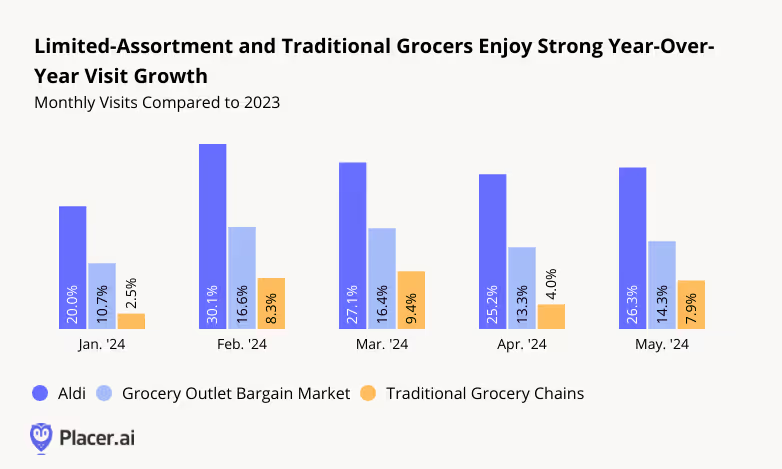
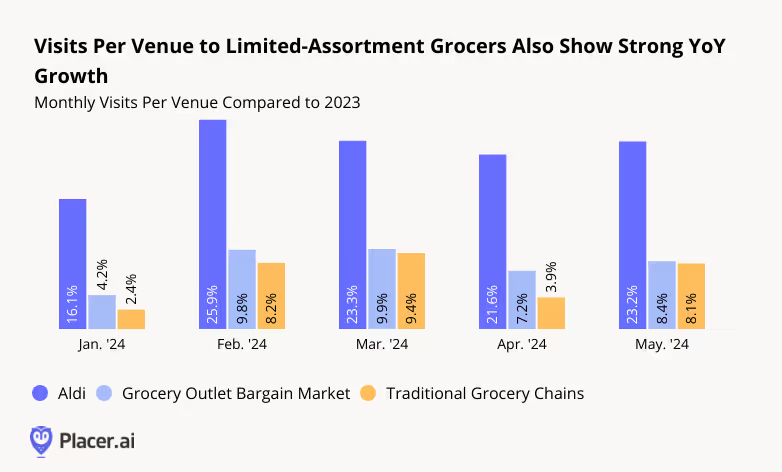
This trend also explains the success of limited assortment grocers in recent years – shoppers are willing to visit these stores to pick up their favorite snack or a particularly cheap store-branded basic, knowing that this will be just one of several stops on their grocery run.  

Value-Oriented Categories Fuel Retail Growth 

Value-Forward Retail Categories Still Growing

Diving into the traffic data by retail category reveals that much of the growth in retail visits since COVID can be attributed to the surge in visits to value-oriented categories, such as discount & dollar stores, value grocery stores, and off-price apparel. This period has been defined by an endless array of economic obstacles like inflation, recession concerns, gas price spikes, and tariffs that all trigger an orientation to value. The shift also speaks to an ability of these categories to capitalize on swings – consumers who visited value-oriented retailers to cut costs in the short term likely continued visiting those chains even after their economic situation stabilized.

Some of the visit increases are due to the aggressive expansion strategies of leaders in those categories – including Dollar General and Dollar Tree, Aldi, and all the off-price leaders. But the dramatic increase in traffic – around 30% for all three categories since H1 2019 – also highlights the strong appetite for value-oriented offerings among today's consumers. And zooming into YoY trends shows that the visit growth is still ongoing, indicating that the demand for value has not yet reached a ceiling. 

Value Alone Doesn't Drive Success

While affordable pricing has clearly driven success for value retailers, offering low prices isn't a guaranteed path to growth. Although traffic to beauty and wellness chains remains significantly higher than in 2019, this growth has now plateaued – even top performers like Ulta saw slight YoY declines following their post-pandemic surge – despite the relatively affordable price points found at these chains.

Some of the beauty visit declines likely stems from consumers cutting discretionary spending – but off-price apparel's ongoing success in the same non-essential category suggests budget constraints aren't the full story. Instead, the plateauing of beauty and drugstore visits while off-price apparel visits boom may be due to the difference in value perception: Off-price retailers are inherently associated with savings, while drugstores and beauty retailers, despite carrying affordable items, lack that same value-driven brand positioning. This may suggest that in today's market, perceived value matters as much as actual affordability.

Traffic to Chains Selling Big-Ticket Products Significantly Below 2019 Levels 

Another indicator of the importance of value perception is the decline in visits to chains selling bigger-ticket items – both home furnishing chains and electronic stores saw double-digit drops in traffic since H1 2019. 

And looking at YoY trends shows that visits here have stabilized – like in the beauty and drugstore categories – suggesting that these sectors have reached a new baseline that reflects permanently shifted consumer priorities around discretionary spending.

Bifurcation of Consumer Behavior  

Mid-Market Apparel Underperforms Luxury & Off-Price

A major post-pandemic consumer trend has been the bifurcation of consumer spending – with high-end chains and discount retailers thriving while the middle falls behind. This trend is particularly evident in the apparel space – although off-price visits have taken off since 2019 (as illustrated in the earlier graph) overall apparel traffic declined dramatically – while luxury apparel traffic is 7.6% higher than in 2019. 

Bifurcated Dining Behavior

Dining traffic trends also illustrate this shift: Categories that typically offer lower price points such as QSR, fast casual, and coffee have expanded significantly since 2019, as has the upscale & fine dining segment. But casual dining – which includes classic full-service chains such as Red Lobster, Applebee's, and TGI Fridays – has seen its footprint shrink in recent years as consumers trade down to lower-priced options or visit higher-end venues for special occasions. 

Chili's has been a major exception to the casual dining downturn, largely driven by the chain's success in cementing its value-perception among consumers – suggesting that casual dining chains can still shine in the current climate by positioning themselves as leaders in value. 

Are Consumers De-Prioritizing Experiences? 

Consumers' current value orientation seems to be having an impact beyond the retail and dining space: When budgets are tight, spending money in one place means having less money to spend in another – and recent data suggests that the consumer resilience in retail and dining may be coming at the expense of travel – or perhaps experiences more generally.  

While airport visits from domestic travelers were up compared to pre-COVID, diving into the data reveals that the growth is mostly driven by frequent travelers visiting airports two or more times in a month. Meanwhile, the number of more casual travelers – those visiting airports no more than once a month – is lower than it was in 2019. 

This may suggest that – despite consumers' self-reported preferences for "memorable, shareable moments" – at least some Americans are actually de-prioritizing experiences in the first half of 2025, and choosing instead to spend their budgets in retail and dining venues. 

Stability and Volatility in the Entertainment Space

The out of home entertainment landscape has also undergone a significant change since COVID – and the sector seems to have settled into a new equilibrium, though for part of the sector, the equilibrium is marked by consistent volatility. 

Museums & Eatertainment Reach New Set Point 

Eatertainment chains – led by significant expansions from venues like Top Golf – saw a 5.5% visit increase compared to pre-pandemic levels, though YoY growth remained modest at 1.1%. On the other hand, H1 2025 museum traffic fell 10.9% below 2019 levels with flat YoY performance (+0.2%). The minimal year-over-year changes in both categories suggest that these entertainment segments have found their new post-COVID equilibrium. 

The rise of eatertainment alongside the drop in museum visits may also reflect the intense focus on value for today's consumers. Museums in 2025 offer essentially the same value proposition that they offered in 2019 – and for some, that value proposition may no longer justify the entrance fee. But eatertainment has gained popularity in recent years as a format that offers consumers more bang for their buck relative to stand-alone dining or entertainment venues – which makes it the perfect candidate for success in today's value-driven consumer landscape.  

But movie theaters traffic trends are still evolving – even accounting for venue closures, visits in H1 2025 were well below H1 2019 levels. But compared to 2024, movie traffic was also up – buoyed by the release of several blockbusters that drove audiences back to cinemas in the first half of 2025. So while the segment is still far from its pre-COVID baseline, movie theaters retain the potential for significant traffic spikes when compelling content drives consumer demand.

The blockbuster-driven YoY increase can perhaps also be linked to consumers' spending caution. With budgets tight, movie-goers may want to make sure that they're spending time and money on films they are sure to enjoy – taking fewer risks than they did in 2019, when movie tickets and concession prices were lower and consumers were less budget-conscious. 

Office Traffic Slowly Inching Up  

H1 2025 also brought some moderate good news on the return to office (RTO) front, with YoY visits nationwide up 2.1% and most offices seeing YoY office visit increases – perhaps due to the plethora of RTO mandates from major companies. But comparing office visitation levels to pre pandemic levels highlights the way left to go – nationwide visits were 33.3% below H1 2019 levels in H1 2025, with even RTO leaders New York and Miami still seeing 11.9% and 16.1% visit gaps, respectively. 

So while the data suggests that the office recovery story is still being written – with visits inching up slowly – the substantial gap from pre-pandemic levels suggests that remote and hybrid work models have fundamentally reshaped office utilization patterns.

Post-COVID Stabilization of Consumer Behavior 

Five years post-pandemic, consumer behavior across the retail, dining, entertainment, and office spaces has crystallized into distinct new patterns.

Traffic to retail and dining venues now surpasses pre-pandemic levels, driven primarily by value-focused segments. But retail and dining segments that cater to higher income consumers –such as luxury apparel and fine dining – have also stabilized at a higher level, highlighting the bifurcation of consumer behavior that has emerged in recent years. Entertainment formats show more variability – while eatertainment traffic has settled above and museums below 2019 levels, and movie theaters still seeking stability. Office spaces remain the laggard, with visits well below pre-pandemic levels despite corporate return-to-office initiatives showing modest impact.

It seems, then, that the new consumer landscape rewards businesses that can clearly articulate their value proposition to attract consumers' increasingly selective spending and time allocation – or offer a premium product or experience catering to higher-income audiences.

INSIDER
Report
‍Out-Of-Home Dining in 2025: Performance & Consumer Trends  
Dive into the data to find out how the dining category is performing in 2025, which segments are coming out on top, and how dining consumer behavior has shifted in recent years.
June 26, 2025
10 minutes

Key Takeaways:

1. Overall dining traffic is mostly flat, but growth is concentrated in specific areas.

While nationwide dining visits were nearly unchanged in early 2025, western states like Utah, Idaho, and Nevada showed moderate growth, while states in the Midwest and South, along with Washington D.C., saw declines.

2. Fine dining and coffee chains are growing through expansion, not just busier locations.

These two segments were the only ones to see an increase in total visits, but their visits-per-location actually decreased, indicating that opening new stores is the primary driver of their growth.

3. Higher-income diners are driving the growth in resilient categories.

The segments that saw visit growth—fine dining and coffee—also attracted customers with the highest median household incomes, suggesting that affluent consumers are still spending on dining despite economic headwinds.

4. Remote work continues to reshape dining habits.

The share of suburban customers at fine dining establishments has increased since 2019, while it has decreased for coffee chains. This reflects a shift towards "destination" dining closer to home and away from commute-based coffee runs.

5. Limited-service restaurants own the weekdays; full-service restaurants win the weekend.

QSR, fast casual, and coffee chains see the majority of their traffic from Monday to Friday, whereas casual and fine dining see a significant spike in visits on weekends.

6. Each dining segment dominates a specific time of day.

Consumer visits are highly predictable by the hour: coffee leads in the early morning, fast casual peaks at lunch, casual dining takes the afternoon, fine dining owns the dinner slot, and QSR captures the late-night crowd.

Year-over-Year Dining Traffic Trends 

Dining Visits Mostly Up in the West, Down in Most of Midwest and East  

Overall dining visits held relatively steady in the first five months of 2025, with year-over-year (YoY) visits to the category down 0.5% for January to May 2025 compared to the same period in 2024. Most of the country saw slight declines (less than 2.0%), though some states and districts experienced larger drops: Washington, D.C, saw the largest visit gap (-3.6% YoY), followed by Kansas and North Dakota (-2.9%), Arkansas (-2.8%), Missouri and Kentucky (-2.6%), Oklahoma (-2.1%), and Louisiana (-2.0%). 

Still, there were several pockets of moderate dining strength, specifically in the west of the United States. January to May 2025 dining visits in Utah, Idaho, and Nevada increased 1.8% to 2.4% YoY, while the coastal states saw traffic rise 0.6% (California) to 1.2% (Washington). Vermont also saw a slight increase in dining visits (+1.9%). 

Coffee & Fine Dining See Strongest Overall Visit Growth 

Diving into visit trends by dining segment shows that fine dining and coffee saw the strongest overall visit trends, with visits to the segments up 1.3% and 2.6% YoY, respectively, between January and May 2025. But visits per location trends were negative for both segments – a decline of 0.8% YoY for fine dining and 1.8% for coffee during the period – suggesting that much of the visit strength is due to expansions rather than more crowded restaurants and coffee shops. 

In contrast, full-service casual dining saw overall visits decrease by 1.5%, while visits per location remained stable (+0.2%) YoY between January and May 2025. Several casual dining chains have rightsized in the past twelve months – including Red Lobster, TGI Fridays, and Outback Steakhouse – which impacted overall visit numbers. But the data seems to show that their rightsizing was effective, as the remaining locations successfully absorbed the traffic and maintained performance levels from the previous year. And the monthly data also provides much reason for optimism, with May traffic up both overall and on a visit per location basis – suggesting that the casual dining segment is well positioned for growth in the second half of 2025. 

Meanwhile, QSR and fast casual chains saw similar minor visits per venue dips (-1.5% and -1.2%, respectively). At the same time, QSR also saw an overall visit dip (-0.8%) while traffic to fast casual chains increased slightly (+0.3%) – suggesting that the fast casual segment is expanding more aggressively than QSR. But the two segments decoupled somewhat in May, with overall traffic and visits per venue to fast casual chains up YoY while traffic remained flat and visits per venue fell slightly for QSR – perhaps due to the relatively greater affluence of fast casual's consumer base. 

Dining Demographics

Visitor Income Levels Hold Steady in Most Segments 

Analyzing the income levels of visitors to the various dining segments over time shows that each segment followed a slightly different trend – and the differences in visitor income may help explain some of the current traffic patterns. 

The only three segments with YoY visit growth – casual dining, fine dining, and coffee – also had the highest captured market median household income (HHI). Although the median HHI in the captured market of upscale and fine dining chains fell after COVID, it has risen back steadily over time and now stands at $98.0K – slightly higher than the $97.1K median HHI between January to May 2019. This may explain the segment's resilience in the face of wider consumer headwinds. Meanwhile, the median HHI at fast casual and coffee chains has fallen slightly, perhaps due to aggressive expansions in the space – including Dave's Hot Chicken and Dutch Bros – which likely broadened the reach of the segments, driving visits up and trade area median HHI down.   

Like fine dining, casual dining also saw its trade area median HHI increase slightly over time – but the segment has still been facing visit dips. This could mean that, even though consumers trading down to casual dining may have boosted the trade area median HHI for the segment, it still might not have been enough to make up for the customers lost to tighter budgets. 

The QSR segment saw its trade area median HHI remain remarkably steady – and visits to the segment have also been quite consistent – staying between $70.6K and $70.9K between 2019 and 2025 – which may explain why the segment's visits remained relatively stable YoY. 

Suburban Dining Patterns

Diving into the psychographic segmentation shows that, although the fine dining segment attracted visitors from the highest-income areas between January and May 2025, fast casual chains drew the highest share of visitors from suburban areas, followed by casual dining and coffee. QSR attracted the smallest share of suburban visitors, with just 30.5% of the category's captured market between January and May 2025 belonging to Spatial.ai: PersonaLive suburban segments. 

But looking at the data since 2019 reveals small but significant changes in the shares of suburban audiences in some categories' captured markets. And although the percentage changes are slight, these represent hundreds of thousands of diners every year. 

The data shows that shares of suburban segments in the captured markets of fine dining chains have increased, while their share in the captured market of coffee chains has decreased. The shares of suburban visitors to QSR, fast casual, and casual chains have remained relatively steady. 

This may suggest that the COVID-19 pandemic and the subsequent rise of remote and hybrid work models are still impacting consumer dining habits, benefiting destination-worthy experiences in suburban locales such as fine dining chains while reducing the necessity of daily coffee runs that were often tied to commuting and office work. Meanwhile, the stability in QSR, fast casual, and casual dining segments could indicate that these categories continue to meet consistent suburban demand for convenience and everyday dining, largely unaffected by the redistribution seen in the fine dining and coffee sectors.

Dining Consumer Behavior Trends 

Although QSR, fast casual, casual dining, fine dining, and coffee all fall under the wider dining umbrella, the data shows distinct consumer behavior patterns regarding visits to these five categories. 

Limited Service Leads Weekday Visit Share, Full Service Rules the Weekend 

Limited service segments, including QSR, fast casual, and coffee tend to see higher shares of visits on weekdays, while full service segments – casual dining and fine dining – receive higher shares of weekend visits. Diving deeper shows that QSR has the largest share of weekday visits, with 72.3% of traffic coming in between Monday and Friday, followed by fast casual (69.8% of visits on weekdays) and coffee (69.4% of visits on weekdays.) Looking at trends within the work week shows that QSR receives a slightly larger visit share between Monday and Thursday compared to the other limited service segments. Meanwhile, coffee seems to receive the smallest share of Friday visits – 16.3% compared to 17.0% for fast casual and 17.2% for QSR. 

On the full-service side, casual dining and fine dining chains have relatively similar shares of weekend visits (39.0% and 38.8%, respectively), but fine dining also sees an uptick of visits on Fridays (with 19.1% of weekly visits) as consumers choose to start the weekend on a festive note. 

Each Segment Owns a Different Daypart

Hourly visit patterns also show variability between the segments. Coffee is the unsurprising leader of early visits, with 14.6% of visits taking place before 8 AM and, almost two-thirds (64.9%) of visits taking place before 2 PM. Fast casual leads the lunch rush (29.4% of visits between 11 AM and 2 PM), casual dining chains receive the largest share of afternoon (2 PM to 5 PM) visits, and fine dining chains receive the largest share of dinner visits, with almost 70% of visits taking place between 5 PM and 11 PM. QSR leads the late night visit share – 4.1% of visits take place between 11 PM and 5 AM – followed by casual dining chains (3.2% late night and overnight visit share), likely due to the popularity of 24-hour diners. 

This suggests that each dining segment effectively "owns" a different part of the day, from the morning coffee ritual and the quick lunch break to the leisurely evening meal and late-night cravings.

Shorter Visits in Most Segments 

An analysis of average visit duration also reveals a small but lasting shift in post-pandemic dining behavior. Between January and May 2025, the average dwell time for nearly every dining segment was shorter than during the same period in 2019. This efficiency trend is evident across limited-service categories like QSR, fast casual, and coffee shops, suggesting a continued emphasis on speed and convenience. 

The one notable exception to this trend is upscale and fine dining, where the average visit duration has actually increased compared to pre-COVID levels. This may suggest that, while visits to most segments have become more transactional, consumers are treating fine dining more as an extended, deliberate experience, reinforcing its position as a destination-worthy occasion.

INSIDER
Report
Crafting Targeted Promotions in 2025: A Regional Perspective
Dive into the data to see how consumer response to major promotional events – from Black Friday and the back-to-school shopping rush to brand-crafted LTOs – varies by market.
June 19, 2025

Key Takeaways

1. The Midwest is the only region where Black Friday retail visits outpace Super Saturday.

But several major Midwestern markets, including Chicago and Detroit, actually see higher shopper turnout on Super Saturday.

2. Holiday season demographic shifts also vary across regions. 

Nationwide, electronics stores see a slight uptick in median household income (HHI) in December – yet in certain markets, electronics retailers such as Best Buy see a drop in captured market median HHI during this period. 

3. Back-to-school shopping starts earliest for clothing and office supplies retailers in the South Central region, likely tied to earlier school schedules. 

But back-to-school visits surge higher for these retailers in the Northeast later in the season. 

4. The share of college students among back-to-school shoppers varies by region

In August 2024, “Collegians” made up the largest share of Target’s back-to-school shopping crowd in New England, and the smallest in the West. 

5. Mother’s Day drives the biggest restaurant visit spikes in the Middle Atlantic Region, while Father’s Day sees its biggest boosts in the South Atlantic states

Mother’s Day diners also tend to travel farther to celebrate, suggesting an extra effort to treat mom. 

6. Western states proved particularly responsive to McDonald’s recent Minecraft promotion. 

During the week of A Minecraft Movie’s release, the promotion drove significantly higher visit spikes in the West than in the Eastern U.S.

Zooming in on Local Trends

Retailers rely on promotional events to fuel sales – from classics like Black Friday and back-to-school sales to unique limited-time offers (LTOs) and pop-culture collaborations. Yet consumer preferences and behavior can vary significantly by region, making it critical to tailor campaigns to local markets. 

This report dives into the data to reveal how consumers in 2025 are responding to major retail promotions, exploring both broad regional trends and more localized market-level nuances. Where is Black Friday most popular, and which areas see a bigger turnout on Super Saturday? Where are restaurants most packed on Mother’s Day, and where on Father’s Day? Which region kicks off back-to-school shopping – and where are August shoppers most likely to be college students? And also – which part of the country went all out on McDonald’s recent Minecraft LTO? 

Read on to find out. 

The Holiday Season: A Regional Story

Promotions aimed at boosting foot traffic on key holiday season milestones like Black Friday and Super Saturday are central to retailers’  strategies across industries. The day after Thanksgiving and the Saturday before Christmas typically rank among in-store retail’s busiest days, last year generating foot traffic surges of 50.1% and 56.3%, respectively, compared to a 12-month daily average. And 

But a closer look at regional data shows that these promotions land differently across the country. In the Midwest, Black Friday outperformed Super Saturday last year, fueling the nation’s biggest post-Thanksgiving retail visit spike – a testament to the milestone’s strong local appeal. Meanwhile, in the Western U.S. Black Friday trailed well behind Super Saturday, though both milestones drove smaller upticks than in other regions. And in New England and the South Central states, Super Saturday achieved its biggest impact, suggesting that last-minute holiday specials may resonate especially well in that area. 

Plenty of Local Variety

Digging deeper into major Midwestern hubs shows that even within a single region, holiday promotions can produce widely different responses.

In St. Louis, Indianapolis, and Minneapolis, for example, consumers followed the broader Midwestern pattern, flocking to stores on Black Friday exhibiting less enthusiasm for Super Saturday deals. By contrast, Chicago and Detroit saw Super Saturday edge ahead, with Chicago’s Black Friday peak falling below the nationwide average of 50.1%.  examples highlight the power of local preferences to shape holiday campaign results.  

Differing Demographic Shifts Across Regions

Holiday promotions don’t just drive visit spikes; they also spark subtle but significant changes in the demographic profiles of brick-and-mortar shoppers, expanding many retailers’ audiences during peak periods. And these shifts, too, can vary widely across regions. 

Outlet malls, department stores, and beauty & self-care chains, for instance, which typically attract higher-income consumers, tend to see slight declines in the median household incomes (HHI) of their visitor bases in December. This dip may be due to promotions drawing in more mid- and lower-income shoppers during the peak holiday season. Electronics stores and superstores, on the other hand, which generally serve a less affluent base, see modest upticks in median HHI in the lead-up to Christmas. 

But once again, drilling further down into regional chain-level data reveals more nuanced regional patterns. Take Best Buy, a leading holiday season electronics destination. In some of the chain’s biggest, more affluent markets – including New York, Los Angeles, and Chicago – the big-box retailer sees small dips in median HHI during December. But in Atlanta and Houston – also relatively affluent, but slightly less so – December saw a minor HHI uptick, hinting at a stronger holiday rush from higher-income shoppers in those cities. 

Back-to-School Bonanzas

Back-to-school promotions also play a pivotal role in the retail calendar, with superstores, apparel chains, office supply stores and others all vying for shopper attention. And though summer markdowns drive increased foot traffic nationwide, both the timing of these shifts and the composition of the back-to-school shopping crowd differ among regions. 

A Southern Head Start

Analyzing weekly fluctuations in regional foot traffic to clothing and office supplies stores shows, for example, that back-to-school shopping picks up earliest in the South Central region, likely due to earlier school start dates. 

But the biggest visit peaks occur in the Northeast – with clothing retailer foot traffic surging in New England in late August, and office supplies stores seeing an even bigger surge in the Middle Atlantic region in early September. Retailers and advertisers can plan their back-to-school deals around these differences, targeting promotions to local trends. 

A New England Collegian Affair

Though K-12 families drive much of the back-to-school rush, college student shoppers also play a substantial role. And here, too, their participation varies by region. 

For instance, the “Collegians” segment accounted for 2.2% of Target’s shopper base nationwide over the past year – rising to 3.0% in August 2024. But regionally, the share of “Collegians” soared as high as 4.0% in New England versus just 2.2% in the West. So while retailers in New England may choose to lean into the college vibe, those in Western states may place greater emphasis on families with children.

Mother’s Day and Father’s Day: Differing Dining Peaks 

When it comes to dining, Mother’s Day and Father’s Day are the busiest days of the year for the full-service restaurant (FSR) category, as families treat their parents to a hassle-free meal out. And eateries nationwide capitalize on this trend by offering a variety of deals and promotions that add a little extra charm (and value) to the experience. 

Atlantic Specials

Nationwide, Mother’s Day drives more FSR foot traffic than Father’s Day – except in parts of the Pacific Northwest, where Father’s Day traditions run especially deep. Still, the size of these holiday boosts varies substantially by region.  

This year, for instance, Mother’s Day (May 11, 2025) drove the largest FSR surge in the Middle Atlantic, with the South Atlantic and Midwest not far behind. Father’s Day, by contrast, saw its biggest lift in the South Atlantic. Mother’s Day proved least resonant in the West, whereas Father’s Day had its smallest impact in New England.

Going the Extra Mile for Mom

Dining behavior also differs between the two occasions. Mother’s Day celebrants display a slight preference for morning FSR visits and a bigger one for afternoon visits, while Father’s Day crowds favor evenings – perhaps reflecting a preference for sports bars and later dinners with dad. Another interesting nuance: On Mother’s Day, a larger share of FSR visits originate from between 3 and 50 miles away compared to Father’s Day, suggesting that families go the extra mile – sometimes literally – to celebrate mom. 

Self-Styled Celebrations: Driving Traffic with DIY Milestones

While established dates like Black Friday or Mother’s Day naturally spur promotions, brands can also craft their own moments with limited-time offers (LTOs). And much like holiday campaigns, these retailer-led events can produce varied outcomes across different regions.   

Fast food restaurants, for example, have leaned heavily on limited-time offers (LTOs) and pop-culture tie-ins to fuel buzz in what remains a challenging overall market. And McDonald’s recent Minecraft promotion, launched on April 1, 2025 to coincide with the April 3 release of A Minecraft Move, shows just how impactful the practice can be. 

Nationally, the Minecraft promotion (featuring offerings for both kids and adults) drove a 6.9% lift in visits during the movie’s opening week. But the impact of the promotion was far from uniform across the U.S. Many of McDonald’s Western markets – including Utah, Idaho, Nevada, California, Texas, Arizona, Colorado, and Oregon – recorded visit lifts above 10.0%. Meanwhile, Kentucky saw a 2.1% dip, and several other Eastern states registered modest gains below 3.0%. The McDonald’s example illustrates the power of regional tastes to shape the success of even the most creative pop-culture collabs.

Adopting a Regional Lens

Whether it’s properly timing holiday and back-to-school discounts, recognizing where Mother’s Day or Father’s Day will resonate more, or pinpointing markets that respond best to pop-culture tie-ins, the data reveals that effective promotions depend heavily on local nuances. And by analyzing regional and DMA-level trends, retailers and advertisers can craft compelling, relevant campaigns that heighten engagement where it matters most. 

Loading results...
We couldn't find anything matching your search.
Browse one of our topic pages to help find what you're looking for.
For more in-depth analyses on a variety of subjects, explore Reports.
The Anchor Logo
INSIDER
Stay Anchored: Subscribe to Insider & Unlock more Foot Traffic Insights
Gain insider insights with our in-depth analytics crafted by industry experts
— giving you the knowledge and edge to stay ahead.
Subscribe