Thank you! Your submission has been received!
Oops! Something went wrong while submitting the form.
0
0
0
0
----------
0
0
Articles
Article
Retail & Dining Q1 2025 Recap: Budget-Friendly Segments Shine 
With Q1 2025 behind us, we analyzed the performance of key retail and dining categories to understand how consumer sentiment is shaping visit trends across different segments.
Shira Petrack
Apr 14, 2025
4 minutes

Minor Retail & Dining Visit Declines

Visits to brick-and-mortar retail and dining chains fell slightly in Q1 2025 compared to Q1 2024. The year-over-year (YoY) visit gaps widened to 0.5% for retail while dining visits dropped 1.4% below Q1 2024 levels. And while some of the dip may be due to Q1 2025 having one day less than 2024’s longer February, the decline could also signal a softening of consumer sentiment. 

At the same time, the decrease in visits was extremely minor. In the retail space especially, YoY visits were technically negative, but at -0.5% this year’s Q1 visitation trends remained essentially on par with last year’s traffic numbers. The muted dip in visits during this period of economic uncertainty is likely due to the resilience of the U.S. consumer and to the range of budget-friendly retail and dining segments that provide options to even the most price conscious consumers.

Lower-Priced Dining Offerings Stand Out

Although overall dining visits declined in Q1, some budget-friendly options did experience visit growth. Visits to coffee chains were up 1.7% in Q1 2025, and fast casual and QSR concepts – that operate at a somewhat higher price point – saw a minor traffic drop of 1.4% YoY. Meanwhile, traffic to full-service restaurants declined 3.0% YoY.

These visitation patterns suggest that consumers are still willing to spend on budget-friendly treats, such as a specialty coffee or pastry, and – to a lesser extent – slightly pricier fast-food or fast-casual entrees. But many may be cutting back on meals at sit-down restaurants and redirecting their spending towards more affordable indulgences.

Grocery Leads Essential Retail 

Although overall retail visits remained relatively close to Q1 2024 levels, traffic declined to several essential retail categories – including superstores, gas stations & convenience stores, and drugstores & pharmacies. Retailers in these categories also carry many non-essential items, so the dip in visitation may be due to reduced discretionary spending within those categories. 

Meanwhile, visits to the grocery category increased 0.9% relative to last year following three straight quarters of YoY visit growth, and traffic to discount & dollar stores stabilized following several years of rapid growth. This suggests that the competitive pressure from discount & dollar stores on traditional grocery formats may be abating and highlights grocery's ability to withstand challenges in the evolving retail landscape.

Off-Price Remains On Top 

Consumers’ budgetary concerns are also evident in the recent performance of the various apparel segments. Off-price continued leading the apparel pack with Q1 2025 visits up 3.2% YoY, while every other apparel segment analyzed experienced a dip in traffic. Sportswear & athleisure in particular – which saw visits surge over the pandemic – saw visits decline for the fourth quarter in a row.

More Auto Repairs, Fewer New Cars

The auto retail space also revealed consumers' relatively thrifty preferences over this past quarter. While visits to auto parts shops & service chains increased 2.5% YoY in Q1 2025, visits to car dealerships fell 4.1% – suggesting that consumers are bringing in their cars for repairs rather than trading them in for newer vehicles.

Catering to Value 

Q1 2025’s retail and dining visitation patterns suggest that today’s consumer continues to be highly price conscious, with the budget-friendly segment coming out ahead in almost every category analyzed. Retailers and dining concepts who can cater to consumer’s value orientation will likely come out ahead in this increasingly competitive market. 

For more data-driven retail and dining insights, visit placer.ai/anchor

Article
Albertsons Analysis: Stable Start to 2025
Albertsons Companies, Inc. commands a significant share of the U.S. grocery market through a wide range of grocery banners. We dove into recent customer traffic and engagement metrics to discover what’s changed for the company – and what’s stayed the same – over the past few years.
Bracha Arnold
Apr 11, 2025
4 minutes

Visits Slow Relative to 2023, But Still on Upward Trajectory

Traffic to Albertsons banners has increased steadily over the past couple of years, with visits still significantly higher (10.5%) than in pre-pandemic 2019. So while visits did dip slightly relative to 2023 (-1.1%) – likely due to stabilization following the robust growth of recent years – the minimal decline highlights Albertsons’ capacity to maintain strong foot traffic despite a challenging economic environment.

Albertsons Closes Visit Gap in 2025 

Zooming into quarterly-level data also highlights Albertsons’ strength. After narrowing its year-over-year (YoY) visit gap from -2.5% in Q2 2024 to -0.9% in Q3 and Q4 2024, Q1 2025 visits are now level with Q1 2024 traffic – suggesting that Albertsons’ visits have indeed stabilized, with the company holding on the gains of the past couple of years.

Stable Visit Share Over The Years

The company’s resilience in the face of the growing competition from discount & dollar stores is likely contributing to Albertsons’ strength.

Inflation and high prices have had a major impact on grocery shopping behavior in recent years, with discount stores emerging as significant players in the grocery market. Indeed, between 2019 and 2024, the share of visits to the discount & dollar category out of total grocery and discount & dollar store visits increased from 23.4% to 25.5% – likely due to some shoppers favoring more affordable grocery channels over traditional supermarkets. Meanwhile, grocery’s relative visit share decreased, with traffic to the grocery category (excluding Albertsons banners) falling from 67.8% in 2019 to 66.0% in 2024. But Albertsons’ relative visit share remained largely stable during this period – suggesting that, even as budget-conscious consumers gravitate towards discount stores, Albertsons has managed to retain its customer base.

Shorter, Mission-Driven Visits

Albertsons, like other grocery stores, has seen an increase in short visits in recent years, leading to shorter average dwell time. Between 2019 and 2024, the average length of stay across Albertsons brands dropped from 22.7 minutes to 21.6 minutes.

The drop in visit duration may be partially attributed to the growing segment of consumers who prefer the convenience of picking up their groceries via lockers or curbside, or who are supplementing their online orders with quick trips in-store. And as Albertsons has invested in curbside pickup, delivery, and online shopping options across a number of its banners, the company is well positioned to meet the demand for flexibility and efficiency in the grocery space.

Albertsons Brands Stay the Course

Diving into some of Albertsons’ biggest brands reveals that visits to most banners stayed relatively close to 2023 levels, with YoY traffic trends ranging from -2.7% to +2.9%. While banners like Albertsons, Safeway, and VONS saw slightly fewer visits in 2024 compared to 2023, Jewel-Osco and Shaw's Supermarket enjoyed YoY visit growth. 

Albertsons Keeps It Consistent

Albertsons is making the best of a challenging economic environment, keeping visits close to previous levels and maintaining its share of the grocery visit pie.

Will the grocery banner see visit growth into 2025? Visit Placer.ai for more up-to-date grocery retail insights.

Article
What Visitation Data Reveals About Consumer Behavior Ahead of Tariff Implementation
Tariffs have the potential to impact everything from product pricing to in-store foot traffic. We took a look at how retail visits and consumer behavior shifted as tariffs were announced.
R.J. Hottovy
Apr 11, 2025
4 minutes

Consumer Behavior Amidst Tariff Uncertainty

While the U.S. government has currently partially paused its consideration of reciprocal tariffs on global imports, retailers are still bracing for the possibility of future enactment and potential ripple effects across the industry of the tariffs still in place. From rising supply chain costs to shifts in consumer behavior, tariffs have the potential to impact everything from product pricing to in-store foot traffic. And in an environment where consumers remain highly price-sensitive and economic uncertainty persists, understanding how tariffs could influence retail visitation is critical. While we won’t know the full impact until the tariffs are implemented and impacted retailers adjust, Placer.ai visitation data can help evaluate how the proposed tariffs may be shaping consumer patterns and what that might mean for retailers moving forward.

When new regulations like tariffs are introduced, they often create both short-term and long-term effects. In the short term, consumers remain highly price-sensitive following prolonged inflation in key areas such as food, rent, and healthcare. As a result, our visitation data suggests that some consumers acted early to avoid potential price increases tied to tariff implementation. While visit trends for the week of March 24–30, 2025 were also influenced by the timing of Easter in 2024 (which fell on March 31), Placer.ai data indicates a possible pull forward in demand during the weeks leading up to the expected implementation of the latest tariffs—particularly at “stock-up” retailers like warehouse clubs. In fact, warehouse clubs recorded their strongest year-over-year visitation week of 2025 on the week of March 24-30th, while superstores and grocery stores saw declines, likely due to comparisons to strong performance during the same Easter week in the previous year.

Pre-Tariff Traffic to Discretionary Categories 

Looking at more discretionary retail categories, we also see evidence that consumers were trying to get ahead of tariff implementation. Our data indicates that retailers selling products sourced from countries potentially facing higher tariffs experienced stronger year-over-year visitation trends. The timing of Easter 2024 likely contributed to this boost as well—many of these retailers were closed or operating with reduced hours during that week last year. Categories such as home improvement, electronics, luxury department stores, apparel and accessories, and clothing all saw notable year-over-year visitation increases for the week of March 24–30, 2025, as shown below.

Tariff Resilience and Vulnerabilities  

While many uncertainties remain around tariff implementation, consumers are likely to increasingly gravitate toward retailers that offer bulk purchasing, strong private label alternatives, and everyday low prices—areas where warehouse clubs and discount grocers with robust private label assortments excel. Similarly, national restaurant chains with streamlined operations, diversified global supply chains, and the ability to scale value-driven promotions will hold a competitive edge. Off-price retailers and thrift stores offering secondhand and resale items may also benefit, appealing to deal-seeking consumers. These types of retailers are often better positioned to absorb rising costs and maintain affordability, making them attractive options in an increasingly inflation-sensitive environment.

Consumer electronics, apparel, luxury goods, and beverage alcohol retailers may be disproportionately affected by potential tariffs due to their heavy reliance on imported products and limited pricing flexibility. Many electronics, luxury, and apparel items are sourced from countries subject to implemented or potential tariffs, which could significantly increase costs in categories already operating with tight margins. For beverage alcohol retailers, tariffs on imported wine, spirits, and specialty ingredients could lead to supply chain disruptions and higher prices, particularly for premium or niche products. In these segments, passing additional costs on to consumers may be challenging in an environment where shoppers remain highly price-sensitive, potentially resulting in decreased demand, inventory issues, and increased reliance on promotional strategies.

Leveraging Data to Navigate Tariff Impacts

As the U.S. moves closer to implementing new tariffs, retailers across categories must prepare for both immediate and long-term impacts. From early signs of stock-up behavior at warehouse clubs to shifting visitation patterns in discretionary categories like apparel and electronics, consumer response is already taking shape. While value-focused retailers and those with operational agility may be better positioned to weather the storm, others – particularly those reliant on imported goods – could face heightened challenges. In this evolving landscape, visitation data can help to assess consumer behavior in real time, helping retailers adapt strategies and remain competitive as the full effects of tariff policies unfold.

For more data-driven consumer insights, visit placer.ai/anchor 

Article
Block-Buster Alert: A Minecraft Movie Placer Byte
Lila Margalit
Apr 11, 2025
1 minute

A Minecraft Movie shattered box office predictions with a $162.75 million opening, as eager fans – some tossing popcorn or yelling “chicken jockey” – flocked to theaters nationwide. 

On the weekend of A Minecraft Movie’s release (Friday, April 4th to Sunday, April 6th), leading cinema chains AMC Theatres, Regal Cinemas, and Cinemark enjoyed a 92.6% visit boost compared to an average weekend during the past 12 months. Only Moana 2 and Deadpool & Wolverine drew bigger crowds. 

And examining daily cinema visit fluctuations this year shows that visits to cinemas peaked on Saturday, April 5th, when foot traffic surged 336.7% above the year-to-date daily average. 

Already dubbed “the gamer version” of 1960’s cult film The Rocky Horror Picture Show, A Minecraft Movie has become Warner Bros.’ third-biggest opening of all time. But how long will the film keep drawing crowds? 

Follow Placer.ai to find out.

Article
Placer.ai March 2025 Office Index: Back to Recovery
Lila Margalit
Apr 10, 2025
3 minutes

The Placer.ai Nationwide Office Building Index: The office building index analyzes foot traffic data from some 1,000 office buildings across the country. It only includes commercial office buildings, and commercial office buildings with retail offerings on the first floor (like an office building that might include a national coffee chain on the ground floor). It does NOT include government buildings or mixed-use buildings that are both residential and commercial.

RTO mandates seem to be everywhere. Following the federal government’s example, local governments from the City of Atlanta to the State of Texas have introduced stricter in-office requirements. And an increasing number of corporations are demanding full-time in-person work – including firms like JPMorgan, which began enforcing a five-day RTO mandate in early March. 

But what does ground-level data tell us about how these new policies are affecting office attendance in practice? Did the RTO slowdown observed in January and February continue into March? Or is a new resurgence underway?

RTO Marches Ahead

The latest data from the Placer.ai Office Index suggests that nationwide office visits may be trending upwards once again. Although March 2025 office visit levels didn’t match the peaks of October and July 2024, visits last month were only 32.2% below March 2019 levels – an improvement over March 2024. 

Significantly, among months with 21 or fewer working days, March 2025 ranked as the second-busiest in-office month since the pandemic, just slightly behind October 2023 (October and July 2024 both had 22 days). So while January and February’s declining numbers hinted at a stalled market, March’s uptick suggests that lower office attendance earlier in the year may have been due to temporary factors like weather – and that the RTO may still be gaining momentum.

New York Still in the Lead

Diving into the data for eleven major business hubs nationwide shows New York and Miami once again at the head of the office recovery pack. Visits to NYC office buildings in March 2025 were just 11.4% below pre-pandemic (March 2019) levels – while Miami trailed by 17.3%. Meanwhile, Atlanta (-29.3%), Washington, D.C. (-30.6%), Dallas (-30.7%), and Houston (-31.0%) all outperformed the nationwide average of -32.2%. San Francisco tied in last place with Chicago, with visits 44.6% below 2019 levels. 

YoY Upticks (Nearly) Across the Board

Turning to year-over-year (YoY) data, ten of the eleven analyzed cities experienced YoY office visit growth – led by Boston, with a 10.2% uptick. Washington, D.C. also recorded strong YoY gains (9.8%) – while San Francisco continued its recent positive momentum with a 9.6% increase. Los Angeles was the only city to see a minor (-2.2%) YoY visit lag – perhaps lingering fallout from the wildfires earlier this year. 

More Gains Ahead?

Overall, the Placer.ai Office Index points to a renewed upswing in RTO momentum, likely driven by increasingly strict mandates from governments and corporations. Though persistent post-pandemic office visit gaps point to the continued prevalence of hybrid work, March’s noticeable uptick suggests that offices may be poised to make further gains in the coming months.

For more data-driven CRE insights, visit placer.ai/anchor 

Article
Q1 2025 Quick-Service and Fast-Casual Recap
Lila Margalit
Apr 9, 2025
4 minutes

With Q1 2025 just under our belts, we dove into the data to see how quick-service and fast-casual restaurants (QSRs) fared in the year’s early months. Which chains managed to weather the headwinds – both fiscal and meteorological – that have weighed on consumer traffic in recent months? And which brands emerged as top performers? 

We dove into the data to find out. 

Raising Cane’s and Taco Bell Lead QSR Space

QSRs faced a challenging environment in the first part of 2025, as harsh winter weather, economic uncertainty, and heightened value competition from fast-casual chains, full-service restaurants (Chili’s, anyone?), and even grocery stores drove visits down. Overall, QSR foot traffic declined by 1.6% year over year (YoY) in Q1, with much of the drop occurring in February – when a polar vortex and the comparison to a leap-year February 2024 led to a traffic dip. By March, however, visits began to stabilize, and the segment finished out the month with foot traffic levels essentially flat YoY (-0.3%). 

Still, some QSRs stood out. Rapidly expanding Raising Cane’s Chicken Fingers, for example, saw YoY gains in both overall visits and average visits per location (12.3% and 3.7%, respectively). Known for quick, quality fare – the chain’s sauces have even inspired viral tik-tok videos – Raising Cane’s fleet growth is clearly meeting robust demand.

Taco Bell also emerged as a Q1 leader, with quarterly visits rising 3.7% YoY. The brand doubled down on value with its expanded selection of Luxe Cravings Boxes. And the tex-mex giant’s limited-time Crunchwrap Slider offering – launched in early 2025 to celebrate the 20th anniversary of the Crunchwrap Supreme – generated plenty of buzz

Meanwhile, McDonald’s, which launched its new McValue menu in January 2025, narrowed its visit gap to 1.0% in March – an encouraging sign as the year gets into full swing.

Fast-Casual Brands Leading the Pack

Fast-casual fared somewhat better, ending Q1 2025 with flat YoY visits (+0.0%). And though the segment mirrored QSR’s monthly pattern of gains in January, a dip in February, and stabilization in March, several major players posted positive Q1 results – including Chipotle (+4.6%), Panda Express (+3.8%), Jersey Mike’s Subs (+3.1%) and Qdoba Mexican Grill (+1.5%). While fleet expansion contributed to some of these increases, menu innovation – particularly well-chosen chicken and shrimp-focused limited-time offerings – likely also played a role.

Smaller Fries Making Big Waves

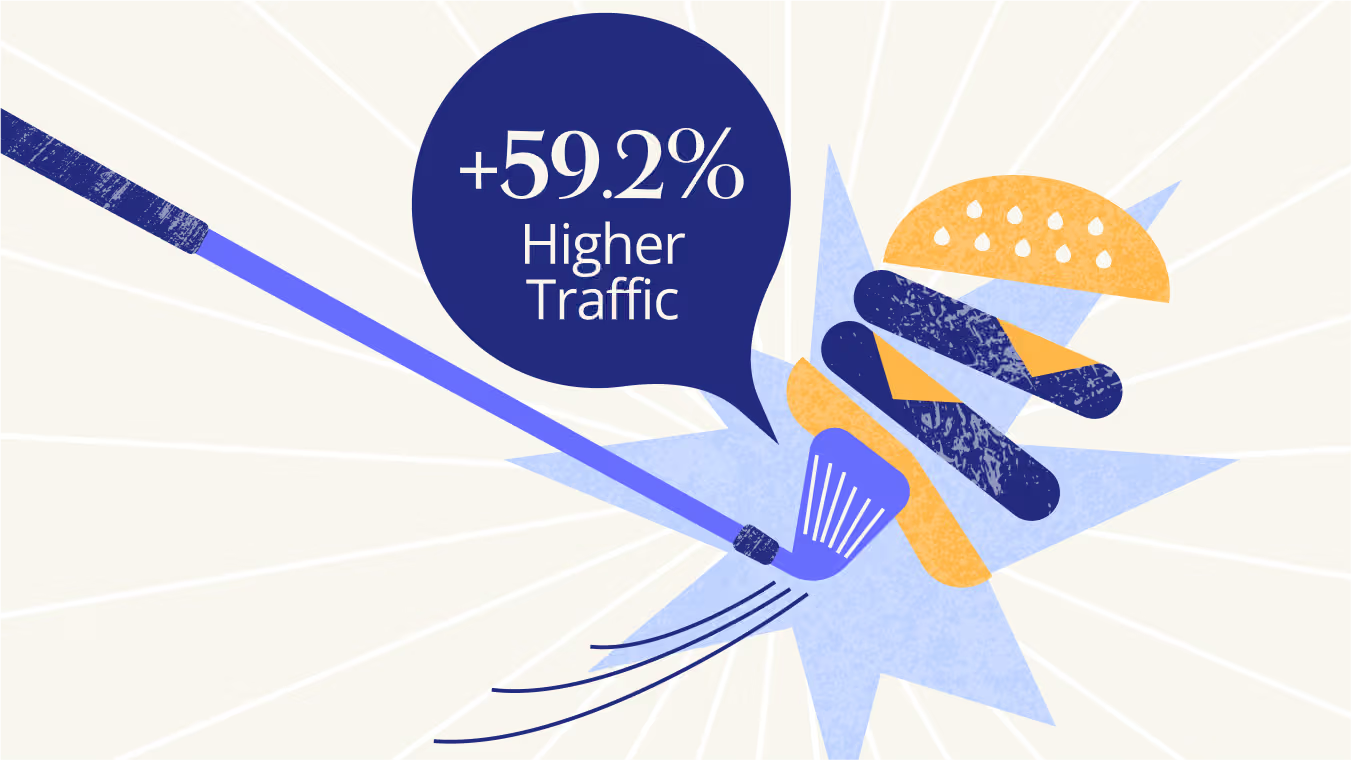
In addition to these major chains, several smaller fast-casual brands enjoyed outsized visit performance in early 2025, driven by rapid expansion meeting strong demand. Dave’s Hot Chicken, capitalizing on consumers’ ongoing enthusiasm for chicken dishes, logged a remarkable 59.3% YoY visit surge in Q1 2025, and an 11.6% jump in average visits per location. Health-forward chains CAVA and sweetgreen also grew their footprints – and audiences – likely supported by the return-to-office trend and continued interest in wholesome, convenient dining options. 

Looking Ahead

All told, QSR and fast-casual brands held their own in Q1 2025 – with some brands standing out through strategic value offerings, menu innovation, and expansion. How will QSRs and fast-casual chains continue to fare as 2025 wears on? 

Follow Placer.ai’s data-driven dining analyses to find out.

Reports
INSIDER
Report
6 Trends Still Defining Post- Pandemic Consumer Behavior
Dive into the data five years post-COVID to uncover six fundamental shifts in consumer behavior since the pandemic.
Placer Research
July 17, 2025
10 minutes

Key Takeaways: 

1. Appetite for offline retail & dining is stronger than ever. Both retail and dining visits were higher in H1 2025 than they were pre-pandemic.

2. Consumers are willing to go the extra mile for the perfect product or brand. The era of one-stop-shops may be waning, as many consumers now prefer to visit multiple chains or stores to score the perfect product match for every item on their shopping list.

3. Value – and value perception – gives chains a clear advantage. Value-oriented retail and dining segments have seen their visits skyrocket since the pandemic. 

4. Consumer behavior has bifurcated toward budget and premium options. This trend is driving strength at the ends of the spectrum while putting pressure on many middle-market players. 

5. The out-of-home entertainment landscape has been fundamentally altered. Eatertainment and museums have stabilized at a different set point than pre-COVID, while movie theater traffic trends are now characterized by box-office-driven volatility.   

6. Hybrid work permanently reshaped office utilization. Visits to office buildings nationwide are still 33.3% below 2019 levels, despite RTO efforts.

The first half of 2025 marked five years since the onset of the pandemic – an event that continues to impact retail, dining, entertainment, and office visitation trends today. 

This report analyzes visitation patterns in the first half of 2025 compared to H1 2019 and H1 2024 to identify some of the lasting shifts in consumer behavior over the past five years. What is driving consumers to stores and dining venues? Which categories are stabilizing at a higher visit point? Where have the traffic declines stalled? And which segments are still in flux? Read the report to find out. 

Retail Outperforming Dining

In the first half of 2025, visits to both the retail and dining segments were consistently higher than they were in 2019. In both the dining and the retail space, the increases compared to pre-COVID were probably driven by significant expansions from major players, including Costco, Chick-fil-A, Raising Cane's, and Dutch Bros, which offset the numerous retail and dining closures of recent years. 

The overall increase in visits indicates that, despite the ubiquity of online marketplaces and delivery services, consumer appetite for offline retail and dining remains strong – whether to browse in store, eat on-premises, collect a BOPIS order, or pick up takeaway. 

Product and Brand Focused Consumers Bypass Convenience 

A closer look at the chart above also reveals that, while both retail and dining visits have exceeded pre-pandemic levels, retail visit growth has slightly outpaced the dining traffic increase. 

The larger volume of retail visits could be due to a shift in consumer behavior – from favoring convenience to prioritizing the perfect product match and exhibiting a willingness to visit multiple chains to benefit from each store's signature offering. Indeed, zooming into the superstore and grocery sector shows an increase in cross-shopping since COVID, with a larger share of visitors to major grocery chains regularly visiting superstores and wholesale clubs. It seems, then, that many consumers are no longer looking for a one-stop-shop where they can buy everything at once. Instead, shoppers may be heading to the grocery stores for some things, the dollar store for other items, and the wholesale club for a third set of products. 

This trend also explains the success of limited assortment grocers in recent years – shoppers are willing to visit these stores to pick up their favorite snack or a particularly cheap store-branded basic, knowing that this will be just one of several stops on their grocery run.  

Value-Oriented Categories Fuel Retail Growth 

Value-Forward Retail Categories Still Growing

Diving into the traffic data by retail category reveals that much of the growth in retail visits since COVID can be attributed to the surge in visits to value-oriented categories, such as discount & dollar stores, value grocery stores, and off-price apparel. This period has been defined by an endless array of economic obstacles like inflation, recession concerns, gas price spikes, and tariffs that all trigger an orientation to value. The shift also speaks to an ability of these categories to capitalize on swings – consumers who visited value-oriented retailers to cut costs in the short term likely continued visiting those chains even after their economic situation stabilized.

Some of the visit increases are due to the aggressive expansion strategies of leaders in those categories – including Dollar General and Dollar Tree, Aldi, and all the off-price leaders. But the dramatic increase in traffic – around 30% for all three categories since H1 2019 – also highlights the strong appetite for value-oriented offerings among today's consumers. And zooming into YoY trends shows that the visit growth is still ongoing, indicating that the demand for value has not yet reached a ceiling. 

Value Alone Doesn't Drive Success

While affordable pricing has clearly driven success for value retailers, offering low prices isn't a guaranteed path to growth. Although traffic to beauty and wellness chains remains significantly higher than in 2019, this growth has now plateaued – even top performers like Ulta saw slight YoY declines following their post-pandemic surge – despite the relatively affordable price points found at these chains.

Some of the beauty visit declines likely stems from consumers cutting discretionary spending – but off-price apparel's ongoing success in the same non-essential category suggests budget constraints aren't the full story. Instead, the plateauing of beauty and drugstore visits while off-price apparel visits boom may be due to the difference in value perception: Off-price retailers are inherently associated with savings, while drugstores and beauty retailers, despite carrying affordable items, lack that same value-driven brand positioning. This may suggest that in today's market, perceived value matters as much as actual affordability.

Traffic to Chains Selling Big-Ticket Products Significantly Below 2019 Levels 

Another indicator of the importance of value perception is the decline in visits to chains selling bigger-ticket items – both home furnishing chains and electronic stores saw double-digit drops in traffic since H1 2019. 

And looking at YoY trends shows that visits here have stabilized – like in the beauty and drugstore categories – suggesting that these sectors have reached a new baseline that reflects permanently shifted consumer priorities around discretionary spending.

Bifurcation of Consumer Behavior  

Mid-Market Apparel Underperforms Luxury & Off-Price

A major post-pandemic consumer trend has been the bifurcation of consumer spending – with high-end chains and discount retailers thriving while the middle falls behind. This trend is particularly evident in the apparel space – although off-price visits have taken off since 2019 (as illustrated in the earlier graph) overall apparel traffic declined dramatically – while luxury apparel traffic is 7.6% higher than in 2019. 

Bifurcated Dining Behavior

Dining traffic trends also illustrate this shift: Categories that typically offer lower price points such as QSR, fast casual, and coffee have expanded significantly since 2019, as has the upscale & fine dining segment. But casual dining – which includes classic full-service chains such as Red Lobster, Applebee's, and TGI Fridays – has seen its footprint shrink in recent years as consumers trade down to lower-priced options or visit higher-end venues for special occasions. 

Chili's has been a major exception to the casual dining downturn, largely driven by the chain's success in cementing its value-perception among consumers – suggesting that casual dining chains can still shine in the current climate by positioning themselves as leaders in value. 

Are Consumers De-Prioritizing Experiences? 

Consumers' current value orientation seems to be having an impact beyond the retail and dining space: When budgets are tight, spending money in one place means having less money to spend in another – and recent data suggests that the consumer resilience in retail and dining may be coming at the expense of travel – or perhaps experiences more generally.  

While airport visits from domestic travelers were up compared to pre-COVID, diving into the data reveals that the growth is mostly driven by frequent travelers visiting airports two or more times in a month. Meanwhile, the number of more casual travelers – those visiting airports no more than once a month – is lower than it was in 2019. 

This may suggest that – despite consumers' self-reported preferences for "memorable, shareable moments" – at least some Americans are actually de-prioritizing experiences in the first half of 2025, and choosing instead to spend their budgets in retail and dining venues. 

Stability and Volatility in the Entertainment Space

The out of home entertainment landscape has also undergone a significant change since COVID – and the sector seems to have settled into a new equilibrium, though for part of the sector, the equilibrium is marked by consistent volatility. 

Museums & Eatertainment Reach New Set Point 

Eatertainment chains – led by significant expansions from venues like Top Golf – saw a 5.5% visit increase compared to pre-pandemic levels, though YoY growth remained modest at 1.1%. On the other hand, H1 2025 museum traffic fell 10.9% below 2019 levels with flat YoY performance (+0.2%). The minimal year-over-year changes in both categories suggest that these entertainment segments have found their new post-COVID equilibrium. 

The rise of eatertainment alongside the drop in museum visits may also reflect the intense focus on value for today's consumers. Museums in 2025 offer essentially the same value proposition that they offered in 2019 – and for some, that value proposition may no longer justify the entrance fee. But eatertainment has gained popularity in recent years as a format that offers consumers more bang for their buck relative to stand-alone dining or entertainment venues – which makes it the perfect candidate for success in today's value-driven consumer landscape.  

But movie theaters traffic trends are still evolving – even accounting for venue closures, visits in H1 2025 were well below H1 2019 levels. But compared to 2024, movie traffic was also up – buoyed by the release of several blockbusters that drove audiences back to cinemas in the first half of 2025. So while the segment is still far from its pre-COVID baseline, movie theaters retain the potential for significant traffic spikes when compelling content drives consumer demand.

The blockbuster-driven YoY increase can perhaps also be linked to consumers' spending caution. With budgets tight, movie-goers may want to make sure that they're spending time and money on films they are sure to enjoy – taking fewer risks than they did in 2019, when movie tickets and concession prices were lower and consumers were less budget-conscious. 

Office Traffic Slowly Inching Up  

H1 2025 also brought some moderate good news on the return to office (RTO) front, with YoY visits nationwide up 2.1% and most offices seeing YoY office visit increases – perhaps due to the plethora of RTO mandates from major companies. But comparing office visitation levels to pre pandemic levels highlights the way left to go – nationwide visits were 33.3% below H1 2019 levels in H1 2025, with even RTO leaders New York and Miami still seeing 11.9% and 16.1% visit gaps, respectively. 

So while the data suggests that the office recovery story is still being written – with visits inching up slowly – the substantial gap from pre-pandemic levels suggests that remote and hybrid work models have fundamentally reshaped office utilization patterns.

Post-COVID Stabilization of Consumer Behavior 

Five years post-pandemic, consumer behavior across the retail, dining, entertainment, and office spaces has crystallized into distinct new patterns.

Traffic to retail and dining venues now surpasses pre-pandemic levels, driven primarily by value-focused segments. But retail and dining segments that cater to higher income consumers –such as luxury apparel and fine dining – have also stabilized at a higher level, highlighting the bifurcation of consumer behavior that has emerged in recent years. Entertainment formats show more variability – while eatertainment traffic has settled above and museums below 2019 levels, and movie theaters still seeking stability. Office spaces remain the laggard, with visits well below pre-pandemic levels despite corporate return-to-office initiatives showing modest impact.

It seems, then, that the new consumer landscape rewards businesses that can clearly articulate their value proposition to attract consumers' increasingly selective spending and time allocation – or offer a premium product or experience catering to higher-income audiences.

INSIDER
Report
‍Out-Of-Home Dining in 2025: Performance & Consumer Trends  
Dive into the data to find out how the dining category is performing in 2025, which segments are coming out on top, and how dining consumer behavior has shifted in recent years.
June 26, 2025
10 minutes

Key Takeaways:

1. Overall dining traffic is mostly flat, but growth is concentrated in specific areas.

While nationwide dining visits were nearly unchanged in early 2025, western states like Utah, Idaho, and Nevada showed moderate growth, while states in the Midwest and South, along with Washington D.C., saw declines.

2. Fine dining and coffee chains are growing through expansion, not just busier locations.

These two segments were the only ones to see an increase in total visits, but their visits-per-location actually decreased, indicating that opening new stores is the primary driver of their growth.

3. Higher-income diners are driving the growth in resilient categories.

The segments that saw visit growth—fine dining and coffee—also attracted customers with the highest median household incomes, suggesting that affluent consumers are still spending on dining despite economic headwinds.

4. Remote work continues to reshape dining habits.

The share of suburban customers at fine dining establishments has increased since 2019, while it has decreased for coffee chains. This reflects a shift towards "destination" dining closer to home and away from commute-based coffee runs.

5. Limited-service restaurants own the weekdays; full-service restaurants win the weekend.

QSR, fast casual, and coffee chains see the majority of their traffic from Monday to Friday, whereas casual and fine dining see a significant spike in visits on weekends.

6. Each dining segment dominates a specific time of day.

Consumer visits are highly predictable by the hour: coffee leads in the early morning, fast casual peaks at lunch, casual dining takes the afternoon, fine dining owns the dinner slot, and QSR captures the late-night crowd.

Year-over-Year Dining Traffic Trends 

Dining Visits Mostly Up in the West, Down in Most of Midwest and East  

Overall dining visits held relatively steady in the first five months of 2025, with year-over-year (YoY) visits to the category down 0.5% for January to May 2025 compared to the same period in 2024. Most of the country saw slight declines (less than 2.0%), though some states and districts experienced larger drops: Washington, D.C, saw the largest visit gap (-3.6% YoY), followed by Kansas and North Dakota (-2.9%), Arkansas (-2.8%), Missouri and Kentucky (-2.6%), Oklahoma (-2.1%), and Louisiana (-2.0%). 

Still, there were several pockets of moderate dining strength, specifically in the west of the United States. January to May 2025 dining visits in Utah, Idaho, and Nevada increased 1.8% to 2.4% YoY, while the coastal states saw traffic rise 0.6% (California) to 1.2% (Washington). Vermont also saw a slight increase in dining visits (+1.9%). 

Coffee & Fine Dining See Strongest Overall Visit Growth 

Diving into visit trends by dining segment shows that fine dining and coffee saw the strongest overall visit trends, with visits to the segments up 1.3% and 2.6% YoY, respectively, between January and May 2025. But visits per location trends were negative for both segments – a decline of 0.8% YoY for fine dining and 1.8% for coffee during the period – suggesting that much of the visit strength is due to expansions rather than more crowded restaurants and coffee shops. 

In contrast, full-service casual dining saw overall visits decrease by 1.5%, while visits per location remained stable (+0.2%) YoY between January and May 2025. Several casual dining chains have rightsized in the past twelve months – including Red Lobster, TGI Fridays, and Outback Steakhouse – which impacted overall visit numbers. But the data seems to show that their rightsizing was effective, as the remaining locations successfully absorbed the traffic and maintained performance levels from the previous year. And the monthly data also provides much reason for optimism, with May traffic up both overall and on a visit per location basis – suggesting that the casual dining segment is well positioned for growth in the second half of 2025. 

Meanwhile, QSR and fast casual chains saw similar minor visits per venue dips (-1.5% and -1.2%, respectively). At the same time, QSR also saw an overall visit dip (-0.8%) while traffic to fast casual chains increased slightly (+0.3%) – suggesting that the fast casual segment is expanding more aggressively than QSR. But the two segments decoupled somewhat in May, with overall traffic and visits per venue to fast casual chains up YoY while traffic remained flat and visits per venue fell slightly for QSR – perhaps due to the relatively greater affluence of fast casual's consumer base. 

Dining Demographics

Visitor Income Levels Hold Steady in Most Segments 

Analyzing the income levels of visitors to the various dining segments over time shows that each segment followed a slightly different trend – and the differences in visitor income may help explain some of the current traffic patterns. 

The only three segments with YoY visit growth – casual dining, fine dining, and coffee – also had the highest captured market median household income (HHI). Although the median HHI in the captured market of upscale and fine dining chains fell after COVID, it has risen back steadily over time and now stands at $98.0K – slightly higher than the $97.1K median HHI between January to May 2019. This may explain the segment's resilience in the face of wider consumer headwinds. Meanwhile, the median HHI at fast casual and coffee chains has fallen slightly, perhaps due to aggressive expansions in the space – including Dave's Hot Chicken and Dutch Bros – which likely broadened the reach of the segments, driving visits up and trade area median HHI down.   

Like fine dining, casual dining also saw its trade area median HHI increase slightly over time – but the segment has still been facing visit dips. This could mean that, even though consumers trading down to casual dining may have boosted the trade area median HHI for the segment, it still might not have been enough to make up for the customers lost to tighter budgets. 

The QSR segment saw its trade area median HHI remain remarkably steady – and visits to the segment have also been quite consistent – staying between $70.6K and $70.9K between 2019 and 2025 – which may explain why the segment's visits remained relatively stable YoY. 

Suburban Dining Patterns

Diving into the psychographic segmentation shows that, although the fine dining segment attracted visitors from the highest-income areas between January and May 2025, fast casual chains drew the highest share of visitors from suburban areas, followed by casual dining and coffee. QSR attracted the smallest share of suburban visitors, with just 30.5% of the category's captured market between January and May 2025 belonging to Spatial.ai: PersonaLive suburban segments. 

But looking at the data since 2019 reveals small but significant changes in the shares of suburban audiences in some categories' captured markets. And although the percentage changes are slight, these represent hundreds of thousands of diners every year. 

The data shows that shares of suburban segments in the captured markets of fine dining chains have increased, while their share in the captured market of coffee chains has decreased. The shares of suburban visitors to QSR, fast casual, and casual chains have remained relatively steady. 

This may suggest that the COVID-19 pandemic and the subsequent rise of remote and hybrid work models are still impacting consumer dining habits, benefiting destination-worthy experiences in suburban locales such as fine dining chains while reducing the necessity of daily coffee runs that were often tied to commuting and office work. Meanwhile, the stability in QSR, fast casual, and casual dining segments could indicate that these categories continue to meet consistent suburban demand for convenience and everyday dining, largely unaffected by the redistribution seen in the fine dining and coffee sectors.

Dining Consumer Behavior Trends 

Although QSR, fast casual, casual dining, fine dining, and coffee all fall under the wider dining umbrella, the data shows distinct consumer behavior patterns regarding visits to these five categories. 

Limited Service Leads Weekday Visit Share, Full Service Rules the Weekend 

Limited service segments, including QSR, fast casual, and coffee tend to see higher shares of visits on weekdays, while full service segments – casual dining and fine dining – receive higher shares of weekend visits. Diving deeper shows that QSR has the largest share of weekday visits, with 72.3% of traffic coming in between Monday and Friday, followed by fast casual (69.8% of visits on weekdays) and coffee (69.4% of visits on weekdays.) Looking at trends within the work week shows that QSR receives a slightly larger visit share between Monday and Thursday compared to the other limited service segments. Meanwhile, coffee seems to receive the smallest share of Friday visits – 16.3% compared to 17.0% for fast casual and 17.2% for QSR. 

On the full-service side, casual dining and fine dining chains have relatively similar shares of weekend visits (39.0% and 38.8%, respectively), but fine dining also sees an uptick of visits on Fridays (with 19.1% of weekly visits) as consumers choose to start the weekend on a festive note. 

Each Segment Owns a Different Daypart

Hourly visit patterns also show variability between the segments. Coffee is the unsurprising leader of early visits, with 14.6% of visits taking place before 8 AM and, almost two-thirds (64.9%) of visits taking place before 2 PM. Fast casual leads the lunch rush (29.4% of visits between 11 AM and 2 PM), casual dining chains receive the largest share of afternoon (2 PM to 5 PM) visits, and fine dining chains receive the largest share of dinner visits, with almost 70% of visits taking place between 5 PM and 11 PM. QSR leads the late night visit share – 4.1% of visits take place between 11 PM and 5 AM – followed by casual dining chains (3.2% late night and overnight visit share), likely due to the popularity of 24-hour diners. 

This suggests that each dining segment effectively "owns" a different part of the day, from the morning coffee ritual and the quick lunch break to the leisurely evening meal and late-night cravings.

Shorter Visits in Most Segments 

An analysis of average visit duration also reveals a small but lasting shift in post-pandemic dining behavior. Between January and May 2025, the average dwell time for nearly every dining segment was shorter than during the same period in 2019. This efficiency trend is evident across limited-service categories like QSR, fast casual, and coffee shops, suggesting a continued emphasis on speed and convenience. 

The one notable exception to this trend is upscale and fine dining, where the average visit duration has actually increased compared to pre-COVID levels. This may suggest that, while visits to most segments have become more transactional, consumers are treating fine dining more as an extended, deliberate experience, reinforcing its position as a destination-worthy occasion.

INSIDER
Report
Crafting Targeted Promotions in 2025: A Regional Perspective
Dive into the data to see how consumer response to major promotional events – from Black Friday and the back-to-school shopping rush to brand-crafted LTOs – varies by market.
June 19, 2025

Key Takeaways

1. The Midwest is the only region where Black Friday retail visits outpace Super Saturday.

But several major Midwestern markets, including Chicago and Detroit, actually see higher shopper turnout on Super Saturday.

2. Holiday season demographic shifts also vary across regions. 

Nationwide, electronics stores see a slight uptick in median household income (HHI) in December – yet in certain markets, electronics retailers such as Best Buy see a drop in captured market median HHI during this period. 

3. Back-to-school shopping starts earliest for clothing and office supplies retailers in the South Central region, likely tied to earlier school schedules. 

But back-to-school visits surge higher for these retailers in the Northeast later in the season. 

4. The share of college students among back-to-school shoppers varies by region

In August 2024, “Collegians” made up the largest share of Target’s back-to-school shopping crowd in New England, and the smallest in the West. 

5. Mother’s Day drives the biggest restaurant visit spikes in the Middle Atlantic Region, while Father’s Day sees its biggest boosts in the South Atlantic states

Mother’s Day diners also tend to travel farther to celebrate, suggesting an extra effort to treat mom. 

6. Western states proved particularly responsive to McDonald’s recent Minecraft promotion. 

During the week of A Minecraft Movie’s release, the promotion drove significantly higher visit spikes in the West than in the Eastern U.S.

Zooming in on Local Trends

Retailers rely on promotional events to fuel sales – from classics like Black Friday and back-to-school sales to unique limited-time offers (LTOs) and pop-culture collaborations. Yet consumer preferences and behavior can vary significantly by region, making it critical to tailor campaigns to local markets. 

This report dives into the data to reveal how consumers in 2025 are responding to major retail promotions, exploring both broad regional trends and more localized market-level nuances. Where is Black Friday most popular, and which areas see a bigger turnout on Super Saturday? Where are restaurants most packed on Mother’s Day, and where on Father’s Day? Which region kicks off back-to-school shopping – and where are August shoppers most likely to be college students? And also – which part of the country went all out on McDonald’s recent Minecraft LTO? 

Read on to find out. 

The Holiday Season: A Regional Story

Promotions aimed at boosting foot traffic on key holiday season milestones like Black Friday and Super Saturday are central to retailers’  strategies across industries. The day after Thanksgiving and the Saturday before Christmas typically rank among in-store retail’s busiest days, last year generating foot traffic surges of 50.1% and 56.3%, respectively, compared to a 12-month daily average. And 

But a closer look at regional data shows that these promotions land differently across the country. In the Midwest, Black Friday outperformed Super Saturday last year, fueling the nation’s biggest post-Thanksgiving retail visit spike – a testament to the milestone’s strong local appeal. Meanwhile, in the Western U.S. Black Friday trailed well behind Super Saturday, though both milestones drove smaller upticks than in other regions. And in New England and the South Central states, Super Saturday achieved its biggest impact, suggesting that last-minute holiday specials may resonate especially well in that area. 

Plenty of Local Variety

Digging deeper into major Midwestern hubs shows that even within a single region, holiday promotions can produce widely different responses.

In St. Louis, Indianapolis, and Minneapolis, for example, consumers followed the broader Midwestern pattern, flocking to stores on Black Friday exhibiting less enthusiasm for Super Saturday deals. By contrast, Chicago and Detroit saw Super Saturday edge ahead, with Chicago’s Black Friday peak falling below the nationwide average of 50.1%.  examples highlight the power of local preferences to shape holiday campaign results.  

Differing Demographic Shifts Across Regions

Holiday promotions don’t just drive visit spikes; they also spark subtle but significant changes in the demographic profiles of brick-and-mortar shoppers, expanding many retailers’ audiences during peak periods. And these shifts, too, can vary widely across regions. 

Outlet malls, department stores, and beauty & self-care chains, for instance, which typically attract higher-income consumers, tend to see slight declines in the median household incomes (HHI) of their visitor bases in December. This dip may be due to promotions drawing in more mid- and lower-income shoppers during the peak holiday season. Electronics stores and superstores, on the other hand, which generally serve a less affluent base, see modest upticks in median HHI in the lead-up to Christmas. 

But once again, drilling further down into regional chain-level data reveals more nuanced regional patterns. Take Best Buy, a leading holiday season electronics destination. In some of the chain’s biggest, more affluent markets – including New York, Los Angeles, and Chicago – the big-box retailer sees small dips in median HHI during December. But in Atlanta and Houston – also relatively affluent, but slightly less so – December saw a minor HHI uptick, hinting at a stronger holiday rush from higher-income shoppers in those cities. 

Back-to-School Bonanzas

Back-to-school promotions also play a pivotal role in the retail calendar, with superstores, apparel chains, office supply stores and others all vying for shopper attention. And though summer markdowns drive increased foot traffic nationwide, both the timing of these shifts and the composition of the back-to-school shopping crowd differ among regions. 

A Southern Head Start

Analyzing weekly fluctuations in regional foot traffic to clothing and office supplies stores shows, for example, that back-to-school shopping picks up earliest in the South Central region, likely due to earlier school start dates. 

But the biggest visit peaks occur in the Northeast – with clothing retailer foot traffic surging in New England in late August, and office supplies stores seeing an even bigger surge in the Middle Atlantic region in early September. Retailers and advertisers can plan their back-to-school deals around these differences, targeting promotions to local trends. 

A New England Collegian Affair

Though K-12 families drive much of the back-to-school rush, college student shoppers also play a substantial role. And here, too, their participation varies by region. 

For instance, the “Collegians” segment accounted for 2.2% of Target’s shopper base nationwide over the past year – rising to 3.0% in August 2024. But regionally, the share of “Collegians” soared as high as 4.0% in New England versus just 2.2% in the West. So while retailers in New England may choose to lean into the college vibe, those in Western states may place greater emphasis on families with children.

Mother’s Day and Father’s Day: Differing Dining Peaks 

When it comes to dining, Mother’s Day and Father’s Day are the busiest days of the year for the full-service restaurant (FSR) category, as families treat their parents to a hassle-free meal out. And eateries nationwide capitalize on this trend by offering a variety of deals and promotions that add a little extra charm (and value) to the experience. 

Atlantic Specials

Nationwide, Mother’s Day drives more FSR foot traffic than Father’s Day – except in parts of the Pacific Northwest, where Father’s Day traditions run especially deep. Still, the size of these holiday boosts varies substantially by region.  

This year, for instance, Mother’s Day (May 11, 2025) drove the largest FSR surge in the Middle Atlantic, with the South Atlantic and Midwest not far behind. Father’s Day, by contrast, saw its biggest lift in the South Atlantic. Mother’s Day proved least resonant in the West, whereas Father’s Day had its smallest impact in New England.

Going the Extra Mile for Mom

Dining behavior also differs between the two occasions. Mother’s Day celebrants display a slight preference for morning FSR visits and a bigger one for afternoon visits, while Father’s Day crowds favor evenings – perhaps reflecting a preference for sports bars and later dinners with dad. Another interesting nuance: On Mother’s Day, a larger share of FSR visits originate from between 3 and 50 miles away compared to Father’s Day, suggesting that families go the extra mile – sometimes literally – to celebrate mom. 

Self-Styled Celebrations: Driving Traffic with DIY Milestones

While established dates like Black Friday or Mother’s Day naturally spur promotions, brands can also craft their own moments with limited-time offers (LTOs). And much like holiday campaigns, these retailer-led events can produce varied outcomes across different regions.   

Fast food restaurants, for example, have leaned heavily on limited-time offers (LTOs) and pop-culture tie-ins to fuel buzz in what remains a challenging overall market. And McDonald’s recent Minecraft promotion, launched on April 1, 2025 to coincide with the April 3 release of A Minecraft Move, shows just how impactful the practice can be. 

Nationally, the Minecraft promotion (featuring offerings for both kids and adults) drove a 6.9% lift in visits during the movie’s opening week. But the impact of the promotion was far from uniform across the U.S. Many of McDonald’s Western markets – including Utah, Idaho, Nevada, California, Texas, Arizona, Colorado, and Oregon – recorded visit lifts above 10.0%. Meanwhile, Kentucky saw a 2.1% dip, and several other Eastern states registered modest gains below 3.0%. The McDonald’s example illustrates the power of regional tastes to shape the success of even the most creative pop-culture collabs.

Adopting a Regional Lens

Whether it’s properly timing holiday and back-to-school discounts, recognizing where Mother’s Day or Father’s Day will resonate more, or pinpointing markets that respond best to pop-culture tie-ins, the data reveals that effective promotions depend heavily on local nuances. And by analyzing regional and DMA-level trends, retailers and advertisers can craft compelling, relevant campaigns that heighten engagement where it matters most. 

Loading results...
We couldn't find anything matching your search.
Browse one of our topic pages to help find what you're looking for.
For more in-depth analyses on a variety of subjects, explore Reports.
The Anchor Logo
INSIDER
Stay Anchored: Subscribe to Insider & Unlock more Foot Traffic Insights
Gain insider insights with our in-depth analytics crafted by industry experts
— giving you the knowledge and edge to stay ahead.
Subscribe