.png)
.png)

.png)
.png)
Family Dollar’s parent company Dollar Tree recently announced plans to dramatically rightsize the discount chain’s store fleet, with 600 stores slated for closure in 2024 and more to follow in upcoming years for a total of almost 1000 closures. We dove into the location intelligence for Family Dollar and three other leading value-forward retailers to understand which chain stands to benefit most from Family Dollar’s contraction.
Dollar Tree’s plans to close almost 1000 Family Dollar stores did not surprise retail analysts. Discount & Dollar Stores have been on the rise in recent years, driven in part by significant expansions – visits to the industry up 25.4% in Q1 2023 and up 55.8% in Q4 2023 relative to pre-pandemic Q1 2019. But this growth seems to have bypassed Family Dollar. Q1 2023 visits to the brand were up just 0.8% and traffic during the critical holiday-driven Q4 2023 was up just 9.8% since Q1 2019.
Meanwhile, the eponymous banner of Family Dollar’s parent company Dollar Tree outperformed the wider industry during the same period, with a 28.4% increase in Q1 2023 visits and a 72.1% increase in Q4 2023 visits relative to a Q1 2019 baseline.
.avif)
The Discount & Dollar Store space includes major players like Dollar General and the Dollar Tree banner that can fill the voids left by shuttering Family Dollar Venues. Walmart also may step into some of the newly created gaps. Analyzing the demographic and psychographic composition of the trade areas of these four chains – Family Dollar, Dollar General, Dollar Tree, and Walmart – may reveal the chain(s) best positioned to cater to Family Dollar’s current visitor base.
Most people have set daily shopping habits, and chains will likely have more success vying for Family Dollar’s visitor base if they can accommodate the current visitation patterns of Family Dollar shoppers.
Family Dollar and Dollar General respectively receive 37.0% and 37.9% of their daily visits between the hours of 5:00 PM and 8:59 PM. Meanwhile, only 31.2% of Dollar Tree’s visitors and 34.3% of Walmart visitors visited those chains in the late afternoon and evening. The similarities between Dollar General and Family Dollar’s visitation patterns may mean that Dollar General’s staffing and opening schedule is suited to handle the influx of former Family Dollar visitors without making these visitors modify their current shopping behavior.
.png)
Analyzing the four chains by trade area median household income (HHI) also shows that Family Dollar is closer to Dollar General than to Walmart or Dollar Tree – but the data also reveals that Family Dollar serves a distinct demographic base. The chain has a potential market median HHI of $62.1K and a captured market median HHI of $48.3K – in both cases, the lowest trade area median HHI of the four chains analyzed.
Potential market analysis weighs the Census Block Groups (CBG) making up a trade area according to the number of residents in each CBG. The low median HHI in Family Dollar’s potential market means that the chain’s venues tend to be located in lower-income areas compared to the other chains’ store fleets.
Captured market median HHI reflects the median HHI in the CBGs making up a trade area weighted according to the number of visits to the chain from each CBG. And comparing the four chains indicates that the gap between Family Dollar and the other three chains is even larger when looking at the captured market median HHI, with Family Dollar serving the lowest income households within its potential market.
Still, Dollar General’s trade area median HHI is closest to that of Family Dollar – although Family Dollar’s trade area median HHI is still significantly lower than that of Dollar General – which could mean that Dollar General will be most attractive to Family Dollar’s former visitors.
.png)
But looking at other metrics suggests differences in household composition between Family Dollar and Dollar General. Although the potential market share of households with children is similar for the two chains, Family Dollar’s captured market share is higher while Dollar General’s captured market share of households with children is lower.
Family Dollar’s popularity among lower-income households with children may explain why the chain has been struggling in recent years, as this demographic has been particularly hard-hit by the recent economic headwinds. And this distinct demographic base may also mean that Dollar General might want to make some merchandising, pricing, or marketing adjustments to best serve Family Dollar’s former visitors.
.png)
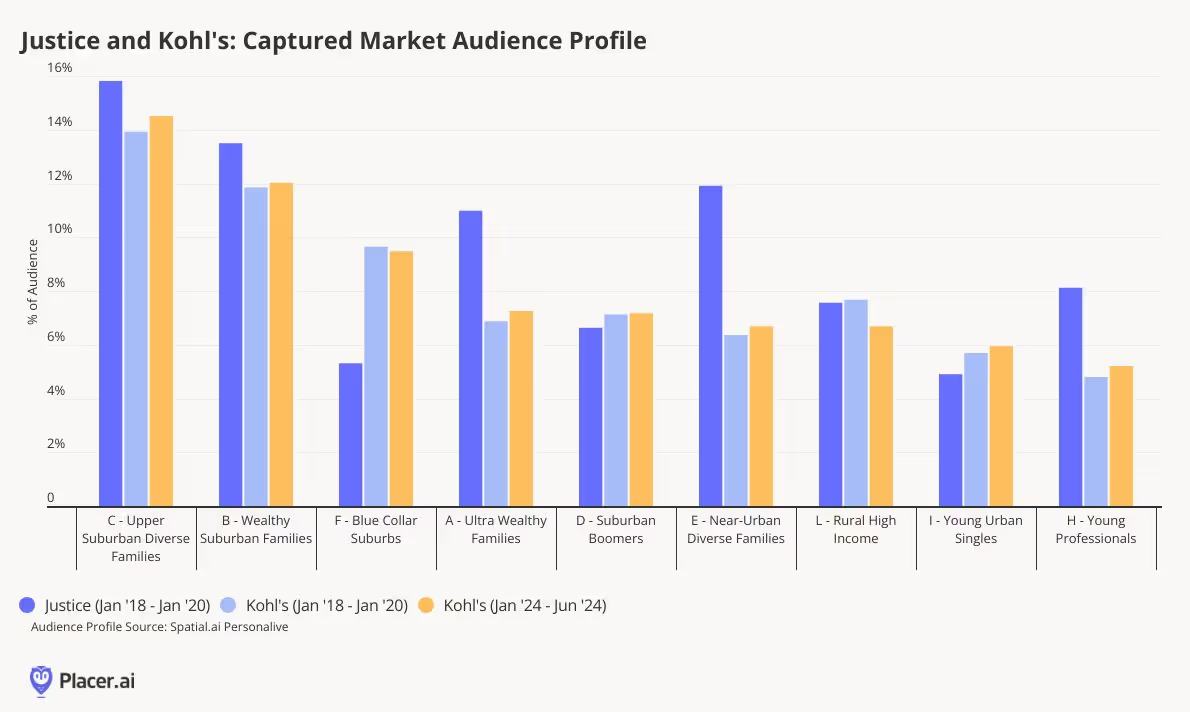
Although the demographic composition of Family Dollar’s trade areas sets the chain’s visitor base apart, diving into the psychographic segmentation of the chain’s captured and potential market highlights similarities with other value-forward retailers.
All four chains analyzed seem particularly popular with rural audiences – specifically with the Rural Average Income and Rural Low Income segments as defined by the Spatial.ai: PersonaLive dataset. (Dollar General and Walmart also see a disproportionate number of visits from the Rural High Income segment within their potential markets.) So some of Family Dollar’s rural shoppers may already be visiting Walmart or Discount & Dollar Stores – and these other retailers may choose to open in areas where Family Dollar is closing and where no other discounter currently operates.
.avif)
The massive rightsizing of Family Dollar’s store fleet creates major opportunities for other value-driven retailers to expand their reach. Who will end up benefiting most from these shifts?
Check in with placer.ai to find out.
This blog includes data from Placer.ai Data Version 2.0, which implements improvements to our extrapolation capabilities, adds short visit monitoring, and enhances visit detection.

Last year’s retail vibe was nothing if not experiential. Inflation led consumers to trade down and cut back on discretionary spending – but people still sought out fun, affordable venues to meet up with friends and let off some steam.
So with 2023 firmly in the rearview mirror, we dove into the data to check in with Dave & Buster’s Entertainment Inc., owner of eatertainment chain Dave & Buster's, and – since 2022 – Main Event Entertainment. How did the company’s two brands fare in the final months of 2023 and at the start of 2024? And what lies in store for them in the months ahead?
Dave & Buster’s, the sports bar arcade that invites harried grown-ups to cast aside their worries and “unlearn adulthood”, is thriving. With some 160 venues across 42 states, Dave and Buster’s offers the most tightly-wound consumers an inexpensive escape from real life – someplace they can unwind with friends over a beer, some mouthwatering shareables, and a bit of friendly skee-ball.
Over the past several years, Dave & Buster’s has grown its store count, and in 2022 broadened its portfolio with Main Event Entertainment – the family-oriented eatertainment concept that pairs arcade games with larger format activities such as laser tag and bowling. And since November 2023, both brands have sustained mainly positive year-over-year (YoY) visit growth, disrupted only by January 2024’s inclement weather.
.png)
Main Event Entertainment’s purchase by Dave & Buster’s appears to have been a natural move on the company’s part. Overlaying foot traffic data with demographics from STI’s PopStats reveals that the two chains’ comparable offerings attract customers with similar income profiles: In 2023, Dave & Buster’s’ and Main Event’s captured markets featured median household incomes (HHIs) of $67.3K and $67.6K, respectively – just under the nationwide baseline of $69.5K.
But the acquisition of Main Event has also allowed Dave & Buster’s Entertainment, Inc. to broaden its visitor base. Both of the company’s brands attract plenty of singles and families with children. But while Dave & Buster’s young-adult-oriented vibe holds special appeal for people living on their own, Main Event’s child-friendly activities make it a particularly attractive destination for parental households. Together, the two chains offer something for everyone – cementing the company’s role as an eatertainment leader.
.png)
Dave & Buster’s and Main Event also enjoy similar weekly visitation patterns. Unsurprisingly, the two chains are busiest on Saturdays, followed by Sundays and Fridays, and quieter during the rest of the week. But both brands have also found creative ways to boost weekday visits. On Wednesdays, Dave & Buster’s offers a 50%-off deal, letting customers play their favorite games at half the price – and fueling a significant midweek foot traffic spike. Main Event Entertainment, for its part, draws weekday crowds on Mondays with an afternoon all–you-can-play special.
.png)
Everybody needs to let their hair down sometimes – and with Spring Break right around the corner, both Dave & Buster’s and Main Event are building momentum with seasonal specials aimed at making their offerings even more affordable.
For both chains, March is an important milestone – in 2023, Dave & Buster’s and Main Event drew 41.0% and 82.9% more traffic during the week of March 13th, respectively, than they did, on average, throughout the rest of year. And if recent visit trends are any indication, the two brands appear poised to enjoy a healthy Spring Break and a strong rest of 2024.
For more data-driven retail and dining insights, follow Placer.ai.
This blog includes data from Placer.ai Data Version 2.0, which implements improvements to our extrapolation capabilities, adds short visit monitoring, and enhances visit detection.

Despite the individual restaurant success stories in 2023, last year was also a period of economic headwinds in the dining industry. But Darden Restaurants – and its largest chains Olive Garden, LongHorn Steakhouse, and Cheddar’s Scratch Kitchen – continued to drive foot traffic. We dove into the location analytics for these three Darden brands and took a closer look at the shifts in consumer behavior impacting the dining space.
Foot traffic in 2023 was largely positive for Olive Garden, LongHorn Steakhouse, and Cheddar’s Scratch Kitchen, with the strong visit trends likely helping drive Darden’s recent sales growth.
All three brands posted impressive YoY visit growth in Q1 2023, perhaps aided by the comparison to an Omicron-impacted, muted Q1 2022. LongHorn Steakhouse then pulled ahead of the pack in Q2 and Q3 with YoY foot traffic up 3.7% and 4.8%, respectively, before finishing the year off strong with a 3.8% YoY visit increase in Q4. But the real Darden star in Q4 was Olive Garden. The Italian-focused chain’s success was likely bolstered by the return of the Never Ending Pasta Bowl – offered from late September 2023 through mid-November – which appears to have attracted even more hungry diners than it did the previous year.
Meanwhile, YoY visits to Cheddar’s Scratch Kitchen increased during the first three quarters of 2023 and held relatively steady in Q4 – YoY visits during the last quarter of the year were down just 0.7% – highlighting the overall strength of Darden’s portfolio.
.avif)
Though 2023 was a particularly successful year for Darden foot traffic, Olive Garden, LongHorn, and Cheddar’s were not immune to this year’s arctic blast. The extreme weather in January 2024 impacted dining visits and put a damper on traffic to these chains. But once the weather warmed up in February 2024, YoY visits to Olive Garden, LongHorn, and Cheddar’s began to heat up as well – outpacing even the strong early 2023 traffic – indicating that Darden brands are likely in for another year of robust visits.
.avif)
Diving deeper into the analytics for Darden’s brands indicated that shifts in consumer behavior may be a factor in the restaurants’ recent foot traffic gains. Analysis of hourly visits to Olive Garden, LongHorn, and Cheddar’s since 2019 revealed that a greater share of visitors are now engaging with their favorite restaurants during non-traditional dayparts in the mid and late afternoon.
The share of daily Olive Garden, LongHorn, and Cheddar’s visitors visiting between 2 PM and 5:59 PM was higher in 2023 than in 2019 for all three brands. Olive Garden had the largest share of mid and late afternoon visits in 2022 at 32.6% and maintained its share of 2:00 PM to 5:59 PM visitation in 2023. Meanwhile, LongHorn and Cheddar’s share of visits during the 2:00 PM to 5:59 PM daypart continued increasing in 2023 relative to the previous year, which suggests that this trend of late afternoon and early dinner visits is becoming the new normal.
As eating out early is becoming more prevalent in the casual dining space – as well as in fine dining and steakhouse restaurants – Darden might capitalize on this trend by adding more happy hours and other late-afternoon specials to its restaurants’ menus.
.png)
Darden’s biggest chains succeeded in driving foot traffic growth in 2023 and early 2024. Location analytics indicated that while demand for the brands is consistent, consumer behavior is always changing. How will these restaurants navigate the rest of 2024? Visit Placer.ai to find out.
This blog includes data from Placer.ai Data Version 2.0, which implements improvements to our extrapolation capabilities, adds short visit monitoring, and enhances visit detection.

Athleisure and sportswear are a go-to for consumers looking to move seamlessly between activities – from a workout to work-from-home. That functionality has kept the category running hot in recent years even while more consumers are getting back to the office and socializing. And since athleisure and sportswear are now bonafide wardrobe staples, more consumers are investing in high-end items. We dove into the data for two of the category’s biggest upscale players – Nike and lululemon – in order to take a closer look at the consumer behavior driving visit growth.
During all four quarters of 2023, Nike and lululemon saw year-over-year (YoY) foot traffic growth that surpassed the visit increases in the wider Athleisure & Sportswear space. Part of Nike’s sizable 2023 YoY visit gains were likely due to the addition of a large number of stores relative to its somewhat modest footprint. Nike is continuing to invest in own-brand stores to boost DTC business including the first U.S. Michael Jordan "World of Flight" store coming to Philadelphia, PA. Lululemon also expanded its store count – albeit more modestly – which likely also helped the company stay ahead of the competition.
.png)
Fueled by significant store growth, Nike managed to keep YoY foot traffic positive in the first two months of 2024 despite the arctic blast that plagued overall retail visits in January.
Lululemon and the wider Athleisure & Sportswear space were less insulated from the effects of the storm, and the comparison to a strong 2023 made for mild YoY visit gaps in January 2024. But by the end of February 2024, both lululemon and the Athleisure & Sportswear space had narrowed their visit gaps and appeared to be on an upward trajectory.
.png)
Diving deeper into the demographic data for Nike’s trade area indicated that the aggressive expansion is not the only factor driving the brand’s recent foot traffic gains. Analysis using the AGS: Demographic Dimensions dataset revealed that since the 2021 retail reopening – and specifically Q3 2021 – the median household income (HHI) of Nike’s captured market has been higher than that of its potential market*. And the gap between the median HHI in the brand’s captured and potential markets seems to have widened even further in 2022-2023.
Driving traffic from affluent consumers appears to be an intentional strategy by the brand. Nike CEO John Donahoe recently noted that the brand is expanding in products across price points and now offers more expensive womenswear than ever before – and location intelligence indicates that this strategy is working. By Q4 2023, the median HHI of Nike’s captured market had climbed to $95.6K – the highest in nearly five years. This suggests that despite the adverse impact of inflation on some aspirational shoppers, Nike is succeeding in driving high-value foot traffic.
*A chain’s potential market refers to the population residing in a given trade area, where the Census Block Groups (CBGs) making up the trade area are weighted to reflect the number of households in each CBG. A chain’s captured market weighs each CBG according to the actual number of visits originating to the chain from that CBG.
.png)
Will the success of upscale athleisure and sportswear continue in 2024? Visit Placer.ai to find out.
This blog includes data from Placer.ai Data Version 2.0, which implements improvements to our extrapolation capabilities, adds short visit monitoring, and enhances visit detection.

The big news coming out of Dollar Tree’s Q4 2023 update was that the company plans to close 1,000 stores following a comprehensive portfolio review (which we first discussed in December). Management plans to close approximately 600 Family Dollar stores in the first half of fiscal 2024, with another 370 Family Dollar and 30 Dollar Tree stores expected to close over the next several years as store lease terms expire. The 970 anticipated Family Dollar store closures represent 11.6% of the banner’s 8,359 stores opened as of the end of February. Dollar stores were one of the strongest performing categories from a visitation (new stores and perspective during 2023 (below), so it may seem surprising that Dollar Tree plans to close so many Family Dollar stores during 2024.
Dollar Tree’s decision to close Family Dollar stores echoes a lot of what we’ve heard from other retailers closing stores in recent years, including Macy’s, CVS/Walgreens, and others. For the most part, retailers’ decisions to close stores comes down to a combination of factors: (1) population migration has changed the supply/demand balance in a given market; (2) consumer behavior has changed post-COVID; (3) the retailer is facing new sources of competition and eroding consumer loyalty; and (4) retailers are replacing underperforming stores with a modernized store layout.
Management cited changing demographics and market saturation as key considerations driving its consolidation efforts for Family Dollar. While the company has not announced which locations it plans to close, we’ve plotted Family Dollar’s 1,000 lowest performing locations over the trailing twelve months on a visit per square foot basis below.
If we compare this to a map of changes in Origin/Destination Household Income Ratio over the past four years (using Placer’s Migration Trends report), the changing demographics that Dollar Tree cited becomes evident. Many underperforming Family Dollar locations are in the Mid-Atlantic and Southeast markets, several of which have seen an increase in higher household income population due to migration (represented by the green dots below). As populations in these markets have shifted, it’s not surprising that the company is reevaluating its store portfolio in these markets.
The other factor at play behind these store closures is increasing competition. We’ve discussed disruption from Temu and other online marketplaces in the past, but dollar stores are also fighting for visitor share with value grocery chains, superstores, and convenience stores. And it’s not just lower-income consumers that these chains are fighting over–we’re seeing increasing evidence that dollar stores are seeing visits from middle income consumers. In fact, Dollar Tree CEO Rick Dreiling noted that Dollar Tree added 3.4 million new customers in 2023, mostly from households earning over $125,000 a year. We’ve previously noted how Walmart has been successful attracting more middle-income consumers but if we look at captured trade area demographics for the Dollar Tree banner (and not including Family Dollar) from Q3 2023 to Q4 2023, we do see an increase in the trade areas between $50-$150K in household income (below).
Admittedly, some of the increase in higher-income consumers can be explained by the aforementioned migration trends, but management also attributes the pick up in middle-income consumers to its multi-price point strategy called “More Choices” (which we’ve discussed in the past). In particular, we believe the company has seen success driving visits to Dollar Tree stores with its $3, $4, and $5 frozen and refrigerated assortment, which have been rolled out to more than 6,500 locations today (almost 80% of the banner’s store base as of February). The company has also discussed adding cooler capacity at Family Dollar stores; 17,000 cooler doors were added at Family Dollar last year, which brought the average to 26 coolers per store (versus a long-term goal of 30 coolers per store). We suspect that many of the closed Family Dollar stores will be replaced with new stores featuring expanded cooler offerings to better compete for customers across all demographic groups.
There are also more practical reasons for the store closures, including improved execution. Dreiling pointed out that underperforming stores can “take the bulk of a district manager's time”. By closing them, the company can better focus on service and execution at existing stores. Also, management believes that the closings will be accretive from a cash perspective (i.e., it’s cheaper to run these underperforming stores dark than it is to operate them at a loss).
When closing stores, there is always the risk that customers will churn to competing retail brands and categories. In fact, we’ve seen a meaningful number of visitors to CVS and Walgreens locations that closed the past two years migrate to nearby grocery and superstore chains. However, by replicating many of Dollar Tree’s successful strategies–including expanded cooler assortments–at future Family Dollar store openings, it gives the chain an opportunity to offset potential visitors lost to this round of closures.

While many retailers have embraced smaller format stores, one chain bucking this trend is Dick’s Sporting Goods through its large-format House of Sport concept. This format offers shoppers an “elevated assortment and service model, premium experiences and enhanced visual expressions”. We discussed the early success of the House of Sport last summer, and with a few months of additional data to look at, we can now better assess the longer-term potential of this concept sporting goods retail category.
Below, we’ve presented visit per location data for the 12 Dick’s House of Sport locations currently open versus Dick’s chainwide average since the beginning of 2023. The strong visits per location trends that we identified last July continued into the back half of 2023 and early 2024, with House of Sport locations now seeing 5-6 times the number of visits per location compared to the rest of the chain. For reference, the average Dick’s Sporting Goods store is roughly 50K square feet square feet compared to 100K-120K square feet for House of Sport, indicating that House of Sport is also outperforming on a visit per square foot basis.
Given the strong visitation trends, it’s not surprising that Dick’s plans to invest more in the House of Sport concept in the years ahead. In 2024, the company plans to open eight new locations, with seven being planned relocations/conversions of existing Dick’s stores and one new store at Prudential Center in Boston. The company also plans to begin construction this year on approximately 15 House of Sport locations that will open throughout 2025, bringing the total number of House of Sport locations to 35 by the end of 2025. Longer-term, management sees an opportunity for 75-100 House of Sport locations by 2027.
Interestingly, Dick’s plans to incorporate experiential elements similar to House of Sport across the rest of its store portfolio. During its Q4 2023 update this past week, management also announced plans to open 16 next-generation 50K square foot Dick’s Sporting Goods stores in 2024, including the relocation/remodeling of 12 existing stores (on top of the 11 next-generation stores already opened). These next generation stores were inspired by the House of Sport format and incorporate expanded product assortments for certain categories, emphasis on services, and improved visuals. The company also plans to open 10 Golf Galaxy Performance Center locations in 2024 (aligning well with golf’s post-COVID comeback).
In total, Dick’s Sporting Goods plans to increase square footage by approximately 2% in 2024, marking the retailer's largest annual square footage increase since 2017. Importantly, the economics behind Dick’s nascent store formats are compelling. The House of Sport formats generate approximately $35 million in omnichannel sales per store, approximately 20% EBITDA margins, and cash-on-cash returns of 35% on an initial investment of $18.5M ($11.5M capex, $3.5M inventory, and $3.5M pre-opening costs). The next-generation Dick’s stores are expected to generate $14M in omnichannel sales per store, 20% EBITDA margins, and cash-on-cash returns of 65% on an initial investment of $4.5M ($2.5M capex, $1.5M inventory, and $0.5M in pre-opening costs).


1. The hypergrowth of Costco, Dollar Tree, and Dollar General between 2019 and 2025 has fundamentally changed the brick-and-mortar retail landscape.
2. Overall visits to Target and Walmart have remained essentially stable even as traffic to the new retail giants skyrocketed – so the increased competition is not necessarily coming at legacy giants' expense. Instead, each retail giant is filling a different need, and success now requires excelling at specific shopping missions rather than broad market dominance.
3. Cross-shopping has become the new normal, with Walmart and Target maintaining their popularity even as their relative visit shares decline, creating opportunities for complementary rather than purely competitive strategies.
4. Dollar stores are rapidly graduating from "fill-in" destinations to primary shopping locations, signaling a fundamental shift in how Americans approach everyday retail.
5. Walmart still enjoys the highest visit frequency, but the other four chains – and especially Dollar General – are gaining ground in this realm.
6. Geographic and demographic specialization is becoming the key differentiator, as each chain carves out distinct niches rather than competing head-to-head across all markets and customer segments.
Evolving shopper priorities, economic pressures, and new competitors are reshaping how and where Americans buy everyday goods. And as value-focused players gain ground, legacy retail powerhouses are adapting their strategies in a bid to maintain their visit share. In this new consumer reality, shoppers no longer stick to one lane, creating a complex ecosystem where loyalty, geography, and cross-visitation patterns – not just market share – define who is truly winning.
This report explores the latest retail traffic data for Walmart, Target, Costco, Dollar Tree, and Dollar General to decode what consumers want from retail giants in 2025. By analyzing visit patterns, loyalty trends, and cross-shopping shifts, we reveal how fast-growing chains are winning over consumers and uncover the strategies helping legacy players stay competitive in today's value-driven retail landscape.
In 2019, Walmart and Target were the two major behemoths in the brick-and-mortar retail space. And while traffic to these chains remains close to 2019 levels, overall visits to Dollar General, Dollar Tree, and Costco have increased 36.6% to 45.9% in the past six years. Much of the growth was driven by aggressive store expansions, but average visits per location stayed constant (in the case of Dollar Tree) or grew as well (in the case of Dollar General and Costco). This means that these chains are successfully filling new stores with visitors – consumers who in the past may have gone to Walmart or Target for at least some of the items now purchased at wholesale clubs and dollar stores.
This substantial increase in visits to Costco, Dollar General, and Dollar Tree has altered the competitive landscape in which Walmart and Target operate. In 2019, 55.9% of combined visits to the five retailers went to Walmart. Now, Walmart’s relative visit share is less than 50%. Target received the second-highest share of visits to the five retailers in 2019, with 15.9% of combined traffic to the chains. But Between January and July 2025, Dollar General received more visits than Target – even though the discount store had received just 12.1% of combined visits in 2019.
Some of the growth of the new retail giants could be attributed to well-timed expansion. But the success of these chains is also due to the extreme value orientation of U.S. consumers in recent years. Dollar General, Dollar Tree, and Costco each offer a unique value proposition, giving today's increasingly budget-conscious shoppers more options.
Walmart’s strategy of "everyday low prices" and its strongholds in rural and semi-rural areas reflect its emphasis on serving broad, value-focused households – often catering to essential, non-discretionary shopping.
Dollar General serves an even larger share of rural and semi-rural shoppers than Walmart, following its strategy of bringing a curated selection of everyday basics to underserved communities. The retailer's packaging is typically smaller than Walmart's, which allows Dollar General to price each item very affordably – and its geographic concentration in rural and semi-rural areas also highlights its direct competition to Walmart.
By contrast, Target and Costco both compete for consumer attention in suburban and small city settings, where shopper profiles tilt more toward families seeking one-stop-shopping and broader discretionary offerings. But Costco's audience skews slightly more affluent – the retailer attracts consumers who can afford the membership fees and bulk purchasing requirements – and its visit growth may be partially driven by higher income Target shoppers now shopping at Costco.
Dollar Tree, meanwhile, showcases a uniquely balanced real estate strategy. The chain's primary strength lies in suburban and small cities but it maintains a solid footing in both rural and urban areas. The chain also offers a unique value proposition, with a smaller store format and a fixed $1.25 price point on most items. So while the retailer isn't consistently cheaper than Walmart or Dollar General across all products, its convenience and predictability are helping it cement its role as a go-to chain for quick shopping trips or small quantities of discretionary items. And its versatile, three-pronged geographic footprint allows it to compete across diverse markets: Dollar Tree can serve as a convenient, quick-trip alternative to big-box retailers in the suburbs while also providing essential value in both rural and dense urban communities.
As each chain carves out distinct geographic and demographic niches, success increasingly depends on being the best option for particular shopping missions (bulk buying, quick trips, essential needs) rather than trying to be everything to everyone.
Still, despite – or perhaps due to – the increased competition, shoppers are increasingly spreading their visits across multiple retailers: Cross-shopping between major chains rose significantly between 2019 and 2025. And Walmart remains the most popular brick-and-mortar retailer, consistently ranking as the most popular cross-shopping destination for visitors of every other chain, followed by Target.
This creates an interesting paradox when viewed alongside the overall visit share shift. Even as Walmart and Target's total share of visits has declined, their importance as a secondary stop has actually grown. This suggests that the legacy retail giants' dip in market share isn't due to shoppers abandoning them. Instead, consumers are expanding their shopping routines by visiting other growing chains in addition to their regular trips to Walmart and Target, effectively diluting the giants' share of a larger, more fragmented retail landscape.
Cross-visitation to Costco from Walmart, Target, and Dollar Tree also grew between 2019 and 2025, suggesting that Costco is attracting a more varied audience to its stores.
But the most significant jumps in cross-visitation went to Dollar Tree and Dollar General, with cross-visitation to these chains from Target, Walmart, and Costco doubling or tripling over the past six years. This suggests that these brands are rapidly graduating from “fill-in” fare to primary shopping destinations for millions of households.
The dramatic rise in cross-visitation to dollar stores signals an opportunity for all retailers to identify and capitalize on specific shopping missions while building complementary partnerships rather than viewing every chain as direct competition.
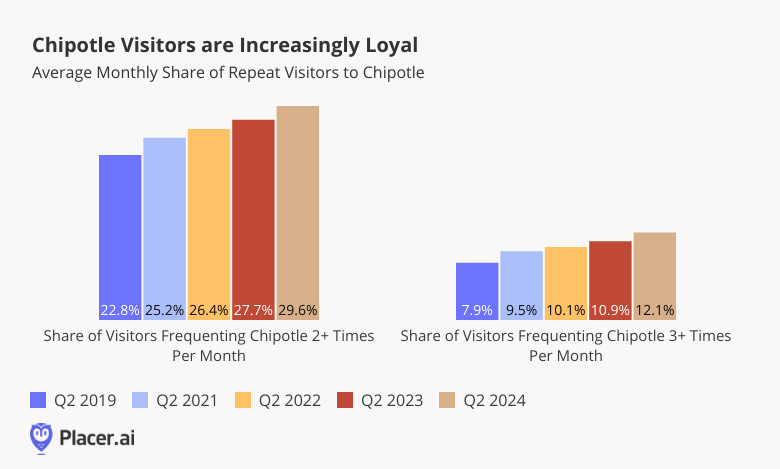
Walmart’s status as the go-to destination for essential, non-discretionary spending is clearly reflected in its exceptional loyalty rates – nearly half its visitors return at least three times per month on average -between January to July 2025, a figure virtually unchanged since 2019. This steady high-frequency visitation underscores how necessity-driven shopping anchors customer routines and keeps Walmart atop the retail loyalty ranks.
But the data also reveals that other retail giants – and Dollar General in particular – are steadily gaining ground. Dollar General's increased visit frequency is largely fueled by its strategic emphasis on adding fresh produce and other grocery items, making it a viable everyday stop for more households and positioning it to compete more directly with Walmart.
Target also demonstrates a notable uptick in loyal visitors, with its share of frequent shoppers visiting at least three times a month rising from 20.1% to 23.6% between 2019 and 2025. This growth may suggest that its strategic initiatives – like the popular Drive Up service, same-day delivery options, and an appealing mix of essentials and exclusive brands – are successfully converting some casual shoppers into repeat customers.
Costco stands out for a different reason: while overall visits increased, loyalty rates remained essentially unchanged. This speaks to Costco’s unique position as a membership-based outlet for targeted bulk and premium-value purchases, where the shopping behavior of new visitors tends to follow the same patterns as those of its already-loyal core. As a result, trip frequency – rooted largely in planned stock-ups – remains remarkably consistent even as the warehouse giant grows foot traffic overall.
Dollar Tree currently has the smallest share of repeat visitors but is improving this metric. As it successfully encourages more frequent trips and narrows the loyalty gap with its larger rivals, it's poised to become an increasing source of competition for both Target and Costco.
The increase in repeat visits and cross-shopping across the five retail giants showcases consumers' current appetite for value-oriented mass merchants and discount chains. And although the retail giants landscape may be more fragmented, the data also reveals that the pie itself has grown significantly – so the increased competition does not necessarily need to come at the expense of legacy retail giants.
The retail landscape of 2025 demands a fundamental shift from zero-sum competition to strategic complementarity, where success lies in owning specific shopping missions rather than fighting for total market dominance. Retailers that forego attempting to compete on every front and instead clearly communicate their mission-specific value propositions – whether that's emergency runs, bulk essentials, or family shopping experiences – may come out on top.

1. Market Divergence: While San Francisco's return-to-office trends have stabilized, Los Angeles is increasingly lagging behind national averages with office visits down 46.6% compared to pre-pandemic levels as of June 2025.
2. Commuter Pattern Shifts: Los Angeles faces a persistent decline in out-of-market commuters while San Francisco's share of out-of-market commuters has recovered slightly, indicating deeper structural challenges in LA's office market recovery.
3. Visit vs. Visitor Gap: Unlike other markets where increased visits per worker offset declining visitor numbers, Los Angeles saw both metrics decline year-over-year, suggesting fundamental workforce retention issues.
4. Century City Exception: Century City emerges as LA's strongest office submarket with visits only 28.1% below pre-pandemic levels, driven by its premium amenities and strategic location adjacent to Westfield Century City shopping center.
5. Demographic Advantage: Century City's success may stem from its success in attracting affluent, educated young professionals who value lifestyle integration and are more likely to maintain consistent office attendance in hybrid work arrangements.
While return-to-office trends have stabilized in many markets nationwide, Los Angeles and San Francisco face unique challenges that set them apart from national patterns. This report examines the divergent trajectories of these two major West Coast markets, with particular focus on Los Angeles' ongoing struggles and the emergence of one specific submarket that bucks broader trends.
Through analysis of commuter patterns, demographic shifts, and localized performance data, we explore how factors ranging from out-of-market workforce changes to amenity-driven location advantages are reshaping the competitive landscape for office real estate in Southern California.
Both Los Angeles and San Francisco continue to significantly underperform the national office occupancy average. In June 2025, average nationwide visits to office buildings were 30.5% below January 2019 levels, compared to a 46.6% and 46.4% decline in visits to Los Angeles and San Francisco offices, respectively.
While both cities now show similar RTO rates, they arrived there through different trajectories. San Francisco has consistently lagged behind national return-to-office levels since pandemic restrictions first lifted.
Los Angeles, however, initially mirrored nationwide trends before its office market began diverging and falling behind around mid-2022.
The decline in office visits in Los Angeles and San Francisco can be partly attributed to fewer out-of-market commuters. Both cities saw significant drops in the percentage of employees who live outside the city but commute to work between H1 2019 and H1 2023.
However, here too, the two cities diverged in recent years: San Francisco's share of out-of-market commuters relative to local employees rebounded between 2023 and 2024, while Los Angeles' continued to decline – another indication that LA's RTO is decelerating as San Francisco stabilizes.
Like in other markets, Los Angeles saw a larger drop in office visits than in office visitors when comparing current trends to pre-pandemic levels. This is consistent with the shift to hybrid work arrangements, where many of the workers who returned to the office are coming in less frequently than before the pandemic, leading to a larger drop in visits compared to the drop in visitors.
But looking at the trajectory of RTO more recently shows that in most markets – including San Francisco – office visits are up year-over-year (YoY) while visitor numbers are down. This suggests that the workers slated to return to the office have already done so, and increasing the numbers of visits per visitor is now the path towards increased office occupancy.
In Los Angeles, visits also outperformed visitors – but both figures were down YoY (the gap in visits was smaller than the gap in visitors). So while the visitors who did head to the office in LA in Q2 2025 clocked in more visits per person compared to Q2 2024, the increase in visits per visitor was not enough to offset the decline in office visitors.
While Los Angeles may be lagging in terms of its overall office recovery, the city does have pockets of strength – most notably Century City. In Q2 2025, the number of inbound commuters visiting the neighborhood was just 24.7% lower than it was in Q2 2019 and higher (+1.0%) than last year's levels.
According to Colliers' Q2 2025 report, Century City accounts for 27% of year-to-date leasing activity in West Los Angeles – more than double any other submarket – and commands the highest asking rental rates. The area benefits from Trophy and Class A office towers that may create a flight-to-quality dynamic where tenants migrate from urban core locations to this Westside submarket.
The submarket's success is likely bolstered by its strategic location adjacent to Westfield Century City shopping center – visit data reveals that 45% of weekday commuters to Century City also visited Westfield Century City during Q2 2025. The convenience of accessing the mall's extensive retail, dining, and entertainment options during lunch breaks or after work may encourage employees to come into the office more frequently.
Perhaps thanks to its strategic locations and amenities-rich office buildings, Century City succeeds in attracting relatively affluent office workers.
Century City's office submarket has a higher median trade area household income (HHI) than either mid-Wilshire or Downtown LA. The neighborhood also attracts significant shares of the "Educated Urbanite" Spatial.ai: PersonaLive segment – defined as "well educated young singles living in dense urban areas working relatively high paying jobs".
This demographic typically has fewer family obligations and greater flexibility in their work arrangements, making them more likely to embrace hybrid schedules that include regular office attendance. Affluent singles also tend to value the lifestyle amenities and networking opportunities that come with working in a premium office environment like Century City: This demographic is often in career-building phases where in-person collaboration and visibility matter more, driving consistent office utilization that helps sustain the submarket's performance even as other LA office areas struggle with lower occupancy rates.
The higher disposable income of this audience also aligns well with the submarket's upscale retail and dining options at nearby Westfield Century City, creating a mutually reinforcing ecosystem where the office environment and surrounding amenities cater to their preferences.
As the broader Los Angeles market grapples with a shrinking commuter base and declining office utilization, the performance gap between premium, amenity-rich locations and traditional office districts is likely to widen. For investors and tenants alike, these trends underscore the growing importance of location quality, demographic targeting, and lifestyle integration in determining long-term office market viability across Southern California.
Century City's success – anchored by its affluent, career-focused workforce and integrated lifestyle amenities – can offer a blueprint for office market resilience in the hybrid work era.