.png)
.png)

.png)
.png)


Downtown Austin is navigating a period of unusual complexity. A convention center renovation and major highway construction have created significant disruption, while extreme summer heat and pullbacks in consumer spending are adding further pressure.
Yet despite these headwinds, visitation is nearing pre-pandemic levels. And a key factor driving Austin’s recovery has been its deliberate use of data to guide strategy, align stakeholders, and deploy resources where they can have the greatest impact.
Since 2022, Downtown Austin has been on a steady recovery trajectory. By 2025, non-resident and non-employee visits to the area reached 94.4% of 2019 levels – a milestone that becomes even more meaningful against the backdrop of this year’s intensely hot summer and the temporary closure of Austin’s convention center, which has remained offline since April 2025.
This data reveals resilience that might otherwise have gone unnoticed – critical framing when coordinating across agencies and reassuring stakeholders that downtown remains a reliable economic engine even during infrastructure transitions.
The composition of that visitation tells an equally important story. A growing share of visitors to downtown Austin are coming from within Texas – especially on weekends.
In an environment where consumers are more value-conscious and long-haul travel remains uneven, this regional draw has become a strategic asset. In-state travelers are more likely to make shorter, repeat trips, creating consistent demand for restaurants, entertainment venues, and retail corridors.
The Downtown Austin Alliance uses this insight to refine both marketing and access strategies. Partnerships such as discounted ride programs within a 30-mile radius reduce friction for local visitors during the holiday season, while targeted programming ensures downtown remains competitive as a weekend destination.
At the policy level, this data strengthens the case that downtown’s success benefits the broader state economy. When a rising share of visitors originates within Texas, the dollars spent downtown circulate locally – supporting jobs, generating tax revenue, and reinforcing Austin’s role as an economic anchor.
Data also helps the Alliance optimize services around major events that drive tourism to Austin – such as the annual ACL Music Festival and Formula 1 Grand Prix – supporting operational precision. High-traffic areas receive intensified cleaning and hospitality services, while lower-traffic zones become candidates for murals, activations, and smaller-scale programming designed to distribute energy more evenly. Event-driven data also informs conversations with transportation partners as construction continues to reshape mobility routes.
The strategic use of data is also evident in the revitalization of East Sixth Street. Long known as a historic entertainment corridor with a late-night reputation, the district is now the focus of a coordinated effort to evolve its positioning and offerings.
And data has played an important role in getting people on board. Location analytics, for example, show that out-of-market visitors to the district are coming from more affluent areas, showing that spending power exists and is growing – and that the district’s offerings may have room to evolve alongside its audience.
For property owners and local businesses, this data provides a clearer picture of market potential. And for public-sector partners, it strengthens the case for infrastructure upgrades and placemaking investments.
Austin’s experience offers a broader lesson for cities navigating disruption. Infrastructure transitions, climate pressures, and evolving travel patterns present real challenges – but by grounding placemaking strategies in clear, measurable data, Austin is strengthening downtown’s economic foundation and aligning stakeholders around a shared vision.
.avif)
Amid a tightening job market, the list of employers requiring workers to show up in person – many now mandating five days a week – continues to grow. But how did the office recovery fare in February 2026, a month marked by heavy snowstorms across major Northeast markets?
We dove into the data to find out.
In February 2026, visits to the Placer.ai Nationwide Office Index were 31.9% below 2019 levels – marking the smallest February post-pandemic visit gap to date. Overall attendance even slightly outpaced February 2024, a leap year that benefited from 20 business days instead of the usual 19.
While this is hardly the most impressive RTO showing we’ve seen in recent months, February’s gains came in spite of meaningful headwinds.
A late-February blizzard disrupted major Northeast markets, driving a year-over-year (YoY) decline in New York City office visits and widening Manhattan’s post-pandemic gap to 21.3% below 2019 levels. Boston, also hit hard by snow, saw visits remain flat YoY, slipping behind San Francisco and Denver in overall recovery progress.
By contrast, cities in other regions posted clear gains, with San Francisco – still benefiting from AI-driven hiring and renewed tech activity – once again seeing some of the strongest growth at +11.9% YoY.
February’s performance underscores a familiar pattern of month-to-month fluctuation, even as the broader RTO trajectory continues its upward climb. Regional dynamics – from weather disruptions to sector-specific hiring cycles – are shaping local outcomes, but the national baseline for office utilization is steadily rising.
For more data driven CRE insights, visit placer.ai/anchor.
Placer.ai leverages a panel of tens of millions of devices and utilizes machine learning to make estimations for visits to locations across the US. The data is trusted by thousands of industry leaders who leverage Placer.ai for insights into foot traffic, demographic breakdowns, retail sale predictions, migration trends, site selection, and more.
.avif)
The bifurcated consumer trends established in the second half of 2025 have persisted. While higher-income shoppers maintain relatively stable spending habits, lower- and middle-income households continue to feel the squeeze on essential categories like groceries and fuel. These consumers have become increasingly selective and price-sensitive, actively pivoting away from traditional mid-market chains in favor of discount retailers and value-oriented brands. Because affordability remains a core focus, average households are spreading their visits across a wider number of non-discretionary stores to hunt for deals. For example, our data shows that grocery visit growth is currently being driven by low- and middle-income households, as elevated food costs necessitate more frequent, budget-conscious trips.
However, despite this intense focus on everyday value, it would be a mistake to count out the discretionary sector, where consumer visits have also been mostly positive year-over-year (YoY) since the start of 2026. Despite weather-driven volatility, we continue to see healthy demand for discretionary categories as consumers start to put their tax refunds to work, actively seeking affordable indulgences and high-end brands at a discount.
E-commerce fulfillment centers are also seeing robust activity. Excluding a brief weather-related slump in late January, visits to these facilities are growing at a high-single to low-double-digit clip.
This surge in logistics activity is being driven by a perfect storm of consumer behavior and retail strategy: value-seeking shoppers, massive supply chain investments from giants like Walmart and Target, and the rise of frictionless "agentic" and social commerce. Furthermore, record-high product returns are forcing these centers to process a massive wave of reverse logistics, keeping facility utilization incredibly high.
As delayed tax refunds finally hit consumer bank accounts in the months ahead, we expect this strong e-commerce and fulfillment momentum to continue.
Manufacturing data has been highly volatile in early 2026. Placer.ai’s Industrial Manufacturing Index – which measures physical visits to manufacturing facilities across a wide range of verticals – showed an ebb and flow in the early weeks of the year. Severe winter storms heavily weighed on facility visits in late January, followed by a clear rebound in February.
This physical, on-the-ground improvement aligns with the latest macroeconomic indicators. According to the most recent ISM report, the U.S. manufacturing sector expanded for the second consecutive month in February, with the PMI registering a solid 52.4. Crucially, this growth is being driven by strong forward-looking demand, as the ISM New Orders Index remained firmly in expansion territory at 55.8. Ultimately, while underlying production and new orders show sustained momentum, unpredictable weather patterns continue to create short-term fluctuations in actual facility operations.
Looking ahead, volatility will likely be the baseline expectation for both the retail and manufacturing sectors throughout 2026. Unpredictable weather events, shifting supply chain dynamics, and the complexities of lapping 2025's macroeconomic hurdles will continue to create week-to-week fluctuations in physical foot traffic and industrial output.
Yet, beneath this turbulence lies a remarkably stable foundation: the American consumer. Despite the ongoing pressures of inflation and depleted household savings, shoppers remain incredibly resilient. They are highly strategic – pinching pennies on daily essentials and heavily utilizing value channels – precisely so they can continue to fund discretionary spending and lifestyle upgrades. The market may be volatile, but the 2026 consumer is proving that they are willing and able to spend when the value proposition is right.
Placer.ai leverages a panel of tens of millions of devices and utilizes machine learning to make estimations for visits to locations across the US. The data is trusted by thousands of industry leaders who leverage Placer.ai for insights into foot traffic, demographic breakdowns, retail sale predictions, migration trends, site selection, and more.

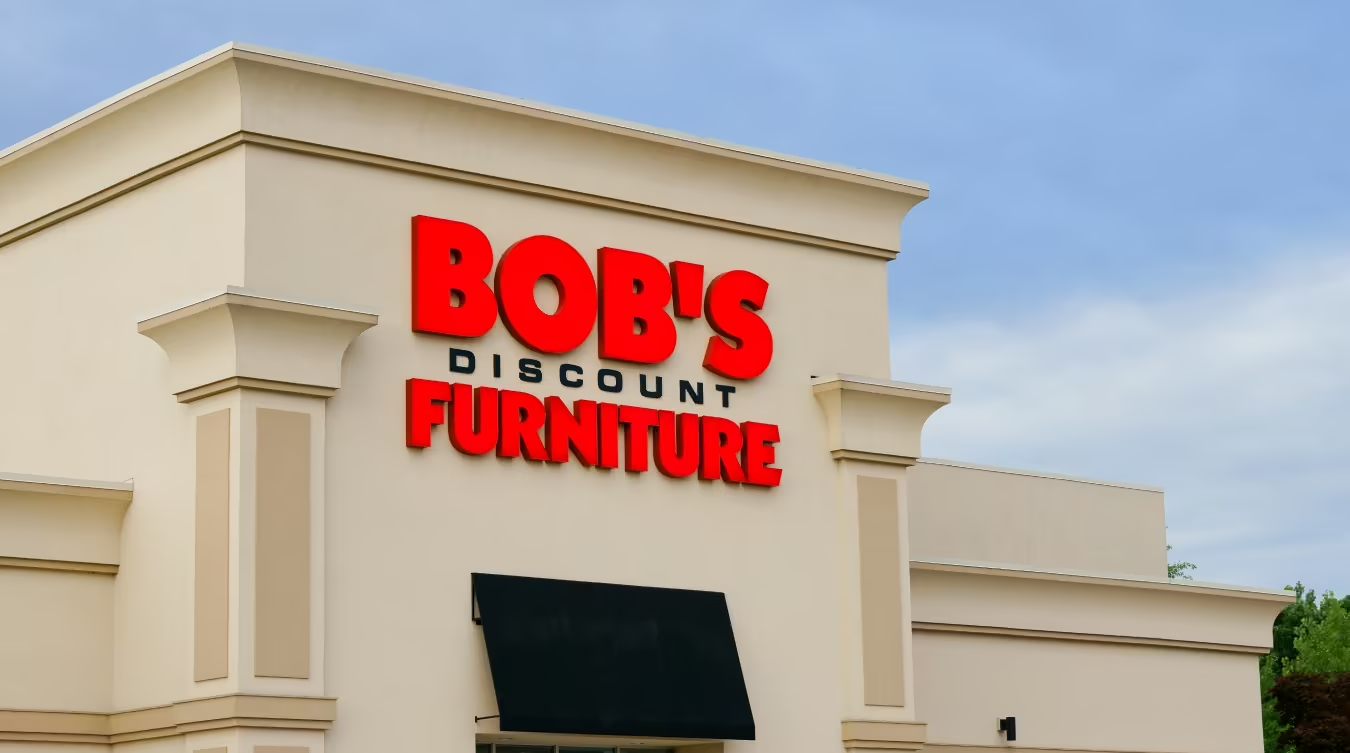
With its recent IPO, Bob’s Discount Furniture has officially entered a new chapter, stepping onto the public stage at a time when the home furnishings sector continues to face macroeconomic pressures. Yet despite these challenges, Bob’s has demonstrated notable momentum. This AI-powered data analysis takes a closer look at Bob’s performance, examining traffic trends, demographic positioning, and cross-shopping behavior to better understand what’s driving the company’s success.
Bob’s continued expansion supported year-over-year (YoY) visit increases throughout 2025 – but growth was not driven by footprint alone. Visits per location to the chain also climbed by 1.8% in 2025, indicating that existing stores captured incremental demand alongside new openings.
Analysis of Bob’s and the broader home furnishings category suggests that a favorable mix of value-oriented and affluent shoppers may be supporting the brand’s growth.
In 2025, the median household income of Bob’s captured market was $89.0K – below the category median of $92.5K, yet above the nationwide median of $79.6K. A similar pattern emerged when examining Bob’s audience by income groups. Among households earning under $100K and those earning over $150K, Bob’s share fell between the category benchmark and the national baseline.
This positioning suggests that while Bob’s resonates strongly with value-seeking consumers, its appeal is not limited to lower-income households – which could reflect the strength of its "Good, Better, Best" assortment strategy. As value-prioritization has gained traction across income levels, Bob’s appears to be attracting shoppers who are price-conscious yet still maintain discretionary spending power – a combination that is especially advantageous in a bigger-ticket category like furniture.
Reinforcing its position as a primary destination for furniture shoppers appears to be another factor fueling Bob’s growth.
AI-based location intelligence reveals that in 2025, the share of Bob’s visitors who also visited other major home furnishings chains declined compared to 2024. The shift was consistent across several key competitors, suggesting that fewer shoppers felt compelled to compare offerings at other chains before visiting Bob's Discount Furniture.
In a category where consumers frequently comparison-shop, declining cross-visitation may signal that Bob’s relaxed in-store environment – featuring the “Little Bob” sock-puppet and complementary cafés – is resonating with shoppers, reducing the incentive to look elsewhere.
These insights underscore Bob’s differentiated strategy within a volatile retail landscape. By combining disciplined expansion with broad cross-income appeal and brand loyalty, Bob’s is building both growth and resilience as it enters its public chapter.
Will Bob’s continue to find success in 2026? Visit Placer.ai/anchor to find out.
Placer.ai leverages a panel of tens of millions of devices and utilizes machine learning to make estimations for visits to locations across the US. The data is trusted by thousands of industry leaders who leverage Placer.ai for insights into foot traffic, demographic breakdowns, retail sale predictions, migration trends, site selection, and more.

Traffic to Darden banners remained relatively stable in 2025, with the company seeing an average increase of 1.2% in overall visits coupled with a slight dip of 0.3% in average visits per venue across its brands. Average visits per venue improved towards the end of the year relative to the annual average, growing 1.5% YoY in Q4 2025 – likely due to the closure of several Bahama Breeze restaurants in 2025, part of the company's plans to sunset the banner entirely by April 2026.
Analyzing traffic by banner points to clear resilience at the top of the market, with upscale casual and premium brands such as Yard House and Ruth's Chris Steakhouse generally showing the strongest and most consistent traffic growth. This pattern suggests that higher-income consumers remain relatively insulated and willing to spend, even amid broader volatility.
At the same time, LongHorn Steakhouse, one of Darden’s largest brands, also emerged as a standout performer, delivering steady positive traffic across multiple months. Given its scale within the portfolio, LongHorn likely made an outsized contribution to Darden’s overall positive traffic trends, helping to offset softness in other chains and reinforcing the company’s momentum.
Same-store YoY visit trends in recent months are very close to overall visit trends, suggesting that Darden’s traffic trends are largely same-store-driven rather than expansion-driven, with little evidence that unit growth is materially distorting overall traffic trends. Premium brands continue to perform well, and LongHorn is generating steady same-store growth across its large footprint, suggesting that Darden’s results are being driven by real consumer demand – especially among higher-income diners.
Darden’s results suggest that performance is being driven less by sheer scale and more by brand positioning, with concepts that offer either premium experiences or strong value perception (like LongHorn) capturing disproportionate demand. As consumer budgets remain tight, growth is likely to concentrate further in brands that clearly justify their price point – leaving middle-of-the-road concepts increasingly pressured to sharpen their value proposition or differentiate more meaningfully.
For up-to-date restaurant foot traffic, visit our free Industry Trends tool.
Placer.ai leverages a panel of tens of millions of devices and utilizes machine learning to make estimations for visits to locations across the US. The data is trusted by thousands of industry leaders who leverage Placer.ai for insights into foot traffic, demographic breakdowns, retail sale predictions, migration trends, site selection, and more.
.avif)
Shopping centers continued their growth streak in February 2026, with visits to all three formats – indoor malls, open-air shopping centers, and outlet malls – up year-over-year (YoY). After leading traffic gains in 2025, indoor malls took a back seat once again to open-air centers which led the category with a 7.3% YoY increase in February visits. Importantly, outlet malls followed closely behind with foot traffic up 7.2% YoY, after increasing 3.5% YoY in January 2026 – suggesting that the format is regaining momentum after its recent lull.
Even more notable is that when isolating the peak mall hours (11 AM to 8 PM), outlet malls led all formats in year-over-year visit growth across every daypart – 11 AM to 2 PM, 2 PM to 5 PM, and 5 PM to 8 PM. And while evening gains were strongest across all mall types, outlet malls posted the most significant increase during those hours.
This evening momentum may reflect a broader shift in how outlet centers are positioning themselves. Rather than serving solely as transactional shopping destinations, some are expanding their food and experiential offerings to encourage longer, more social visits. Recent examples include the addition of a craft beer truck at San Marcos Premium Outlets in Texas and the debut of a highly anticipated Japanese-Peruvian concept restaurant at Sawgrass Mills in Florida, which are likely drawing more leisure-oriented visitors to the centers.
Outlet mall's traffic softness in recent years likely reflected intensifying competition for value-driven apparel from off-price retailers and resale channels, which siphoned off some of the bargain-focused demand that traditionally fueled outlet visits. But if outlet malls can successfully differentiate through dining and experiential offerings – extending visits beyond purely transactional trips – they may be better positioned for a stronger 2026 as they compete on experience as well as price.
For more data-driven retail insights, visit placer.ai/anchor.
Placer.ai leverages a panel of tens of millions of devices and utilizes machine learning to make estimations for visits to locations across the US. The data is trusted by thousands of industry leaders who leverage Placer.ai for insights into foot traffic, demographic breakdowns, retail sale predictions, migration trends, site selection, and more.

This report leverages location intelligence data to analyze the auto dealership market in the United States. By looking at visit trends to branded showrooms, used car lots, and mixed inventory dealerships – and analyzing the types of visitors that visit each category – this white paper sheds light on the state of car dealership space in 2023.
Prior to the pandemic and throughout most of 2020, visits to both car brand and used-only dealerships followed relatively similar trends. But the two categories began to diverge in early 2021.
Visits to car brand dealerships briefly returned to pre-pandemic levels in mid-2021, but traffic fell consistently in the second half of the year as supply-chain issues drove consistent price increases. So despite the brief mid-year bump, 2021 ended with overall new car sales – as well as overall foot traffic to car brand dealerships – below 2019 levels. Visits continued falling in 2022 as low inventory and high prices hampered growth.
Meanwhile, although the price for used cars rose even more (the average price for a new and used car was up 12.1% and 27.1% YoY, respectively, in September 2021), used cars still remained, on average, more affordable than new ones. So with rising demand for alternatives to public transportation – and with new cars now beyond the reach of many consumers – the used car market took off and visits to used car dealerships skyrocketed for much of 2021 and into 2022. But in the second half of last year, as gas prices remained elevated – tacking an additional cost onto operating a vehicle – visits to used car dealerships began falling dramatically.
Now, the price of both used and new cars has finally begun falling slightly. Foot traffic data indicates that the price drops appear to be impacting the two markets differently. So far this year, sales and visits to dealerships of pre-owned vehicles have slowed, while new car sales grew – perhaps due to the more significant pent-up demand in the new car market. The ongoing inflation, which has had a stronger impact on lower-income households, may also be somewhat inhibiting used-car dealership visit growth. At the same time, foot traffic to used car dealerships did remain close to or slightly above 2019 levels for most of 2023, while visits to branded dealerships were significantly lower year-over-four-years.
The situation remains dynamic – with some reports of prices creeping back up – so the auto dealership landscape may well continue to shift going into 2024.
With car prices soaring, the demand for pre-owned vehicles has grown substantially. Analyzing the trade area composition of leading dealerships that sell used cars reveals the wide spectrum of consumers in this market.
Dealerships carrying a mixed inventory of both new and used vehicles seem to attract relatively high-income consumers. Using the STI: Popstats 2022 data set to analyze the trade areas of Penske Automotive, AutoNation, and Lithia Auto Stores – which all sell used and new cars – reveals that the HHI in the three dealerships’ trade areas is higher than the nationwide median. Differences did emerge within the trade areas of the mixed inventory car dealerships, but the range was relatively narrow – between $77.5K to $84.5K trade area median HHI.
Meanwhile, the dealerships selling exclusively used cars – DriveTime, Carvana, and CarMax – exhibited a much wider range of trade area median HHIs. CarMax, the largest used-only car dealership in the United States, had a yearly median HHI of $75.9K in its trade area – just slightly below the median HHI for mixed inventory dealerships Lithia Auto Stores and AutoNation and above the nationwide median of $69.5K. Carvana, a used car dealership that operates according to a Buy Online, Pick Up in Store (BOPIS) model, served an audience with a median HHI of $69.1K – more or less in-line with the nationwide median. And DriveTime’s trade areas have a median HHI of $57.6K – significantly below the nationwide median.
The variance in HHI among the audiences of the different used-only car dealerships may reflect the wide variety of offerings within the used-car market – from virtually new luxury vehicles to basic sedans with 150k+ miles on the odometer.
Visits to car brands nationwide between January and September 2023 dipped 0.9% YoY, although several outliers reveal the potential for success in the space even during times of economic headwinds.
Visits to Tesla’s dealerships have skyrocketed recently, perhaps thanks to the company’s frequent price cuts over the past year – between September 2022 and 2023, the average price for a new Tesla fell by 24.7%. And with the company’s network of Superchargers gearing up to serve non-Tesla Electric Vehicles (EVs), Tesla is finding room for growth beyond its already successful core EV manufacturing business and positioning itself for a strong 2024.
Japan-based Mazda used the pandemic as an opportunity to strengthen its standing among U.S. consumers, and the company is now reaping the fruits of its labor as visits rise YoY. Porsche, the winner of U.S New & World Report Best Luxury Car Brand for 2023, also outperformed the wider car dealership sector. Kia – owned in part by Hyundai – and Hyundai both saw their foot traffic increase YoY as well, thanks in part to the popularity of their SUV models.
Analyzing dealerships on a national level can help car manufacturers make macro-level decisions on marketing, product design, and brick-and-mortar fleet configurations. But diving deeper into the unique characteristics of each dealership’s trade area on a state level reveals differences that can serve brands looking to optimize their offerings for their local audience.
For example, analyzing the share of households with children in the trade areas of four car brand dealership chains in four different states reveals significant variation across the regional markets.
Nationwide, Tesla served a larger share of households with children than Kia, Ford, or Land Rover. But focusing on California shows that in the Golden State, Kia’s trade area population included the largest share of this segment than the other three brands, while Land Rover led this segment in Illinois. Meanwhile, Ford served the smallest share of households with children on a nationwide basis – but although the trend held in Illinois and Pennsylvania, California Ford dealerships served more households with children than either Tesla or Land Rover.
Leveraging location intelligence to analyze car dealerships adds a layer of consumer insights to industry provided sales numbers. Visit patterns and audience demographics reveal how foot traffic to used-car lots, mixed inventory dealerships, and manufacturers’ showrooms change over time and who visits these businesses on a national or regional level. These insights allow auto industry stakeholders to assess current demand, predict future trends, and keep a finger on the pulse of car-purchasing habits in the United States.