Skip to Main Content
Thank you! Your submission has been received!
Oops! Something went wrong while submitting the form.
0
0
0
0
----------
0
0
Articles
Article
Let’s Get Physical: Fitness In 2024
The fitness industry has experienced steady growth in recent years, propelled by consumers’ prioritization of health and wellness – and gyms across the country are benefiting. We take a closer look at the data to see how the segment is performing relative to last year.
Bracha Arnold
May 6, 2024
3 minutes

The fitness industry has experienced steady growth in recent years, propelled by consumers’ prioritization of health and wellness – and gyms across the country are benefiting. 

So with 2024 underway, we dove into the data to examine the segment’s performance during the first months of the year. Did Fitness’ strong January showing persist beyond the season of new year’s resolutions? And how did major gym chains – including Planet Fitness, Life Time, Crunch Fitness, and EōS – perform in Q1 2024 relative to last year

Let’s Get Physical

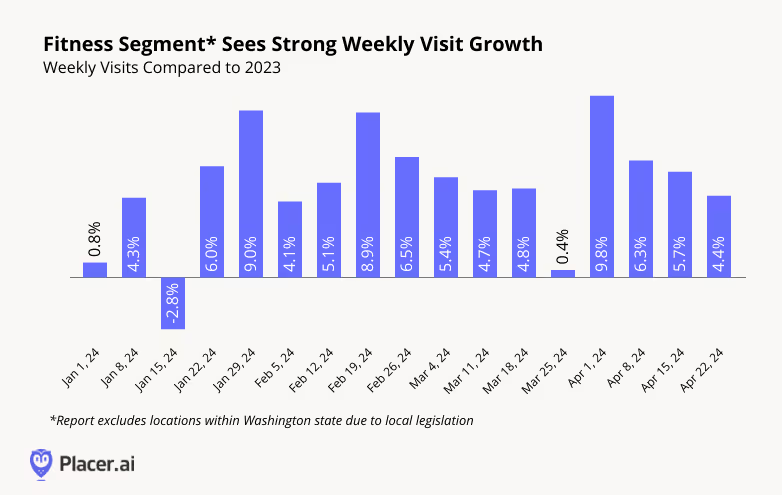
Fitness has been a consistent success story over the past few years, and the category is showing no signs of slowing down. Year-over-year (YoY) visits to the industry were up nearly every week between January and April 2024, with the sole exception of the week of January 15th, when an Arctic blast saw many people hunkering down indoors. And visits remained slightly elevated even during the week of March 25th, when Easter celebrations likely distracted many people from their gym goals – an impressive feat given the comparison to a non-holiday week in 2023.

Weekly visits to overall fitness segment compared to 2023. Excludes locations in Washington state due to local legislation

Flexing Into 2024

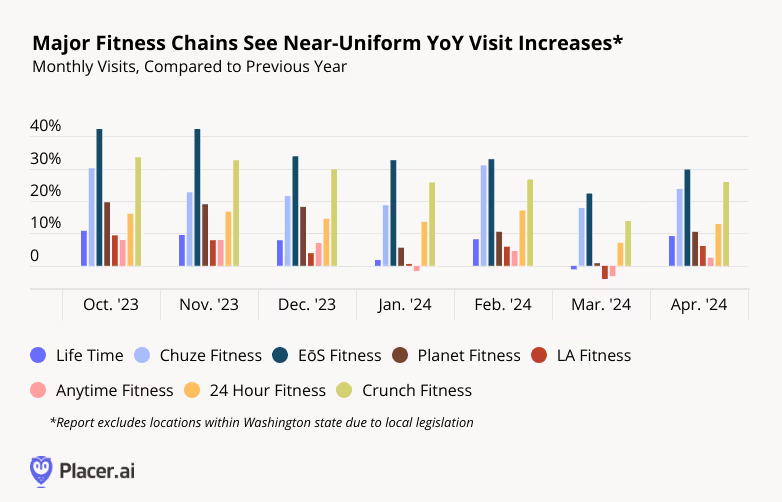
Drilling down into visit trends for eight major fitness chains shows that in today’s robust fitness environment, there’s enough demand to sustain a variety of chains: Both premium and mid-range options like Life Time and LA Fitness as well as more affordable choices like Planet Fitness and Crunch Fitness saw visits increase or remain steady for most of Q1 – and all saw YoY visit bumps in April. 

Monthly visits to leading fitness chains compared to previous year. Excludes data from Washington state due to local legislation

Getting Pumped 

Some gym-goers hit the gym several times a week and spend hours working out, while others have a more relaxed get-in-shape schedule. And analyzing leading chains’ visitation patterns shows that gyms are finding success by catering to fitness buffs’ varying preferences. 

Perhaps unsurprisingly, the data reveals a strong correlation between a chain’s share of frequent visitors (i.e. those visiting the gym eight or more times in a month), and a chain’s share of visitors staying longer than 90 minutes. While some clubs, including Life Time and EōS appear to attract highly dedicated gym-goers, others, including Planet Fitness and Anytime Fitness, seem to draw more casual visitors. 

The fact that both fitness chains attracting frequent visitors for longer workouts and gyms that cater to more casual exercisers who spend less time in the gym during each session are seeing positive visitation trends indicates that there are plenty of models for fitness success in 2024.

Correlation between the share of visitors visiting gyms more than 8 times & share of visits lasting 90 or more minutes among leading fitness chains, April 2024. Excludes Washington state due to local legislation.

The Final Weigh-In

One thing seems clear – interest in gyms is not going away anytime soon. Visits continue to show YoY growth, and the industry is full of options for every kind of fitness enthusiast. Whether opting for occasional visits or adhering to a structured workout regimen – there’s something for everyone.  

To stay ahead of the latest retail and fitness developments, visit placer.ai/blog.

Article
McDonald’s and the Evolving State of Food Retail
R.J. Hottovy
May 3, 2024

Following a busy week of Q1 2024 updates several restaurant chains, the key question facing operators is whether menu price increases the past several years have forced consumers into alternative food retail channels. Several restaurant chains--most notably McDonald’s–highlighted a more “discriminating” consumer during their quarterly updates. According McDonald’s CEO Chris Kempczinski on the company’s Q1 2024 update this week: “U.S. consumers continued to be even more discriminating with every dollar that they spend as they faced elevated prices in their day-to-day spending which is putting pressure on the QSR industry.” In turn, this has resulted in flat-to-declining industry traffic in the U.S. during the quarter. Looking at year-to-date visitation trends across the different restaurant categories, we see a weak start to the year due to inclement weather, followed by a rebound to low-single-digit growth for the limited-service categories (QSR and fast casual) and low-single-digit declines for the full-service restaurant chains.

As we discuss throughout this week’s Anchor report, consumers will likely remain discriminating over the next several quarters.  As such, we expect a continuation of the channel shifts we’ve been witnessing across the broader food retail sector. According to our data, the QSR category saw a +5% increase in visits from 2019-2023, while the full-service restaurant category saw a -8% decrease in visits (partly explained by the permanent closure of many smaller, regional full-service dining chains). Conversely, the grocery, superstore, convenience store, and dollar/discount stores have all seen meaningfully higher visit growth over the same period (as our friends at Restaurant Business have also called out), indicating these channels are taking share from the restaurant industry.

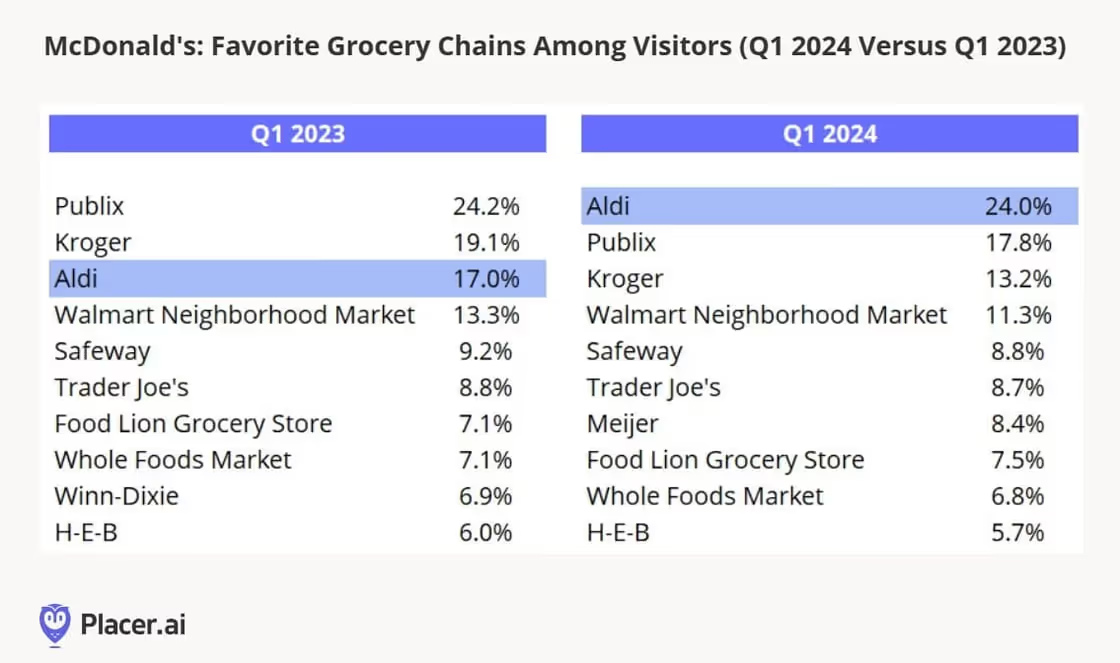
Looking at McDonald’s cross-visitation trends during the quarter, we see further evidence of this shift. We’ve compared the favorite grocery chains of McDonald’s visitors in Q1 2024 to Q1 2023 below. We see a material increase in the percentage of McDonald’s visitors that visited an Aldi location year-over-year–24% versus 17% in the year ago period. We also see a decrease in percentage of visits to most conventional grocery chains.

MCD_050324

Not surprisingly, McDonald’s plans to accentuate its value offerings in the coming quarters. On its update call, management noted that 90% of its U.S. locations offer meal bundles for $4 or less and that it has been running several promotions through its digital app. The company also noted the need to align around a strong national value proposition so that the company can use its tremendous media scale to drive high consumer awareness. It will likely take time for McDonald’s to organize around its value platform, but once it does start to promote its value offerings on a nationwide basis, we would expect much of the rest of the QSR category to follow suit.

Article
Formula 1: U.S. Grand Prix Expansion Winning Key Visitor Segments
Elizabeth Lafontaine
May 3, 2024

This weekend, Formula 1 is once again ready to take the track in the United States, this time at the Miami Grand Prix on Sunday. The Miami Grand Prix is the first U.S. race in the 2024 calendar, followed by the U.S. Grand Prix in Austin, Texas and the Las Vegas Grand Prix in the fall.

America has grown into the new epicenter of the sport and is the only country besides Italy to host multiple races in a singular season. Not only does the U.S. host races, but countless American retail, tech, CPG and hospitality brands serve as team sponsors, including Marriott, Rokt, Tommy Hilfiger, Google, eBay, Coca Cola and more. For brands looking at the consumption habits of younger, more affluent consumers, the rise of Formula 1 in the U.S. can help unlock insights on this group. Credit for Formula 1’s exponential growth in popularity is largely due to the Netflix docuseries, Drive to Survive, which just released its sixth season in the first quarter of 2024. According to Netflix, over 90 million hours of the program were watched throughout the first half of last year. The immense popularity of the show and its behind the scenes access to the luxurious world of F1 generated a large demand for the sport by Americans, and the appetite for home grown F1 races where U.S. based fans can participate is palpable.

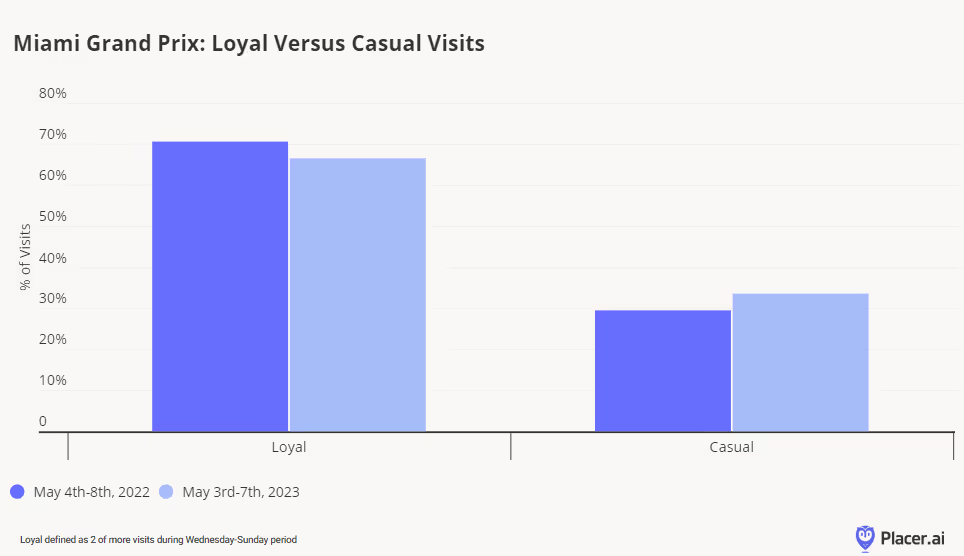
2024 is the third running of the Miami Grand Prix, held around Hard Rock Stadium, with the event debuting in 2022. According to Placer.ai data, traffic at the event, which usually runs Thursday-Sunday, in 2023 increased 3% compared to 2022. Usually during grand prix weekends, visitors have the option to purchase single or multi-day passes, and our data (as shown below) indicates that there were fewer repeat visits in 2023 compared to 2022; consumers may have chosen single day passes more often or made the event a part of a larger weekend in Miami. The highest number of visits occurred on Sunday each year, which aligns with the fact that the actual race takes place that day, with practice sessions and qualifying taking place on Friday and Saturday respectively.

Miami GP loyal

Despite slightly fewer loyal visits during the weekend, the time spent at the event increased, with an average of 179 minutes, up 4% year-over-year. With consumers spending around three hours at the venue, there is a huge opportunity for American CPG and retail companies to engage with this captive audience.

The U.S. Grand Prix, held annually in Austin, has seen similar success from the influx of American F1 fans. Traffic at the 2023 event weekend grew by 38% compared to 2019. 2022 saw peak event attendance, most likely due to a competitive and exhilarating end to the 2021 season that bled into the next year. 2023 also saw the highest percentage of three-day visits during the weekend, highlighting that most U.S. Grand Prix attendees visit the track multiple days for the various race weekend events.

While the growth of the event itself is impressive, the change in visitor demographics provides an even more striking opportunity for American retailers and brands. 2023 brought the highest percentage of visits from young professionals and young urban singles compared to all other segments in 2023. Young professionals also grew to 36% of visits in 2023 from less than 30% in 2019, showcasing the rise in younger and more affluent visitors. Both the popularity of Netflix coupled with the increase in influencer marketing brand trips to races may both have contributed to this shift over time.

It’s clear that Formula 1’s growing popularity has no doubt fueled race expansion stateside and that has been able to capture the attention of the elusive younger consumer, especially those with disposable income.  Brands, licensees and retailers have all jumped on the opportunity to collaborate with drivers, teams and race weekends to tap into this growth market. Sporting events are a highly competitive landscape, excuse the pun, but the intersection of sports and content have paved the way for Formula 1’s success in the U.S.

Article
Chipotle: Staffing Matters
R.J. Hottovy
May 3, 2024

Last week, Chipotle’s Q1 2024 update featured a number of positives, including visitation trends that outperformed the broader restaurant category and strong contribution from new store openings. More than 5% of the company’s 7% comparable sales growth during the quarter was driven by transaction growth, and year-over-year visitation trends have accelerated thus far in April. (Recall that our year-over-year visitation data includes contribution from stores opened during the past year as well as improvements in visits per location).

Impressively, there were multiple sources driving Chipotle’s transaction growth during the quarter. The company’s strong track record for menu innovation under CEO Brian Niccol continued during the most recent quarter, with the company spotlighting Barbacoa and the return of Chicken Al Pastor as a limited time offer. Management will continue to explore new menu additions, and is currently developing a new product pipeline for the next 18-24 months.

While menu innovation is important, it’s clear that throughput (the amount of customers that can be served with Chipotle’s assembly line process)  is becoming a major factor in visitation traffic outperformance. We believe this has been driven by lower employee turnover rates—the company noted that it is experiencing the lowest turnover rates since Niccol joined the company in March 2018. According to management, throughput reached the highest levels in four years because of more consistent staffing, which aligns with our visit per location data for the past five years (below).

Chipotle noted that its throughput improved by nearly 2 entrees in its peak 15 minutes compared to last year with each month showing an acceleration. According to the company, “the restaurants run more smoothly as our teams are properly trained and deployed, which allows them to keep up with demand without stress. This leads to more stability and therefore more experienced teams that execute better every day, and this can be seen in our latest turnover data which is at historically low levels.” Our data also shows that visitation trends are improving during its peak hours, but that its peak hours are also changing. Historically, the hours between 12:00 PM-2:00 PM have represented Chipotle’s most frequently visited hours, but post-pandemic, we’ve seen visits shift to the 6:00 PM-8:00 PM timeframe (below). Return-to-office trends partly explain these trends, as do Chipotle’s push into smaller, more suburban/rural markets.

When we look at visit per location trends by hour, we see that most of the improvement during the Q1 2024 compared to Q1 2023 took place during the later afternoon and evening dayparts.

Looking ahead, Chipotle sees an opportunity to improve peak hour throughput, including adjusting the cadence of digital orders to better balance the deployment of labor (thus eliminating the need to pull a crew member from the front makeline to help the digital makeline during peak periods). The company also plans to bring back a coaching tool for its associates that it had in place prior to the pandemic. With more and more retailers embracing generative AI to help educate and train their employees-–a trend we heard consistently at this week’s Analytics Unite conference–we would expect Chipotle to also adopt generative AI with its updated coaching tool, potentially unlocking greater throughput improvements in the process.

Article
Where Are Workers Returning to Office in 2024?
Hybrid work is here to stay, and many office buildings are below capacity, while others are thriving. We take a look at outperforming office buildings in New York, Chicago, San Francisco, and Dallas to find out what is driving foot traffic to these buildings. 
Ben Witten
May 2, 2024
5 minutes

The widespread adoption of hybrid work continues to be one of the most significant paradigm shifts since the COVID pandemic. As employees visit offices less frequently, or not at all, corporate users are opting for less but better space which is driving office vacancy rates to record highs.   

But even as utilization for many office buildings remains below capacity, some buildings are clearly prospering. So what sets these thriving properties apart from the pack? We looked at outperforming office buildings in four major metro areas – New York, Chicago, San Francisco, and Dallas – to find out. 

Buildings where Visits Exceed 2019 Levels 

The post-pandemic office recovery has been uneven across the country. As of February 2024, a significantly larger share of workers in the New York-Newark-Jersey City and Dallas-Fort Worth CBSAs were back in the office, while office visits in the Chicago-Naperville-Elgin and San Francisco-Oakland-Berkeley CBSAs remained subdued. 

But throughout the country, the reality is much more nuanced as some office buildings struggle to maintain occupancy,others are thriving. We identified four office buildings in four major metropolitan areas where the recovery in utilization was significantly stronger than the respective metro: 

What sets these buildings apart from the pack?

Line charts showing monthly visits to various office buildings and CBSA office indexes compared to a January 2019 baseline

Similar Visit Patterns in High-Occupancy Office Buildings 

One factor that isn’t driving the office recovery at these high-occupancy office buildings is different weekly visitation patterns. 

Location intelligence for offices nationwide indicates that hybrid workers appear to prefer coming to the office mid-week: The bulk of weekly visits occur on Tuesdays, Wednesdays, and Thursdays, with fewer visits taking place on Monday and even less visits on Fridays. And this was also the weekly visitation pattern in the four CBSAs analyzed as well as in the high-occupancy office buildings. In fact, the outperforming office buildings had even more of their visits concentrated mid-week compared to the visit patterns in the wider CBSA.

Share of visits during each workday out of total Monday-Friday visits across various office buildings and CBSAs

It seems, then, that the higher visits to these outperforming offices is not due to more employees coming in on typical WFH days. Instead, more workers are likely coming in mid-week to make up for the lull on Mondays and Fridays. 

So who are these visitors? And could they hold the key to these buildings' strong recovery numbers? 

High-Occupancy Office Buildings Draw Visitors From Areas with Higher Income & Fewer Families 

Focusing on the period between March 2023 and February 2024 reveals that in all the labor catchment areas of the analyzed Office Indexes, the share of one-person households was larger than the nationwide share of 27.5%. And during the same period, the share of one-person households in the catchment areas of the high-performing office buildings was even greater – almost 50% of households in the captured market of 2010 Flora St. in Dallas consisted of one-person households. 

On the other hand, families with children were underrepresented in the catchment areas of the office indexes relative to the nationwide average of 27.1% – and the share of households with children was even lower in the catchment areas of the high-occupancy office buildings. 

This indicates that those with young children at home were generally less likely to go into the office – and so the office buildings seeing the strongest post-COVID recovery are those that serve a large contingent of single employees. On the flip side, there is often a motivation for young singles to visit the office more frequently, whether driven by the desire for training and mentorship or the prospect of meeting a significant other in or around the workplace. 

Household segmentation across various office building indexes showing higher post-COVID occupancy among areas with higher incomes and fewer families

Much has been written on the challenging impact that return-to-office mandates can have on working parents – and especially on working mothers – so it may not come as a surprise that employees from family households are underrepresented in office buildings in 2024. 

But the fact that one-person households are even more prevalent in the labor markets of the overperforming buildings (as compared to the wider CBSA Office Index) indicates that businesses and office assets can thrive even without wooing working parents back to the office.

Outperforming Office Buildings See Larger Share of Visits from Managers & Executives

So who are these singles driving the return to the office? Some of this segment may be made up of Gen-Zers seeking the networking and mentorship opportunities provided by an in-person office setting. But it’s not just younger workers leading the return to the office – the data indicates that executives and managers also make up an outsized portion of the outperforming buildings’ catchment  areas. In all four CBSAs analyzed, the catchment area of the high-occupancy building included a significantly larger share of people in a managerial or executive role compared to the average catchment area composition of the wider CBSA Office Index. 

Many of these executives are likely choosing – rather than being forced – to work on-site. Some might be looking to encourage their staff to return to the office by leading by example, while many are likely leveraging their space to host clients, driving foot traffic to these locations higher. But whatever factors are driving the trend – it appears that office buildings looking to bounce back in the new normal need to make sure they are drawing back the managerial ranks.

Share of population in trade area in a managerial/executive role - household segmentation among various office indexes across the country

Overperforming Offices Serve More Finance & Tech Workers

Analyzing the popular industries and occupations in the catchment areas of the office buildings and industries also reveals that the overperforming buildings serve a much higher share of employees working in finance, insurance, and real estate. A larger share of the catchment area population of the high-occupancy office complexes also works in professional services – including high-tech jobs – compared to the office index in the wider CBSA.

Share of population in trade areas of various office buildings that are in finance, insurance, tech, and real estate

Many financial institutions and tech companies have asked employees to return to the office at least three days a week, which could explain why these industries are overrepresented in the catchment area of the high-occupancy buildings. This data may indicate, then, that while some of the foot traffic is coming from executives choosing to return to their pre-COVID work habits, the return-to-office mandates – whether full or part-time – are likely also helping these buildings stay ahead of the curve.  

Return to Office Story Still Being Written 

Although the proliferation of office vacancies across the country can make it seem like the return to office battle has already been lost, several buildings are bucking the trend. Location intelligence indicates that a combination of partial return-to-office mandates along with a larger-than-usual share of visitors from executives and non-parental households is helping these office complexes thrive. 

Article
2024 Wins: Sweetgreen & First Watch on the Rise
Expansions are helping sweetgreen & First Watch receive more visits and expand their reach with new audiences.
Samuel Roche
May 1, 2024
3 minutes

Sweetgreen and First Watch both went public in 2021 and have since steadily increased in popularity – and in store count. So with 2024 well underway, we checked in with the two brands to see how they fared in Q1 and to explore some of the factors underlying their success. 

Sweetgreen’s Successful Expansion

Despite the dining challenges of much of 2023 and early 2024, sweetgreen posted impressive visits between April 2023 and March 2024, with the chain’s YoY traffic increases ranging from 21.4% to 51.6%. 

The remarkable visit surge was partially driven by the sweetgreen’s significant expansion, which could explain the slight dips in average visits per location for much of 2023 while consumers around sweetgreen’s newer restaurantes familiarized themselves with the brand’s offerings. But since December 2023, YoY visits per location have been positive – with the exception of a weather-induced slump in January – indicating that the chain’s newer venues have established themselves within their community. 

This narrowing of the gap between visits and visits per location may also signal the success of sweetgreen’s strategic shift towards prioritizing "quality over quantity” – slowing down expansion and investing in an enhanced customer experience.

Monthly visits & visits per location to sweetgreen compared to previous year

Healthy Salads for Everyone

As a salad and grain-bowl chain, sweetgreen holds special appeal for wellness-focused younger consumers, including singles and members of the coveted Gen Z demographic. But as the chain has expanded, it has also succeeded in reaching new audiences.

Sweetgreen has been explicit about its goal of reaching Gen Z consumers. And analyzing the demographic makeup of the chain’s captured market reveals that sweetgreen’s trade area includes a relatively large share of one-person households (that tend to be on the younger side) But analyzing shifts in the chain’s captured market composition over the past five years also reveals that the share of one-person households has been decreasing – while remaining above the nationwide average of 28.0% – and the share of households with children has increased. So even as sweetgreen continues serving its core consumers, the chain’s expansion has also allowed sweetgreen to reach new audiences.

Household segmentation in sweetgreen's captured market trade area

First Watch’s Never-Ending Expansion

First Watch is also in expansion mode, and with plans to open some 50 more restaurants this year the chain shows no signs of slowing down. And, like sweetgreen, First Watch’s expansion has driven significant growth to the chain’s overall visits – and the chain’s average visits per location numbers are up as well, indicating that the new venues are finding a receptive audience. 

By staying nimble on its feet and continually changing up its menu offerings, First Watch has succeeded in differentiating itself from other breakfast chain giants – and appears poised to enjoy continued success throughout the year.

Monthly visits to First Watch compared to previous year

Expanding Its Reach 

First Watch’s expansion has also helped the company reach new types of diners even as the chain continues catering to its core audience. The share of the Spatial.ai: PersonaLive’s “Upper Suburban Diverse Families” segment in First Watch’s captured market has held steady over the past five years, even as the share of the “Blue Collar Suburbs” and “Urban Low Income” segments increased. It seems, then, that First Watch has also succeeded in leveraging its store fleet expansion to reach new audience segments – without sacrificing its core patrons.

Household segmentation in First Watch's captured market trade area

Sweetgreen and First Watch Head into 2024 on an Upswing

Sweetgreen and First Watch’s expansions have helped the companies increase visits and reach new segments – without sacrificing their core audiences. What does the rest of 2024 have in store for the chains?  

Visit our blog at placer.ai to find out. 

Reports
INSIDER
Report
2026 CRE Outlook
Read the report to find out which markets are gaining ground in office recovery, where retail traffic is strongest, and how population shifts are reshaping demand.
March 19, 2026

Commercial real estate in 2026 is characterized by differentiated performance across markets and asset types. Office recovery trajectories vary meaningfully by metro, retail performance reflects format-specific resilience, and domestic migration patterns continue to influence long-term demand fundamentals.


Return to Office Patterns 

Many higher-income metros continue to trail 2019 benchmarks but drive the strongest Year-over-year gains, signaling a potential inflection in office utilization trends.

Miami Continued Leading RTO in 2025; San Francisco Led the Year-over-Year Office Recovery

Major Insights:

• Sunbelt markets along with New York, NY are closest to pre-pandemic office visit levels, while many coastal gateway and tech-heavy markets trail 2019 benchmarks. 

• Many of the metros still furthest below pre-pandemic levels are now posting the strongest year-over-year gains.

Key Takeaways for CRE Professionals: 

• Leasing velocity may accelerate in coastal markets – particularly in high-quality assets – even if full recovery remains distant. The expansion of AI-driven firms and innovation-focused employers could support incremental demand in these ecosystems, reinforcing a bifurcation between top-tier buildings and the broader office inventory.

Median Household Income in Market Correlates With Office Recovery

Major Insights:

• Higher-income metros such as San Francisco show deeper structural gaps vs 2019, perhaps due to their higher concentration of hybrid-eligible workers – yet those same metros are driving the strongest YoY recovery in 2025.

• Accelerating growth in 2025 suggests that shifting employer policies, workplace enhancements, or broader labor dynamics may be beginning to drive increased in-office activity.

Key Takeaway for CRE Professionals: 

• Office performance in higher-income markets will increasingly depend on workplace quality and policy alignment. Assets that support premium amenities, modern design, and tenants implementing clear in-office expectations are likely to influence sustained office visits and leasing velocity in these metros.


Shopping Center Patterns

Retail traffic is broadly improving across states, though performance varies by region and format.

Shopping Center Visits Increased in 2025

Major Insights:

• Retail traffic growth is broad-based, with the majority of states showing year-over-year gains in shopping center traffic in 2025.

• Still, even as many states are posting gains, pockets of softer performance remain – specifically in parts of the Southeast and Midwest. 

Key Takeaway for CRE Professionals: 

• Broad-based traffic gains indicate consumer demand is more durable than anticipated. In growth states, operators can shift from defensive stabilization to capturing upside – pushing rents, upgrading tenant quality, and accelerating leasing while momentum holds. In softer markets, the focus should remain on protecting traffic through strong anchors and necessity-driven tenancy.

Convenience-Based Performance Pulling Ahead

Major Insights: 

• Convenience-oriented formats are leading traffic growth, with strip/convenience centers materially outperforming all other shopping center types, and neighborhood and community centers also posting gains. This reinforces the strength of proximity-driven, daily-needs retail.

• Destination retail formats, including regional malls and factory outlets, continue to lag, while super-regional malls were essentially flat. Larger-format, discretionary-driven centers are not capturing the same momentum as convenience-based formats.

Key Takeaway for CRE Professionals: 

• The data suggests that consumer behavior continues to favor convenience, frequency, and necessity over destination-based shopping. Operators should lean into service-oriented and daily-needs tenancy in strip and neighborhood formats, while mall operators may need to further reposition assets toward experiential, mixed-use, or non-retail uses to stabilize traffic. 


Migration Patterns 

Domestic migration continues to reshape state-level demand, with gains clustering in select growth corridors.

Northern Planes, Southeast Lead State-Level Migration Growth

Major Insights: 

• Domestic migration drove population gains in parts of the Southeast and Northern Plains, while several Western and Northeastern states show flat or negative migration.

• Some previously strong in-migration states in the South and West, including Texas and Utah, are showing softer movement, while other established migration leaders such as Florida and the Carolinas continue to attract net inbound residents.

Key Takeaway for CRE Professionals: 

• Migration flows are shifting relative to prior years. Operators should temper growth assumptions in states where inflows are slowing and prioritize markets where inbound demand remains strong.

Florida Metros Magnet For Domestic Migration

Major Insights: 

• Florida dominates metro-level migration growth, with eight of the top ten U.S. metros for net domestic migration are in Florida.

• The markets with the strongest domestic migration-driven population gains are not major gateway cities but smaller, often retirement- or lifestyle-oriented metros, suggesting that migration-driven demand is increasingly flowing to secondary markets.

Key Takeaway for CRE Professionals: 

• CRE operators should prioritize expansion, leasing, and site selection in high-growth secondary metros where population inflows can directly translate into retail spending, housing absorption, and service demand.

INSIDER
Report
5 Grocery Growth Drivers in 2026
How Expanded Supply, Trip Frequency, and Shopping Missions Are Reshaping Food Retail and Creating Multiple Paths to Growth
February 19, 2026

Key Takeaways

1. Expanded grocery supply is increasing overall category engagement. New locations and deeper food assortments across formats are bringing shoppers into the category more often, rather than fragmenting demand.

2. Grocery visit growth is being driven by low- and middle-income households. Elevated food costs are leading to more frequent, budget-conscious trips, reinforcing grocery’s role as a non-discretionary category.

3. Short, frequent trips are a major driver of brick-and-mortar traffic growth. Fill-in shopping, deal-seeking, and omnichannel behaviors are pushing visit frequency higher, even as trip duration declines.

4. Scale is accelerating consolidation among large grocery chains. Larger retailers are using their size to invest in value, assortment, private label, and execution, allowing them to capture longer and more engaged shopping trips.

5. Both large and small grocers have viable paths to growth. Large chains are winning by competing for the full grocery list, while smaller banners can grow by specializing, owning specific missions, or offering compelling value that earns them a place in shoppers’ routines.

What is Driving Grocery Growth in 2026?

While much of the retail conversation going into 2026 focused on discretionary spending pressure, digital substitution, and higher-income consumers as the primary drivers of growth, grocery foot traffic tells a different story.

More Trips, More Formats, and a Shift Toward Mission-Driven Shopping

Rather than being diluted by new formats or eroded by e-commerce, brick-and-mortar grocery engagement is expanding. Visits are rising even as grocery supply spreads across wholesale clubs, discount and dollar stores, and mass merchants. At the same time, growth is being powered not by affluent trade areas, but by low- and middle-income households navigating higher food costs through more frequent, targeted trips. Shoppers are showing up more often and increasingly splitting their trips across retailers based on value, availability, and mission – pushing grocers to compete for portions of the grocery list instead of the full weekly basket. 

Scale Captures Demand – But Fragmented Trips Leave Room to Grow

The data also suggests that the largest grocery chains are capturing a disproportionate share of rising grocery demand – but the multi-trip nature of grocery shopping in 2026 means that smaller banners can still drive traffic growth. By strengthening their value proposition, specializing in specific products, or owning specific shopping missions, these smaller chains can complement, rather than compete with, larger one-stop destinations.

The Core Drivers of Grocery Growth in 2026

Ultimately, AI-based location analytics point to a clear set of grocery growth drivers in 2026: expanded supply that increases overall engagement, more frequent and mission-driven trips, and continued traffic concentration among large chains alongside new opportunities for smaller banners.

1. Expanded Grocery Supply Is Fueling Growth While Traditional Grocery Stores Hold Their Lead 

Expanded Grocery Access Is Increasing Overall Category Engagement

One driver of grocery growth in recent years is simply the expansion of grocery supply across multiple retail formats. Wholesale clubs are constantly opening new locations and discount and dollar stores are investing more heavily in their food selection, giving consumers a wider choice of where to shop for groceries. And rather than fragmenting demand, this broader availability appears to have increased overall grocery engagement – benefiting both dedicated grocery stores and grocery-adjacent channels.

Traditional Grocery Stores Maintain a Stable Share of Visits Despite Growing Competition

Grocery stores continue to capture nearly half of all visits across grocery stores, wholesale clubs, discount and dollar stores, and mass merchants. That share has remained remarkably stable thanks to consistent year-over-year traffic growth – so even as grocery supply increases across categories, dedicated grocery stores remain the primary destination for food shopping.

Mass Merchants Face Share Pressure as One-Stop Competition Expands

Meanwhile, mass merchants have seen a decline in relative visit share as expanding grocery assortments at discount and dollar stores and the growing store fleets of wholesale clubs give consumers more alternatives for one-stop shopping. 

2. Low and Medium-Income Households Driving Larger Visit Gains 

Grocery Growth Is Shifting Toward Lower- and Middle-Income Trade Areas

While much of the broader retail conversation heading into 2026 centers on higher-income consumers carrying growth, the trend looks different in the grocery space. Recent visit trends show that grocery growth has increasingly shifted toward lower- and middle-income trade areas, underscoring the distinct dynamics of non-discretionary retail. 

Higher Food Costs Likely Driving More Frequent, Budget-Conscious Trips

For lower- and middle-income shoppers, elevated food costs appear to be translating into more frequent grocery trips as consumers manage budgets through smaller baskets, deal-seeking, and shopping across retailers. In contrast, higher-income households – often cited as a key growth engine for discretionary retail – are contributing less to grocery visit growth, likely reflecting more stable shopping patterns or a greater ability to consolidate trips or shift spend online.

Necessity-Driven Shopping Is Powering Grocery Visit Growth

This means that, in 2026, grocery growth is not being propped up by high-income consumers. Instead, it is being fueled by necessity-driven shopping behavior in lower- and middle-income communities – reinforcing grocery’s role as an essential category and suggesting that similar dynamics may be at play across other non-discretionary retail segments.

3. Rise in Short Grocery Trips Driving Offline Grocery Gains

More Frequent, Shorter Grocery Trips

Another factor driving grocery growth is the rise in short grocery visits in recent years. Between 2022 and 2025, the biggest year-over-year visit gains in the grocery space went to visits under 30 minutes, with sub-15 minute visits seeing particularly big boosts. As of 2025, visits under 15 minutes made up over 40% of grocery visits nationwide – up from 37.9% of visits in 2022. 

Omnichannel Grocery Shopping Fueling Short Trips to Physical Stores 

This shift toward shorter visits – especially those under 15 minutes – is driven in part by the continued expansion of omnichannel grocery shopping, as many consumers complete larger stock-up orders online and rely on in-store trips for order collection or quick, fill-in needs. At the same time, the rise in short visits paired with consistent YoY growth in grocery traffic points to additional, behavior-driven forces at play – consumers' growing willingness to shop around at different grocery stores in search of the best deal or just-right product. 

Grocery Shoppers Are Splitting Trips Across Multiple Retailers

Value-conscious shoppers – particularly consumers from low- and middle-income households, which have driven much of recent grocery growth – seem to be increasingly shopping across multiple retailers to secure the best prices. This behavior often involves making targeted trips to different stores in search of the strongest deals, a pattern that is contributing to the rise in shorter, more frequent grocery visits. At the same time, other grocery shoppers are making quick trips to pick up a single ingredient or specialty item – perhaps reflecting the increasingly sophisticated home cooks and social media-driven ingredient crazes. In both these cases, speed is secondary to getting the best value or the right product.

Different Trip Types, One Outcome: Continued Store Traffic Growth

So while some shorter visits reflect a growing emphasis on efficiency – as shoppers use in-store trips to complement primarily online grocery shopping – others appear driven by a preference for value or product selection over speed. Despite their differences, all of these behaviors have one thing in common – they're all contributing to continued growth in brick-and-mortar grocery visits. Grocers who invest in providing efficient in-store experiences are particularly well-positioned to benefit from these trends. 

4. Consolidation as a Growth Driver 

Large Chains Continue to Pull Ahead in Visit Share

As early as 2022, the top 15 most-visited grocery chains already accounted for roughly half of all grocery visits nationwide. And by outpacing the industry average in terms of visit growth, these chains have continued to capture a growing share of grocery foot traffic.

Scale Enables Broader Assortment, Stronger Value, and Better Execution

This widening gap suggests that scale is increasingly enabling grocers to reinvest in the factors that attract and retain shoppers. Larger chains are better positioned to invest in broader and more differentiated product selection, stronger private-label programs that deliver quality at accessible price points, competitive pricing, and operational excellence across stores and omnichannel touchpoints. These capabilities allow top chains to serve a wide range of shopping missions – from quick, convenience-driven trips to more intentional visits in search of the right product or ingredient.

Consolidation at the top of the grocery category is reinforcing a virtuous cycle: scale enables better value, selection, and experience, which in turn draws more shoppers into stores and supports continued grocery traffic growth.

5. Competition for "Share of List" Growing Grocery Visit Pie 

Both Long and Short Trips Are Driving Grocery Traffic Growth

In 2025, the top 15 most-visited grocery chains accounted for a disproportionate share of visits lasting 15 minutes or more, while smaller grocers captured a larger share of the shortest trips. As shown above, larger grocery chains, which tend to attract longer visits, grew faster than the industry overall – but short visits, which skew more heavily toward smaller chains, accounted for a greater share of total traffic growth. Together, these patterns show that both long, destination trips and short, targeted visits are driving grocery traffic growth and creating viable paths forward for retailers of all sizes.

Large and Small Chains Win by Competing for Different Shopping Missions

Larger chains are more likely to serve as destinations for fuller shopping missions, competing for the entire grocery list – or a significant share of it. But smaller banners can grow too by competing for more short visits. By specializing in a specific product category, owning a clearly defined shopping mission, or delivering a compelling value proposition, smaller grocers can earn a place in shoppers’ routines and become a deliberate stop within a broader grocery journey. 

What These Trends Mean for Grocery Growth in 2026

As grocery moves deeper into 2026, growth is being driven by the cumulative effect of how consumers are navigating food shopping today. Expanded supply has increased overall engagement, higher food costs are driving more frequent and targeted trips, and shoppers are increasingly willing to split their grocery list across retailers based on value, availability, and mission.

Looking ahead, this suggests that grocery growth will remain resilient, but unevenly distributed. Retailers that clearly understand which trips they are best positioned to win – and invest accordingly – will be best placed to capture that growth. Large chains are likely to continue benefiting from scale, consolidation, and their ability to serve full shopping missions, while smaller banners can grow by earning a defined role within shoppers’ broader grocery journeys. In 2026, success in grocery will be less about winning every trip and more about consistently winning the right ones.

INSIDER
Report
Office Attendance Drivers in 2026: The New Rules of Showing Up
Dive into the data to learn how convenience-driven behaviors are impacting the office recovery – and how stakeholders from employers to office owners and local retailers can best adapt.
February 5, 2026

Key Takeaways:

To optimize office utilization and surrounding activity in 2026, stakeholders should: 

1. Plan for continued, but slower, office recovery. Attendance continues to rise and has reached a post-pandemic high, but moderating growth suggests the return-to-office may progress at a more gradual and incremental pace than in prior years.

2. Account for growing seasonality in office staffing, local retail operations, and municipal services. As office visitation becomes increasingly concentrated in late spring and summer, offices, downtown retailers, and cities may need to plan for more predictable peaks and troughs by adjusting hours, staffing levels, and local services accordingly, rather than relying on annual averages.

3. Align leasing strategies with seasonal demand. Stronger attendance in Q2 and Q3 suggests these quarters are best suited for leasing activity, while softer Q1 and Q4 periods may be better used for renovations, repositioning, and targeted activation efforts designed to draw workers in.

4. Design hybrid policies around midweek anchor days. With Tuesdays and Wednesdays consistently driving the highest office attendance, employers can maximize collaboration and space utilization by concentrating meetings, programming, and in-office expectations midweek.

5. Reduce early-week commute friction to support attendance. Monday office attendance appears closely correlated with commute ease, suggesting that reliable and efficient transportation may be an important factor in early-week office recovery.

6. Prioritize proximity in leasing and development decisions. Visits from employees traveling less than five miles to work have increased steadily since 2019, reinforcing the value of centrally located offices and housing near employment hubs.

When Policy Isn’t Enough

2025 was the year of the return-to-office (RTO) mandate. Employers across industries – from Amazon to JPMorgan Chase –  instituted full-time on-site requirements and sought to rein in remote work. But the year also underscored the limits of policy. As employee pushback and enforcement challenges mounted, many organizations turned to quieter tactics such as “hybrid creep” to gradually expand in-office expectations without triggering outright resistance.

For employers seeking to boost attendance, as well as office owners, retailers, and cities looking to maximize today’s visitation patterns, understanding what actually drives employee behavior has become more critical than ever. This reports dives into the data to examine office visitation patterns in 2025 – and explore how structural factors such as weather, commute convenience, and workplace proximity have emerged as key differentiators shaping how and when, and how often workers come into the office. 

Office Attendance Reaches a New High, But Momentum Slows

National office visits rose 5.6% year over year in 2025, bringing attendance to just 31.7% below pre-pandemic levels and marking the highest point since COVID disrupted workplace routines. At the same time, the pace of growth slowed compared to 2024, signaling a possible transition into a steadier phase of recovery.

With new return-to-office mandates expected in 2026, and the balance of power quietly shifting towards employers, additional gains remain likely. But the trajectory suggested by the data points toward gradual progress rather than a return to the more rapid rebounds seen in 2023 or 2024. 

Weather, Workations, and a New Kind of Seasonality 

Before COVID, “I couldn’t come in, it was raining” would have sounded like a flimsy excuse to most bosses. But today, weather, travel, and individual scheduling are widely accepted reasons to stay home, reflecting a broader assumption that face time should flex around convenience.

This shift is visible in the growing seasonality of office visitation, which has intensified even as overall attendance continues to rise. In 2019, office life followed a relatively steady year-round cadence, with only modest quarterly variation after adjusting for the number of working days. In recent years, however, greater seasonality has emerged. Since 2024, Q1 and Q4 have consistently underperformed while Q2 and Q3 have posted meaningfully stronger attendance – a pattern that became even more pronounced in 2025. Winter weather disruptions, extended holiday travel, and the growing normalization of “workations” appear to be pulling some visits out of the colder, holiday-heavy months and concentrating them into late spring and summer.

For employers, office owners, downtown retailers, and city planners, this emerging seasonality matters. Staffing, operating budgets, and programming decisions increasingly need to account for predictable soft quarters and peak periods, making quarterly planning a more useful lens than annual averages. Leasing activity may also convert best in Q2 and Q3, when districts feel most active. Slower quarters, meanwhile, may be better suited for renovations, construction, or employer- and city-led programming designed to give workers a reason to show up.

The Quest for Convenience and the TGIF Workweek

The growing premium placed on convenience is also evident in the persistence of the TGIF workweek – and in the factors shaping its regional variability.

Before COVID, Mondays were typically the busiest day of the week, followed by relatively steady attendance through Thursday and a modest drop-off on Fridays. Today, Tuesdays and Wednesdays have firmly established themselves as the primary anchor days, while Mondays and Fridays see consistently lower activity. And notably, this pattern has remained essentially stable over the past three years – despite minor fluctuations – as workers continue to cluster their in-office time around the days that offer the most perceived value while preserving flexibility at the edges of the week.

Commute Friction Shaping the Start of the Week

At the same time, while the hybrid workweek remains firmly entrenched nationwide, its contours vary significantly across regions – and the data suggests that convenience is once again a key differentiator.

Across major markets, a clear pattern emerges: Cities with higher reliance on public transportation tend to see weaker Monday office attendance, while markets where more workers drive alone show stronger early-week presence. While industry mix and local office culture still matter, the data points to commute hassle as another factor potentially shaping Monday attendance. 

New York City, excluded from the chart below as a clear outlier, stands as the exception that proves the rule. Despite nearly half of local employees relying on public transportation (48.7% according to the Census 2024 (ACS)), the city’s extensive and deeply embedded transit system appears to reduce perceived friction. In 2025, Mondays accounted for 18.4% of weekly office visits in the city, even with heavy transit usage.

The contrast highlights an important nuance: Where transit is fast, frequent, and integrated into daily routines, it can support office recovery, offering a potential roadmap for other dense urban markets seeking to rebuild early-week momentum. 

Proximity as a Key Attendance Driver

Another powerful signal of today’s convenience-first mindset shows up in commute distances. Since 2019, the share of office visits generated by employees traveling less than five miles has steadily increased, largely at the expense of mid-distance commuters traveling 10 to 25 miles.

To be sure, this metric reflects total visits rather than unique visitors, so the shift may be driven by increased visit frequency among workers with shorter, simpler commutes rather than a change in where employees live overall. Still, the pattern is telling: Workers with shorter commutes appear more likely to generate repeat in-person visits, while longer and more complex commutes correspond with fewer trips. Over time, this dynamic could shape office leasing decisions, residential demand near employment centers – whether in urban cores or in nearby suburbs – and the geography of the workforce.

Friction in Focus 

Taken together, the data paints a clear picture of the modern return-to-office landscape. Attendance is rising, but behavior is no longer driven by mandates alone. Instead, workers are making rational, convenience-based decisions about when coming in is worth the effort.

For cities, the implication is straightforward: Ease of access matters. Investments in transit reliability, last-mile connectivity, and housing near employment centers can all play a meaningful role in shaping how consistently people show up. For employers, too, the lesson is that the path back to the office runs through convenience, not just compulsion, as attendance gains are increasingly driven by how effectively organizations reduce friction and increase the perceived value of being on-site.

Loading results...
We couldn't find anything matching your search.
Browse one of our topic pages to help find what you're looking for.
For more in-depth analyses on a variety of subjects, explore Reports.
The Anchor Logo
INSIDER
Stay Anchored: Subscribe to Insider & Unlock more Foot Traffic Insights
Gain insider insights with our in-depth analytics crafted by industry experts
— giving you the knowledge and edge to stay ahead.
Subscribe