Thank you! Your submission has been received!
Oops! Something went wrong while submitting the form.
0
0
0
0
----------
0
0
Articles
Article
Coffee Chains: Q1 2024 Update and What’s Changed Since COVID
How has the coffee space changed since the pandemic ushered in a new age of remote work that slashed commuting and office-wide coffee orders? We take a closer look at how visits to brands like Starbucks, Dunkin', and Dutch Bros. have changed since the pandemic.
Ezra Carmel
Apr 25, 2024
3 minutes

Pandemic restrictions ushered in a new age of remote work that slashed commuting and office-wide coffee orders. But the coffee space has adapted to changing consumer behavior, and category leaders – Starbucks, Dunkin’, and Dutch Bros. Coffee – have found success in the new normal. 

With Q1 2024 in the rearview mirror, we took a closer look at how visitation to the coffee space has changed since the pandemic. 

Key Takeaways

  • Since 2019, Starbucks, Dunkin’, and especially Dutch Bros. have expanded their footprints – driving their pandemic recovery.
  • Year-over-year visits to the coffee leaders are also on the rise, indicating that the space is continuing to grow. 
  • Starbucks, Dunkin’, and Dutch Bros each have a unique hourly visitation pattern, suggesting that – despite the apparent crowding in the coffee space – coffee demand is varied enough to sustain multiple major players.

Coffee’s Recovery Since COVID

Over the last few years, Starbucks, Dunkin’, and Dutch Bros have expanded their footprints, helping drive visits in a turbulent retail environment. Notably, visits to all three chains have remained above pre-pandemic levels nearly every quarter since Q2 2021, signifying a rapid and robust foot traffic recovery for the space. 

Starbucks and Dunkin’ have both implemented expansion plans recently, with Starbucks focusing on smaller-format stores and Dunkin’ going after non-traditional sites such as airports, universities, and travel plazas. The store fleet growth likely contributed to both chains’ visit increases – in Q1 2024, foot traffic to Starbucks and Dunkin’s was up 14.5% and 9.5%, respectively, compared to Q1 2019.

Baseline change in visits to Starbucks and Dunkin, Q1 2019 to Q1 2024

Meanwhile Dutch Bros.’ physical footprint has grown exponentially since 2019, and the chain is now working on developing its digital footprint, including the rollout of mobile ordering.The company’s aggressive expansion contributed to Dutch Bros.’ significantly elevated visits in Q1 2024 – 177.6% above the Q1 2019 baseline. (The chain’s considerably larger year-over-five-year visit increases compared to Starbucks and Dunkin’ can be attributed to Dutch Bros.’ substantially smaller starting footprint, so that every opening brings a larger visit boost to the chain as a whole.)

Baseline change in visits to Dutch Bros. and Breakfast/Coffee shop segment, Q1 2019 to Q1 2024

Monthly Momentum for Coffee Leaders

Zooming in on visits since the halfway point of 2023 shows that the coffee space’s post-pandemic momentum continued in recent months, with year-over-year (YoY) monthly visits to all three chains positive since the beginning of 2024. 

Dutch Bros.’ ongoing aggressive expansion once again gave the Oregon-based chain the largest year-over-year boost, and Starbucks and Dunkin’ also sustained YoY visit growth nearly every month.

Monthly visits to Starbucks, Dunkin', and Dutch Bros. compared to previous year

Each Coffee Brand Fills a Different Need

The visit growth for the three coffee leaders analyzed shows that there is enough consumer demand to support across-the-board growth in the space. And analyzing the Q1 2024 hourly visit distribution for Starbucks, Dunkin’, and Dutch Bros. reveals that visits to each chain follow a unique pattern – suggesting that every brand plays a unique role in the wider coffee landscape.

Visits to Starbucks, Dunkin', and Dutch Bros. in Q1 2024 as a % of Chain's total Visits

Dunkin’ received almost half (47.8%) of its visits before 11:00 AM, indicating that many guests visit Dunkin’ primarily for coffee or other breakfast fare. Starbucks’s guests tended to visit a little later in the day – with 38.5% of Starbucks visits taking place between 11:00 AM and 3:59 PM – so many consumers may be visiting the Seattle-based chain for a midday pick-me-up. Meanwhile, Dutch Bros. saw the largest share of late afternoon and evening visits (between 4:00 and 10:59 PM) relative to the other two chains – perhaps thanks to the chain’s wide variety of non-caffeinated beverages.  

The variance in the hourly visit distribution between the three chains shows that the coffee space is big enough for multiple players and bodes well for the three chains’ performance in 2024.

For more data-driven pick-me-ups, visit Placer.ai.

This blog includes data from Placer.ai Data Version 2.0, which implements improvements to our extrapolation capabilities, adds short visit monitoring, and enhances visit detection.

Article
Checking in with RBI and YUM!
Restaurant Brands International and Yum! Brands own and operate some of the biggest brands in the QSR and Fast Casual space. How are players like Burger King and Taco Bell performing in 2024? We find out.
Lila Margalit
Apr 24, 2024
4 minutes

Amid the economic headwinds that plagued the wider dining industry in 2022 and 2023, the QSR and Fast Casual segments offered price-conscious consumers places to treat themselves to affordable indulgences and grab quick meals on the go. 

Many of the major chains in this space – including Burger King, Popeyes, Pizza Hut, Taco Bell, and KFC – are brands owned by Restaurant Brands International (RBI) or Yum! Brands. How are these players faring in 2024? 

We dove into the data to find out.

Key Takeaways

  • RBI’s Popeyes and Tim Hortons experienced positive quarterly visit growth in Q1 2024, 
  • Quarterly traffic numbers for RBI’s Burger King held steady, even as rightsizing efforts boosted the chain’s average number of visits per venue. Firehouse Subs, for its part,  was significantly impacted by January’s inclement weather – but rallied in February and March with YoY visit growth.
  • YUM! Brand’s Pizza Hut and Taco Bell also enjoyed positive visit growth in Q1 2024.
  • Both RBI and YUM! Brands are finding success with promotions and limited time offerings: Pizza Hut drew huge numbers of fans on Super Bowl Sunday, while Firehouse Subs drove visits with its leap day special.

RBI Chains Enjoy Mostly Positive Visit Growth

Restaurant Brands International, Inc. owns three leading QSR banners – Burger King, Popeyes Louisiana Kitchen, and Tim Hortons – as well as Fast Casual chain Firehouse Subs. And since December 2023, all four chains have experienced mainly-positive year-over-year monthly (YoY) foot traffic growth – with the stark exception of January 2024, when unusually cold weather caused overall dining visits to dip.

The January Arctic Blast did not impact all RBI brands equally: Coffee favorite Tim Horton managed to maintain positive visit growth throughout the first month of the year, perhaps thanks to the chain’s emphasis on hot drinks. On the other hand, YoY visits to Firehouse Subs dropped 8.8% in January 2024 – so although the traffic picked back up in February and March, the brand still finished out Q1 2024 with a minor YoY quarterly visit gap.

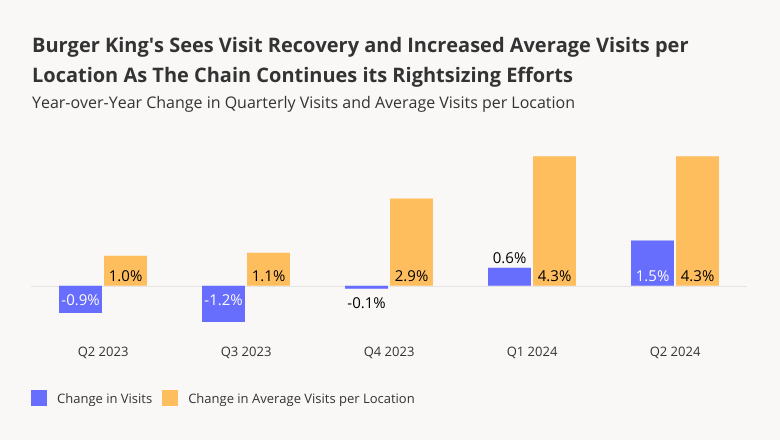
Popeyes, for its part, enjoyed a 4.4% quarterly visit bump in Q1 2024, fueled in part by the chain’s fleet expansion. And though Burger King ended the quarter with just a slight overall quarterly visit increase (0.3%), this is likely a reflection of the chain’s rightsizing efforts: In Q1 2024, the average number of visits to each of the chain’s venues increased by 4.3%.

Monthly visits to RBI brands compared to previous year

YUM! Brand’s Largest Banners Poised to Thrive

Yum! Brands also owns three major fast food chains – Pizza Hut, Taco Bell, and KFC – in addition to Fast Casual The Habit Burger Grill. And though KFC – which has been focusing on international expansion – maintained a Q1 2024 YoY visit gap, quarterly visits to YUM!’s two biggest QSR banners, Pizza Hut and Taco Bell, were up 4.3% and 3.8%, respectively.

Monthly visits to Pizza Hut and Taco Bell compared to previous year

Making the Most of Super Bowl and Leap Day

Neither RBI nor YUM! banners are resting on their laurels. Banners at both companies are finding creative ways to drive business, leaning into limited time offers (LTOs) to help customers mark special occasions.

RBI’s Firehouse Subs celebrated leap day – Thursday, February 29th, 2024 – with a special 2-for-1 LTO for customers whose names start with the letters L, E, A, or P. The day of the promotion was the restaurant’s single busiest Thursday between March 2023 and March 2024: Visits were up 21.5% compared to an average Thursday, and about 6.0% compared to an average Friday or Saturday (Firehouse Sub’s two busiest days of the week).

Super Bowl Sunday came this year just two days after National Pizza Day – and YUM!’s Pizza Hut enticed hungry viewers with crowd-pleasing limited time menu offerings. Although many football fans likely ordered their grub online, February 11th, 2024 was still the chain’s busiest day of the past year – with visits up 47.5% compared to a daily average. In the Las Vegas-Henderson-Paradise, NV CBSA, which hosted Super Bowl LVIII, Pizza Hut’s big-day visit spike was an even more impressive 74.1%. 

Visits to Pizza Hut, Firehouse Subs on Super Bowl Sunday and Leap Day compared to relevant monthly visit average

Final Thoughts

Inflation may have cooled, but food-away-from-home prices remain high – and are likely to continue to increase this year. Against this backdrop, companies like RBI and YUM! that offer hungry consumers affordable ways to fill up and have fun appear poised for success. 

Follow Placer.ai for more data-driven dining insights.

This blog includes data from Placer.ai Data Version 2.0, which implements improvements to our extrapolation capabilities, adds short visit monitoring, and enhances visit detection. ‍

Article
Chipotle & McDonald's Serving Up Success
With the first quarter of the year behind us, we take a look at how McDonald's and Chipotle are doing, and take a look at how McDonald's new beverage concept, CosMc, is performing.
Bracha Arnold
Apr 23, 2024
3 minutes

McDonald’s and Chipotle are two of the biggest names in the QSR and fast-casual space, with thousands of restaurants to their names and millions of visitors monthly. With Q1 2024 behind us, how are the two chains performing? And what can visitation patterns to McDonald’s new beverage concept, CosMc, tell us about the new chain? 

We dove into the foot traffic data to find out.

Key Takeaways:

  • McDonald’s year-over-year visit and visit per location numbers continued to grow.
  • McDonald’s new beverage chain CosMc’s is seeing strong afternoon visitation patterns. 
  • Chipotle saw strong monthly visit growth and outperformed the wider Fast-Casual segment.

Golden Arches Growth: McDonald’s Outperforms QSR

Foot traffic to McDonald’s has remained consistently strong over the past year, with the chain generally outperforming the wider Quick-Service Restaurant (QSR) and posting positive visit growth almost every month.

As the chain continues to roll out new concepts, like its Krispy Kreme partnership or revamped menu, visits may keep trending in their positive direction.

Monthly visits to McDonald's, QSR segment compared to previous year

CosMc’s: Out of This World 

McDonald’s isn’t limiting its innovation to in-store partnerships and menu tweaks. The company recently launched its first spin-off restaurant, CosMc's, in December 2023 in the Chicago suburb of Bolingbrook, Illinois, and plans to open at least ten stores by the end of the year. CosMc is named after a lesser-known McDonald's character and aims to compete with beverage and coffee-focused chains while meeting the growing demand for an afternoon pick-me-up.

Hourly visit distribution to CosMc, Q1 2024

Comparing the Q1 2024 hourly visit distribution for the first CosMc location with that of nearby (within one mile) McDonald’s, Dunkin', and Starbucks locations reveals significant differences in visitation patterns between the concepts. CosMc received the smallest share of 7:00 to 10:59 AM visits – even less than the nearby McDonald’s – while the nearby Dunkin’ and Starbucks received the largest share of morning visits. But CosMc’s saw the largest share of late afternoon and evening visits – 40.2% of CosMc’s visits were between 4:00 and 7:59 PM, compared to 36.4%, 24.7%, and 18.3% for McDonald’s, Dunkin’, Starbucks, respectively. It seems, then, that CosMc’s is creating its own niche: Instead of competing to provide guests with their morning caffeine fix in the already crowded coffee space, the new brand is using its beverage-forward menu and playful snacks to attract guests with the promise of an afternoon pick-me-up. 

Since its launch, CosMc has opened three new locations in Texas and plans to continue rolling out the concept across the country. With a strong reception at its first few locations, CosMc is well-positioned to continue capturing afternoon beverage visits. 

Chipotle: Exceeding The Wider Industry 

Tex-Mex powerhouse Chipotle has also experienced strong foot traffic growth throughout the past twelve months, with the chain outperforming the wider Fast-Casual segment in every month analyzed. Some of the visit increase is likely due to Chipotle’s expansion, and the growth is not likely to slow down any time soon –  the company plans to add around 300  new locations in 2024.

With the Fast-Casual segment expected to continue growing in the coming year – and with Chipotle’s record of staying ahead of the curve – the fast casual leader is well-positioned to continue driving visits to its restaurants.

Monthly visits to Chipotle compared to previous year

Dishing It Out

Despite industry challenges, McDonald's and Chipotle continue to drive visits and innovate in the QSR and fast-casual dining spaces, and CosMc's is making progress in the competitive QSR beverage space.

Will these dining destinations continue on their upward streaks?

To keep up with these and other data-driven dining insights, visit Placer.ai

This blog includes data from Placer.ai Data Version 2.0, which implements improvements to our extrapolation capabilities, adds short visit monitoring, and enhances visit detection. 

Article
Wingstop & Shake Shack Continue Growing Their Reach 
Wingstop and Shake Shack are on a roll. We dove into recent location intelligence data to understand what is driving success at these two dining leaders. 
Shira Petrack
Apr 22, 2024
3 minutes

Wingstop and Shake Shack are on a roll. We dove into recent location intelligence data to understand what is driving success at these two dining leaders. 

Key Insights: 

  • Wingstop and Shake Shack are consistently outperforming the Fast Casual segment, with some of the visit increases driven by the chains’ aggressive expansion. 
  • Visits to Wingstop and Shake Shack tend to be more leisurely than visits to the wider Fast Casual segments, which may be contributing to the chains’ strong performances. 

Wingstop and Shake Shack Stay Ahead of the Curve 

Texas-based Wingstop and New York-based Shake Shack are growing fast. Over the past twelve months, both chains outperformed the fast casual segment and posted impressive traffic increases – in March 2024, visits to Wingstop and Shake Shack were up 25.6% and 32.6%, respectively, compared to March 2023. 

Some of the visit strength is likely driven by the chains’ recent expansion. Last year, Wingstop opened around 200 of its almost 2000 U.S. locations, while Shake Shack opened around 40 new restaurants domestically for a total of more than 300 locations in December 2023.

Monthly visits to Wingstop & Shake Shack compared to previous year

Wingstop & Shake Shack Diners Seek Leisurely Dining Experience  

A rapidly expanding footprint is not the only factor driving success for these fast casual leaders. Location intelligence suggests that both chains attract visitors looking for a more leisurely dining experience, which could be helping Wingstop and Shake Shack stay ahead of the competition. 

Compared to the average fast-casual dining venue, Wingstop and Shake Shack receive fewer visits during the lunch rush (12:00 to 2:59 PM) when diners are looking for a quick bite to eat before returning to work. Instead, the two chains attract a larger share of visits in the evening hours (between 7:00 and 9:59 PM) – when guests tend to have more time to savor their meals. Both chains also receive a relatively sizable portion of their visits on weekends, when patrons have more time to linger on premises. 

And the data indicates that Shake Shack and Wingstop visitors do indeed linger longer than the average fast casual patron: Over half of visits to Wingstop and almost two-thirds of Shake Shack visits last longer than 15 minutes, compared to just 48.2% of visits lasting 15+ minutes for the wider fast casual segment.

It seems, then, that consumers are not just visiting Shake Shack or Wingstop for a burger and shake combo or a platter of steaming wings. The data suggests that many guests are also visiting these chains during more leisurely times when they can focus on the dining experience and take in the chains’ atmosphere.

Visit breakdown to WIngstop & Shake Shack by time of day, weekends, and visits lasting 15+ minutes

As the companies continue to expand into new markets and deepen their reach in existing ones, the willingness of consumers to dedicate evenings and weekends to eating at Shake Shack and Wingstop bodes well for these chains in 2024 – and beyond. 

For more data-driven dining insights, visit placer.ai/blog

Article
Home Improvement: Harbor Freight and Ace Hardware Drive Outperformance through Smaller Markets
R.J. Hottovy
Apr 19, 2024

We recently looked at where the home improvement retail category stood after 1Q 2024, noting that industry had seen improved visit trends and that we could see continued momentum in the second half of 2024 as housing turnover picks up.  As a follow up to that analysis, we thought we’d examine a wider range of retailers in the home improvement retail category. Below, we’ve presented year-over-year visitation trends for the top retailers in the home improvement category in terms of visits. While Home Depot and Lowe’s are down on a year-over-year basis, we see that a number of smaller box chains like Harbor Freight and Ace Hardware are seeing year-over-year visits (Large-box Menards has also been relatively strong).

The trend of smaller box home improvement retailers outperforming has actually been going on for a while. Below, we show share visit data from 2017-2023 for the largest home improvement retailers. Here we also see big gains from Ace Hardware and Harbor Freight

What explains these trends? We believe a lot of it boils down to store expansion and migration trends. Both chains have been growing. We discussed Ace Hardware’s unit growth plans back in November 2022, with the chain reaching 5,800 stores globally (and more than 4,700 in the U.S.) after opening 160 locations in 2022 and 170 in 2023. We’ve also called out Harbor Freight’s recent growth–it was one of the reasons we named it to our Top 10 Brands to watch list this year–and the chain now operates almost 1,500 locations across the U.S.  Below, using Placer’s new Map Studio feature to plot Harbor Freight and Ace Hardware locations nationwide. We see a heavy concentration of stores in the Eastern U.S. for both chains.

We’ve also presented a map from Placer’s Migration Report below showing population percentage growth from January 2020 to January 2024 at the market level. Green dots represent markers that have seen permanent population growth, while red represents markets that have seen population declines.

Examining the two maps together sheds some light on the success of Harbor Freight and Ace Hardware–they have a high degree of overlap with some of the highest growth markets in the U.S. We’ve covered the migration of consumers to these markets in the past, including markets have populations smaller than 500,000 people and often under 200,000 individuals. Here, having a smaller format box is an advantage for chains like Harbor Freight and Ace Hardware. Home Depot and Lowe’s both average more than 100,000 square feet per store, which can be difficult to justify in a smaller population market. However, the average Harbor Freight store is 15,000-16,500 square feet and the average Ace Hardware is 10,000 square feet (although ranging between 3,000 and 30,000 square feet). This has allowed both chains to tap smaller markets where much of the population (and household income) has transferred to.

Not surprising, we’ve seen a flood of announcements about retail chains planning to adopt smaller store formats over the past few months. We’ve previously discussed examples across a number of retail categories, including home furnishing (Arhaus and Ethan Allen) and department stores (Bloomie’s), but there has been a notable uptick in announcements from retailers unveiling smaller format stores, including Best Buy, Macy’s, and Whole Foods. Lowe’s has recognized this trend, announcing plans to more aggressively open stores in rural markets.

At a time when it’s more expensive for retailers to operate physical stores due to higher interest rates, higher rent costs (especially among A malls properties), minimum wage increases and labor scarcity, retailers are looking for any way they can to maximize the returns on their store properties, including retail media networks, store-in-store partnerships, and co-branded stores. However, in addition to generating more revenue from ancillary services like advertising or store-in-store partnerships, it’s clear that utilizing a smaller box to address population migration trends has become an increasingly attractive option

Article
Dog Park Bars: When Things Get "Ruff", it's Nice to Have your Doggy Sidekick
Caroline Wu
Apr 19, 2024

Commercial real estate is constantly coming up with new and inventive concepts, and one of the latest ideas is the dog park bar. Chains such as Bark Social and Fetch Park are two such entrants that noted the rise in pet ownership during Covid, and are capitalizing on pet owners’ love for their dogs, as well as desire for human companionship and playdates for their canines.

These dog park bars combine the joy of seeing your furry friend run around with other dogs, while the owners can enjoy a cold frosty brew.

Fetch Park has five locations in Georgia, including Buckhead and Alpharetta. Meanwhile, Bark Social has locations in Baltimore, Bethesda, Alexandria, and Philadelphia, with upcoming plans for Los Angeles and Columbia.

Fetch Park includes events such as “Ales, Tails, and Trivia”, weekly karaoke nights, stand-up comedy, and even a singles’ mingle to meet other like-minded pooch people. Bark Social styles itself as a bar for dog lovers, and includes Bark Rangers that oversee puppy activities such as holding your pet’s first birthday party. There is even doggy daycare and summer camp available.  

And in sunny LA, it’s not the San Vicente Bungalows or SoHo House that’s getting attention, it’s Dog PPL in Santa Monica, a private dog park whose $80/month membership lets your dog play in style. There are “ruffarrees” on hand to keep the calm while owners socialize and imbibe rosé or kombucha. It can even serve as a co-working location or gym substitute with its dog yoga classes.

dog yoga

Source: Dog PPL

If you’re in the Midwest, check out Barkside in Detroit. This 10,000 sq ft location in the West Village combines a dog park, bar, and beer garden all in one. There is a special focus on Detroit and Michigan brands when it comes to libations, which include beer, wine, spritzers, and a variety of coffee drinks.

And if you truly can’t part from your furry friend for even a minute, new BARK Air has partnered with a jet charter service and offers a Gulfstream V so you and your pet can travel in style. For the price of $6,000 one-way, amenities include dog champagne (aka chicken broth), special blankets and pillows, and delicious dog treats. This service is only available for NY, LA, and London jetsetters, but if this concept takes off and comes to more cities, that would truly be paw-some.

Reports
INSIDER
The Retail Opportunity of Stadiums
Dive into the location intelligence to understand the significant retail and dining opportunities in and around major stadiums – both during games and in the off-season.
January 11, 2024
7 minutes

Play Ball

Sports leagues like the NBA, NFL, and MLB boast billion-dollar revenues – and the venues where these games unfold hold significant commercial potential in their own rights. Many stadiums host concerts and other shows in addition to regularly held sporting matches and can accommodate tens of thousands of spectators at once – creating massive retail, dining, and advertisement opportunities.

This white paper analyzes location intelligence metrics for some of the biggest stadiums across the country to reveal the commercial potential of these venues beyond simple ticketing revenue. Where do visitors of various stadiums like to shop? Do specific sporting and cultural events impact the nearby restaurant scene differently? How can stadium operators, local businesses, and advertisers tailor their offerings to a stadium’s particular audience and make the most of the stadium and the space throughout the year?  

We take a closer look below. 

Major League Visits

The three major sports leagues – the National Basketball League (NBA), Major League Baseball (MLB), and the National Football League (NFL) – play at different points of the year, and the number of games each league holds during the season also varies. 

MLB leads in game frequency, with each team playing 162 games during the regular season, which runs approximately from April through September. Basketball season is also around six months – roughly from mid-October to mid-April – but each NBA team plays only 82 games a season. And the NFL has both the shortest season – 18 weeks running from early September to early January (with the pre-season starting in August) – and the fewest number of matches per team. Understanding the monthly visitation patterns for the various types of stadiums can help advertisers, stadium operators, and other stakeholders ensure that they are leveraging the full potential of the venue throughout the year.

Different Visitation Patterns During the On- and Off-Season

Unsurprisingly, the sports arenas serving the different leagues see visit spikes during their leagues’ respective season. But comparing visit numbers throughout the year to the average monthly visit numbers for each category in 2023 reveals that the relative visit increases and decreases during the on- and off-season vary for each type of stadium. 

MLB stadiums display the steadiest visit strength during the on-season – perhaps due to MLB’s packed game schedule. MLB tickets also tend to be relatively affordable compared to tickets to pro football or basketball matches, which may also contribute to MLB’s consistently strong visit numbers throughout the season. During the MLB off-season, baseball fields – which tend to be uncovered – are relatively empty. 

The seasonal visit spike to NBA arenas is less steady. The beginning and end of the season see strong peaks, and visits slow down slightly during the mid-season months of January and February. Visits then drop during the off-season spring and summer, but the off-season visit dip is not as low as it is for MLB fields – perhaps because the NBA arenas’ indoor nature make them suitable locations for concerts and other non-basketball events. 

Meanwhile, NFL stadiums see the least dramatic drop in visits during the NFL off-season, as these venues’ enormous size also make them the ideal location for concerts and other cultural events that draw large crowds. These arenas’ strong almost year-round visitation numbers mean that sponsors and advertisers looking to expand beyond sports fans to reach a diverse audience may have the most success with these venues. 

Stealing Bases, Winning Retail 

A Higher-Income Visitor Base 

Although MLB offers the most budget-friendly outing, combining STI: Popstats demographic metrics with trade area data reveals that MLB stadium visitors reside in higher-income areas when compared with visitors to NBA or NFL stadiums. 

Baseball fans tend to be older than fans of the other sports, which could partially explain MLB stadium visitors’ higher household income (HHI). The combination of lower ticket prices, higher median HHI among fans, and many games per season offers baseball stadiums significant opportunities to engage effectively with their fan bases. 

But while NBA and NFL stadium attendees may not come from as high-income areas as do MLB stadium visitors, fans of live basketball and football still reside in trade areas with a higher HHI compared to the nationwide median. So by leveraging stadium space, advertisers and other stakeholders can reach tens of thousands of relatively high-income consumers easily and effectively.

An Advertising Slam Dunk

Sports fans are known to be passionate, engaged, and willing to spend money on their team – but stadium visitors also shop for non-sports related goods and services. Retailers and advertisers can draw on location analytics to uncover the consumer preferences of stadium visitors and tailor campaigns, sponsorships, and collaborations accordingly. 

Distinct Retail Choices by Team

Visitation data to the top five most visited MLB stadiums during 2023 showed differences between the apparel and sporting goods shopping preferences of the various stadiums’ attendees. While 39.4% of visitors to Truist Park also visited DICK’s in 2023, only 30.8% of Yankee Stadium visitors stopped by the sporting goods retailer in the same period. Similarly, while 29.9% of visitors to Yankee Stadium frequented Kohl’s, that percentage jumped to 47.3% for Busch Stadium visitors.  

Harnessing location intelligence to see the consumer preferences of a stadium’s visitor base can help retailers, stadium operators, and even team managers choose partnerships and merchandising agreements that will yield the most effective results. 

Fan Tastes: Beyond the Bleachers

Sports and snacks go hand in hand – what would a baseball game be without a hot dog or peanuts? But while every stadium likely provides a similar core of traditional game day eats, each venue also offers a unique set of dining options, both on- and off-premise. And by leveraging location analytics to gain visibility into stadium-goers dining habits, stadium operators and local food businesses can understand how to best serve each arena’s audience.  

End Zone Eats

Mapping where stadium visitors dine before and after games can help stakeholders in the stadium industry reach more fans. 

The chart below shows the share of visitors coming to a stadium from a dining venue (on the x-axis) or going to a dining venue after visiting the stadium (on the y-axis). The data reveals a correlation between pre-stadium dining and post-stadium dining – stadiums where many guests visit dining venues before the stadium also tend to have a large share of guests going to dining venues after the event. For example, the AT&T Stadium in Arlington, Texas, saw large shares of visitors grabbing a bite to eat on their journey to or from the stadium, while the M&T Bank Stadium in Baltimore, Maryland saw low rates of pre- and post stadium dining engagement. 

These trends present opportunities for both local businesses and stadium stakeholders. For example, venues with high dining engagement can explore partnerships with local restaurants, while those with lower rates can build out their in-house dining options for hungry sports fans.

Different Events Drive Different Dining Patterns

Stadiums looking to enhance their food offerings – or local entrepreneurs thinking of opening a restaurant near a stadium – can also get inspired by stadium visitors’ dining preferences. For example, psychographic data taken from the Spatial.ai: FollowGraph dataset reveals that visitors to MetLife Stadium in East Rutherford, New Jersey have a much stronger preference for Asian cuisine compared to New Jersey residents overall. With that knowledge, the stadium can enhance the visitor experience by expanding its Asian food offerings. 

On the other hand, MetLife Stadium goers seem much less partial to Brewery fare than average New Jerseyans, so the stadium operators and restaurateurs may want to avoid offering too many Brewery-themed dining options. Stadium stakeholders can reserve the craft beers for Caesars Stadium, M&T Bank Stadium, and Soldier Field Stadiums, where visitors seem to enjoy artisanal brews more than the average resident in Louisiana, Maryland, and Illinois, respectively. 

All of the stadiums analyzed exhibited unique visitor dining tastes, a reminder that no customer or fan base is alike. Aligning on- or off-site dining options with offerings that align with a given customer base’s preferences can improve overall visitor satisfaction and boost revenues.

Pitches to Plates

Zooming in to look at consumer behavior around individual events reveals further variability in dining preferences even among visitors to the same stadium, with different types of events driving distinct dining behaviors.

State Farm Stadium in Glendale, Arizona, is home to the Arizona Cardinals. The stadium hosted the 2023 Super Bowl, but the NFL stadium also acts as a concert venue for acts ranging from Taylor Swift to Metallica. And location intelligence reveals that the dining preferences of stadium visitors vary based on the events held at the venue. 

During the Super Bowl, sports bars such as Yard House and Buffalo Wild Wings saw the largest increase in visits compared to the chains’ daily average. A month later, attendees at Taylor Swift's concert gave fried-chicken leader Raising Cane’s a significant boost. 

Local restaurants can leverage location analytics to see what types of events are popular with their visitor base and craft collaborations and advertising campaigns that resonate effectively with their patrons.

Final Buzzer

Sports stadiums and arenas are not just spaces for sports and music enthusiasts to gather; they also offer significant commercial opportunities for the surrounding communities. Stadium operators and local businesses can fine-tune their offerings by utilizing location analytics to better connect with their visitor bases and uncover new retail opportunities. 

INSIDER
3 Trends Shaping the Dining Industry
This report leverages the latest location intelligence data to identify three dining trends that will shape the dining industry in 2024.
November 30, 2023

Digging Into Dining

The dining industry showcased its agility over the past couple of years as it rapidly adapted to shifts in consumer preference brought on by COVID and rising prices. And with a new year around the corner, the pace of change shows no signs of slowing down. 

This white paper harnesses location analytics, including visitation patterns, demographic data, and psychographic insights, to explore the trends that will shape the dining space in 2024. Which dining segments are likely to pull ahead of the pack? How are chains responding to changes in visitor behavior? And where are brands driving dining foot traffic by taking advantage of a new advertising possibility? Read on to find out how dining leaders can tap into emerging trends to stay ahead of the competition in 2024. 

Stepping Up To The Plate

Comparing quarterly visits in 2023 and 2022 highlights the impact of the ongoing economic headwinds on the dining industry. The year started off strong, with year-over-year (YoY) dining visits up overall in Q1 2023 – perhaps aided by the comparison to an Omicron-impacted muted Q1 2022. And while overall dining growth stalled in Q2 2023, several segments – including QSR, Fast Casual, and Coffee – continued posting YoY visit increases, likely bolstered by consumers trading down from pricier full-service concepts. 

Foot traffic slowed significantly in Q3 2023 as inflation and tighter consumer budgets constrained discretionary spending. Overall dining visits fell 2.4% YoY, and full-service restaurants – with their relatively high price point compared to other dining segments – seemed to be particularly impacted by the wider economic outlook. But the data also revealed some bright spots: Fast Casual still succeeded in maintaining positive YoY visit numbers and Coffee saw its Q3 visit grow an impressive 5.4% YoY. As the return to office continues, a pre-work coffee run or lunchtime foray to a fast-casual chain may continue propelling the two segments forward. 

Shifting Demographics and Shifting Dining Behavior

Restaurant visitation patterns have evolved over the past few years. Although an 8 PM seating was once the most coveted slot at fine-dining restaurants, recent visitation data suggests that sitting down to dinner earlier is rising in popularity. 

But among the QSR segment, the opposite trend is emerging, with late-night visits rising. Analyzing hourly foot traffic to several major QSR chains reveals that the share of visits between 9 PM and 12 AM increased significantly between Q3 2019 and Q3 2023. Even Taco Bell – already known for its popularity among the late-night crowd – saw a substantial increase in late-night visits YoY – from 15.4% to 20.3%. 

Younger Customers Staying Out Later

Who is driving the late night visit surge? One reason restaurants have been expanding their opening hours is to capture more Gen-Z diners, who tend to seek out nighttime dining options. But location intelligence reveals that younger millennials are also taking advantage of the later QSR closing times. 

An analysis of the captured market for trade areas of top locations within one of Taco Bell’s major markets – the ​Chicago-Naperville-Elgin, IL-IN-WI Metropolitan area – reveals a year-over-four-year (Yo4Y) increase in “Singles & Starters.” The “Singles & Starters” segment is defined by Experian: Mosaic as young singles and starter families living in cities who are typically between 25 and 30 years old. As consumers continue to prioritize experiential entertainment and going out with friends, late-night dining may continue to see increased interest from young city-dwellers. 

Smoothies Drive Weekend Visits

Millennials and Gen-Z consumers aren’t only heading to their favorite fast food joint for a late-night bite – these audience segments are also helping drive visits on the weekends. Smoothie King is one chain feeling the benefits of young, health-conscious consumers.

The chain, which opened in New Orleans, LA, in 1973 as a health food store, has since grown to over 1,100 locations nationwide and is currently expanding, focusing on the Dallas-Fort Worth CBSA. The area’s Smoothie King venues have seen strong visitation patterns, particularly on the weekends – weekend visits were up 3.4% YoY in Q3 2023.  The smoothie brand’s trade areas in the greater Dallas region is also seeing a YoY increase in weekend visits from “Young Professionals” – defined by the Spatial.ai PersonaLive dataset as “well-educated young professionals starting their careers in white-collar or technical jobs.” 

Sports and Dining - Match Made in Heaven

While some dining chains are appealing to the late-night or weekend crowd, others are driving visits by appealing to sports lovers. How have recent rule changes around student athletes changed the restaurant game, and how can college football teams drive business in their hometowns?

Scoring Big: Leveraging Fan Insights to Fuel Successful Partnerships

College sports have long been a major moneymaker, with top-tier teams raking in billions of dollars annually. And as of 2021, college athletes can enjoy a piece of the significant fan following of college sports thanks to the change in the NCAA’s Name, Image, and Likeness (NIL) rules, which now allows student athletes to sign endorsement deals.

Since then, multiple restaurants have jumped on the opportunity to partner with student athletes, some of whom have millions of followers on Instagram and TikTok. Chains like Chipotle, Sweetgreen, Slim Chickens, and Hooters have all signed college athletes to various brand deals.

How can brands ensure they partner with athletes their customers will want to engage with? Analyzing a chain’s audience by looking at the interests of residents in a given chain’s trade area can reveal which type of athlete will be the most attractive to each brand’s customer base. For example, data from Spatial.ai: Followgraph provides insight into the social media activity of consumers in a given trade area and can highlight desirable partnerships. 

Examining the trade areas of Chipotle, Sweetgreen, Slim Chickens, and Hooters, for instance, reveals that Sweetgreen’s visitors tended to have the largest share of Women’s Soccer followers. Conversely, Sweetgreen’s trade area had lower-than-average shares of College Football Fans or College Basketball Fans, while residents of the trade areas of the other three chains showed greater-than-average interest in these sports. Leveraging location intelligence can help companies choose brand deals that their customers resonate with and find the ideal athletes to represent the chain. 

College Gameday - Wins for Dining

Finding the right college athlete partnership is one way for dining brands to appeal to college sports enthusiasts. But dining chains and venues located near major college stadiums also benefit from the popularity of their local team by enjoying a major game day visit boost. 

One of the country’s most popular college football teams, the Ohio State Buckeyes, can draw millions of TV viewers, and its stadium has a capacity of 102,780 – one of the largest stadiums in the country. And while tailgating is a popular activity for Buckeyes fans, nearby restaurants are some of the biggest beneficiaries of the college football craze. Panera experienced a 235.3% increase on game days as compared to a typical day, Domino’s Pizza visits grew by 283.3%, and Tommy’s Pizza, a local pie shop, saw its visits jump by a whopping 600.9%. 

Game Day Visitor Spikes

This influx in diners also causes a major shift in game day visitor demographics, as revealed by changes in visitors at dining venues located near stadiums of two of the nation’s best college football teams – the Ohio State Buckeyes and Ole Miss Rebels. Based on Spatial.ai: Personalive data for the captured market of these dining venues, game day visitors tended to come from “Ultra Wealthy Families” when compared to visitors during a typical non-game day in September or October. 

The analysis indicates that popular sporting events create a unique opportunity for restaurants near college stadiums to attract high-income customers game day after game day, year after year. 

Subwars: Room for Everyone

While some spend game day tailgating or visiting a college restaurant, others hold a viewing party – with a six-foot submarine. And the sub’s popularity extends beyond Superbowl Sundays. Sandwich chains including Jersey Mike’s, Firehouse Subs, Jimmy John’s, and Subway (recently purchased by the same company that owns Jimmy John’s) have seen sustained YoY increases in visits and visits per venue in the first three quarters of 2023.

Some of the growth to these chains may be related to their affordability, a draw at all times but especially during a period marked by consumer uncertainty and rising food costs. And subway leaders seem to be seizing the moment and striking while the iron is hot – Jersey Mike’s opened 350 stores in 2023 and still saw its YoY visits per venue grow by 6.6%. And Subway reported ten consecutive quarters of positive sales, a promising sign for its new owner. 

Sandwich Chains Attract a Wide Consumer Base

The love for a healthy, affordable sandwich extends across all income levels, with all four chains seeing a range in their visitors' median household income (HHI). Out of the four chains analyzed, Jersey Mike’s – which has long prioritized a suburban, middle-income customer – had the highest trade area median household income of the four chains at $77.3K/year. Subway, known for its affordability, had the lowest, with $62.9K/year. The variance in median HHI combined with the strong foot traffic growth shows that when it comes to sandwiches, there’s something for everyone. 

So What’s The Dining Space Cooking Up?

Persistent inflation and declining consumer sentiment may pose serious challenges for the dining space, but emerging trends are helping boost some restaurants. Customers seeking out a late-night bite drive visits to QSR chains, and health-conscious diners are boosting foot traffic to smoothie bars and sandwich shops. Meanwhile, sports sponsorships and game-day restaurant visits can provide a boost to dining businesses that take advantage of these opportunities. 

INSIDER
Retail’s New Media Power
Get a first look at the growing power of retail media networks. Learn how brick-and-mortar brands can measure reach and track impact to transform the advertising space.

“Retail media networks have turned retailers into ad moguls. That’s a huge change and nobody yet understands all the implications of it.”

Constantine von Hoffman, MARTECH

Retailers Stepping Into Their Media Power 

Companies operating consumer-facing brick-and-mortar venues traditionally relied on selling goods and services as their primary revenue stream. But recently, leading retailers such as Walmart and Target have begun to leverage their immense store fleet into a powerful advertising platform. 

Online retailers have been tapping into the advertising power of their digital sites for years by relying on various automated tools to show third-party advertisements to relevant consumer segments. But now, retailers with a strong offline presence can also leverage physical marketing impressions and focus their campaigns while reaching consumers at the point of purchase. Retailers have long recognized the intent that drives a store visit, and understanding the full value of leveraging that visit to its full extent is an important new frontier.

Major retailers are continuing to see their physical visits outnumber their online ones. 

And in spite of the gloomy predictions regarding the future of brick and mortar retail, major retailers are continuing to see their physical visits outnumber their online ones. Monthly numbers of visitors to Walmart and Target significantly outpace the brands’ online reach, according to web data from Similarweb. So although, up until recently, these brands have focused their media placements on their digital channels, it is becoming increasingly clear that these chains’ physical stores hold powerful – and currently untapped – advertising potential. 

Online visitor data source: similarweb.com

And with the recent rise in digital advertising costs, retail media networks are becoming more attractive for companies looking to make the most of their ad budget. Retail media networks can also help brands reach rural communities, elderly Americans, and other consumer segments that are currently underserved by digital advertisers.

This white paper explores several retailers on the cutting edge of the retail media network revolution. Keep reading to find out how advertisers can use retail media networks to promote to hard-to-reach consumers, segment their ad spending, and optimize their campaigns.

Leveraging Retail Media Networks to Reach Rural Customers 

Residents of rural areas use the internet less frequently, and have lower levels of technology ownership than their urban and suburban counterparts. As a result, companies that stick to digital advertising may have a harder time reaching rural consumers. Brick and mortar retailers popular in smaller markets can fill in the gaps and help brands promote their products and services to this hard-to-reach audience. 

Brick and mortar retailers popular in smaller markets can help brands advertise to hard-to-reach audiences. 

Dollar General’s Growing Strength 

Dollar General saw significant success over the pandemic, with the current economic climate continuing to benefit the brand. Between January and August 2022, nationwide visits to Dollar General venues were 35.6% higher than they were between January and August 2019, while the number of visitors increased 25.4% in the same period.Visit numbers aggregate the visits to the chain’s various locations in a given period, while visitor numbers track the number of people who enter the brand’s stores.

The company has also been operating a media network since 2018. The Dollar General Media Network (DGMN) enables advertisers to reach Dollar General consumers across the company’s channels to build awareness both digitally and in physical spaces. Advertisers with DGMN can display in-store bollard, blade, and wipe stand signs, security pedestals, basket bottomers, and shelfAdz to deliver in-store messaging from parking lot to purchase. Recently, Dollar General announced that its ad platform was now working with 21 new advertising partners, including Unilever, General Mills, Hershey’s, and Colgate-Palmolive. 

Embracing the Power of the Small Market

Advertising partners can leverage the DGMN to promote their goods and services to harder-to-reach consumers.

Dollar General has been serving rural residents for years, with the majority of the company’s stores located in communities with fewer than 20,00 residents. And while the brand is growing nationwide, Dollar General’s strength is particularly evident in small markets – which means that advertising partners can leverage the DGMN to promote their goods and services to harder-to-reach consumers.

Comparing year-over-three-year (Yo3Y) visit change to Dollar General stores in metropolitan and micropolitan core based statistical areas (CBSAs) highlights the company’s success in smaller markets. According to the United States Office of Management and Budget, metropolitan and micropolitan CBSAs have over and under 50,000 residents, respectively. Since January 2022, monthly Yo3Y visit growth to Dollar General venues in select Texas micropolitans has consistently outpaced foot traffic to nearby metropolitan areas. While the Sherman-Denison metro area saw August 2022 foot traffic hit a solid 24.5% increase over August 2019, the Gainesville, Texas micro area – around 35 miles east of Sherman – saw its foot traffic increase 54.5% in the same period.

Dollar General’s presence across a significant number of smaller markets means that advertising partners can use the growing DGMN to increase awareness and drive purchase consideration among these harder-to-reach consumers. 

Increasing Ad Impressions

In the digital space, three tech giants – Alphabet (previously Google), Meta (previously Facebook), and Amazon – enjoy over 60% of the digital ad revenue in the United States. This means that companies are competing for impressions on a small number of platforms – and smaller brands geared at specific consumer segments may need to spend significant advertising budgets to outbid the larger players. Retail media networks create additional advertising platforms, and enable advertisers to diversify their ad spend, increase their (physical) impressions, focus on more specialized channels to better reach their audience, and potentially reach customers at their highest point of intent. 

Retail media networks create additional advertising platforms and potentially reach customers at their highest point of intent. 

The Albertsons Advantage

Albertsons launched its retail media network, Albertsons Media Collective, in November 2021 with the goal of delivering “digitally native, shopper-centric and engaging branded content to the company’s ever-growing network of shoppers.” Currently, the grocer’s media network is primarily digital, but Albertsons’ head of retail media products Evan Hovorka recognizes the importance of leveraging in-store assets to deliver a unique advertising experience. The company is testing out smart carts that link with “Albertsons for U” loyalty program to display ads to shoppers – and Albertsons is likely to find more ways to reach in-store consumers as it continues to develop its retail media network. 

The chain is also one of the most popular grocers nationwide. With the exception of March and April 2022, when inflation and high gas prices temporarily halted growth, the brand’s monthly visits and visitor numbers have consistently exceeded pre-pandemic levels. Monthly visits for Albertsons in August 2022 were up 5.7% and monthly visitors were up 5.4% on a Yo3Y basis. This means that advertisers with Albertsons can increase their reach and grow their physical ad impressions just by displaying their ads in Albertsons locations and tapping into the chain’s growing visitor base.

Optimizing Physical Ad Campaigns

Looking beyond Albertsons' nationwide average foot traffic trends reveals some important regional differences. Between January and July 2022, visits to the brands increased 4.6% in Wyoming on a Yo3Y basis, while foot traffic to the brand’s locations in Oregon jumped 18.5% compared to January through July 2019. This means that a brand looking to reach consumers in Oregon can contract with Albertsons’ media network to show its ads to a fast-growing pool of visitors. 

A larger visitor count translates to an increase in unique ad impressions, while more visits from fewer visitors can drive repeated exposures.

Diving deeper into the data reveals an additional layer of insight. Some states with only moderate visit growth are seeing a surge in visitor numbers, while other states are seeing a drop in visitor numbers but a rise in visits. A larger visitor count translates to an increase in unique ad impressions and more people exposed to the ads, while more visits from fewer visitors translates to more overall impressions that can drive repeated exposure among a smaller group of visitors. So advertisers can use segmented foot traffic data to decide where to focus their marketing depending on the goal of the campaign. 

For example, Wyoming's moderate increase in visits hides a significant spike in visitors, which means that advertisers to Albertsons venues in Wyoming can get their impressions before a large number of different potential consumers. Meanwhile, Oregon's 18.5% increase in visits is the result of just a 9.4% increase in visitors – so Albertsons is cultivating an increasingly loyal following in the Beaver State, and the grocer’s advertising partners can expect that the same visitors will be exposed to their brand repeatedly. 

So companies that want to increase unique ad impressions and build awareness can advertise to Albertsons customers in Wyoming, where their ads will be seen by a large number of new people. But in Oregon, companies may want to promote a campaign that focuses on moving Albertsons visitors through their funnel. 

In order to accurately assess the ad distribution patterns in each location, brands operating retail media networks need to understand both visits and visitors trends in each region and for the chain as a whole.

Insights from Consumer Cross-Visits

Advertisers with retail media networks can use foot traffic data to refine their geographic audience by identifying the consumer preferences of a given brick-and-mortar brand on a store or city level.

CVS Launches a Media Network 

In August 2020, CVS Pharmacy launched its media network, the CVS Media Exchange (cMx). The company estimates that 76% of U.S. consumers live within five miles of at least one store, and the cMx allows partners to tap into the chain’s reach by giving advertisers access to CVS’ online and offline channels, including in-store ads. 

Although CVS has been closing locations recently, the brand is still one of the strongest players in the brick-and-mortar retail space. Its 2022 visit numbers have consistently exceeded pre-pandemic levels nationwide, and data from CVS locations in leading cities shows that its Yo3Y visits per venue and visitor numbers are even higher. 

CVS’s nationally distributed fleet means that the brand’s locations in different regions attract distinct consumer bases.

CVS carries a varied product mix of daily essentials in addition to its healthcare offerings, so the brand attracts a wide range of consumer segments. And the chain’s nationally distributed store fleet means that CVS has locations in different regions that attract distinct consumer bases who do not all have the same lifestyle preferences. By using foot traffic data to understand the regional consumer preferences of CVS consumers beyond the store, advertising partners can refine their market and make the most of the cMx. 

Reaching Health and Wellness Consumers Through the cMx

Different regions have different fitness cultures. Chains catering to health-conscious consumers can use retail media networks and foot traffic data to focus their efforts on areas where inhabitants exhibit a high demand for regular workouts.

Analyzing cross-visit data from CVS locations across five major urban centers in the U.S. shows that the percentage of those who also visited gyms or fitness studios varied significantly across each DMA. In the New York area, 62.7% of those who visited CVS in Q2 2022 also visited a fitness venue during that period, in contrast with only 38.0% of CVS visitors around Dallas-Ft. Worth, TX in the same period. This information can help advertising partners in the health and wellness space decide where to place their campaigns. 

Refining the Geographic Market 

Looking at cross-visit data on a city-wide level can provide a sense of the consumer culture in each area, but advertisers that dive into foot traffic data for individual stores can refine their messaging even further. 

On average, 43.8% of CVS visitors in the Chicago DMA also visited a gym in Q2 2022. But drilling down to the top CVS locations in the city reveals that the rate of cross-visits varies significantly from location to location. Both the E 53rd Street and W 103rd Street locations have a relatively high share of visitors who visit fitness locations  – 52.5% and 49.2%, respectively. Meanwhile fitness cross-visits were at just 36.6% for the South Stony Island Avenue location. Advertisers promoting health and wellness related products and services may want to focus on the 103rd St. and 53rd St. CVS locations. 

Diving into a customer’s behavior and preferences outside the store can help retail media network operators and advertising partners find the areas and locations best suited for each type of ad. 

Online Consumer Behavior Informing In-Store Preferences 

Cross-visit data is one way to identify consumer preferences beyond the physical store. Advertisers can also analyze digital preferences of offline visitors to focus their marketing on the most appropriate locations.

Advertisers can also analyze digital preferences of offline visitors to focus on the most appropriate locations.

Macy’s Continued Popularity 

Over the past couple of years, Macy’s has been finding ways to reinvent itself and optimize its store fleet – and foot traffic data indicates that the retailer's efforts are paying off. In the first half of 2022, Macy’s exceeded its H1 2021 overall visit and average visits per venue numbers and posted a positive year-over-year (YoY) visitor count. In Q2 2022, despite the wider economic challenges, Macy’s visitors, visits, and average visits per venue saw YoY increases of 3.4%, 4.0% and 9.9% increases.

Leveraging Macy’s Media Network to Reach the Right Shoppers

Like CVS, Macy’s launched its media network in August 2020, and by February 2021 the Macy’s Media Network was already generating $35 million annually. In addition to advertising on the company’s digital channels, Macy’s also offers partners the use of in-store screen displays, package inserts, and the brand’s iconic billboard in New York City’s Herald Square. 

Advertisers can optimize their advertising by analyzing the differences in consumer profiles between a chain’s various stores. 

Advertisers that understand the differences in consumer profiles between a chain’s various stores can optimize their advertising efforts. While looking at variations in cross-visit trends is one way to identify interested brick-and-mortar consumers, diving into visitor’s digital behavior and online preferences can also provide valuable insights.  

Tools such as Spatial.ai’s GeoWeb, which tracks online engagement with various trends and topics by neighborhood, can reveal how offline consumers behave online. An index score of 100 indicates that consumers in an area have an average interest in a given topic, while scores over (or under) 100 indicate that consumers are more (or less) interested in the topic when compared to the national average interest. 

We used Spatial.ai’s GeoWeb tool to analyze the online behavior of consumers in the True Trade Areas (TTA) of five Macy’s locations in the Philadelphia, PA DMA – and found that residents of the different TTAs stores showed differing indexes. For example, the Macy’s in the King of Prussia Mall location showed a high index of 161 in “Men’s Business Clothes Shoppers,” while the Cottman Ave. location had an only slightly above average index of 102. This means that advertisers of men’s business apparel may see more results by focussing their advertising on visitors to the King of Prussia location. 

Macy’s Herald Square Billboard 

Advertisers that use retail media networks do a lot more than just reach in-store shoppers. Stores exist in the physical world, so advertisers can also reach passers-by through physical venues’ windows, blade signs – or in the case of Macy’s, through its Herald Square Billboard. Here too, foot traffic data can reveal the consumer preferences of people walking by the sign.

We looked at the online behavior in the TTA around the traffic pin on the corner  where the billboard is located (Broadway/6th Ave and 34th Street in New York) to understand which advertisers might benefit most from a billboard at that location. While the “Men’s Business Clothes Shoppers” category was over-indexed compared to the national average, as would be expected in midtown Manhattan, “Women’s Fashion Brand Shoppers” had an even higher index. “Gen Z Apparel Shoppers” were over-represented, but “Leather Good Shoppers” and ”Athleisure Shoppers” were under-represented. So a brand that carries both elegant wear and athleisure may want to display its less casual clothing lines on the billboard.

Understanding how consumers behave both on and offline can help retail media networks and advertising partners promote their campaigns most effectively. 

Retail Media Networks Revolutionizing Advertising

To transform their physical store fleet into a media network, brands and companies need to analyze the reach of each venue. The same chain operating in multiple regions may be reaching different types of consumers in each area, or even in various neighborhoods of the same city. These distinct audiences may have contrasting products, brands, and shopping preferences. 

Retailers that leverage their brick and mortar presence can transform the advertisement space as it exists today.

Retailers can also partner with advertising partners who wish to promote goods and services not carried by the retailer. For this to succeed, the retailer will need to analyze how consumers behave outside of its stores. Understanding what characterizes the overall behavior of consumers in each locations’ trade area will allow the retailer to reach a larger audience and truly compete with the digital giants. And by leveraging their brick and mortar presence, brick and mortar retail can transform the advertisement space as it exists today.

Loading results...
We couldn't find anything matching your search.
Browse one of our topic pages to help find what you're looking for.
For more in-depth analyses on a variety of subjects, explore Reports.
The Anchor Logo
INSIDER
Stay Anchored: Subscribe to Insider & Unlock more Foot Traffic Insights
Gain insider insights with our in-depth analytics crafted by industry experts
— giving you the knowledge and edge to stay ahead.
Subscribe