.png)
.png)

.png)
.png)

In the spirit of retail quarterly earnings season, it has been eye-opening to see the disparity in performances, especially among specialty retailers. This week, Urban Outfitters, Inc. (URBN) reported first quarter earnings, with comparable dollar sales up 4.6%, a strong growth number compared to many in the industry. Urban Outfitters, Inc. benefitted from a diversified retail portfolio, with the growth stemming from its Anthropologie, Free People and Nuuly brands, both in-store and online, while its namesake brand continues to be challenged over the past few years. As far as specialty apparel retailers go, the company has done a fantastic job of creating retail experiences that are unique and irreplaceable for their customers, and finding true competitors of its brands proves difficult.
Looking at Q1 2024 traffic performance, Free People and Anthropologie led the way, echoing the earnings release. Free People visits, excluding FP Movement, grew 8% year-over-year and Anthropologie saw an increase in traffic of 5% year-over-year. Urban Outfitters, on the other hand, actually saw traffic levels beat sales performance, with traffic flat compared to Q1 2023.
Anthropologie, despite retail and economic headwinds, has tightened up its value proposition to consumers and has a clear vision of its target shopper. Using Spatial.ai’s PersonaLive segmentation (as shown below), Anthropologie attracted the most visits from Ultra Wealthy Families in Q1 2024, followed by Young Professionals and Sunset Boomers. Compared to the other portfolio brands, Anthropologie attracts a higher median income consumer and over indexes with more mature consumers, two groups that have higher levels of spending power in today’s economy and haven’t decidedly altered their retail habits as much as middle- and lower-income shoppers. Anthropologie has clearly benefited from the strength of its visitors, and its curated multi-category retail experience that has shielded the chain from the struggles of other home furnishing and apparel retailers. It will be interesting to watch if the brand is able to continue to maintain its success through the remainder of the year if economic conditions become further challenged.
Free People appeals to a consumer somewhat in the middle of both Anthropologie and Urban Outfitters, and has been able to capitalize on Anthropologie’s success and hedge against Urban Outfitters’ struggles. Free People’s design sense makes it a crowd-favorite but also a source for many “dupes” on other retail platforms; however, the influx of similar designs haven’t seen to slow their momentum. FP Movement, the brand’s athleisure line that also has stand alone retail locations, has been another lever for growth. Using Placer.ai to look at three FP movement locations compared to the Free People chain, FP movement grew visits faster than the parent brand, and also had a higher dwell time. Urban Outfitters, Inc. disclosed that dollar sales for Free People were up almost 18% in Q1 2024, but the company doesn't break out sales between FP Movement and Free People. There are some risks with the athleisure market, as brands face softening performance and consumers shift away from more discretionary apparel categories. FP movement has created core and in-demand silhouettes that drive traffic, but with fashion trends, that may not be enough to sustain long-term visit growth.
Finally, there’s the lackluster performance from the namesake brand. Younger adults have so many retail options at their fingertips that retailers who cater to these consumers can often be lost in the shuffle, especially with so much competition coming from online and offline retail. Urban Outfitters long curated a distinct look and feel, as well as a mix of national brands and private labels that differentiated it from competitors; with retailers in similar price bands like Abercrombie & Fitch staging a comeback, Urban Outfitters has lost its footing. Looking into the consumer segments using Spatial.ai’s PersonaLive, Educated Urbanites and Young Professionals top Urban Outfitters segmentation; price-sensitivity could be making younger shoppers more discerning in their apparel purchases. Off-price may also be a factor here and provide higher levels of competition for the customer base. Urban Outfitters holds a lot of brand value, and if the brand is able to right size assortments and value in the short term, there could be upside to bring it closer to its sister brands.
Compared to most of the specialty retail narratives out in the market, Urban Outfitters, Inc. has a lot of positive momentum with a few of its brands. Nuuly, its subscription rental service, was also called out as a positive highlight of the quarter, and learnings about consumer preferences through that service could help to inform the go-forward strategies at Anthropologie, Free People and Urban Outfitters. There is a lot to celebrate as it relates to its discretionary retail fleet, despite the challenges at the namesake brand, and proves that specialty retail that still feels “special” has consumers' lasting attention.

Earlier this week, we attended the National Restaurant Association show in Chicago and had the chance to speak with a wide range of restaurant owner/operators (large chains, small chains, independents, and franchisees) as well as their vendors, distributors, and other technology solutions. We’ve already seen some great recaps of the event (including one from Nation’s Restaurant News), but we thought we’d offer some of our own observations from the event.
Fierce Fight for Visits Amid New Sources of Competition
We discussed this during our trade show preview last week, but concerns about slowing foot traffic trends and increased competition with alternative food retail channels like grocery, dollar stores, and convenience stores was easily the number one topic of discussion at the event. Most operators we spoke with acknowledged flat or year-over-year declines in comparable visits, which is consistent with the year-to-date on most of the restaurant subcategories we monitor (below)
Most of the restaurant executives we spoke to at the event also noted the improvements of prepared food offerings in the grocery and c-store channels as a competitive headwind. One executive even told us that “C-stores have gone from copying QSR category innovations to setting the bar higher in many ways.” We’ve seen this in the channel shift taking place across the food retail category, which we touched upon last week.
As it pertains to competition in the months ahead, operators across all categories admitted that they were curious about the ripple effect of McDonald’s plans to launch a $5 value menu on June 25 (which will run for a month). We’re already starting to see competitors try to front-run McDonald’s $5 value menu, and there will likely be others who introduce similar promotions in the coming weeks. While these offers are likely to help QSR chains recapture some of the visits lost to other channels, these chains will likely need to continue with their value messaging in the back half of the year (especially with the rollbacks taking place at Walmart, Target, and other superstore chains) while also committing to more menu innovation than we’ve seen year-to-date.
Coffee’s Momentum Continues–With A Notable Outlier
One of the two subcategories that is seeing year-over-year increases is coffee. Some of this growth has been fueled by expansion plans of Dutch Bros, 7 Brew Coffee, 151 Coffee, Scooter’s Coffee, Philz Coffee, particularly in the South and Southeast U.S. (something we touched on late last year). Below, we’ve put together a custom chain of drive-thru focused chains versus the category average to put some context behind where the growth in the category is coming from (although the category itself as a whole continues to see healthy growth).
Starbucks–which reported a 7% decline in comparable transactions during its January-March 2024 quarter–is one of the key outliers from this category. Starbucks CEO Laxman Narasimhan called the company’s performance “disappointing” on its most recent update call. There have been no shortage of opinions on why the chain has underperformed, but our data continues to indicate that occasional visitors are the root of the softer visitation trends, much like they were last quarter. To reverse these trends, the company has already launched flavored pearls for a series of summer seasonal drinks and an improved blueberry muffin. Additionally, the company plans to launch more sugar-free customization options (including syrups) as well as a zero-to-low-calorie energy beverage.
Casual Dining’s Quiet Comeback
The other restaurant category posting seeing year-over-year growth may come as a surprise: casual-dining chains. After a slow start to the year due to weather, the category has generally seen low-single-digit growth on a year-over-year basis (something Placer’s blog team pointed out a few weeks ago). Several executives in the casual dining space we spoke with noted that they had started to see improving trends, with a few citing a narrowing price gap with QSR/fast casual chains (in other words, if consumers are going to pay the same price per entree, they’ll gravitate toward casual dining) as well as a continued propensity to spend for events/holidays (a theme we touched on repeatedly in the past).
Where is the growth coming from? There are a couple of expected categories, including steakhouses, breakfast-first concepts, and eatertainment. Asian concepts have also performed well this year, helped by growth from experiential concepts like Kura Sushi and GEN Korean BBQ.
On the other end of the spectrum, we see weakness in Mexican and Seafood concepts. Seafood should not come as a surprise given that one of other notable development in the restaurant industry this week was Red Lobster’s bankruptcy announcement. The company's Endless Shrimp promotion has been widely blamed for the company's bankruptcy filing--and our visitation data does show a spike in visits coinciding with the promotion--but there were certainly other factors such as unfavorable lease terms that played a part.

It’s been nicknamed the “Superbowl for Dealmakers” and this year’s packed ICSC Las Vegas conference paved the way for tons of pipelines. All had comfy shoes on, phones ready to scan badges, and everyone was eager to learn and network.
Based on the buzz in the booths, it’s clear that dealmakers were happy to be able to meet face-to-face. High-demand retail locations are staying strong and able to command higher rents. However, there are also landlords in areas with less demand willing to negotiate and toss in reduced rent or concessions. With higher costs for construction and borrowing and limited supply in hot areas, both landlord and tenants are getting creative with solutions. Some are carving up vacant anchors for non-traditional tenants or experimenting with smaller footprints and more curated merchandise. Kroger is launching new concepts within the ethnic grocery space. Meanwhile others are taking advantage of large spaces to create experiential flagships, as we noted in the panel on “Shifting Store Formats” that Placer participated in, along with Kohl’s, CBRE, and Colliers. Other fascinating panels included understanding the impact of influencer marketing and innovations that are revolutionizing the shopping experience.
In a panel on “The Office - The Effect of Flexible Work Models on Foot Traffic,” a panel including Avison Young, CBRE, and Placer discussed how shoppers are shifting their times and locations for shopping, dining, fitness, and entertainment as a result of migration and varying remote and hybrid work schedules.
Over the course of the conference, one city kept popping up in conversation and that city was Miami. Whether it was cocktail party conversation, pub crawl chit chat, or booth banter, people kept lauding how this city barely missed a beat during COVID, new residents kept flocking in, its vibrant and cosmopolitan feel, and the opportunity for new concepts and store openings here. Let’s unpack some of the things happening in Miami.
Migration
Using Placer’s Migration Dashboard and honing on our Migration Draw tool, we see that Miami’s coastal areas are extremely attractive to residents.

Some of the factors that most affect Miami’s desirability include weather, being pedestrian-friendly, and superior access to restaurants and nightlife.

There are of course some trade-offs as well, such as higher housing costs and overall cost of living than many transplants’ original locales.

Nightlife
If you want to party in the city where the heat is on, Miami's the place for you. Taking a look at the time period of 6pm- midnight, nightlife visits in Miami outnumber those in East Williamsburg, Capitol Hill, or Deep Ellum.
Return to Office
In an interesting twist, Miami also leads in having the highest rate of return-to-office. How do they manage to do that if they’ve been out partying? It’s likely a work hard/play harder mentality. Or, like many at ICSC mentioned, Miami never really closed down as much as other cities during Covid, hence there is less to recover from. Placer's Office Dashboard notes that Miami is in the lead with the highest recovery rate.

Shopping and Entertainment
For those who love all things retail, there are plenty of shopping centers and shopping areas to choose from. Brickell City Centre has seen some of the largest year-over-year increases. Meanwhile, Aventura’s April visits are up considerably compared to last year. The Miami Design District, which the Anchor has written about previously, has also been showing consistent year-over-year growth this year.

DICK’S Sporting Goods is one of the best-known names in the sportswear and sporting goods retail segment, with more than 700 stores across the country. The company, which also operates several smaller banners including its interactive House of Sport, has thrived in recent years, buoyed by a continued interest in health and wellness.
How is the chain faring into 2024? We took a look at the latest location intelligence to find out.
DICK'S was a major pandemic-era winner, sustaining visit gains through 2021 and 2022 and into early 2023. And though YoY visits slowed as 2023 wore on, DICK’s ended last year in a strong position, reporting the largest sales quarter of its history in Q4 2023.
And in early 2024, DICK’s largely held on to its gains. Like many retailers, DICK’S saw YoY foot traffic fall in January, as unusually cold and stormy weather kept many shoppers at home. But in February and March, the chain’s YoY visit gap narrowed considerably, with foot traffic hovering just under 2023 levels – no small feat for a discretionary chain in an environment marked by stubbornly elevated prices and flagging consumer confidence.
During most analyzed months, DICK’S outperformed both traditional Apparel and Sportswear & Athleisure retailers. And though the chain saw monthly YoY foot traffic drop once again in April, an analysis of weekly data shows that it entered May on an upswing.

Indeed, zooming into weekly visits to DICK’S shows that only during the week of April 8th, 2024 did the chain experience a large visit gap. And visits to the sportswear company began to trend upward towards the end of April and beginning of May – with YoY visits growing by 1.9% during the week of April 29th, and by 0.7% in the week of May 6th. The company also outperformed the Apparel and Sportswear segments in all but one of the analyzed weeks – Sportswear retailers had a slightly stronger showing than DICK’S did for the week of April 22.

Experiential retail has emerged as a significant success story in recent years, and DICK’S has enthusiastically embraced the trend. In 2021, the company introduced its House Of Sport concept, offering visitors the opportunity to browse athletic gear or try their hand at a climbing wall or a batting cage.
The concept quickly gained traction, expanding to fourteen locations, with several more slated to open in 2024 alone. And an analysis of visitation patterns at DICK’S House Of Sport locations shows why the model is such a powerful one.
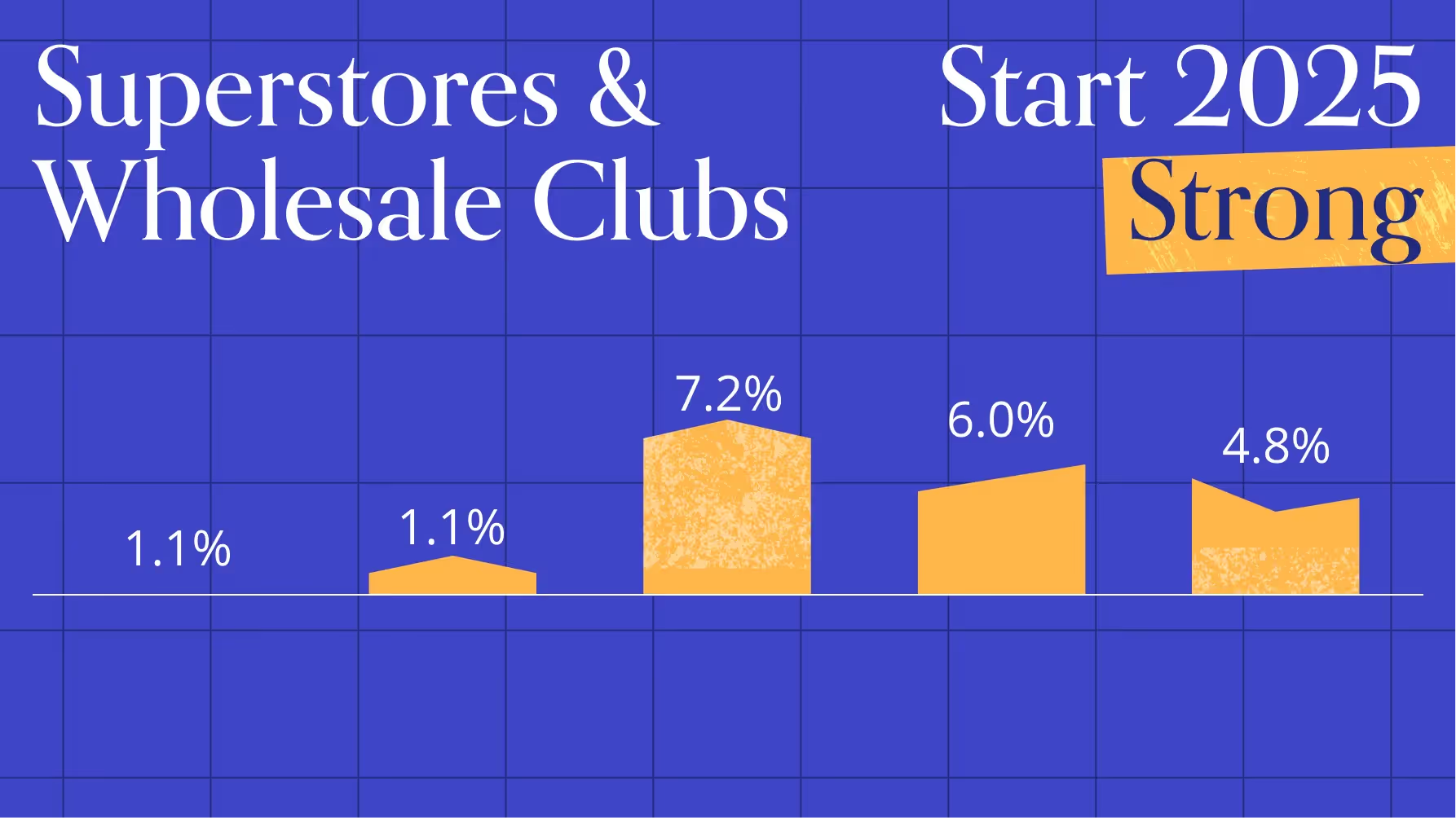
In Q1 2024, YoY visits to the three original House of Sport locations in Victor, NY, Minnetonka, MN, and Knoxville TN – the only ones operational at the start of 2023 – increased by 4.8%. So as DICK’S continues to expand its portfolio of House of Sport locations, existing ones are also drawing bigger crowds.
The original House of Sport locations also drew more extended visits in Q1 2024 than other DICK’s locations – with a remarkable 40.7% of visits lasting more than 30 minutes. With the success of House of Sport under its belt, DICK’S has begun further diversifying its fleet with a new store format that brings an interactive retail experience to the chain’s traditional store type.

DICK’S continues to outperform the wider Apparel and Sportswear retail segments, and its expanding House of Sport concept is meeting healthy and growing demand. As the company continues to lean into its experiential offerings, will the chain’s positive momentum accelerate further?
Visit placer.ai for the latest data-driven retail insights.

As cars get more expensive, demand for repairs rises – and auto part chains are reaping the benefits. We analyzed the visit data for four leading auto part chains – AutoZone, O'Reilly Auto Parts, NAPA Auto Parts and Advance Auto Parts – and dove into O’Reilly Auto Parts’ recent growth to understand what may be driving success in this flourishing segment.
Auto parts chains are having a moment. With vehicle prices significantly higher than before COVID, many consumers would rather fix their cars than purchase new ones. At the same time, inflation has begun to subside, leaving people with more room in their budgets for non-essential maintenance and repairs.
Following a drop in December 2023, YoY visits to AutoZone, O’Reilly Auto Parts, Advance Auto Parts, and NAPA Auto Parts began to pick up in January 2024 – despite unusually cold and stormy weather that left many consumers hunkered down at home. And between February and April, YoY visits to the four chains remained nearly uniformly elevated.

On a quarterly basis, O’Reilly Auto Parts saw the biggest YoY visit increase, despite lapping a strong 2023. The chain, which drew 32.1% of total visits to the four brands in Q1, saw quarterly YoY foot traffic increase by 5.1%. AutoZone, which received 40.1% of quarterly visits to the four chains, saw quarterly YoY visits increase by 3.5%. And Advance Auto Parts and NAPA Auto Parts both saw quarterly YoY visits increase by 1.7%.
One strategy that has likely helped O’Reilly Auto Parts stay ahead of the pack is its much-touted loyalty program, recently ranked by Newsweek as one of the best in the nation.
Location intelligence shows that since COVID, O’Reilly Auto Parts has seen a steady increase in the loyalty of its customer base. And in April 2024, O’Reilly Auto Parts boasted the most loyal customer base of the four analyzed chains – with 52.0% of visits made by individuals that frequented the chain at least twice during the month. But other auto chains, including AutoZone, also enjoyed significant shares of visits by repeat customers – showing that there’s plenty of room at the top in the auto parts space.

The auto parts industry is poised for success in 2024, with leading chains like O'Reilly Auto Parts, AutoZone, Advance Auto Parts, and NAPA Auto Parts demonstrating resilience and growth. How will these chains continue to perform as the year wears on?
Visit placer.ai to find out.

We looked at nationwide and regional visitation patterns for CAVA to understand how the fast-growing fast-casual chain is performing across its major markets.
CAVA – which operated a little over 300 locations by the end of 2023 – is growing rapidly, with plans to reach 1,000 locations by 2032. The chain has seen consistent year-over-year (YoY) visit growth in most of its major markets, with a 23.6% YoY overall increase in nationwide visits in Q1 2024 – in large part due to its ongoing expansion.

CAVA is headquartered in Washington, D.C., and currently, most of its venues are located in the mid-Atlantic and southeastern United States. But the chain also has a strong presence in Texas and California and operates restaurants in a handful of additional states. Recently, CAVA entered the Midwest with its first Chicago location – and has plans to extend its reach even further. So what do CAVA’s various markets have in common – and what sets them apart?
Nationwide, the median household income (HHI) in CAVA’s captured market trade area is higher than the US median HHI – and diving into the regional markets indicates that this trend persists across regional markets.
In most states with a major CAVA presence – including Texas, Virginia, California, North Carolina, Georgia, and Maryland – the median HHI in CAVA’s trade area is 11% to 24% higher than the statewide median. Even in Florida, where the chain’s trade area HHI is closest to the statewide median, households in CAVA’s captured market are still slightly more affluent than in Florida as a whole.

But while the chain seems to attract a similar demographic across states, diving into the hourly visitation patterns in CAVA’s various markets indicates that dining habits differ between regions.
In Texas, Georgia, Florida, and North Carolina, the share of 11:00 AM - 10:00 PM CAVA visits taking place during the lunchtime daypart (11:00 AM - 2:00 PM) ranges from 35.5% to 36.9% – at or above the nationwide average of 35.4%. But in Virginia and Maryland, and especially California, the lunchtime rush is more subdued. In these states, the afternoon and evening dayparts tend to be busier than in the other analyzed states – with California in particular seeing 35.7% of visits taking place between 6:00 PM and 10:00 PM.

Identifying similarities and differences between the visitor bases in CAVA’s various markets can help the company identify ideal locations, optimize staffing needs, and tailor promotional efforts as it continues to enter new markets and open additional restaurants in existing ones.
For more data-driven dining insights, visit placer.ai/blog.

Last year ended on a high note for many retailers, with cooling inflation and rebounding consumer confidence contributing to a robust holiday season. Still, 2023 was a year of headwinds for the sector, as consumers traded down and cut back on unnecessary indulgences.
In the midst of these challenges, some segments thrived. Continued prioritization of health and wellness by consumers drove strong visit growth for the Fitness and Beauty & Self Care segments – which emerged as 2023 winners and enjoyed positive foot traffic growth in Q4. At the same time, price consciousness drove foot traffic to Discount & Dollar Stores and Superstores, both of which made inroads into the affordable grocery space during the year.
The Grocery category, too, saw a 4.3% jump in visits last year compared to 2022, as well as a slight uptick in Q4 visits. And even the discretionary Dining sector held its own, with a 2.1% year-over-year (YoY) annual increase in foot traffic, and a Q4 quarterly visit gap of just 1.8%.
Fitness had a particularly strong 2023, buoyed by consumers’ sustained interest in self-care and wellness. Since the pandemic, gym memberships have graduated from a discretionary expense to something of a necessity – an important investment in health and wellbeing. The category has also likely continued to benefit from the post-COVID craving for experiences.
And quarterly data shows that the Fitness segment is positively flourishing. Throughout most of Q4 2023, Fitness venues experienced YoY weekly visit growth ranging from 8.8% to 12.2%. (The unusual visit spike and dip during the last two weeks of the quarter are due to calendar discrepancies: The week of December 18th, 2023 is being compared to the week of December 19th, 2022, which included Christmas Day – while the week of December 25th, 2023 is being compared to the week of December 26th, 2022, which did not).
Drilling down into the data for several leading fitness chains shows that there’s plenty of success to go around. Crunch Fitness – ranked by Entrepreneur as 2024’s top fitness franchise – led the pack with a remarkable 28.2% YoY annual increase in visits, partly fueled by the steady expansion of its fleet. And while other value gyms like Planet Fitness also saw robust visit growth, the boost wasn’t limited to budget options. Given the Fitness sector’s already-impressive 2022 performance, the category’s strong YoY showing is especially noteworthy.
Beauty & Self Care was another category to benefit from 2023’s obsession with wellness – as well as the “lipstick effect”, which sees consumers treating themselves to fun, affordable luxuries when money’s tight. Driven in part by the evolving preferences of Gen Z consumers, cosmetics leaders have embraced wellness-focused approaches to cosmetics that prioritize self-care and self-expression. This strategy continues to prove successful: Throughout Q4 2023, Beauty & Self Care chains saw steady YoY weekly visit growth, especially in November and early December – perhaps highlighting Beauty’s growing role in the holiday shopping frenzy.
One brand leading the cosmetics pack in 2023 was Ulta Beauty – which drew growing crowds with its diverse product selection. Everybody loves makeup, and Ulta makes sure to have something for everyone – from discount fare to more upscale products. Buff City Soap, which now pairs its signature offerings with experiential vibes at some 270 locations across 33 states, also experienced YoY annual visit growth of 14.7%. And Bath & Body Works, which made the Wall Street Journal’s list of best-managed companies for 2023, also saw visit strength, with an overall increase in annual foot traffic, even as Q4 visits saw a slight decline.
If wellness was a key retail buzzword in 2023, value was an equally discussed topic. And Discount & Dollar Stores – ideal destinations for cash-strapped consumers seeking bargain merchandise – made the most of this opportunity. Shoppers frequented these chains year-round for everything from groceries to home goods, propelling the category firmly into the mainstream.
And in Q4 2023, shoppers flocked to discount chains in droves to snag food items, stocking stuffers, and other holiday fare – fueling near-uniform positive YoY foot traffic growth throughout the quarter. The week of October 30th seems to have kicked off the Discount & Dollar holiday shopping season, perhaps showcasing the segment’s growing role as a Halloween candy and costume hotspot.
Every discount chain is somewhat different – and the success of the various Discount & Dollar chains can be attributed to a range of factors. Dollar Tree and Dollar General likely benefited from the broadening and diversification of their grocery selections – while Ollie’s (“Get Good Stuff Cheap!”) solidified its position as a place to find relatively upscale items at a bargain. All three chains – and particularly Dollar General and Ollie’s – also grew their footprints over the past year. Family Dollar (also owned by Dollar Tree) also came out ahead on an annual basis – despite the comparison to a strong 2022.
Of all the Discount & Dollar chains, Five Below saw the biggest surge in foot traffic, partly as a result of its increasing store count. But the retailer’s offerings – affordable toys, party supplies, and other fun splurges – also appear to have been tailor-made for 2023’s retail vibe.
During the fourth quarter of the year, Superstores saw a slight YoY increase in visits – including during the all-important week of Black Friday, beginning on November 20th. (This week was compared with the week of November 21st, 2022, which also included Black Friday). Like Discount & Dollar chains, Superstores saw an appreciable YoY visit uptick during the week of Halloween.
On an annual basis, Superstore mainstays Walmart and Target experienced visit increases of 2.8% and 4.7%, respectively. But while all the major category players enjoyed a successful year, membership warehouse chains’ YoY visit numbers were especially strong. As perfect venues for mission-driven shopping expeditions, Costco, Sam’s Club, and BJ’s likely drew shoppers eager to load up on both inexpensive gifts and essentials.
The traditional Grocery sector also held its own during Q4 2023. Notably, grocery stores saw positive visit growth for most weeks of November and December, a period encompassing the critical Turkey Wednesday milestone – no small feat given the disruptions experienced by the category.
Unsurprisingly, it was discount grocery chains that saw some of the greatest YoY visit growth, as shoppers – including higher-income segments – sought to counter inflation with lower-priced food-at-home alternatives. Whether through opportunistic buying models, private label merchandising, or no-frills customer experiences, value supermarkets proved once again that even quality specialty items don’t have to carry high price tags.
Eating out can be expensive – and when money’s tight, restaurants and other discretionary categories are often first to feel the crunch. But the Dining category seems to have emerged from 2023 relatively unscathed, with overall yearly visits up 2.1% compared to 2022 despite the modest YoY weekly visit gaps in Q4 2023. And given the myriad challenges out-of-home eateries had to contend with in 2023 – from inflation to labor shortages – even the minor weekly gaps are quite an attainment. (As noted, the last two weeks of the quarter reflect calendar discrepancies).
Foot traffic data shows that dining success could be found across sub-categories. Wingstop, Shake Shack, and Jersey Mike’s Subs rocked Fast Casual and QSR, with annual YoY visit growth ranging from 11.8% to 20.3%, partly fueled by the chains’ growing footprints. Full-Service Restaurants also had their bright spots, including all-you-can-eat buffet star Golden Corral and two steak venues: Texas Roadhouse and LongHorn Steakhouse.
And in the Coffee, Breakfast, and Bakeries space, Playa Bowls led the charge. The superfruit bowl chain’s affordable, wellness-oriented treats seem to have been created with 2023 in mind – and during the year Playa Bowls expanded its fleet while also seeing double-digit increases in comparable store sales. Steadily expanding Biggby Coffee and Dutch Bros. Coffee also saw significant YoY foot traffic growth.

New year, new retail opportunities. And though 2023 is firmly in the rearview mirror, the economic headwinds that characterized much of the year have yet to fully dissipate. But every challenge also brings with it new opportunities, and many retailers are adapting to meet their customers' changing wants and needs.
This white paper analyzes location intelligence for 10 brands poised to succeed in 2024. Some, like low-cost apparel and home furnishing stores, are benefitting from consumer trade-down. Others are expanding into rural or suburban areas to meet customers where they are. Read on for some of 2024’s retail winners.
Until around four years ago, New Balance sneakers were commonly seen on the feet of suburban dads – not exactly a recipe for high fashion. But all that began to change in 2019 when the company began collaborating with Teddy Santis, who eventually became New Balance’s creative director. Since then, the brand’s popularity has surged among Gen Z and X and is now one of the fastest-growing sneaker companies in the industry, despite the increasing competition in sneaker space. In 2023, foot traffic to New Balance stores grew 3.3% year-over-year (YoY) and the brand has firmly established itself as ultimate retro cool.
Diving into the demographics of New Balance stores’ captured market trade area reveals the success of the chain’s rebranding. In 2023, New Balance’s trade area included larger shares of “Ultra Wealthy Families,” “Young Professionals,” and “Educated Urbanites” than the average shoe store’s trade area – highlighting New Balance’s successful reinvention as a brand for the young and hip.
The home improvement space is dominated by Lowe’s and Home Depot – but Harbor Freight Tools is quickly making a name for itself as a go-to destination for affordable tools and supplies.
Over the past few years, Harbor Freight Tools has expanded rapidly, with many of its new stores opening in smaller towns and cities. And the expansion appears to be paying off, with visits up YoY during every month of 2023. And although the chain is now operating with a significantly larger store fleet, the average number of visits per venue has generally increased – indicating that the company is expanding into markets where it is meeting a ready demand.
Over a decade after Mackelmore dropped his smash hit “Thrift Shop” in 2012, second-hand stores are still enjoying their time in the limelight. Shoppers, driven by a desire to reduce waste, find unique styles, and to save a few dollars at the till, continue to flock to thrift stores. And Winmark Corporation, which operates five secondhand goods chains – including apparel brands Plato’s Closet (young adult clothes), Once Upon a Child (children's clothes and toys), and Style Encore (women's clothing) – has benefited from the strong demand. Visits to the three Winmark clothing banners increased an average of 5.3% YoY in 2023.
The median household income (HHI) in the trade areas of Winmark’s apparel chains tends to be lower than the median HHI in the wider apparel category – so budget-conscious consumers are driving at least some of the company’s growth. With more consumers looking for ways to cut back on spending in 2024, the demand for second-hand clothes is expected to grow even further – and Winmark is likely to continue reaping the benefits.
HomeGoods, a treasure hunter's dream, is the discount home furnishing retailer owned by off-price retail giant TJX Companies. The chain, which operates over 900 brick-and-mortar stores, recently closed its e-commerce platform to focus on its physical locations – where foot traffic grew 6.0% between 2023 and 2022.
HomeGoods carries kitchen and home decor items along with furniture, and may be benefiting from the relative strength of the houseware segment, driven in part by an increase in at-home entertainment. And in a surprising twist, this low-cost retailer attracts more affluent visitors than visitors to the home furnishing segment overall. The median household income (HHI) in HomeGoods’ trade area stood at $84.7K/year compared to a $78.5K median HHI in the trade area of the average home furnishing chain. As economic uncertainty and the resumption of student loan payments impact consumers, wealthier shoppers seeking a budget-friendly home refresh are likely to continue choosing HomeGoods over pricier alternatives.
Florida-based Bealls, Inc., which got its start as a small town five-and-dime in 1915 in Bradenton, Florida, now operates over 600 stores across the country. The company, which saw an impressive 9.0% YoY increase in visits in 2023, recently consolidated its two largest banners – Burkes Outlet and Bealls Outlet – under the Bealls name.
One reason for Bealls’ success could be its appeal to rural consumers. Over the past five years, the share of households falling into Spatial.ai: PersonaLive’s “Rural Average Income” segment has steadily increased, growing from 12.6% in 2019 to 15.1% in 2023. With rural shoppers continuing to command ever-more attention from retailers, the increase in visits from this segment bodes well for Bealls in 2024.
Ollie’s Bargain Outlet was built for this economy. The chain saw a 13.0% YoY increase in visits in 2023, thanks in part to its popularity among a wide array of budget-conscious consumers. Ollie’s has found success with rural shoppers while maintaining its appeal among value-oriented suburban segments – and the chain’s diverse audience base seems to be setting it apart from other discount retailers.
A closer look at the chain’s captured market data, layered with the Spatial.ai: Personalive dataset, reveals that Ollie’s trade area includes larger shares of the “Blue Collar Suburbs” and “Suburban Boomer” segments when compared to the wider Discount & Dollar Stores category. As the chain plots its expansion, focusing on suburban and rural areas may help Ollie’s meet its customers where they are.
Trader Joe’s has managed to do what few stores can. The company does not invest in marketing, has no online shopping options, and loyalty programs? Forget about it. But despite this unusual approach to running a business, the California native has enjoyed consistent success over the years, with a 12.4% YoY increase in visits in 2023.
Trader Joe’s is particularly popular among younger shoppers, perhaps thanks to the company’s focus on sustainability and social responsibility – as well as its famously low prices. Analyzing the chain’s trade area using the AGS: Panorama dataset reveals that Trader Joe’s attracts more “Emerging Leaders” and “Young Coastal Technocrats” (segments that describe highly educated young professionals) than the average grocery chain. With Gen Z particularly concerned about putting their money where their mouth is, Trader Joe’s is likely to sustain its momentum in 2024 and beyond.
Convenience stores are growing up and evolving into bona-fide dining destinations. And Foxtrot, a Chicago-based chain with 29 stores across Texas, Illinois, Washington, Maryland, and Virginia, is one c-store redefining what a convenience store can be. The chain, which announced a merger with Dom’s Kitchen in November 2023, offers an upscale convenience store experience and is particularly known for including local brands in its product assortment as well as its excellent wine curation and dining options.
Visitors to the chain were significantly more likely to fall into AGS: Behavior & Attitudes dataset’s “Wine Drinker” or “Nutritionally Aware” segments than visitors to nearby convenience stores. The company plans to ramp up store openings, particularly in the suburbs, where convenience and a good bottle of wine might just find the perfect home as a welcome distraction from the daily grind.
Jersey Mike’s is one of the fastest-growing franchise dining chains in the country, operating over 2,500 locations in all 50 states. The sandwich chain has seen its popularity take off over the past few years, with 2023 visits up 14.1% YoY and plans to open 350 new stores in 2024.
The company has long prioritized affluent class suburban customers – and visitation data layered with the Experian: Mosaic dataset reveals that Jersey Mike’s has indeed succeeded in attracting this audience. The percentage of “Booming with Confidence” and “Flourishing Families” (both affluent segments) in Jersey Mike’s trade area was larger than in the trade areas of the average sub sandwich chain. As Jersey Mike’s continues its expansion, focusing on suburban areas may continue to serve the chain well.
The East Coast may not be the first region that pops to mind when thinking about tropical smoothies – but New Jersey-based Playa Bowls is making it work. The company was founded by avid surf enthusiasts determined to bring the flavors of their favorite surfing towns stateside.
Playa Bowls has enjoyed strong visit numbers in 2023, with overall visits up 23.0% and average visits per venue up 17.1% YoY – and part of the chain’s success may be driven by its ability to draw wealthier customers to its stores. The Experian: Mosaic dataset reveals that the “Power Elite” segment is overrepresented in the company’s trade areas: The share of households falling into that segment from Playa Bowl’s captured market exceeded their share in the company’s potential market. As the chain continues expanding its domestic footprint, it seems to have found its niche among a wealthy customer base.
The past year saw a wide range of challenges facing brick-and-mortar retailers as economic fears continued to shake consumer confidence. But there are plenty of bright spots as the new year gets underway. These ten brands prove that the retail world never stands still, and that the next opportunity is just around the corner.

Sports leagues like the NBA, NFL, and MLB boast billion-dollar revenues – and the venues where these games unfold hold significant commercial potential in their own rights. Many stadiums host concerts and other shows in addition to regularly held sporting matches and can accommodate tens of thousands of spectators at once – creating massive retail, dining, and advertisement opportunities.
This white paper analyzes location intelligence metrics for some of the biggest stadiums across the country to reveal the commercial potential of these venues beyond simple ticketing revenue. Where do visitors of various stadiums like to shop? Do specific sporting and cultural events impact the nearby restaurant scene differently? How can stadium operators, local businesses, and advertisers tailor their offerings to a stadium’s particular audience and make the most of the stadium and the space throughout the year?
We take a closer look below.
The three major sports leagues – the National Basketball League (NBA), Major League Baseball (MLB), and the National Football League (NFL) – play at different points of the year, and the number of games each league holds during the season also varies.
MLB leads in game frequency, with each team playing 162 games during the regular season, which runs approximately from April through September. Basketball season is also around six months – roughly from mid-October to mid-April – but each NBA team plays only 82 games a season. And the NFL has both the shortest season – 18 weeks running from early September to early January (with the pre-season starting in August) – and the fewest number of matches per team. Understanding the monthly visitation patterns for the various types of stadiums can help advertisers, stadium operators, and other stakeholders ensure that they are leveraging the full potential of the venue throughout the year.
Unsurprisingly, the sports arenas serving the different leagues see visit spikes during their leagues’ respective season. But comparing visit numbers throughout the year to the average monthly visit numbers for each category in 2023 reveals that the relative visit increases and decreases during the on- and off-season vary for each type of stadium.
MLB stadiums display the steadiest visit strength during the on-season – perhaps due to MLB’s packed game schedule. MLB tickets also tend to be relatively affordable compared to tickets to pro football or basketball matches, which may also contribute to MLB’s consistently strong visit numbers throughout the season. During the MLB off-season, baseball fields – which tend to be uncovered – are relatively empty.
The seasonal visit spike to NBA arenas is less steady. The beginning and end of the season see strong peaks, and visits slow down slightly during the mid-season months of January and February. Visits then drop during the off-season spring and summer, but the off-season visit dip is not as low as it is for MLB fields – perhaps because the NBA arenas’ indoor nature make them suitable locations for concerts and other non-basketball events.
Meanwhile, NFL stadiums see the least dramatic drop in visits during the NFL off-season, as these venues’ enormous size also make them the ideal location for concerts and other cultural events that draw large crowds. These arenas’ strong almost year-round visitation numbers mean that sponsors and advertisers looking to expand beyond sports fans to reach a diverse audience may have the most success with these venues.
Although MLB offers the most budget-friendly outing, combining STI: Popstats demographic metrics with trade area data reveals that MLB stadium visitors reside in higher-income areas when compared with visitors to NBA or NFL stadiums.
Baseball fans tend to be older than fans of the other sports, which could partially explain MLB stadium visitors’ higher household income (HHI). The combination of lower ticket prices, higher median HHI among fans, and many games per season offers baseball stadiums significant opportunities to engage effectively with their fan bases.
But while NBA and NFL stadium attendees may not come from as high-income areas as do MLB stadium visitors, fans of live basketball and football still reside in trade areas with a higher HHI compared to the nationwide median. So by leveraging stadium space, advertisers and other stakeholders can reach tens of thousands of relatively high-income consumers easily and effectively.
Sports fans are known to be passionate, engaged, and willing to spend money on their team – but stadium visitors also shop for non-sports related goods and services. Retailers and advertisers can draw on location analytics to uncover the consumer preferences of stadium visitors and tailor campaigns, sponsorships, and collaborations accordingly.
Visitation data to the top five most visited MLB stadiums during 2023 showed differences between the apparel and sporting goods shopping preferences of the various stadiums’ attendees. While 39.4% of visitors to Truist Park also visited DICK’s in 2023, only 30.8% of Yankee Stadium visitors stopped by the sporting goods retailer in the same period. Similarly, while 29.9% of visitors to Yankee Stadium frequented Kohl’s, that percentage jumped to 47.3% for Busch Stadium visitors.
Harnessing location intelligence to see the consumer preferences of a stadium’s visitor base can help retailers, stadium operators, and even team managers choose partnerships and merchandising agreements that will yield the most effective results.
Sports and snacks go hand in hand – what would a baseball game be without a hot dog or peanuts? But while every stadium likely provides a similar core of traditional game day eats, each venue also offers a unique set of dining options, both on- and off-premise. And by leveraging location analytics to gain visibility into stadium-goers dining habits, stadium operators and local food businesses can understand how to best serve each arena’s audience.
Mapping where stadium visitors dine before and after games can help stakeholders in the stadium industry reach more fans.
The chart below shows the share of visitors coming to a stadium from a dining venue (on the x-axis) or going to a dining venue after visiting the stadium (on the y-axis). The data reveals a correlation between pre-stadium dining and post-stadium dining – stadiums where many guests visit dining venues before the stadium also tend to have a large share of guests going to dining venues after the event. For example, the AT&T Stadium in Arlington, Texas, saw large shares of visitors grabbing a bite to eat on their journey to or from the stadium, while the M&T Bank Stadium in Baltimore, Maryland saw low rates of pre- and post stadium dining engagement.
These trends present opportunities for both local businesses and stadium stakeholders. For example, venues with high dining engagement can explore partnerships with local restaurants, while those with lower rates can build out their in-house dining options for hungry sports fans.
Stadiums looking to enhance their food offerings – or local entrepreneurs thinking of opening a restaurant near a stadium – can also get inspired by stadium visitors’ dining preferences. For example, psychographic data taken from the Spatial.ai: FollowGraph dataset reveals that visitors to MetLife Stadium in East Rutherford, New Jersey have a much stronger preference for Asian cuisine compared to New Jersey residents overall. With that knowledge, the stadium can enhance the visitor experience by expanding its Asian food offerings.
On the other hand, MetLife Stadium goers seem much less partial to Brewery fare than average New Jerseyans, so the stadium operators and restaurateurs may want to avoid offering too many Brewery-themed dining options. Stadium stakeholders can reserve the craft beers for Caesars Stadium, M&T Bank Stadium, and Soldier Field Stadiums, where visitors seem to enjoy artisanal brews more than the average resident in Louisiana, Maryland, and Illinois, respectively.
All of the stadiums analyzed exhibited unique visitor dining tastes, a reminder that no customer or fan base is alike. Aligning on- or off-site dining options with offerings that align with a given customer base’s preferences can improve overall visitor satisfaction and boost revenues.
Zooming in to look at consumer behavior around individual events reveals further variability in dining preferences even among visitors to the same stadium, with different types of events driving distinct dining behaviors.
State Farm Stadium in Glendale, Arizona, is home to the Arizona Cardinals. The stadium hosted the 2023 Super Bowl, but the NFL stadium also acts as a concert venue for acts ranging from Taylor Swift to Metallica. And location intelligence reveals that the dining preferences of stadium visitors vary based on the events held at the venue.
During the Super Bowl, sports bars such as Yard House and Buffalo Wild Wings saw the largest increase in visits compared to the chains’ daily average. A month later, attendees at Taylor Swift's concert gave fried-chicken leader Raising Cane’s a significant boost.
Local restaurants can leverage location analytics to see what types of events are popular with their visitor base and craft collaborations and advertising campaigns that resonate effectively with their patrons.
Sports stadiums and arenas are not just spaces for sports and music enthusiasts to gather; they also offer significant commercial opportunities for the surrounding communities. Stadium operators and local businesses can fine-tune their offerings by utilizing location analytics to better connect with their visitor bases and uncover new retail opportunities.