.png)
.png)

.png)
.png)

In recent years, Tennessee has emerged as a surprising migration hotspot. The state, which offers a growing tech scene, business-friendly tax regulations, and a relatively low cost of living is rapidly gaining popularity and attracting inbound migration from across the nation.
Where are newcomers coming from – and where within Tennessee are they going? Using Placer.ai’s Migration Trends Report, we took a closer look at the migration data to gain a more thorough understanding of the shifts taking place in the Volunteer State.
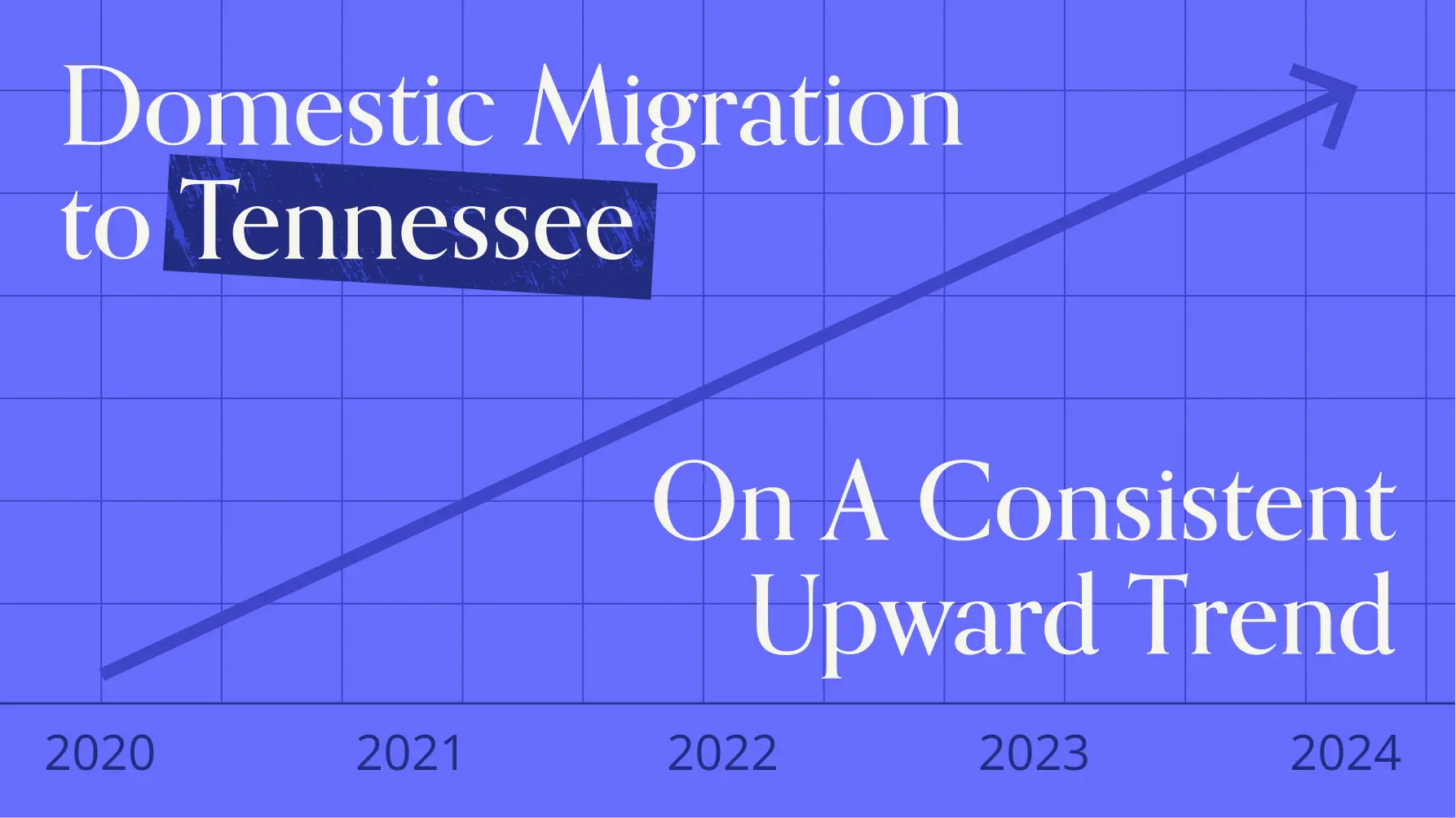
The state of Tennessee has experienced significant positive migration over the past few years. Between July 2020 and July 2024, the cumulative net migrated percent of Tennessee’s population increased steadily, with 2.1% of the state’s July 2024 population having moved there from elsewhere in the country over the previous four years.
Diving deeper into Tennessee’s migration patterns reveal that between July 2020 and July 2024, the state had net positive domestic migration from 41 out of 50 states – meaning Tennessee gained more residents from these states than it lost to those states. Illinois and California together accounted for almost 40% of Tennessee’s net positive domestic migration during the period, and the state also drew a large contingent (33.6% of net positive domestic migration) from the East Coast.
While Memphis, Tennessee’s second-largest city, has made headlines in recent years for its declining population, other metro areas in the state are experiencing strong interest from newcomers.
Between July 2020 and July 2024, the Nashville CBSA (core-based statistical area) received the largest share of net positive domestic migration, with 24.6% of newcomers to Tennessee settling in the Music City. Nashville has been establishing itself as a tech hub, a factor which may have driven its strong net migration.
Knoxville came in second, welcoming 18.7% of the positive net migration to Tennessee between July 2020 and July 2024. Other CBSAs rounding out the top five were Chattanooga (9.0% share of positive net migration), Kingsport-Bristol (8.7%), and Johnson City (6.0%).
The influx of new residents into Tennessee is not only helping drive the state’s population up – it’s also reshaping its demographic composition. Zooming into the top five CBSAs mentioned above reveals that newcomers generally are coming from CBSAs of origin where the weighted median age is younger than the existing population.
The only metro area bucking this trend was Clarksville, where incoming residents were slightly older than the youthful median 31 years of its residents, though this may be a reflection of its strong university and military presence.
The movement of younger people into these up-and-coming CBSAs reflects the opportunities available for people to grow their careers and put down roots in a state that is quickly becoming a hub for growth and opportunity.
Tennessee seems to have reinvented itself as a destination for young people seeking out opportunities for growth. By continuing to foster a business-friendly environment and supporting its diverse communities, the state is well-positioned to thrive.
Visit Placer.ai to keep up with the latest data-driven migration trends.

How have McDonald’s and Chipotle, two of the most recognizable names in the quick-service and fast-casual dining scenes, fared over the last year? We take a closer look at each chain’s visit performance, and highlight some bright spots of 2024.
Visits to McDonald’s were mixed throughout 2024, with most months seeing minor visitation lags relative to 2023. Still, YoY traffic trends outpaced those of the overall QSR segment in all but one month (October 2024), highlighting the chain’s power relative to the rest of the market.
Some of the visitation dips at both McDonald's and the overall QSR segment are likely due to inflation impacting prices across the dining industry. And the rise of the budget-conscious consumer has prompted many chains to lean on limited-time offers and special releases to both offer affordable deals and turn a trip to a QSR into a special occasion. McDonald’s capitalized on this trend, driving impressive visit boosts following the June launch of its $5 Meal Deal. However, it was the chain’s special releases that delivered the most significant increases in weekly visits.
The introduction of the Chicken Big Mac on October 10th, 2024 proved to be a major success, driving a 7.2% increase in visits during the week of the launch (October 7th-13th) and an even larger 8.7% increase in the first full week following the release (October 14th-20th). The chain also enjoyed a jump in foot traffic from its limited-edition collector’s meal, launched on August 12th, 2024, further highlighting the effectiveness of these strategic, nostalgia-driven releases.
Chipotle has been a fast-casual darling for several years now, consistently driving YoY visit growth and expanding into new markets. And 2024 was no exception for the chain, with visits growing in all months analyzed. This included an impressive 21.1% year-over-year increase in April 2024, followed by sustained growth throughout the remainder of the year, culminating in an 8.8% increase in December 2024 compared to 2023. In contrast, the broader fast-casual category saw much more muted visitation patterns.
Some of Chipotle’s visit growth can be attributed to the aggressive growth strategy the company has undertaken, opening approximately 300 stores in 2024 with plans to add another 300 locations in 2025. A significant part of this expansion strategy focuses on rural and suburban markets in a bid to capture untapped demand beyond traditional urban hubs.
And diving into visits per location reveals that, overall, this strategy is working. All but eight states analyzed showed YoY visit per location growth in 2024 – and five of the top ten states for visits per location growth are among the least densely populated in the country. This suggests that Chipotle's decision to target smaller markets is paying off, enabling the brand to attract new audiences while reinforcing its stronghold in more densely populated areas.
Despite a challenging 2024, McDonald’s and Chipotle are surviving – and even thriving.
What might lie ahead for the two chains as 2025 gets underway?
Visit Placer.ai for the latest data-driven dining updates.

The Container Store has been a prime example of a specialty retailer that successfully catered to a highly specific and niche consumer need. The home organization trend gained traction in the early 2000s with the rise of custom closet solutions and continued to grow in popularity through influential figures like Marie Kondo and The Home Edit.
The home furnishings category experienced a surge during the pandemic as consumers focused on improving their living spaces, whether by purchasing new homes or renovating existing ones. However, as discretionary spending habits have normalized and interest rates have risen, consumer spending in this category has declined.
Additionally, the sector has seen significant consolidation, most notably with the closure of Bed Bath & Beyond, a major player in home furnishings and organization. The remaining retailers in the space now largely fall into two distinct categories: niche specialists and value-driven brands..
Those retailers that play in the more niche space – including The Container Store – have had an even more challenging path to meet changing consumer needs. Despite offering a high level of customization and expertise, the chain has struggled against increasing industry-wide promotional activity and waning interest in the home organization category. Additionally, mass merchants and other home retailers have expanded their offerings in this space, providing organization solutions at price points that better align with today’s cost-conscious consumers.
Placer’s foot traffic estimates indicate a clear rise in competition for The Container Store since 2022, aligning with a broader decline in demand for its category. In 2024, visitors to The Container Store cross-shopped at Target, HomeGoods, IKEA, and World Market at higher rates than in 2022. This growing preference for competitive alternatives – many of which emphasize greater value – has likely contributed to the retailer’s challenges.
Specialty retailers play a crucial role in the industry by offering expert knowledge, superior service, and a wider assortment of products. However, as we move into 2025, the retail landscape must continue evolving to meet shifting consumer expectations, making adaptation essential for specialty retailers.
%20_%20Texas%20Roadhouse.avif)
In 2024, many inflation-squeezed consumers looked to budget-dining options or simply ate more meals at home. How did full-service chains Chili’s and Texas Roadhouse drive foot traffic in such a challenging macroeconomic environment? We dove into the data to find out.
In 2024, value was a key ingredient in Chili’s and Texas Roadhouses’ recipes for success – although each chain used a different strategy to communicate its affordability to consumers.
Chili’s leaned into budget-friendly meal deals in 2024. The chain’s rebooted 3 For Me value menu drove significant traffic in Q2 2024 (9.7% visit growth YoY), and visits skyrocketed again in the fall, due in part to the viral Fried Mozzarella appetizer, part of a Triple Dipper deal, and the promotional $6 “Witches Brew” margarita – propelling the chain to 23.0% YoY visit growth in Q4 2024.
Texas Roadhouse, on the other hand, doesn’t run promotions – and instead relies on its already strong value perception to drive traffic when budgets are tight. But the chain’s consistent YoY visit growth (7.2% in 2024) was also likely due to its growing real estate footprint: over 30 new locations that are approximately 10% larger than previous builds, allowing for higher guest volumes.
Chili’s and Texas Roadhouse’s value perception appears to attract many consumers from lower-income households – but the chains drive traffic from diners with slightly more discretionary income as well.
Diving into the demographic characteristics of visitors revealed that in 2024, Chili’s and Texas Roadhouse received a smaller share of visits from the households earning over $100K/year compared to the nationwide distribution. (Texas Roadhouse served a slightly smaller share of these households, likely due to its smaller market strategy.) At the same time, both chains drove a larger share of traffic from households earning less than $50K/year and between $50K and $100K/year, compared to the nationwide distribution. This suggests that Chili's and Texas Roadhouse visitors are likely seeking value for money, but a significant share have more discretionary income to spend on higher-priced items – like top-shelf margaritas and steaks – than the average U.S. consumer.
As Chili’s and Texas Roadhouse continue investing in innovations and technological solutions to improve efficiency and customer experience, the chains are likely to continue attracting visitors looking to get the most bang for their dining bucks in 2025.
Chili’s and Texas Roadhouse may attract visitors from a similar demographic, but analysis of the markets in which the chains drive the most visits reveals several distinct regional preferences among dining consumers nationwide.
In 2024, Texas Roadhouse received a greater share of visits in a majority of Midwest and Mid-Atlantic CBSAs – consistent with a smaller market strategy – while Chili's drove a greater share of visits in denser markets and a majority of the CBSAs in California, Texas, and Florida.
But despite these regional differences, the chains received a near-even share of visits. Texas Roadhouse, with 675 U.S. locations, claimed 51.2% of visits to both chains, while Chili’s with over 1200 locations claimed 48.8% of the chains’ combined visits.
Chili’s and Texas Roadhouse have found success by providing value for money that sets them apart from other full-service chains. Yet, both chains drive an above-average share of high-income traffic, indicating that they are winning with value-conscious consumers with the means to indulge.
For more data-driven dining insights, visit Placer.ai.

College students often have to count their pennies – but they also know how to have a good time and are willing to pony up for things that matter to them. So with spring semester underway, we dove into the data to explore collegiate dining habits in the University City district of Philadelphia, PA – home to the University of Pennsylvania and Drexel University, as well as several smaller schools. How does the campus vibe impact visitation trends at local convenience stores and restaurants?
We dove into the data to find out.
Wawa – famous for low prices and round-the-clock service – is the perfect place to grab a sandwich to fuel an all-night study session or a cup of coffee on the go. And the University City Wawa at 3724-2744 Spruce Street is a local landmark, serving everyone from students and university employees to other area residents.
Analyzing visitation patterns at the Spruce Street Wawa shows that the store’s visitation patterns mirror the rhythms of campus life – with an uptick in late-night visits and fewer early-morning ones. Between September and December 2024, for example, some 8.7% of visits to the Spruce Street location took place between midnight and 3:00 AM – far exceeding the chainwide average of 3.8%. Meanwhile, visits during the early morning hours (6:00 AM to 9:00 AM) remained subdued – a trend consistent with the typical university lifestyle. And while the average Wawa’s traffic peaked during lunchtime, the Spruce Street location peaked between 3:00 PM and 6:00 PM – prime afternoon snack time.
Examining the Spruce Street Wawa’s captured market – i.e. the census block groups (CBGs) feeding visits to the store, weighted to reflect the share of visits from each CBG – shows that it is indeed college students driving the location’s late-night activity. Between September and December 2024, 63.3% of the Spruce Street Wawa’s captured market during the 12:00 AM - 3:00 AM daypart was made up of STI:Landscape’s “Collegian” segment – a group encompassing currently-enrolled college students living in dorms or off campus. By 3:00 AM, this share dropped to 12.2%, before bottoming out at 10.1% between 6:00 AM and 9:00 AM – unthinkably early for many undergrads. The share of “Collegians” then began to climb back upwards, reaching just over 50.0% in the evening.
Of course, Wawa isn’t the only local dining spot to benefit from student patronage. Local favorites – from the full-service White Dog Cafe in University City to the quick-serve Kiwi Yogurt on Chestnut St. – also attract plenty of undergrads.
But while Kiwi Yogurt stands out as a key weekday attraction for busy students, White Dog Cafe is more of a weekend destination. On Mondays through Fridays, the share of “Collegians” in Kiwi Yogurt’s captured market stood at 36.4%, dropping to 22.6% on weekends. Meanwhile, White Dog Cafe experienced an opposite trend, with the share of “Collegians” increasing on weekends (36.7%) and declining during the week (24.5%).
Whether it’s a late-night Wawa hoagie run or a weekend brunch at White Dog Cafe, even skint college students can find room in their budgets for convenient snacks and fun outings with friends – funneling steady foot traffic to local restaurants, cafes, and stores.
How will student dining trends continue to evolve in 2025?
Follow Placer.ai to find out.

Looking at the discretionary categories that outperformed this holiday season, we may be on the cusp of a new trend heading into 2025: reinvention. Our data highlights that home furnishings, beauty, and apparel were among the top-performing discretionary retail categories in terms of year-over-year visits during November and December, as shown below.
The performance of these three categories is notable for different reasons. After significant declines earlier in the year, the home furnishings category rebounded strongly. As discussed in November, this recovery was supported by strength in the housewares category and mattress retailers. Housewares retail has generally outperformed home furnishings over the past few years – a trend partly attributed to increased out-of-home entertaining. While purchasing gifts for hosts likely drive visits for some home furnishing retailers, we may now be entering a replacement cycle for many home furnishing products purchased during the pandemic, which could further support the category’s recovery. In other words, many consumers may be looking to reinvent their personal spaces starting with their homes.
The strength in beauty and apparel may reflect a broader trend of personal reinvention. What fueled this movement? It could be as simple as buying a new outfit for a holiday party or experimenting with seasonal beauty products. However, several apparel retailers we spoke to over the past few months pointed to additional factors, including health and wellness trends. 2024 saw a rise in in-person workouts (one of the strongest retail categories in year-over-year visitation), greater adoption of technology-driven fitness and wellness routines, and increased use of wellness supplements and GLP-1 drugs like Ozempic and Mounjaro. Retailers noted that healthier lifestyles during 2024 drove increased demand for apparel this holiday season—a trend that could have substantial implications for the year ahead.
This report includes data from Placer.ai Data Version 2.0, which implements improvements to our extrapolation capabilities, adds short visit monitoring, and enhances visit detection.
Grabbing a coffee or snack at a convenience store is a time-honored road trip tradition – but increasingly, Convenience Stores (C-Stores) have also emerged as places people go out of their way to visit.
Convenience stores have thrived in recent years, making inroads into the discretionary dining space and growing both their audiences and their sales. Between April 2023 and March 2024, C-Stores experienced consistent year-over-year (YoY) visit growth, generally outperforming Overall Retail. Unsurprisingly, C-Stores fell behind Overall Retail in November and December 2023, when holiday shoppers flocked to malls and superstores to buy gifts for loved ones. But in January 2024, the segment regained its lead, growing YoY visits even as Overall Retail languished in the face of an Arctic blast that had many consumers hunkering down at home.
C-Stores’ current strength is partially due to the significant innovation by leading players in the space: Chains like Casey’s, Maverik, Buc-ee’s, and Rutter’s are investing in both in their product offerings and in their physical venues to transform the humble C-Store from a stop along the way into a bona fide destination. Dive into the data to explore some of the key strategies helping C-Stores drive consumer engagement and stay ahead of the pack.
While chain expansion may explain some of the C-Store segment growth, a look at visit-per-location trends shows that demand is growing at the store level as well. Over the past year (April 2023 to March 2024), average visits per location on an industry-wide basis grew by 1.8%, compared to the year prior (April 2022 to 2023).
And within this growing segment, some brands are distinguishing themselves and outperforming category averages. Casey’s, for example, saw the average number of visits to each of its locations increase by 2.3% over the same time frame – while Maverik, Buc-ee’s and Rutter’s saw visits per location increase by 3.2%, 3.4% and 3.9%, respectively.
Each in its own way, Casey’s, Maverik, Buc-ee’s, and Rutter’s, are helping to transform C-Stores from pit stops where people can stretch their legs and grab a cup of coffee to destinations in and of themselves.
Midwestern gas and c-store chain Casey’s – famous for its breakfast pizza and other grab-and-go breakfast items – has emerged as a prime spot for fast food pizza lovers to grab a slice first thing in the morning. And Salt Lake City, Utah-based Maverik – which recently acquired Kum & Go and its 400-plus stores – is also establishing itself as a breakfast destination thanks to its specialty burritos and other chef-inspired creations.
Casey’s and Maverik’s popular breakfast options are likely helping the chains receive its larger-than-average share of morning visits: In Q1 2024, 16.3% of visits to Maverik and 17.5% of visits to Casey’s took place during the 7:00 AM - 10:00 AM daypart, compared to just 14.9% of visits to the wider C-Store category.
Psychographic data from the Spatial.ai’s FollowGraph dataset – which looks at the social media activity of a given audience – also suggests that Casey’s and Maverik’s have opened stores in locations that allow them to reach their target audience. Compared to the average consumer, residents of Casey’s potential market are 7% more likely to be “Fast Food Pizza Lovers” than both the average consumer and the average C-Store trade area resident. Residents of Maverik’s potential market are 16% more likely than the average consumer to be “Mexican Food Enthusiasts,” compared to residents of the average C-Store’s trade area who are only 1% more likely to fall into that category.
With both chains expanding, Casey’s and Maverik can hope to introduce new audiences to their unique breakfast options and solidify their hold over the morning daypart within the C-Store space over the next few years.
Everything is said to be bigger in the Lone Star State, and Texas-based convenience store chain Buc-ee’s – holder of the record for the worlds’ largest C-Store – is no exception. With a unique array of specialty food items and award-winning bathrooms, Buc-ee’s has emerged as a well-known tourist attraction. And the popular chain’s status as a visitor hotspot is reflected in two key metrics.
First, Buc-ee’s attracts a much greater share of weekend visits than other convenience store chains. In Q1 2024, 39.6% of visits to Buc-ee’s took place on the weekends, compared to just 28.3% for the wider C-Store industry. And second, Buc-ee’s captured markets feature higher-than-average shares of family-centric households – including those belonging to Experian: Mosaic’s Suburban Style, Flourishing Families, and Promising Families segments.
Rather than merely a place to stop on the way to work, Buc-ee’s has emerged as a favored destination for families and for people looking for something fun to do on their days off.
Buc-ee’s isn’t the only C-Store chain that believes bigger is better. Pennsylvania-based Rutter’s is increasing visits and customer dwell time by expanding its footprint – both in terms of store count and venue size. New stores will be 10,000 to 12,000 square feet – significantly larger than the industry average of around 3,100 square feet. And in more urban areas, where space is at a premium, the company is building upwards.
Rutter’s added a second floor to one of its existing locations in York, PA in December 2023. The remodel, which was met with enthusiasm by customers, provided additional seating for up to 30 diners, a beer cave, and an expanded wine selection. And in Q1 2024, the location experienced 15.6% YoY visit growth – compared to a chainwide average of 7.6%. Visitors to the newly remodeled Rutter’s also stayed significantly longer than they did pre-renovation. The share of extended visits to the store (longer than ten minutes) grew from 20.8% in Q1 2023 to 27.0% in Q1 2024 – likely from people browsing the chain’s selection of beers or grabbing a bite to eat.
Convenience stores are flourishing, transforming into some of the most exciting dining and tourist destinations in the country. Today, C-Store customers can expect to find brisket sandwiches, gourmet coffees, or craft beers, rather than the stale cups of coffee of old. And the data shows that customers are receptive to these innovations, helping drive the segment’s success.
The first quarter of 2024 was generally a good one for retailers. Though unusually cold and stormy weather left its mark on the sector’s January performance, February and March saw steady year-over-year (YoY) weekly visit growth that grew more robust as the quarter wore on.
March ended on a high note, with the week of March 25th – including Easter Sunday – seeing a 6.1% YoY visit boost, driven in part by increased retail activity in the run-up to the holiday. (Last year, Easter fell on April 9th, 2023, so the week of March 25th is being compared to a regular week.)
Though prices remain high and consumer confidence has yet to fully regain its footing, retail’s healthy Q1 showing may be a sign of good things to come in 2024.
Drilling down into the data for leading retail segments demonstrates the continued success of value-priced, essential, and wellness-related categories.
Discount & Dollar Stores led the pack with 11.2% YoY quarterly visit growth, followed by Grocery Stores, Fitness, and Superstores – all of which outperformed Overall Retail. Dining also enjoyed a YoY quarterly visit bump, despite the segment’s largely discretionary nature. And despite the high interest rates continuing to weigh on the housing and home renovation markets, Home Improvement & Furnishings maintained just a minor YoY visit gap.
Discount & Dollar Stores experienced strong YoY visit growth throughout most of Q1 – and as go-to destinations for groceries and other other essential goods, they held their own even during mid-January’s Arctic blast. In the last week of March, shoppers flocked to leading discount chains for everything from chocolate Easter bunnies to basket-making supplies – driving a remarkable 21.5% YoY visit spike.
Dollar General continued to dominate the Discount & Dollar Store space in Q1, with visits to its locations accounting for nearly half of the segment’s quarterly foot traffic (44.7%). Next in line was Dollar Tree, followed by Family Dollar and Five Below. Together, the four chains – all of which experienced positive YoY quarterly visit growth – drew a whopping 91.6% of quarterly visits to the category.
Rain or shine, people have to eat. And like Discount & Dollar Stores, traditional Grocery Stores were relatively busy through January as shoppers braved the storms to stock up on needed items. Momentum continued to build throughout the quarter, culminating in a 10.5% foot traffic increase in the week ending with Easter Sunday.
Like in other categories, it was budget-friendly Grocery banners that took the lead. No-frills Aldi drove a chain-wide 24.4% foot traffic increase in Q1, by expanding its fleet – while also growing the average number of visits per location. Other value-oriented chains, including Trader Joe’s and Food Lion, experienced significant foot traffic increases of their own. And though conventional grocery leaders like H-E-B, Kroger, and Albertsons saw smaller visit bumps, they too outperformed Q1 2023 by meaningful margins.
January is New Year’s resolution season – when people famously pick themselves up off the couch, dust off their trainers, and vow to go to the gym more often. And with wellness still top of mind for many consumers, the Fitness category enjoyed robust YoY visit growth throughout most of Q1 – despite lapping a strong Q1 2023.
Predictably, Fitness’s visit growth slowed during the last week of March, when many Americans likely indulged in Easter treats rather than work out. But given the category’s strength over the past several years, there is every reason to believe it will continue to flourish.
For Fitness chains, too, cost was key to success in Q1 – with value gyms experiencing the biggest visit jumps. EōS Fitness and Crunch Fitness, both of which offer low-cost membership options, saw their Q1 visits skyrocket 28.9% and 22.0% YoY, respectively – helped in part by aggressive expansions. At the same time, premium and mid-range gyms like Life Time and LA Fitness are also finding success – showing that when it comes to Fitness, there’s plenty of room for a variety of models to thrive.
Superstores – including wholesale clubs – are prime destinations for big, planned shopping expeditions – during which customers can load up on a month’s supply of food items or stock up on home goods. And perhaps for this reason, the category felt the impact of January’s inclement weather more than either dollar chains or supermarkets – which are more likely to see shoppers pop in as needed for daily essentials.
But like Grocery Stores and Discount & Dollar Stores, Superstores ended the quarter with an impressive YoY visit spike, likely fueled by Easter holiday shoppers.
As in Q4 2023, membership warehouse chains – Costco Wholesale, BJ’s Wholesale Club, and Sam’s Club – drove much of the Superstore category’s positive visit growth, as shoppers likely engaged in mission-driven shopping in an effort to stretch their budgets. Still, segment mainstays Walmart and Target also enjoyed positive foot traffic growth, with YoY visits up 3.9% and 3.5%, respectively.
Moving into more discretionary territory, Dining experienced a marked January slump, as hunkered-down consumers likely opted for delivery. But the segment rallied in February and March, even though foot traffic dipped slightly during the last week of March, when many families gathered to enjoy home-cooked holiday meals.
Coffee Chains and Fast-Casual Restaurants saw the largest YoY visit increases, followed by QSR – highlighting the enduring power of lower-cost, quick-serve dining options. But Full-Service Restaurants (FSR) also saw a slight segment-wide YoY visit uptick in Q1 – good news for a sector that has yet to bounce back from the one-two punch of COVID and inflation. Within each Dining category, however, some chains experienced outsize visit growth – including favorites like Dutch Bros. Coffee, Slim Chickens, In-N-Out Burger, and Texas Roadhouse.
Since the shelter-in-place days of COVID – when everybody had their sourdough starter and DIY was all the rage – Home Improvement & Furnishings chains have faced a tough environment. Many deferred or abandoned home improvement projects in the wake of inflation, and elevated interest rates coupled with a sluggish housing market put a further damper on the category.
Against this backdrop, Home Improvement & Furnishings’ relatively lackluster Q1 visit performance should come as no surprise. But the narrowing of the visit gap in March – which also saw one week of positive visit growth – may serve as a promising sign for the segment. (The abrupt foot traffic drop during the week of March 25th, 2024 is likely a just reflection of Easter holiday shopping pattern.)
Within the Home Improvement & Furnishings space, some bright spots stood out in Q1 – including Harbor Freight Tools, which saw visits increase by 10.0%, partly due to the brand’s growing store count. Tractor Supply Co., Menards, and Ace Hardware also registered visit increases.
January 2024’s stormy weather left its mark on the Q1 retail environment, especially for discretionary categories. But as the quarter progressed, retailers rallied, with healthy YoY foot traffic growth that peaked during the last week of March – the week of Easter Sunday. All in all, retail’s positive Q1 performance leaves plenty of room for optimism about what’s in store for the rest of 2024.

This report includes data from Placer.ai Data Version 2.0, which implements improvements to our extrapolation capabilities, adds short visit monitoring, and enhances visit detection.
Over the past year, Fast-Casual & Quick-Service Restaurant (QSR) chains have thrived, consistently outperforming the Full-Service Dining segment with positive year-over-year (YoY) visit growth every quarter since 2023. In this white paper, we dive into the data for leading dining chains to take a closer look at what’s driving visitors to the QSR segment and what other dining categories can learn from fast-food’s success.
One of the key factors separating QSR chains – aptly known as “fast food” – from the rest of the dining industry is the speed at which diners can get a ready-to-eat meal in their hands. And within the QSR space, speed of service is one of the ways chains differentiate themselves from their competition.
Leading fast-food chains are investing heavily in technologies and systems designed to help them serve customers ever more quickly:
Taco Bell’s “Touch Display Kitchen System” is designed to optimize cooking operations and improve wait times, while the chain’s Go Mobile restaurant format seeks to alleviate bottlenecks in the drive-thru lane. Chick-fil-A also has dedicated channels for quick mobile order pick-up and is planning four-lane drive-thrus with second-floor kitchens to get meals out even faster. And to save time at the drive-thru, Wendy’s is experimenting with generative AI and developing an underground, robotic system to deliver digital orders to designated parking spots within seconds.
And location intelligence shows that all three chains are succeeding in reducing customer wait times. Over the past four years, Taco Bell, Chick-fil-A, and Wendy’s have seen steady increases in the share of visits to their venues lasting less than 10 minutes.
The data also suggests that investment in speed of service can increase overall visitation to QSR venues.
In late 2022, McDonald’s opened a to-go-only location outside of Dallas, TX with a lane dedicated to mobile order fulfillment via a conveyor belt. And in Q1 2024, this venue not only had a larger share of short visits compared to the other McDonald’s locations in the region, but also more visits compared to the McDonald’s average visits per venue in the Dallas-Fort Worth CBSA.
This provides further support for the power of fast order fulfillment to drive QSR visits, with customers motivated by the prospect of getting in and out quickly.
The success of the fast-food segment is even driving other restaurants to borrow typical QSR formats – especially during time slots when people are most likely to grab a bite to eat on the go.
In September 2023, full-service leader Applebee’s opened a new format: a fast casual location focusing on To Go orders in Deer Park, NY, featuring pick-up lockers for digital orders and limited dine-in options without table service.
And the new format is already attracting outsized weekday and lunchtime crowds. In Q1 2024, 20.5% of visits to the chain’s To Go venue took place during the 12:00 PM - 2:00 PM time slot, while the average Applebee’s in the New York-Newark-Jersey City CBSA received less than 10% of its daily visits during that daypart. The new restaurant also drew a significantly higher share of weekday visits than other nearby venues.
This suggests that takeaway-focused venues could help full-service chains grow their visit share during weekdays and the coveted lunch rush, when consumers may be less inclined to have a sit-down meal.
An additional factor contributing to QSR and Fast Casual success in 2024 may be the rise of chicken-based chains. Chicken is a versatile ingredient that has remained relatively affordable, which could be contributing to its growing popularity and the rapid expansion of several chicken chains.
Comparing the relative visit share (not including delivery) of various sub-segments within the wider Fast Casual & QSR space showed that the share of visits to chains with chicken-based menus has increased steadily between 2019 and 2023: In Q1 2024, 15.3% of Fast Casual & QSR visits were to a chicken restaurant concept, compared to just 13.4% in Q1 2019.
The strength of chicken-based concepts is also evident when comparing average visits per venue at leading chicken chains with the wider Fast Casual & QSR average.
Both Chick-fil-A, the nation’s predominant chicken chain, and Raising Cane’s, a rapidly expanding player in the fast-food chicken space, are receiving significantly more visits per venue than their Fast Casual & QSR peers: In Q1 2024, Raising Cane’s and Chick-fil-A restaurants saw an average of 153.0% and 237.7% more visits per venue, respectively, compared to the combined Fast Casual & QSR industries average.
The elevated traffic at chicken chains likely plays a part in their profitability per restaurant relative to other Fast Casual & QSR concepts with more sizable fleets.
QSR and Fast-Casual chains are also particularly adept at generating seasonal visit spikes through unique Limited Time Offers and holiday promotions adapted to the calendar.
Arby’s recently launched a 2 for $6 sandwich promotion on February 1st, with two of the three sandwich options on promotion being fish-based in an apparent attempt to entice diners eschewing meat in observance of Lent. The company also brought back a specialty fish sandwich, likely with the goal of further appealing to the Lent-observing demographic.
The offers seem to have driven significant traffic spikes, with foot traffic during the promotion period significantly higher than the January daily visit average. And traffic was particularly elevated during Lent – which this year fell on Wednesday, February 14th through Thursday, March 28th, with visits spiking on Fridays when those observing are most likely to seek out fish-based meals.
Some of the elevated visits in the second half of Q1 may be attributed to the comparison to a weaker January across the dining segment. But the success of the fish-forward promotion specifically during Lent suggests that the company’s calendar-appropriate LTO played a major role in driving visits to the chain.
Shorter-term promotions – even those lasting just a single day – can also drive major visit spikes.
Since 1991, White Castle has transformed its fast-food restaurants into a reservation-only, “fine-dining” experience for dinner on Valentine's Day. In 2024, Valentine’s Day fell on a Wednesday, and White Castle’s sit-down event drove a 11.8% visit increase relative to the average Wednesday in Q1 2024 and a 3.9% visit increase compared to the overall Q1 2024 daily average.
The elevated visit numbers over Valentine’s Day are even more impressive when considering that a full-service dining room can accommodate fewer visitors than the drive-thrus and counter service of White Castle’s typical QSR configuration. The spike in February 14th visits may also be attributed to an increased number of diners showing up throughout the day to take in the Valentine’s Day buzz.
QSR and Fast-Casual dining are having a moment. And the data shows that a combination of factors – including fast and efficient service, the rising popularity of chicken-based dining concepts, and effective LTOs – are all playing a part in the categories’ recent success.