Thank you! Your submission has been received!
Oops! Something went wrong while submitting the form.
0
0
0
0
----------
0
0
Articles
Article
Dutch Bros. & Sprouts: Beverage-Led Success
Find out what's been driving the continued success at Sprouts at Dutch Bros.
Bracha Arnold
Feb 20, 2025
3 minutes

Sprouts Farmers Market and Dutch Bros. have seen impressive foot traffic growth over the past few years. We analyzed their visitation metrics for 2024 to understand what’s driving their continued success.

Continued Visit Dominance

Both Sprouts and Dutch Bros. posted impressive visitation numbers throughout 2024, with visits for the full year elevated by 7.3% and 15.8%, respectively, compared to 2023. This momentum caps off several years of sustained growth – particularly for Dutch Bros. – which has expanded rapidly while maintaining consistent foot traffic increases. And though average visits per location at Dutch Bros. were slightly down YoY in 2024, the visit gaps were relatively modest – indicating that the chain is succeeding in expanding with minimal cannibalization to its existing venues.   

Sprouts also expanded with dozens of new stores over the past year – and the chain’s foot traffic metrics suggest strong shopper interest in these openings. The health-forward grocer saw visits per location rise in the second half of the year, capping off Q4 2024 with a 5.0% YoY increase.

The two chains have kept their visit growth going into the new year. Weekly visits to both Sprouts and Dutch Bros. grew all weeks analyzed, a promising sign as 2025 gets underway. 

New Smoothie Kings

Smoothies are having a major moment, fueled by the growing nationwide focus on health and wellness – an area where Sprouts has successfully positioned itself as a leader. Now, the chain is doubling down on its wellness-focused strategy by introducing smoothies at select locations.

Many Sprouts locations offer smoothies to go – but the chain has also been investing in in-store smoothie bars, allowing shoppers to enjoy a fresh, healthy drink while browsing or take one on the go. Visits to a Cerritos, California location jumped following the introduction of a smoothie bar in January 2025, with YoY monthly visits exceeding the Sprouts nationwide average for the first time in the analyzed period – perhaps thanks to excited reviews posted on social media

By offering smoothies that are more affordable than some of the viral options trending online, Sprouts is solidifying itself as a go-to destination for shoppers seeking wellness-driven choices without breaking the bank.

Dutch Bros.’ Morning Brew 

While Sprouts is expanding into new beverage categories, Dutch Bros is focusing on building out its food offerings. The chain has traditionally been strongest in the afternoon and evening, bucking the usual trends for caffeine-focused brands. To that end, Dutch Bros. has focused on attracting more morning visitors, both by expanding its mobile ordering capabilities and by testing a new food menu in select locations. 

The data suggests that the company’s focus on the morning daypart may amplify changes in Dutch Bros. consumer behavior that are already underway. Between January 2024 and January 2025, the share of visits during morning hours saw a small but meaningful uptick. The share of visits during the 6:00 AM to 11:00 AM daypart grew from 28.4% to 29.5% of daily visits, while the share of evening visits (4:00 PM to 9:00 PM) decreased. While the brand still maintains a strong presence later in the day, this shift could be a sign that Dutch Bros is successfully nudging consumers toward earlier-day coffee runs.

Drink To That

Sprouts and Dutch Bros. are thriving by gearing their offerings to their customer bases. By leaning into health-forward beverages and early-morning visits, the two chains are driving visits and interest.

For more data-driven insights, visit Placer.ai.

Article
Off-Price Apparel: Off to a Strong Start in 2025
The off-price apparel space remains well-positioned as consumers continue to favor budget-friendly retailers. We dive into the latest location intelligence for category leaders Burlington, Marshalls, Ross Dress for Less, and T.J. Maxx – to explore how the segment closed out 2024 and began 2025.
Ezra Carmel
Feb 19, 2025
4 minutes

The off-price apparel space remains well-positioned as consumers continue to favor budget-friendly retailers. We dive into the latest location intelligence for the space – and category leaders Burlington, Marshalls, Ross Dress for Less, and T.J. Maxx – to explore how the segment closed out 2024 and started off in 2025. 

Increased Visitation to Off-Price Leaders

The leaders of the off-price apparel space – Burlington, Marshalls, Ross Dress for Less, and T.J. Maxx – drove the success of the category last year. In 2024, Burlington’s visits increased (7.9%), as did visits to Marshalls (5.3%), Ross (0.7%) and T.J. Maxx (4.9%).

Zooming into H2 2024 reveals that Burlington, Marshalls, and T.J. Maxx saw consistent YoY visit growth. And although Ross Dress for Less saw mild visit gaps for some of the period, all four off-price apparel chains analyzed started the new year on a high note with January 2025 visits up across the board compared to the previous year. 

Marmaxx, Ross, and Burlington expanded their real estate footprints in 2024 – likely contributing to the chains’ YoY visit increases. And all four retailers’ have plans to continue their expansion strategies in the coming years – putting them on a foot traffic growth trajectory for 2025.

Off-Price Tips the Scales

The foot traffic growth of Burlington, Marmaxx, and Ross plays a significant role in the success of the off-price category, which has steadily increased its share of total apparel visits. 

In Q4 2024, the off-price apparel category claimed a majority of the combined off-price and our traditional apparel category visits (51.9%) for the first time since at least 2019. This demonstrates the segment’s strong holiday performance and continued resilience in the face of economic headwinds for both consumers and retailers.

Regional Paths to Success

Diving deeper into the foot traffic for Burlington, Ross, Marshalls, and T.J. Maxx highlights robust nationwide visits as well as several regional preferences among consumers. 

Nationwide, Ross claimed the lion’s share of visits between the four chains in Q4 2024 (31.0%), followed by T.J. Maxx (28.0%), Marshalls (23.1%), and Burlington (17.9%).

Analysis of the chains’ share of visits by CBSA reveals that Ross claimed the greatest share of visits in a majority of the West and Southwest, as well as in many large metropolises. Meanwhile, T.J. Maxx appeared to be the most-visited brand in many CBSAs throughout the Eastern United States, while Marshalls appeared to be the preferred brand in the Mid-Atlantic.

And despite claiming 17.9% of combined visits to the four off-price apparel chains, Burlington received the largest share of visits in only two CBSAs – Midland, TX and Anchorage, AK, which could be due to the brand’s long-term smaller-format strategy. While a smaller-format store may have less physical real estate (and therefore visitor potential) than the typical Marmaxx and Ross location, it affords Burlington the flexibility to source locations with strong economics that can drive productivity for the brand in markets nationwide

All four brands have a robust presence nationwide, yet regional preferences and variations in real estate footprints highlight the different paths to success in the off-price space.

Taking Off

The off-price apparel segment is thriving in 2025, with Burlington, Marshalls, Ross, and T.J. Maxx leading the charge. Consumers continue to prioritize value, fueling steady foot traffic growth and cementing off-price retailers as key players in the apparel space. Each brand is carving out its own regional strongholds while expanding its footprint, setting the stage for even greater success in the year ahead.

Want more data-driven insights? Visit Placer.ai

Article
Visitation Trends and Shopping Behaviors at Walmart & Target 
How did Walmart, Target, and wholesale clubs perform in 2024? What do early 2025 foot traffic trends tell us about superstores’ growth potential in the coming year? And what do visitation patterns at Target and Walmart reveal about the role each chain plays in the wider retail landscape?
Shira Petrack
Feb 18, 2025
3 minutes

How did Walmart, Target, and wholesale clubs perform in 2024? What do early 2025 foot traffic trends tell us about superstores’ growth potential in the coming year? And what do visitation patterns at Target and Walmart reveal about the role each chain plays in the wider retail landscape? We dove into the data to find out. 

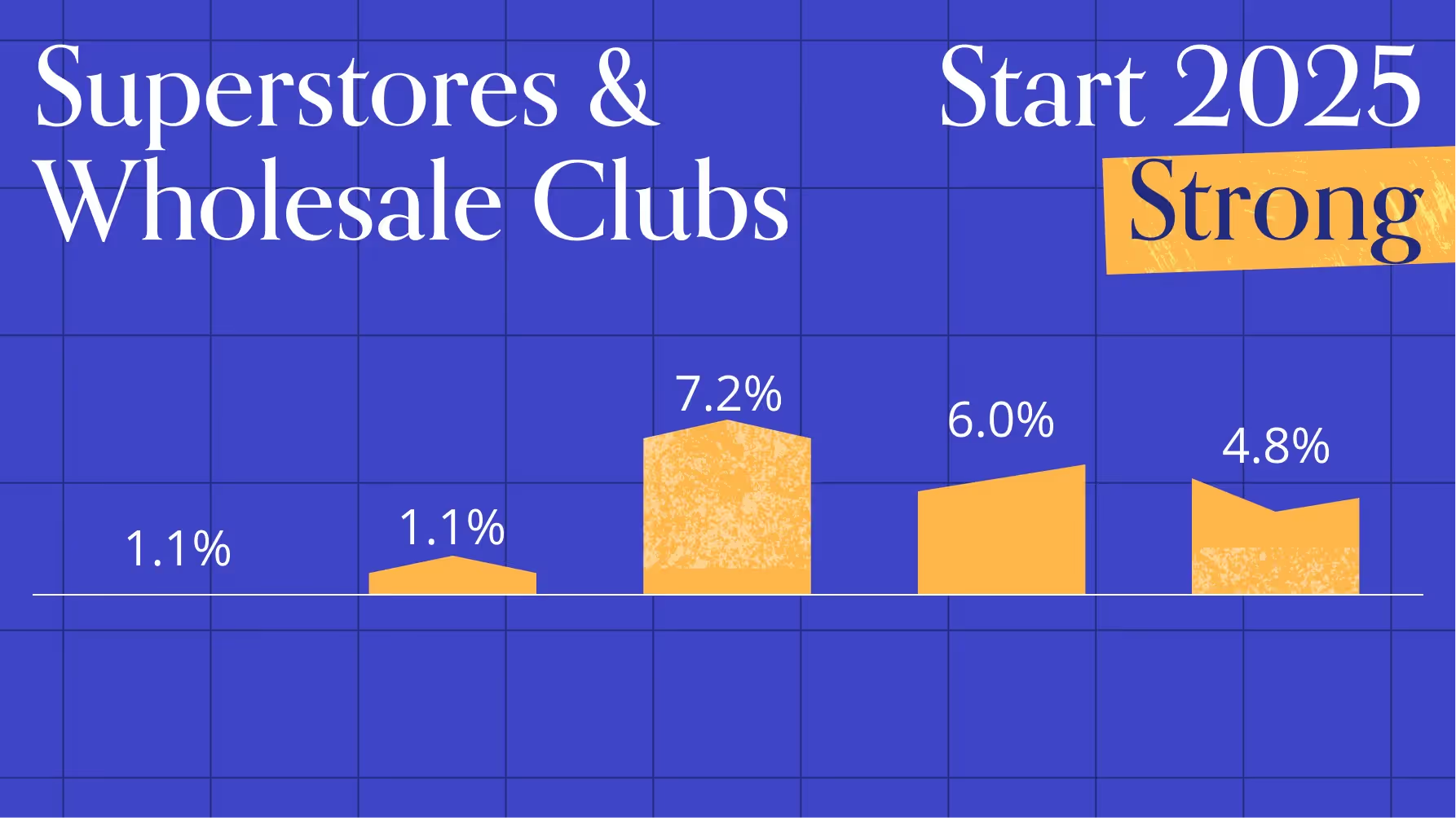
Superstores & Wholesale Clubs Start 2025 Strong

Wholesale clubs outperformed more traditional superstores in 2024, as Costco, BJ’s, and Sam’s Club saw 4.8% to 7.2% YoY increases in visits while Target and Walmart’s traffic remained relatively flat. And though wholesale clubs continued outperforming Target and Walmart in the new year as well, the two superstore leaders did see clear visit increases of 3.6% and 3.0%, respectively, in January 2025 – a promising sign for the retail giants’ growth in the year ahead.

How Do Audience and Shopping Behavior Differ at Target and Walmart? 

Target and Walmart both operate national chains of one-stop shops that carry a variety of consumables and non-consumables, including groceries, apparel, toys, and electronics. But diving into the demographics of the two brand’s captured market reveals that each chain serves a slightly different audience. 

Target tends to attract visitors from areas with higher HHI and larger households: The company’s captured market includes a larger share of both households with children and non-family (e.g. roommates) households than Walmart’s, perhaps due to Target’s relative appeal to both suburban and strongly urbanized segments. Meanwhile, Walmart seems to attract more repeat monthly visitors (who visit the chain at least twice a month), perhaps thanks to the chain’s extensive grocery offerings and to its popularity among rural and semirural segments who may not have a variety of retail options to frequent.

Walmart Shoppers Stay Longer, Target’s Visitors Come Later

The two chains’ visitor base also exhibit differences in in-store behavior. Walmart visitors do seem to linger a little longer in store, with 20.7% of the chain’s visits lasting longer than 45 minutes compared to Target’s 17.1% – maybe thanks to the mission-driven shopping behavior of some of its rural and semirural customer base. But despite the longer visits, Walmart still receives a larger share of weekday visits than Target – perhaps thanks to its larger share of single shoppers with fewer weekday commitments.

For more data-driven consumer insights, visit placer.ai

Article
Home Improvement Traffic Dips Stabilize Somewhat
How did home improvement leaders The Home Depot and Lowe’s perform in 2024? And what lies ahead for the chains in 2025? We dove into the data to find out. 
Bracha Arnold
Feb 17, 2025
3 minutes

How did home improvement leaders The Home Depot and Lowe’s perform in 2024? And what lies ahead for the chains in 2025? We dove into the data to find out. 

Gearing Up For Stability

A challenging retail environment continued weighing on the home improvement space in 2024 as high prices and tighter consumer budgets led many consumers to push off discretionary renovations and remodels. As a result, visits to The Home Depot and Lowe’s remained below 2023 levels throughout 2024. Still, the visit gaps were relatively minor – The Home Depot received 1.6% to 3.5% fewer quarterly visits and Lowe’s saw a 2.2% to 4.7% visit gap relative to 2023 – a testament to the enduring strength of these home improvement giants.

Promotions Drive Home Improvement Visits 

Diving deeper into the daily visits data also reveals that, despite the challenges, the two retailers succeeded in driving significant visit boosts through promotions and holiday sales: Mother’s Day, Black Friday, and the Saturday of Memorial Day were the top three visited days for The Home Depot and Lowe’s in 2024. Lowe’s received its highest daily traffic boost on Mother’s Day – likely thanks to its free plant giveaway – while The Home Depot saw its largest visit surge over the traditionally busy Black Friday. Finally, Memorial Day sales drove the third largest visit peak for both chains. 

The boost in consumer traffic during special events underscores the potential of seasonal promotions to drive engagement and foot traffic – even in times of wider retail headwinds and economic uncertainty.

Hobbyists May Be Taking Center Stage

Both The Home Depot and Lowe’s received fewer visitors in 2024 compared to 2023, but a closer look reveals that the YoY dips in repeat visitors (who visited at least twice a month) were larger than the declines in casual (once a month) shoppers. For example, in December 2024, the number of casual visitors to The Home Depot dipped 3.0% YoY while the number of repeat monthly visitors declined by 4.0% compared to 2023. YoY visitor trends to Lowe’s generally followed a similar trend.

This trend suggests that, with home sales at their lowest levels since 1995 and many consumers looking to avoid non-essential expenditures, demand for large-scale renovations may be slowing. As a result, contractors and homeowners undertaking major remodeling projects are likely visiting these stores less frequently. 

But while these trends may be hampering home improvement visits in the short term, the current downturn could also be setting the stage for a future recovery – as a stabilizing economy could unleash significant pent-up demand.

What Comes Next For Home Improvement?

Visits to the country’s two largest home improvement retailers, while not yet returned to their pandemic-era highs, are beginning to stabilize. Will 2025 see a return to normal for the chains? 

Visit Placer.ai to keep up with the latest data-driven retail insights. 

Article
Fitness Starts Strong in 2025
With consumer interest in wellness showing no sign of slowing down, we dove into fitness foot traffic data to see how the segment performed in 2024 and understand what the new year holds for the category. 
Shira Petrack
Feb 14, 2025
3 minutes

With consumer interest in wellness showing no sign of slowing down, we dove into fitness foot traffic data to see how the segment performed in 2024 and understand what the new year holds for the category. 

Fitness Category Still Growing

The fitness category has yet to hit its peak. Following consistent year-over-year (YoY) growth in monthly visits throughout 2024, traffic to the category rose again in January 2025 with visits 2.3% higher than in January 2024 – a strong start for what is likely to be another standout year in the fitness space.

Traditional January Fitness Spike Continues in 2025

And while some may consider New Year’s resolutions to be an outdated, unhelpful institution, the data indicates that January still drives a significant fitness spike as Americans across the country commit to their wellness goals at the start of the year.

Fitness visits in January 2025 were 21.2% higher than in December 2024 – only a slightly lower spike than the month-over-month (MoM) January 2024 jump of 23.4% – indicating that New Year’s resolutions are still quite popular in 2025. At the same time, the slightly lower MoM growth in January may also reflect the relatively stable visitation trends throughout 2024 – a shift from the traditional patterns of fitness chains losing about 30% of their members each year.

Interest in Wellness Boosting Gyms Across the Board

Diving into individual fitness chains reveals that the category’s ongoing success is driving visit growth across the fitness segment – including at budget gyms such as Planet Fitness and Crunch Fitness, mid-range chains such as LA Fitness, and premium brands such as Life Time. And critically, both overall visitors and visit frequency were consistently elevated in H2 2024 and going into 2025, indicating that not only are more people going to the gym – they’re also generally going more frequently. It seems, then, that the wellness trend of the past few years is still gaining momentum.

Fitness Consumer Trends – Variation in Visit Frequency by Season & Brand Tier 

While the increased interest in wellness seems to have brought a boost in industry-wide fitness visits, analyzing visit frequency by brand and quarter does reveal some differences – and some similarities – across different brand tiers. 

All four brands analyzed – Planet Fitness, Crunch Fitness, LA Fitness, and Life Time – received the largest share of repeat visitors (at least twice a month) in Q1 2024, as New Year’s resolutions drove a boost in gym-going frequency. The share of repeat visitors then consistently fell throughout the year, and the chains (with the exception of Life Time) received the lowest share of repeat visits in Q4 as vacations and holidays likely interfered with people’s exercise schedule. 

One might expect high value low price (HVLP) gyms to attract lower-usage members – since the modest fee may mean that members are not compelled to get the most bang for their buck – but looking at the data reveals that visit frequency did not necessarily correlate with membership pricing. While Planet Fitness and Crunch Fitness are both HVLP chains, their visit frequency patterns differed significantly: Planet Fitness seemed to attract a relatively high share of lower-usage members, while Crunch Fitness’ visit frequency exceeded that of higher-priced LA Fitness and was in fact was closer to that of premium chain Life Time.

For more data-driven consumer insights, visit placer.ai

Article
The Meat of the Matter: Bloomin’ Brands in 2024
Bloomin’ Brands, which owns Outback Steakhouse, Fleming’s Prime Steakhouse, and other full-service chains, experienced mixed results throughout 2024 amid continued dining segment challenges. We took a look at the company's performance, to see what the data can tell us about 2024.
Bracha Arnold
Feb 13, 2025
3 minutes

Bloomin’ Brands, the parent company of Outback Steakhouse, Carrabba’s Italian Grill, Bonefish Grill, and Fleming’s Prime Steakhouse, faced a year of mixed results in 2024 amid continued challenges in the dining sector.

We analyzed the company’s overall performance, along with its individual brands, to see what the visit data reveals about the past year.

The Metrics Behind the Meal

The past year was a challenging one for many restaurant chains, and Bloomin’ Brands was not immune. Overall visits to the restaurant group declined by 2.9% YoY, with quarterly visits in 2024 falling between 1.9% and 4.0% compared to 2023. 

Still, Bloomin’ appears to be working on a pivot – and visits per location metrics suggest that this  is working. The company closed dozens of stores throughout 2024, a rightsizing strategy aimed at focusing on high-performing locations. As a result, visits per location tracked more closely with 2023 levels, with visits per location for 2024 as a whole up by 0.1% compared to 2023. 

Getting Grain-ular

Diving into individual brands reveals that most of Bloomin’s chains displayed minimal visit gaps. In particular, Fleming’s Prime Steakhouse finished the year strong with a 0.8% YoY increase in Q4 2024 visits – in keeping with the general outperformance of fine dining concepts, especially around the holidays

Still, one brand, Bonefish Grill, lagged behind the others. The company intends to simplify the menu and enhance the core brand experience, which may help bring visits back to Bonefish in 2025. 

Rightsizing Reveals Rewards

While most Bloomin’ Brands chains experienced visit declines in 2024, visits per location tracked closely with 2023 levels, reflecting the impact of the company’s strategic closures.

Outback Steakhouse, Carrabba’s Italian Grill, and Fleming’s Prime Steakhouse all saw YoY increases in visits per location for three out of four quarters in 2024. Fleming’s in particular ended the year strong with a 3.3% visit per location increase in Q4 2024 – suggesting that Bloomin’ might do well by focusing on its more upscale offerings. 

And Bonefish Grill saw smaller YoY visit gaps in average visits per location compared to its overall visit metric – a sign that rightsizing may have helped offset some of the broader traffic challenges.

Last Bites

Despite facing a challenging year, the stability in the average visits per location across Bloomin’ Brands serves as a reminder that there are plenty of ways for restaurants to pivot and succeed. 

Follow Placer.ai for the latest data-driven dining insights.

Reports
INSIDER
Unlocking Potential in Underserved Grocery Markets
Dive into the location analytics to uncover potential growth markets in regions with limited grocery store availability.
June 6, 2024
6 minutes

Note: This report is based on an analysis of visitation patterns for regional and nationwide grocery chains and does not include single-location stores. 

Understanding Grocery Store Chain Distribution

Grocery stores, superstores, and dollar stores all carry food products – and American consumers buy groceries at all three. But even in today’s crowded food retail environment, traditional grocery chains have a special role to play. With their primary focus on stocking a wide variety of fresh foods, these chains serve a critical function in offering consumers access to healthy options. 

But visualizing the footprints of major grocery chains across the continental U.S. – alongside those of discount & dollar stores – shows that the geographical distribution of grocery chains remains uneven.

In some areas, including parts of the Northeast, Midwest, South Atlantic, and Pacific regions, grocery chains are plentiful. But in others – some with population centers large enough to feature a robust dollar store presence – they remain in short supply.

And though many superstore locations also provide a full array of grocery offerings, they, too, are often sparsely represented in areas with low concentrations of grocery chains. 

For grocery chain operators seeking to expand, these underserved grocery markets can present a significant opportunity. And for civic stakeholders looking to broaden access to healthy food across communities, these areas highlight a policy challenge. For both groups, identifying underserved markets with significant untapped demand can be a critical first step in deciding where to focus grocery development initiatives.

This white paper dives into the location analytics to examine grocery store availability across the United States – and harnesses these insights to explore potential demand in some underserved markets. The report focuses on locations belonging to regional or nationwide grocery chains, rather than single-location stores. 

Untapped Grocery Markets

Last year, grocery chains accounted for 43.4% of nationwide visits to food retailers – including grocery chains, superstores, and discount & dollar stores. But drilling down into the data for different areas of the country reveals striking regional variation – offering a glimpse into the variability of grocery store access throughout the U.S.  In some states, grocery stores attract the majority of visit share to food retailers, while in others, dollar stores or superstores dominate the scene. 

The ten states where residents were most likely to visit grocery chains in early 2024 – Oregon, Vermont, Washington, Massachusetts, California, Maryland, New Hampshire, Connecticut, New Jersey, and Rhode Island – were all on the East or West Coasts. In these states, as well as in Nevada and New York, grocery chain visits accounted for 50.0% or more of food retail visits between January and April 2024.

Meanwhile, residents of many West North Central and South Central states were much less likely to do their food shopping at grocery chains. In North Dakota, for example, grocery chain visits accounted for just 11.7% of visits to food retailers over the analyzed period. And in Mississippi, Oklahoma, and Arkansas, too, grocery stores drew less than 20.0% of the overall food retail foot traffic. 

YoY Visit Growth Data Highlights Strong Grocery Demand In Some States

But low grocery store visit share does not necessarily indicate a lack of consumer interest or ability to support such stores. And in some of these underserved regions, existing grocery chains are seeing outsize visit growth – indicating growing demand for their offerings. 

North Dakota, the state with the smallest share of visits going to grocery chains in early 2024, experienced a 9.1% year-over-year (YoY) increase in grocery visits during the same period – nearly double the nationwide baseline of 5.7%. Other states with low grocery visit share, including Nebraska, Arkansas, Alabama, Mississippi, and New Mexico, also experienced higher-than-average YoY grocery chain visit growth. This suggests significant untapped potential for grocery stores and a market that is hungry for more. 

Alabama Bound: Identifying Grocery Markets With Increasing Demand

Alabama is one state where grocery chains accounted for a relatively small share of overall food retail foot traffic in early 2024 (just 28.9%) – but where YoY visit growth outperformed the nationwide average. And digging down even further into local grocery store visitation trends provides further evidence that at least in some places, low grocery visit share may be due to inadequate supply, rather than insufficient demand. 

In Central Alabama, for example, many residents drive at least 10 miles to reach a local grocery chain. And several parts of the state, both rural and urban, feature clusters of grocery stores that draw customers from relatively far away.

But zooming in on YoY visitation data for local grocery chain locations shows that at least some of these areas likely harbor untapped demand. Take for example the Camden, Butler, Thomasville, and Gilbertown areas (circled in the map above). The Piggly Wiggly location in Butler, AL, drew 40.1% of visits from 10 or more miles away. The same store experienced a 23.3% YoY increase in visits in early 2024 –  far above the statewide baseline of 6.6%. Meanwhile, the Super Foods location in Thomasville, AL, which drew 52.8% of visits from at least 10 miles away – experienced YoY visit growth of 12.3%. The Piggly Wiggly locations in Camden, AL and Gilbertown, AL saw similar trends. 

At the same time, trade area analysis of the four locations reveals that the grocery stores had little to no trade area overlap during the analyzed period. Each store served specific areas, with minimal cannibalization among customer bases.

These metrics appear to highlight robust demand for grocery stores in the region – grocery visits are growing at a stronger rate than those in the overall state, people are willing to make the drive to these stores, and each one has little to no competition from the others. 

Increasing Access to Fresh Food in Greenville County, SC

While significant opportunity exists across the country, many communities still face considerable challenges in supporting large grocery stores. Though South Carolina has a significant number of grocery chain locations, for example, certain areas within the state have low access to food shopping opportunities. And one local government – Greenville County – is considering offering tax breaks to grocery stores that set up shop in the area, to improve local fresh food accessibility.

Assessing Local Demand – And Preferences

Placer.ai migration and visitation data shows that Greenville County is ripe for such initiatives: the county’s population grew by 4.8% over the past four years – with much of that increase a result of positive net migration. And YoY visits to Greenville County Grocery Stores have consistently outperformed state averages: In April 2024, grocery visits in the county grew by 6.1% YoY, while overall visits to grocery stores in South Carolina grew by 4.2%. This growth – both in terms of grocery visits and population – points to rising demand for grocery stores in Greenville County. 

Analyzing the Greenville County grocery store trade areas with Spatial.ai’s FollowGraph dataset – which looks at the social media activity of a given audience – offers further insight into local grocery shoppers’ particular demand and preferences. 

Consumers in Greenville-area grocery store trade areas, for example, are more likely to be interested in “Mid-Range Grocery Stores” (including brands like Aldi, Kroger, and Lidl) than residents of grocery store trade areas in the state as a whole. This metric provides further evidence of local demand for grocery chains – and offers a glimpse into the kinds of specific grocery offerings likely to succeed in the area. 

Final Thoughts 

Grocery stores remain essential services for many consumers, providing a place to pick up fresh produce, meat, and other healthy food options. And many areas in the country are ripe for expansion, with eager customer bases and growing demand. Identifying such areas with location analytics can help both grocery store operators and municipal stakeholders provide their communities and customer bases with an enhanced grocery shopping experience that caters to local preferences. 

INSIDER
Migration Hotspots in a Cool 2024 Market
Discover which metro areas are still attracting new residents – and what’s drawing people to emerging hotspots.
May 23, 2024
5 minutes

Slowing Domestic Migration

Following COVID-era highs, domestic migration levels have begun to taper off – with the number of Americans moving within the U.S. hitting an all-time low, according to some sources, in 2023

To be sure, some popular COVID-era destinations – including Idaho, the Carolinas, and Utah – saw their net domestic migration continue to rise, albeit at a slower pace. But other states which had been relocation hotspots between February 2020 and February 2023, such as Wyoming and Texas, experienced negative net migration between February 2023 and February 2024. 

Hotspots in a Cool Market

Analyzing CBSA-level migration data reveals differences and similarities between last year’s migration patterns and COVID-era trends. 

Between February 2020 and February 2023, seven out of the ten CBSAs posting the largest population increases due to inbound domestic migration were located in Florida. But between February 2023 and February 2024, the top 10 CBSAs with the largest net migrated percent of the population were significantly more diverse. Only four out of the ten CBSAs were located in Florida, and several new metro areas – including Provo-Orem, UT, Kingsport-Bristol, TN-VA, and Boulder, CO – joined the list. 

This white paper leverages a variety of location intelligence tools – including Placer.ai’s Migration Report, Niche Neighborhood Grades, and ACS Census Data location intelligence – to analyze two migration hotspots. Specifically, the report focuses on Daytona Beach, FL, which already appeared on the February 2020 to February 2023 list and has continued to see steady growth, and Boulder, CO, which has emerged as a new top destination. The data highlights the potential of CBSAs with unique value propositions to continue to attract newcomers despite ongoing housing headwinds. 

High Tech's New Frontier – Boulder, CO 

The Boulder, CO CBSA has emerged as a domestic migration hotspot: The net influx of population between February 2023 and February 2024  (i.e. the total number of people that moved to Boulder from elsewhere in the U.S., minus those that left) constituted 3.1% of the CBSA’s February 2024 population.

The strong migration is partially due to the University of Colorado, Boulder’s growing popularity. But the metro area has also emerged as a flourishing tech hub, with Google, Apple, and Amazon all setting up shop in town, along with a wealth of smaller start ups.  

Moving in from Los Angeles & San Francisco – But Also Chicago, Dallas, and New York

Most domestic relocators tend to remain within state lines – so unsurprisingly, many of the recent newcomers to Boulder moved from other CBSAs in Colorado. But perhaps due to Boulder’s robust tech ecosystem, many of the new residents also came from Los Angeles, CA (6.6%) and San Francisco, CA (3.4%) – other CBSAs known for their thriving tech scenes

At the same time, looking at the other CBSAs feeding migration to the area indicates that tech is likely not the only draw attracting people to Boulder: A significant share of relocators came from the CBSAs of Chicago, IL (6.1%), Dallas , TX (4.9%), and New York, NY (3.9%). The move from these relatively urbanized CBSAs to scenic Boulder indicates that some of the domestic migration to the area is likely driven by people looking for better access to nature or a general lifestyle change. 

Boulder’s Quality of Life Attracting Migration

According to the U.S. News & World Report, Boulder ranked in second place in terms of U.S. cities with the best quality of life. Using Niche Neighborhood Grades to compare quality of life attributes in the Boulder CBSA and in the areas of origin dataset highlights some of the draw factors attracting newcomers to Boulder beyond the thriving tech scene. 

The Boulder CBSA ranked higher than the metro areas of origin for “Public Schools,” “Health & Fitness,” “Fit for Families,” and “Access to Outdoor Activities.” These migration draw factors are likely helping Boulder attract more senior executives alongside younger tech workers – and can also explain why relocators from more urban metro areas may be choosing to make Boulder their home.

Boulder’s strong inbound migration numbers over the past year – likely driven by its flourishing tech scene and beautiful natural surroundings – reveal the growth potential of certain CBSAs regardless of wider housing market headwinds. 

Sun, Sand, and Daytona Beach

Florida experienced a population boom during the pandemic, and several CBSAs in the state – including the Deltona-Daytona Beach-Ormond Beach, FL CBSA – have continued to welcome domestic relocators in high numbers. The CBSA’s anchor city, Daytona Beach – known for its Bike Week and NASCAR’s Daytona 500 – has also seen positive net migration between February 2023 and February 2024. 

An Attractive Destination for Older Americans

Americans planning for retirement or retirees operating on a fixed income are likely particularly interested in optimizing their living expenses. And given Daytona’s relative affordability, it’s no surprise that the median age in the areas of origin feeding migration to Daytona Beach tends to be on the older side. 

According to the 2021 Census ACS 5-Year Projection data, the median age in Daytona Beach was 39.0. Meanwhile, the weighted median age in the areas of migration origin was 42.6, indicating that those moving to Daytona Beach may be older than the current residents of the city. 

Zooming into the migration data on a zip code level also highlights Daytona Beach’s appeal to older Americans: The zip code welcoming the highest rates of domestic migration was 32124, home to both Jimmy Buffet’s Latitude Margaritaville’s 55+ community and the LPGA International Golf Club, host of the LPGA Tour. The median age in this zip code is also older than in Daytona Beach as a whole, and the weighted age in the zip codes of origin was even higher – suggesting that older Americans and retirees may be driving much of the migration to the area.

Daytona’s Migration Draw Factors 

Looking at the migration draw factors for Daytona Beach also suggests that the city is particularly appealing to retirees, with the city scoring an A grade for its “Fit for Retirees.” But the city of Daytona Beach is also an attractive destination for anyone looking to elevate their leisure time, with the city scoring higher than Daytona Beach’s cities of migration origin for “Weather,” “Access to Restaurants,” or “Access to Nightlife.”

Like Boulder, Daytona’s scenery – including its famous beaches – is likely attracting newcomers looking to spend more time outdoors and improve their work-life balance. And like Boulder and its tech scene, Daytona Beach also has an extra pull factor – its affordability and fit for older Americans – that is likely helping the area continue to attract new residents, even as domestic migration slows down nationwide. 

Opportunities for Growth Amidst Slowing Migration 

Although the overall pace of domestic migration has slowed, analyzing location intelligence data reveals several migration hotspots amidst the overall cooldown. Boulder and Daytona Beach each have a set of unique draw factors that seem to attract different populations – and the success of these regions highlights the many paths to migration growth in 2024.  

INSIDER
Winning Strategies for a Stabilizing Fitness Market
Gym visits are stabilizing following two years of post-pandemic growth - and staying on top of changing consumer preferences can help fitness studios continue driving visits.
May 16, 2024
6 minutes

Fitness Segment Back In Shape

The Fitness industry was a major post-pandemic winner. Visits to gyms across the country surged as stay-at-home orders ended and people returned to their in-person workout routines. And even as consumers reduced discretionary spending in the face of inflation, they kept going to the gym – finding room in their budgets for the chance to embrace wellness and get in shape while interacting with other people.

But no category can sustain such unabated growth forever – and as the segment inevitably stabilizes, gyms will need to stay nimble on their feet to maintain their competitive edge. 

This white paper takes a closer look at the state of Fitness as the category transitions into a more stable growth phase following two years of outsize post-pandemic demand. The report digs into the location analytics to reveal how the Fitness space has changed – and what strategies gyms can adopt to stay ahead of the pack. 

*This report excludes locations within Washington state due to local legislation.

Stability Is The Name Of The Game

Monthly visits to the Fitness category have grown consistently year over year (YoY) since early 2022, when COVID subsided and gyms returned to full capacity. And the segment is still doing remarkably well. Even in January and March 2024 – when visits were curtailed by an Arctic blast and by the Easter holiday weekend – YoY Fitness visits remained positive, despite the comparison to an already strong 2023.  

Still, recent months have seen smaller YoY increases than last year, indicating that the Fitness category is entering a more normalized growth phase. 

Leaning Into Evolving Consumer Preferences

By keeping a close watch on evolving consumer preferences, fitness chains can uncover new opportunities for growth and adaptation within a stabilizing market – including leaning into increasingly popular dayparts.  

Late Afternoon And Evening Visits On The Rise

Examining the evolving distribution of gym visits by daypart over the past six years shows that major shifts were brought on by the COVID-19 pandemic. 

Between Q1 2019 and Q1 2021, as remote work took hold, gyms saw their share of 2:00 PM - 5:00 PM visits increase from 15.8% to 18.6%. Though this trend partially reversed as the pandemic receded, afternoon visits remained elevated in Q1 2024 compared to pre-COVID – likely a reflection of hybrid work patterns that leave people free to take an exercise break during their workdays.

At the same time, the share of morning visits to fitness chains (between 8:00 AM and 11:00 AM) dropped from 20.5% in Q1 2019 to 17.2% in Q1 2024, while evening visits (between 8:00 PM and 11:00 PM) increased from 11.3% to 13.2%. 

Gyms that recognize this changing behavior can adapt to new workout preferences – whether by incentivizing morning visits, scheduling popular classes mid-afternoon, or offering extended evening hours.  

Evening Workouts Provide Gains

In fact, the data indicates that gyms that are leaning into the evening workout trend are already finding success: Of the top 12 most-visited gym chains in the country, those that saw bigger increases in their shares of evening visits also tended to see greater YoY visit growth. 

EōS Fitness and Crunch Fitness, for example, have seen their shares of evening visits grow by 5.5% and 3.4%, respectively, since COVID – and in Q1 2024, their YoY visits grew by 29.0% and 21.8%, respectively. Other chains, including 24 Hour Fitness and Chuze Fitness, experienced similar shifts in visit patterns. At the same time, LA Fitness saw just a minor increase in its share of evening visits between Q1 2019 and Q1 2024, and a correspondingly small increase in YoY visits. 

As the evening workout slot gains popularity, gym operators that can adapt to these new trends and encourage evening visits may see significant benefits in the years to come.

Young Gym-Goers Driving Success

Diving into demographic data for the analyzed gym chains sheds light on some factors that may be driving this heightened preference for evening workouts at top-performing gyms. 

The four fitness chains that experienced the greatest YoY visit boosts in Q1 – Crunch Fitness, EōS Fitness, 24 Hour Fitness, and Chuze Fitness all featured trade areas with significantly higher-than-average shares of Young Professionals and Non-Family Households. (STI: PopStat’s Non-Family Household segment includes households with more than one person not defined as family members. Spatial.ai: PersonaLive’s Young Professional consumer segment includes young professionals starting their careers in white collar or technical jobs.) 

In plainer terms, these consumer segments – typically young, well-educated, and without children – and therefore more likely to be flexible in their workout times – are driving visits to some of the best-performing gyms across the country. And these audiences seem to be displaying a preference for nighttime sweat sessions – a factor that gyms can take into account when planning programming and marketing efforts. 

Attracting Niche Markets

Leaning into emerging gym visitation patterns is one way for fitness chains to thrive in 2024 – but it isn’t the only marker of success for the segment. Even after years of visit growth, the market remains open to new opportunities and innovations that meet health-conscious consumers where they are. 

Striding Towards Success

STRIDE Fitness, a gym that offers treadmill-based interval training, has sparked a trend among running enthusiasts. This niche player is finding success, particularly among a specific demographic: runners and endurance training enthusiasts. 

Between January and April 2024, monthly YoY visits to STRIDE Fitness consistently outperformed the wider Fitness space. A standout month was January, when STRIDE Fitness’s visits soared by an impressive 33.6% YoY, surpassing the industry average of 5.7% for the same period.

Psychographic data from the Spatial.ai’s FollowGraph dataset – which looks at the social media activity of a given audience – suggests that STRIDE Fitness’ trade areas are well-positioned to attract those visitors most open to its offerings. Residents of STRIDE Fitness’s potential market are 24% more likely to be, or to be interested in, Endurance Athletes than the nationwide average – compared to just 3% for the Fitness industry as a whole. Similar patterns emerge for Marathon Runners and Triathlon Participants. This indicates that the chain is well-situated near consumers with a passion for endurance sports and long distance running, helping it maintain a competitive edge in the crowded gym market. 

Pickleball Craze Sends Visits Soaring

Pickleball, a game that blends elements of tennis, ping pong, and badminton, is the fastest-growing sport in the country. And recognizing its broad appeal, some fitness chains have begun incorporating pickleball courts into their facilities. 

Arizona-based EōS Fitness added a pickleball court at a Phoenix, AZ location – and early 2024 data highlights the impact of this addition. Between January and April 2024, the location drew between 9.1% and 33.3% more monthly visits than the chain’s Arizona visit-per-location average. 

And analyzing the demographic profile of the chain’s location with a pickleball court reinforces the game’s increasingly wide appeal. Young consumer segments have been embracing the game in large numbers – and the Phoenix EōS Fitness location’s potential market includes a significantly higher share of 18 to 34-year-olds than the chain’s overall Arizona potential market. Residents of the pickleball location’s trade area are also less affluent than the chain’s Arizona average. 

Pickleball has typically been associated with more affluent consumer segments, and it seems like this may be shifting. With more people than ever embracing the game, gyms that choose to add courts to their facilities may reap the foot traffic benefits. 

Something For Everyone

The Fitness industry has undergone a significant transformation since COVID-19. The category’s outsize post-pandemic visit growth has begun to stabilize, and gyms are staying ahead by adapting to changing consumer preferences. Evenings are emerging as crucial dayparts for gym operators, likely driven by younger consumer segments. And niche fitness chains are seeing visit success, proving that there are plenty of ways for the Fitness segment to succeed.

Loading results...
We couldn't find anything matching your search.
Browse one of our topic pages to help find what you're looking for.
For more in-depth analyses on a variety of subjects, explore Reports.
The Anchor Logo
INSIDER
Stay Anchored: Subscribe to Insider & Unlock more Foot Traffic Insights
Gain insider insights with our in-depth analytics crafted by industry experts
— giving you the knowledge and edge to stay ahead.
Subscribe