.png)
.png)

.png)
.png)

Brands like M&Ms, Hershey’s, and Jelly Belly are redefining what it means to be as happy as a “kid in a candy store.” With their life-size M&M characters on a flagship in Orlando, FL, a chocolate Statue of Liberty sculpted out of 800 pounds of Hershey’s chocolate on the Las Vegas Strip, or a working jellybean factory tour in Fairfield, CA, manufacturers are literally bringing their brands to life. M&M’s World in Orlando, FL posted particularly impressive year-over-year visits in the second half of 2023.
Recently, Hollywood darling Timothee Chalamet starred in the fantastical movie Wonka, grossing $600M+ worldwide. In other headline news, the “tried to jump on the wagon but failed miserably” fiasco of the unauthorized Willy’s Chocolate Experience in Scotland reveals that the appetite for sweets and chocolate is insatiable. Never fear, if you missed the Candytopia pop-up a few years ago, you can head over to Dylan’s Candy Bar for an experience right out of Charlie and the Chocolate Factory. It’s clear that demand peaks in the summer, probably due to locations that see summer tourists. The holidays are another popular season for buying sweets.
At Hershey’s Chocolate World, one can be immersed in all-things chocolate, from creating your own candy to taking a selfie with a life-size Reese’s peanut butter cup. The dessert options are limited only by your imagination. That tower of S’mores sure looks tempting!

Many visitors also opt to visit the Hershey Story Museum or stay at Hershey Lodge or the Hotel Hershey.

If you prefer your sweets in liquid form, there are three Coca-Cola Stores--in Atlanta, Las Vegas, and Orlando--to satisfy your cravings. Here, you can buy a Coke plushie, flout the famous “Enjoy Coca-Cola” slogan shirt in a variety of languages, or dress yourself head-to-toe in comfy Coke PJs. One of the coolest options is an international tasting flight that lets you try out Coca-Cola beverages from around the world, with flavors like sparberry from Zimbabwe.

At the Coca-Cola Store in Orlando, FL, visitation jumps during vacations like Spring Break, summer, and Christmas holidays.
Another beloved brand that has made its way into brick-and-mortar is King’s Hawaiian. Founded in 1950, they were famous for their round loaves of sweet and fluffy Hawaiian bread. Fast forward three-quarters of a century later, and they have added new options like savory dinner rolls or pull-apart pans of bread. One can experience gastronomic delights made with Hawaiian bread at their Torrance-based King’s Hawaiian Bakery and Restaurant.
The restaurant menu includes breakfasts featuring their famous King’s Hawaiian Sweet Bread as French toast, lunch and dinner options like Macadamia Nut Onion Rings, Chicken Katsu Curry Loco Moco, and Saimin noodles, but it’s the bakery that literally takes the cake. The Paradise Delight Cake has three layers of chiffon cake in enticing flavors like guava, passionfruit, and lime. It is then topped with layers of fresh strawberries, peaches, and kiwis. One can also choose from chocolate, coconut, pineapple, raspberry cakes, and more.

With Placer's ranking of "Breakfast, Coffee, Bakeries, and Dessert Shops" indicating that King's is in the top 1% nationwide and statewide, it looks like they've found a sweet recipe for success.


The Waldorf Astoria and Ritz-Carlton hotels are two of the most recognizable names in luxury lodging. Both opened in New York City – the Waldorf Astoria in 1893 and the Ritz-Carlton in 1911 – and are owned by two major hotel corporations: the Waldorf Astoria is part the Hilton Hotels & Resorts portfolio of brands, while the Ritz-Carlton is part of Marriott International, Inc’s portfolio.
Who is most likely to visit each brand? What are the similarities – and differences – between the two hotels’ guest segmentations? We take a closer look at the demographic and psychographic data to find out.
Analyzing the demographic makeup of the Waldorf Astoria and Ritz-Carlton’s trade areas by layering the STI: Popstats dataset onto captured market trade areas revealed that the Waldorf Astoria’s trade area has a higher share of households with children compared to that of the Ritz-Carlton (25.6% compared to 23.6%). But both chains had a smaller share of households with children in their trade areas relative to the nationwide average (27.6%). It seems, then, that singles or empty nesters may be more likely to book a luxury getaway than consumers with heavier parenting responsibilities.
Unsurprisingly, the chains also attract a particularly high-income clientele: The median household income (HHI) in both brands’ trade areas is over 50% higher than the nationwide median ($108.4K and $104.5K for the trade areas of the Waldorf Astoria and Ritz Carlton, respectively, compared to a nationwide median of $69.5K). The data also showed that Waldorf Astoria’s trade area is slightly more affluent than that of the Ritz-Carlton – perhaps due in part to the Ritz-Carlton’s recent attempts to court younger guests.
.avif)
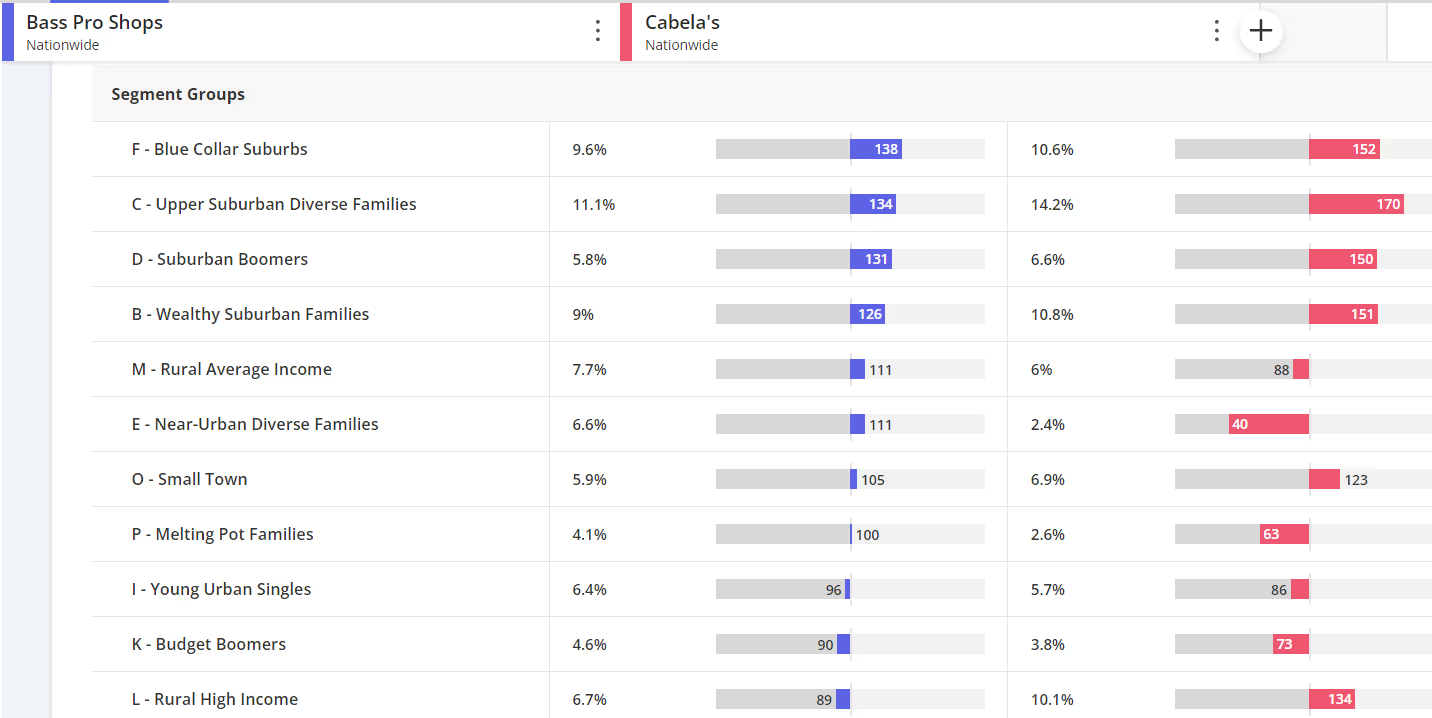
Leveraging the Spatial.ai: PersonaLive dataset to explore the psychographic composition of the hotel chains’ trade area further supports the distinctions between the brands highlighted in the demographic analysis.
The psychographic analysis showed that the Waldorf Astoria had more family segments in its trade area than the Ritz-Carlton, while the Ritz-Carlton catered to more single and empty-nester households – as expected given the demographic composition of the chains’ trade areas.
.avif)
Luxury hotels are known for their impeccable service – and to curate the ideal guest experience, these brands need to accurately predict their visitors' dining and leisure preferences. Hoteliers can leverage the Placer.ai Marketplace and combine trade area data with various datasets – including data on consumers’ social media activity with tools like the Spatial.ai: FollowGraph dataset – to pinpoint their guests’ tastes and preferences.
Analyzing the preferences for certain types of foods or entertainment within the hotel chains’ trade areas revealed – once again – similarities and differences between the brands. Both chains’ trade areas included larger shares of “Farm-to-Table Cooking Enthusiasts”, “Asian Food Enthusiasts”, and “Craft Coffee At-Home Enthusiasts,” as well as more “Opera Lovers” and “Salsa Music Fans” than the nationwide average. But the foodie segments were slightly more over-indexed within the Waldorf’s trade area, while residents of the Ritz-Carlton’s trade area seemed a little more keen on Opera and Salsa. These hotel chains can leverage this data to determine the type of dining or entertainment options that will set these brands apart from the competition and best attract their specific audience.
.avif)
The Waldorf Astoria and Ritz-Carlton continue to define luxury lodging in the country while attracting some of the nation's most discerning guests. Understanding the demographic and psychographic guest segmentation of each chain can help inform your loyalty strategy.
For more data-driven travel & leisure insights, visit placer.ai/blog.
This blog includes data from Placer.ai Data Version 2.0, which implements improvements to our extrapolation capabilities, adds short visit monitoring, and enhances visit detection.

St. Patrick’s Day, which falls each year on March 17th, is a day for bar crawls, green makeup, and drinks with friends. Cities like New York and Chicago host major celebrations, drawing big crowds to their downtown areas. And bars and pubs fill up with revelers eager to mark the occasion with a green cocktail or a taste of corned beef and cabbage.
There’s plenty of joy to go around – and towns across the country are getting in on the St. Paddy’s Day action with parades and family-friendly events. What kind of a lift do traditional St. Patrick’s Day destinations like bars and pubs get on the big day? And what other retail categories stand to benefit from the occasion?
Unsurprisingly, bars and pubs get major boosts on the week of St. Patrick’s Day, as club hoppers and other celebrants converge on their local watering holes for drinks and fun. Chains like The Brass Tap and Bar Louie offer special deals and parties, with everything from green beer to Irish whiskey. And on the week of March 11th, 2024, visits to the two chains were up 15.7% and 21.1%, respectively, compared to an early October baseline – slightly outpacing even the busy Christmas season.
.avif)
But St. Patrick’s Day isn’t just for bar crawling. And although the festivities are usually associated with major metropolises like New York City and Chicago, cities like Myrtle Beach, SC, San Antonio, TX. Indianapolis, IN, and Savannah, GA also come to life mid-March with parades and parties rivaling those of their bigger counterparts.
On Saturday, March 16th 2024 at 11:00 A.M., San Antonio, TX kicked off its annual St. Patrick’s Day festivities with the traditional dyeing of the San Antonio River. Throughout the weekend, parades and celebrations drew crowds to the city’s famed River Walk – and while bars and clubs undoubtedly benefited from the excitement, they weren’t the only ones to do so. San Antonio’s Shops at Rivercenter enjoyed its busiest day since 2019, drawing 61.4% more foot traffic on March 16th than on an average Saturday this year.
Savannah, GA, North Myrtle Beach, SC, and Indianapolis, IN also hosted big St. Patrick’s Day events, bringing foot traffic – and business – to local retailers. For Savannah, March 16th, 2024 marked the 200th anniversary of the city’s famous St. Patrick’s Day Parade, and the town was positively booming. City Market, the iconic shopping corridor located in the heart of Savannah’s Historic District, was the most crowded it’s been since at least January 2023, with March 17th 2023 (the day of last year’s parade) coming in a close second.
Malls and shopping districts weren’t the only places to get significant leprechaun-inspired visit bumps. Grocery stores, pharmacies, and eateries located in proximity to the festivities also reaped the benefits of the hubbub, as parade-goers likely dropped in to snag some essentials or fuel up for the long day.

And it isn’t just locals turning out for all these events. A look at hotel foot traffic patterns nationwide shows that the week of St. Patrick’s Day kicks off the hospitality industry’s spring season – with cities hosting special events seeing even more significant visit spikes. During the week of March 11th, 2024, hotel venues in the analyzed cities drew many more visits than usual, showcasing the power of St. Paddy’s Day to supercharge the tourism sector.
.png)
St. Patrick’s Day is about a lot more than bars and pubs. And in recent years, the popular green-themed holiday has emerged as an important driver of tourism and retail activity across the U.S.
What other local celebrations are fueling foot traffic spikes in cities nationwide? Does your city know the impact of location celebrations on local businesses? Are local businesses prepared for the increase in foot traffic and revenue opportunities during local celebrations?
Follow Placer.ai’s data-driven civic and retail analyses to find out.
This blog includes data from Placer.ai Data Version 2.0, which implements improvements to our extrapolation capabilities, adds short visit monitoring, and enhances visit detection.

JOANN recently announced that it had filed for bankruptcy, and the company expects to go private as early as next month. Can the retailer still make a comeback? We dove into the data to find out.
JOANN went public in March 2021 – at the height of the pandemic – following a particularly strong 2020. The COVID-era crafting boom had put the company on a growth trajectory, with visits during the first year of the pandemic barely lower than in 2019 despite the lockdowns and movement restrictions. But as the country reopened and people’s schedules filled back up – leaving less time for sewing and knitting – visits began to fall. Foot traffic in 2021 was lower than in 2020, and by 2022, overall visits to the chain were 11.8% lower than they had been in 2019
But now, recent foot traffic data indicates that demand for fabric-related crafting supplies may be rebounding. In 2023, visits to the chain grew relative to 2022 and the visit gap relative to 2019 narrowed. Sewing appears to be making a comeback, with both millennials and Gen-Z exhibiting a newfound interest in the craft. And although the resurgence of interest in fiber arts was not strong enough to prevent JOANN’s recent bankruptcy filing, the YoY visit growth in 2023 indicates that the company should not be written off just yet.
.png)
According to C.F.O. Scott Sekella, 95% of JOANN’s stores are cash-flow positive. The company is also committed to maintaining usual operations during the court-supervised procedure. And this year as well – especially since the end of early 2024’s cold spell – JOANN’s year-over-year (YoY) visits have trended positive, even outperforming YoY foot traffic to other leading crafting retailers.
%20(1).png)
The unique nature of JOANN’s products give the company’s brick-and-mortar stores an advantage over digital counterparts: Crafters like to get a feel for the material before purchasing, and amateur DIY-ers who visit physical stores can consult with expert salespeople to receive guidance for ongoing projects. And although foot traffic to JOANN’s stores is not what it was at the height of the pandemic, the YoY visit growth in 2023 indicates that the brand is still serving many committed sewers and knitters who are choosing to shop in-person. So how can JOANN maintain its store fleet while optimizing in-store operations?
Analyzing the change in hourly visits between 2022 and 2023 reveals that the YoY growth is not evenly distributed across dayparts. Morning and early afternoon visits saw modest increases, but traffic growth really ramped up in the afternoon and evening – peaking between 6:00 and 6:59 PM – and visits actually decreased between 7:00 and 8:59 PM. Should the company try to streamline its logistics without sacrificing its large store fleet, JOANN may focus its staffing and operational costs on the dayparts with the most growth potential and reduce expenditure during the less popular timeslots.
.png)
Despite the crafting retailer’s current rough patch, location intelligence suggests that the company is a strong contender for a post-bankruptcy comeback. And the positive YoY trends also indicate that – despite the ongoing headwinds and contraction in discretionary spending – there is still demand for hobby-driven retail in 2024.
How will the bankruptcy proceedings impact foot traffic to JOANN? What does the rest of 2024 hold for the brand?
Check in with our blog at placer.ai to find out.
This blog includes data from Placer.ai Data Version 2.0, which implements improvements to our extrapolation capabilities, adds short visit monitoring, and enhances visit detection.

With rumors swirling of a potential Panera Bread IPO in 2024, we dove into the data to find out how the St. Louis, Missouri-based company is performing – and what sets Panera apart from its competition.
Panera Bread has been on a growth spurt recently, with monthly visits over the past 12 months consistently exceeding 2022/2023 levels. Part of the traffic increase may be due to the brand’s larger store fleet – Panera expanded into urban and non-traditional markets with small-format locations focused on pick-up and digital ordering. And the company is not resting on its laurels, with Panera revamping its menu to compete more directly with meal-focussed fast casual concepts.
.png)
Because Panera straddles the line of coffee QSR and fast-casual lunch spot, there is no one dining chain that directly competes with Panera on all fronts. Instead, Panera plays a unique role in the QSR/fast casual landscape: The chain has a strong café feel, with the company’s “Sip Club” membership program seems specifically designed to appeal to customers looking for frequent coffee fixes. But Panera also offers more substantial fare, and the upcoming menu overhaul promises to add even more hearty salads and affordable sandwiches to its array of options.
The new menu may be aimed towards attracting more budget-conscious diners thanks to a focus on larger portions and the addition of several items priced at under $10. Some speculate that the changes are also part of the company’s broader refocusing towards the lunchtime daypart. Comparing Panera to Starbucks, which competes with Panera on the coffee shop and affordable foods front, and to Sweetgreen, a strong presence in the fast-casual lunch market, can shed light on Panera’s role within the increasingly competitive dining landscape.
Panera’s hourly visitation pattern highlights its unique place within the wider QSR-fast casual landscape. Like Sweetgreen, Panera experiences a lunchtime foot traffic rush – 30.8% of daily visits to the chain take place between 12 PM and 2 PM. But Panera also receives almost a third of its visits before noon – 30.2% of visits to the chain take between 6 AM and 11 AM, compared to just 13.2% of visits to Sweetgreen. Between 9 AM and 11 AM, Panera’s hourly visit share of 20.8% is almost on par with Starbucks’ 25.3%. (The small number of morning Sweetgreen visits is likely also driven by a difference in opening hours, with most Sweetgreen locations only opening at around 10:30 AM).
Meanwhile, Panera also seems to be a strong dinner contender. Although Panera’s evening performance may not be quite as strong as Sweetgreen’s, the St. Louis-based dining chain still sees 17.3% of its daily visits between 6 PM and 8 PM – almost double Starbucks’ 9.8.%.
These hourly visitation patterns indicate that while a significant contingent of Panera patrons treat the chain as their go-to coffee shop, many others tend to consider Panera as a lunch or early dinner destination.
.avif)
Although analyzing hourly visitation patterns highlight similarities between Panera and Sweetgreen, focusing on the three chains’ visitor bases reveals many more similarities between Starbucks and Panera.
The median HHIs in Panera and Starbucks’ trade areas stand at $79.2K/year and $76.4K/year, respectively. Around 34% of both chains’ trade areas consist of non-family and one-person households and 28% consist of households with children. Meanwhile, Sweetgreen tends to attract a much larger share of affluent singles – 42.9% of households in Sweetgreen’s trade area are non-family and one person households, and the salad and grain-bowl focused chain has a trade area median HHI stands at $102K/year.
It seems, then, that although Panera appears to compete with Sweetgreen for the lunch rush – and to a lesser extent, for dinner visits as well – the two brands’ audience bases are substantially different. On the other hand, Panera’s visitor base seems to overlap significantly with that of Starbucks – which may explain Panera’s move towards enhanced portion sizes and affordable meal options, which may set it even further apart from the Seattle-based coffee giant.
.png)
Panera Bread is one of 2024’s most anticipated IPOs – and location intelligence metrics suggest that the buzz is well substantiated.
For more data-driven dining insights, visit our blog at placer.ai.
This blog includes data from Placer.ai Data Version 2.0, which implements improvements to our extrapolation capabilities, adds short visit monitoring, and enhances visit detection.

Nowruz took place on March 20 this year, and this celebration of the spring equinox dates back over three thousand years. Westwood Blvd, just south of UCLA, is home to a profusion of Persian restaurants, markets, bookstores, and ice-cream stores with flavors not found in your typical Baskin-Robbins. Hence, the affectionate moniker Tehrangeles for this little pocket where an Iranian diaspora has settled.
Restaurants like Shamshiri Grill, with its juicy beef koobideh kebab broiled to perfection and tomatoes that burst in your mouth, proves to be a hit with a wide cross-section of Angelenos. For dessert, be sure to stop at nearby Saffron & Rose for their namesake flavors or Mashti Malone’s for a uniquely Persian faloodeh shirazi, similar to a rosewater sorbet, topped with cherry sauce and rice starch vermicelli.

There are also numerous Persian markets in the area should you want to buy groceries and try cooking yourself. Jordan Market, Tehran Market, and Star Market all see over half their clientele come from the segment of Educated Urbanites.

If you’d like to simultaneously celebrate Women’s History Month and buy yourself a little something for the New Year, then look no further than Cult Gaia, just a short drive away in West Hollywood. Founded by Jasmin Larian Hekmat in 2012, its Ark bag reached cult status within just a few years. Oozing a vacation-ready vibe and cool-girl aesthetic, the LA-based designer has most recently opened up a new store on the ritzy island of St. Barths. While the majority of visits to the West Hollywood store come from metro LA, there are still quite a few fans coming from further afield to shop.


The first Lollapalooza – a four-day music festival – took place in 1991. Chicago’s Grant Park became the event’s permanent home (at least in the United States) in 2005, drawing thousands of revelers and music fans to the park each year.
This year, the festival once again demonstrated its powerful impact on the city. On August 1st, 2024, visits to Grant Park surged by 1,313.2% relative to the YTD daily average, as crowds converged on the park to see Chappell Roan’s much-anticipated performance. And during the first three days of the event, the event drew significantly more foot traffic than in 2023 – with visits up 18.9% to 35.9% compared to the first three days of last year’s festival (August 3rd to 5th, 2023).
Lollapalooza led to a dramatic spike in visits to Grant Park – and it also attracted a different type of visitor compared to the rest of the year.
Analyzing Grant Park’s captured market with Spatial.ai’s PersonaLive dataset reveals that Lollapalooza attendees are more likely to belong to the “Young Professionals” and “Ultra Wealthy Families” segment groups than the typical Grant Park visitor.
By contrast, the “Near-Urban Diverse Families” segment group, comprising middle-class diverse families living in or near cities, made up only 6.5% of visitors during the festival, compared to 12.0% during the rest of the year.
Additionally, visitors during Lollapalooza came from areas with higher HHIs than both the nationwide baseline of $76.1K and the average for park visitors throughout the year. Understanding the demographic profile of visitors to the park during Lollapalooza can help planners and city officials tailor future events to these segment groups – or look for ways to make the festival accessible to a wider range of music lovers.
Lollapalooza’s impact on Chicago extended beyond the boundaries of Grant Park, with nearby hotels seeing remarkable surges in foot traffic. The Congress Plaza Hotel on South Michigan Avenue witnessed a staggering 249.1% rise in visits during the week of July 29, 2024, compared to the YTD visit average. And Travelodge on East Harrison Street saw an impressive 181.8% increase. These spikes reflect the festival’s draw not just for locals but for out-of-town visitors who fill hotels across the city.
The North Michigan Avenue retail corridor also enjoyed a significant increase in foot traffic during the festival, with visits on Thursday, August 1st 56.0% higher than the YTD Thursday visit average. On Friday, August 2nd, visits to the corridor were 55.7% higher than the Friday visit average. These numbers highlight Lollapalooza’s role in driving economic activity across Chicago, as festival-goers venture beyond the park to explore the city’s vibrant retail and hospitality offerings.
City parks often serve as community hubs, and Flushing Meadows Corona Park in Queens, NY, has been a major gathering point for New Yorkers. The park hosted one of New York’s most beloved summer concerts – Governors Ball – which moved from Governors Island to Flushing Meadows in 2023.
During the festival (June 9th -11th, 2024), musicians like Post Malone and The Killers drew massive crowds to the park, with visits soaring to the highest levels seen all year. On June 9th, the opening day of the festival, foot traffic in the park was up 214.8% compared to the YTD daily average, and at its height, on June 8th, the festival drew 392.7% more visits than the YTD average.
The park also hosted other big events this summer – a July 21st set by DMC helped boost visits to 185.1% above the YTD average. And the Hong Kong Dragon Boat Festival on August 3rd and 4th led to major visit boosts of 221.4% and 51.6%, respectively.
These events not only draw large crowds, but also highlight the park’s role as a space where cultural and civic life can find expression, flourish, and contribute to the health of local communities.
Analyzing changes in Flushing Meadows Corona Park’s trade area size offers insight into how far people are willing to travel for these events. During Governors Ball, for example, the park’s trade area ballooned to 254.5 square miles, showing the festival's wide appeal. On July 20th, by contrast, when the park hosted several local bands and DJs, the trade area was a much more modest 57.0 square miles.
Summer events drive community engagement, economic activity, and civic pride. Cities that invest in their parks and event hubs, fostering lively and inclusive spaces, can create lasting value for both residents and visitors, enriching the cultural and social life of urban areas.
For more data-driven civic stories, visit Placer.ai.
The pandemic and economic headwinds that marked the past few years presented the multi-billion dollar hotel industry with significant challenges. But five years later, the industry is rallying – and some hotel segments are showing significant growth.
This white paper delves into location analytics across six major hotel categories – Luxury Hotels, Upper Upscale Hotels, Upscale Hotels, Upper Midscale Hotels, Midscale Hotels, and Economy Hotels – to explore the current state of the American hospitality market. The report examines changes in guest behavior, personas, and characteristics and looks at factors driving current visitation trends.
Overall, visits to hotels were 4.3% lower in Q2 2024 than in Q2 2019 (pre-pandemic). But this metric only tells part of the story. A deeper dive into the data shows that each hotel tier has been on a more nuanced recovery trajectory.
Economy chains – those offering the most basic accommodations at the lowest prices – saw visits down 24.6% in Q2 2024 compared to pre-pandemic – likely due in part to hotel closures that have plagued the tier in recent years. Though these chains were initially less impacted by the pandemic, they were dealt a significant blow by inflation – and have seen visits decline over the past three years. As hotels that cater to the most price-sensitive guests, these chains are particularly vulnerable to rising costs, and the first to suffer when consumer confidence takes a hit.
Luxury Hotels, on the other hand, have seen accelerated visit growth over the past year – and have succeeded in closing their pre-pandemic visit gap. Upscale chains, too, saw Q2 2024 visits on par with Q2 2019 levels. As tiers that serve wealthier guests with more disposable income, Luxury and Upscale Hotels are continuing to thrive in the face of headwinds.
But it is the Upper Midscale level – a tier that includes brands like Trademark Collection by Wyndham, Fairfield by Marriott, Holiday Inn Express by IHG Hotels & Resorts, and Hampton by Hilton – that has experienced the most robust visit growth compared to pre-pandemic. In Q2 2024, Upper Midscale Hotels drew 3.5% more visits than in Q2 2019. And during last year’s peak season (Q3 2023), Upper Midscale hotels saw the biggest visit boost of any analyzed tier.
As mid-range hotels that still offer a broad range of amenities, Upper Midscale chains strike a balance between indulgence and affordability. And perhaps unsurprisingly, hotel operators have been investing in this tier: In Q4 2023, Upper Midscale Hotels had the highest project count of any tier in the U.S. hotel construction and renovation pipeline.
The shift in favor of Upper Midscale Hotels and away from Economy chains is also evident when analyzing changes in relative visit share among the six hotel categories.
Upper Midscale hotels have always been major players: In H1 2019 they drew 28.7% of overall hotel visits – the most of any tier. But by H1 2024, their share of visits increased to 31.2%. Upscale Hotels – the second-largest tier – also saw their visit share increase, from 24.8% to 26.1%.
Meanwhile, Economy, Midscale, and Upper Upscale Hotels saw drops in visit share – with Economy chains, unsurprisingly, seeing the biggest decline. Luxury Hotels, for their parts, held firmly onto their piece of the pie, drawing 2.8% of visits in H1 2024.
Who are the visitors fueling the Upper Midscale visit revival? This next section explores shifts in visitor demographics to four Upper Midscale chains that are outperforming pre-pandemic visit levels: Trademark Collection by Wyndham, Holiday Inn Express by IHG Hotels & Resorts, Fairfield by Marriott, and Hampton by Hilton.
Analyzing the captured markets* of the four chains with demographics from STI: Popstats (2023) shows variance in the relative affluence of their visitor bases.
Fairfield by Marriott drew visitors from areas with a median household income (HHI) of $84.0K in H1 2024, well above the nationwide average of $76.1K. Hampton by Hilton and Trademark Collection by Wyndham, for their parts, drew guests from areas with respective HHIs of $79.6K and $78.5K – just above the nationwide average. Meanwhile, Holiday Inn Express by IHG Hotels & Resorts drew visitors from areas below the nationwide average.
But all four brands saw increases in the median HHIs of their captured markets over the past five years. This provides a further indication that it is wealthier consumers – those who have had to cut back less in the face of inflation – who are driving hotel recovery in 2024.
(*A chain’s captured market is obtained by weighting each Census Block Group (CBG) in its trade area according to the CBG’s share of visits to the chain – and so reflects the population that actually visits the chain in practice.)
Much of the Upper Midscale visit growth is being driven by chain expansion. But in some areas of the country, the average number of visits to individual hotel locations is also on the rise – highlighting especially robust growth potential.
Analyzing visits to existing Upper Midscale chains in four metropolitan areas with booming tourism industries – Salt Lake City, UT, Palm Bay, FL, San Diego, CA, and Richmond, VA – shows that these markets feature robust untapped demand.
Utah, for example, has emerged as a tourist hotspot in recent years – with millions of visitors flocking each year to local destinations like Salt Lake City to see the sights and take in the great outdoors. And Upper Midscale hotels in the region are reaping the benefits. In H1 2024, the overall number of visits to Upper Midscale chains in Salt Lake City was 69.4% higher than in H1 2019. Though some of this increase can be attributed to local chain expansion, the average number of visits to each individual Upper Midscale location in the area also rose by 12.5% over the same period.
Palm Bay, FL (the Space Coast) – another tourist favorite – is experiencing a similar trend. Between H1 2019 and H1 2024, overall visits to local Upper Midscale hotel chains grew by 36.4% – while the average number of visits per location increased a substantial 16.9%. Given this strong demand, it may come as no surprise that the area is undergoing a hotel construction boom. Upper Midscale hotels in other areas with flourishing tourism sectors, like San Diego, CA and Richmond, VA, are seeing similar trends, with increases in both overall visits and and in the average number of visits per location.
Though Economy chains have underperformed versus other categories in recent years, the tier does feature some bright spots. Some extended-stay brands in the Economy tier – hotels with perks and amenities that cater to the needs of longer-stay travelers – are succeeding despite category headwinds.
Choice Hotels’ portfolio, for example, includes WoodSpring Suites, an Economy chain offering affordable extended-stay accommodations in 35 states. In H1 2024, the chain drew 7.7% more visits than in the first half of 2019 – even as the wider Economy sector continued to languish. InTown Suites, another Economy extended stay chain, saw visits increase by 8.9% over the same period.
And location intelligence shows that the success of these two chains is likely being driven, in part, by their growing appeal to young, well-educated professionals. In H1 2019, households belonging to Spatial.ai: PersonaLive’s “Young Professionals” segment made up 9.6% of WoodSpring Suites’ captured market. But by H1 2024, the share of this group jumped dramatically to 13.3%. At the same time, InTown Suites saw its share of Young Professionals increase from 12.0% to 13.4%.
Whether due to an affinity for prolonged “workcations” (so-called “bleisure” excursions) or an embrace of super-commuting, younger guests have emerged as key drivers of growth for the extended stay segment. And by offering low–cost accommodations that meet the needs of these travelers, Economy chains can continue to grow their share of the pie.
The hospitality industry recovery continues – led by Upper Midscale Hotels, which offer elevated experiences that don’t break the bank. But today’s market has room for other tiers as well. By keeping abreast of local visitation patterns and changing consumer profiles, hotels across chain scales can personalize the visitor experience and drive customer satisfaction.
The past few years have provided the tourism sector with a multitude of headwinds, from pandemic-induced lockdowns to persistent inflation and a rise in extreme weather events. But despite these challenges, people are more excited than ever to travel – more than half of respondents to a recent survey are planning on increasing their travel budgets in the coming months.
And while revenge travel to overseas destinations is still very much alive and well, the often high costs associated with traveling abroad are shaping the way people choose to travel. Domestic travel and tourism are seeing significant growth as more affordable alternatives.
This white paper takes a closer look at two of the most popular domestic tourism destinations in the country – New York City and Los Angeles. Over the past year, both cities have continued to be leading tourism hotspots, offering a wealth of attractions for visitors. What does tourism to these two cities look like in 2024, and what has changed since before the pandemic? How have inflation and rising airfare prices affected the demographics and psychographics of visitors to these major hubs?
Analyzing the distribution of domestic tourists across CBSAs nationwide from May 2023 to April 2024 reveals New York and Los Angeles to be two of the nation’s most popular destinations. (Tourists include overnight visitors staying in a given CBSA for up to 31 days).
The New York-Newark-Jersey City, NY-NJ-PA metro area drew the largest share of domestic tourists of any CBSA during the analyzed period (2.7%), followed closely by the Los Angeles-Long Beach-Anaheim, CA CBSA (2.5%). Other domestic tourism hotspots included Orlando-Kissimmee-Sanford, FL (tied for second place with 2.5% of visitors), Dallas-Fort Worth-Arlington, TX (1.9%), Las Vegas-Henderson-Paradise, NV (1.8%), Miami-Fort Lauderdale-Pompano Beach, FL (1.8%), and Chicago-Naperville, Elgin, IL-IN-WI (1.6%).
The Big Apple. The City That Never Sleeps. Empire City. Whatever it’s called, New York City remains one of the most well-known tourist destinations in the world. And for many Americans, New York is the perfect place for an extended weekend getaway – or for a multi-day excursion to see the sights.
But where do these NYC-bound vacationers come from? Diving into the data on the origin of visitors making medium-length trips to New York City (three to seven nights) reveals that increasingly, these domestic tourists are coming from nearby metro areas.
Between 2018-2019 and 2023-2024, for example, the number of tourists visiting New York City from the Philadelphia metro area increased by 19.2%.
The number of tourists coming from the Boston and Washington, D.C metro areas, and from the New York CBSA itself (New York-Newark-Jersey City, NY-NJ-PA) also increased over the same period.
Meanwhile, further-away CBSAs like San Francisco-Oakland-Berkeley, CA, Atlanta-Sandy Springs-Alpharetta, GA, and Miami-Fort Lauderdale-Pompano Beach, FL fed fewer tourists to NYC in 2023-2024 than they did pre-pandemic. It seems that residents of these more distant metro areas are opting for vacation destinations closer to home to avoid the high costs of air travel.
Diving even deeper into the characteristics of visitors taking medium-length trips to New York City reveals another demographic shift: Tourists staying between three and seven nights in the Big Apple are skewing younger.
Between 2018-2019 and 2023-2024, the share of visitors to New York City from areas with median ages under 30 grew from 2.1% to 4.5%. Meanwhile, the share of visitors from areas with median ages between 31 and 40 increased from 34.3% to 37.7%.
The impact of this trend is already being felt in the Big Apple, with The Broadway League reporting that the average age of audiences to its shows during the 2022- 2023 season was the youngest it had been in 20 seasons.
The shift towards younger tourists can also be seen when examining the psychographic makeup of visitors to popular attractions in New York City. Analyzing the captured markets of major NYC landmarks with data from Spatial.ai’s PersonaLive dataset reveals an increase in households belonging to the “Educated Urbanites” segment between 2018-2019 and 2023-2024.
These well-educated, young singles are increasingly visiting iconic NYC venues such as the Whitney Museum of American Art, The Metropolitan Museum of Art, The American Museum of Natural History, and the Statue of Liberty. This shift highlights the growing popularity of these attractions among young, educated singles, reflecting a broader trend of increased domestic tourism among this demographic.
New York City’s tourism sector is adapting to meet the changing needs of travelers, fueled increasingly by younger visitors who may be unable to take a costly international vacation. How have travel patterns to Los Angeles changed in response to increasing travel costs?
While New York City is the East Coast’s tourism hotspot, Los Angeles takes center stage on the West Coast. And as overseas travel has become increasingly out of reach for Americans with less discretionary income, the share of domestic tourists originating from areas with lower HHIs has risen.
Before the pandemic, 57.6% of visitors to LA came from affluent areas with median household incomes (HHIs) of over $90K/year. But by 2023-2024, this share decreased to 50.7%. Over the same period, the share of visitors from areas with median HHIs between $41K and $60K increased from 9.7% to 12.5%, while the share of visitors from areas with HHIs between $61K and $90K rose from 32.1% to 35.8%.
Diving into the psychographic makeup of visitors to popular Los Angeles attractions – Universal Studios Hollywood, Disneyland California, the Santa Monica Pier, and Griffith Observatory – also reflects the above-mentioned shift in HHI. The captured markets of these attractions had higher shares of middle-income households belonging to the “Family Union” psychographic segment in 2023-2024 than in 2018-2019.
Experian: Mosaic defines this segment as “middle income, middle-aged families living in homes supported by solid blue-collar occupations.” Pre-pandemic, 16.0% of visitors to Universal Studios Hollywood came from trade areas with high shares of “Family Union” households. This number jumped to 18.8% over the past year. A similar trend occurred at Disneyland, Santa Monica Pier, and Griffith Observatory.
And like in New York City, growing numbers of visitors to Los Angeles appear to be coming from nearby areas. Between 2018-2019 and 2023-2024, the share of in-state visitors to major Los Angeles attractions increased substantially – as people likely sought to cut costs by keeping things local.
Pre-pandemic, for example, 68.9% of visitors to Universal Studios Hollywood came from within California – a share that increased to 72.0% over the past year. Similarly, 59.7% of Griffith Observatory visitors in 2018-2019 came from within the state – and by 2023-2024, that number grew to 64.7%.
Even when times are tight, people love to travel – and New York and Los Angeles are two of their favorite destinations. With prices for airfare, hotels, and dining out increasing across the board, younger and more price-conscious households are adapting, choosing to visit nearby cities and enjoy attractions closer to home. And as the tourism industry continues its recovery, understanding emerging visitation trends can help stakeholders meet travelers where they are.