.png)
.png)

.png)
.png)


Chick-fil-A continues to carve out a distinctive growth story in the quick-service restaurant (QSR) space, pairing steady physical expansion with consistent gains in foot traffic. The latest data highlights a brand strengthening its position through operational efficiency, disciplined growth, and a loyal customer base that values quality and experience over aggressive promotions.
Supported by industry-leading average unit volumes, Chick-fil-A has successfully expanded its physical footprint without sacrificing store-level performance.
Recent traffic data from September 2025 through February 2026 illustrates this efficient scaling, as total visits rose consistently year-over-year throughout the entire six-month period while average visits per location remained elevated in four of those six months.
In addition, since September 2025, Chick-fil-A has largely outpaced other limited-service restaurants in per-location traffic growth, lagging behind QSR and fast-casual competitors only in October and November.
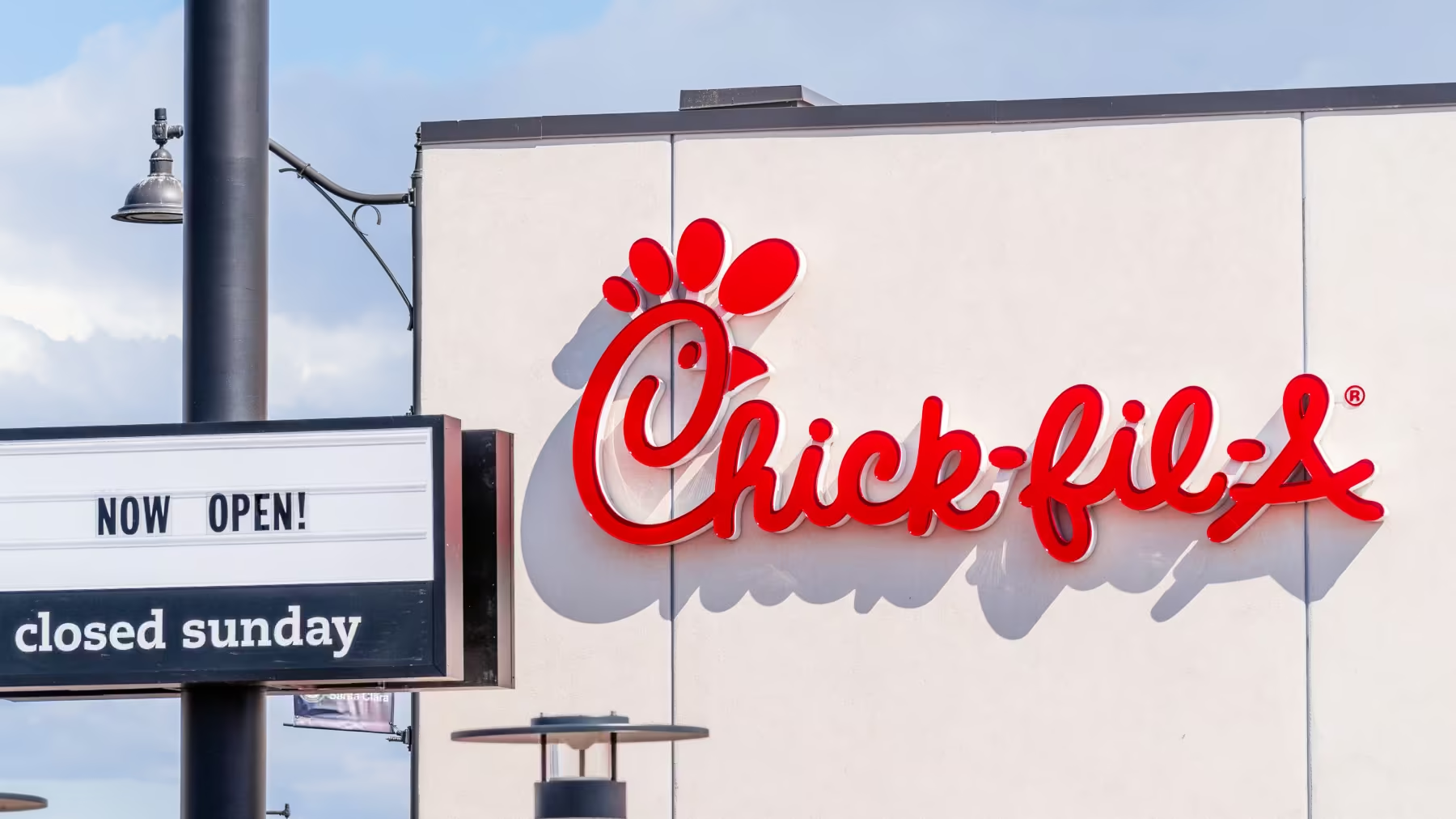
Notably, November’s sharp decline can be attributed to calendar dynamics rather than a drop in consumer interest – Chick-fil-A is famously closed on Sundays, and November 2025 had one more Sunday than November 2024, which could have placed the chain at a disadvantage relative to other restaurants.
Chick-fil-A’s resilience may be rooted in part in the strong alignment between its operating model and its customer base. Positioned as a premium QSR brand straddling the line between fast food and fast casual, the chain emphasizes consistency, menu simplicity, and high-touch service rather than heavy discounting.
This approach has helped Chick-fil-A maintain a top ranking for QSR customer satisfaction for over a decade. At the same time, its trade areas skew more affluent than those of traditional QSR competitors, providing a degree of insulation from macroeconomic pressures and supporting a willingness to pay for a reliable, higher-quality dining experience.
Chick-fil-A’s recent performance highlights a brand executing with discipline – expanding its footprint while maintaining strong unit-level productivity and outperforming key competitors. With a stable operating model and a customer base that supports its offerings, the chain appears well positioned to sustain its upward trajectory.
For more data-driven dining insights, follow Placer.ai/anchor.
Placer.ai leverages a panel of tens of millions of devices and utilizes machine learning to make estimations for visits to locations across the US. The data is trusted by thousands of industry leaders who leverage Placer.ai for insights into foot traffic, demographic breakdowns, retail sale predictions, migration trends, site selection, and more.

Traffic trends highlight a growing divergence between mono-brand boutiques and luxury department stores. While both formats have faced headwinds, department stores have consistently outperformed mono-brand boutiques on a year-over-year basis, maintaining relatively stable visitation compared to the sharper and more sustained declines seen across mono-brand locations. This gap has been especially pronounced since the second half of 2025, where mono-brand traffic trends weakened significantly while department stores showed greater resilience.
Part of this gap may be explained by structural differences between the formats. Department stores offer broader assortments, multiple price points, and the ability to support a range of shopping missions in a single visit, allowing them to capture demand across a wider spectrum of consumers. Mono-brand boutiques, by contrast, are more tightly tied to full-price luxury positioning, making them inherently more exposed to fluctuations in discretionary spending.
But even as luxury department stores offer a broader range of products that can appeal to a wider audience, trade area demographics suggest that mono-brand boutiques rely more heavily on aspirational shoppers. While both formats drew from affluent areas in 2025, mono-brand stores captured a higher share of households below the $100K income threshold – indicating greater exposure to more price-sensitive consumers. Department stores, by contrast, skewed toward higher-income households, providing a more stable demand base.
This distinction also helps explain the widening traffic gap between the two formats. As discretionary spending tightens, aspirational shoppers are often the first to pull back. And because mono-brand boutiques seem to depend more on this segment – and lack the pricing flexibility and assortment breadth to retain them – they are experiencing sharper declines. Meanwhile, department stores, supported by a more affluent customer base and greater assortment diversity, are better positioned to sustain traffic and overall performance.
The divergence between the two luxury formats suggests that both who shops and how they shop matter as much as brand strength. Mono-brand boutiques’ greater exposure to aspirational consumers leaves them more vulnerable in periods of constrained spending, while department stores benefit from both structural flexibility and a more resilient customer base. As the environment remains uneven, performance will likely hinge on a retailer’s ability to align format, pricing strategy, and audience with today’s shifting demand dynamics.
For more data-driven retail insights, visit placer.ai/anchor.

As economic pressure continues to reshape consumer behavior, one retail segment is accelerating through the storm. Thrift stores, long viewed as a niche segment, are emerging as a core apparel channel – attracting more affluent value-seekers and a younger generation of shoppers. An AI-powered analysis of the thrift category and one of its leading players – Goodwill – highlights the segment’s rise to prominence and the takeaways for other apparel players in an uncertain retail environment.
Thrift stores have seen sustained visit growth in recent years. The chart below compares visits across thrift, traditional apparel, and luxury apparel chains relative to Q4 2022. Thrift has maintained a clear upward trajectory, outperforming both traditional and luxury apparel since Q1 2025, as visits to those segments wane.
This trend likely reflects several dynamics at work. Economic pressure has encouraged consumers to seek out lower-cost alternatives, while the opportunity to score stylish, high-quality, and even luxury items at a fraction of their original price introduces a “treasure hunt” dynamic that traditional retail often struggles to replicate.
In this sense, thrifting has redefined value-seeking behavior – not out of necessity, but because it enhances the thrill of the hunt: a wholly discretionary shopping mentality.
Thrift’s visit growth is also being driven by increasing visitor frequency.
At Goodwill, for example, customer loyalty has been on the rise. Between early 2022 and early 2026, the share of visitors making an average of two or more visits per month, rose from roughly 28% to around 30%.
This trend aligns with the very nature of the thrift experience. Constantly changing inventory combined with meaningful variation across locations encourages shoppers to visit more often and explore multiple stores within short timeframes.
At the same time, online resale activity is increasing, particularly among younger, digitally savvy consumers. As economic uncertainty persists, many are turning thrifting into a side hustle, leveraging low-cost sourcing and online platforms to generate income – providing additional financial incentive to make repeat trips.
Social creators are further accelerating this behavior. “Thrift flip” videos, haul content, and store walkthroughs are reshaping discovery and growing in popularity among Gen Z audiences. And operators are adapting accordingly – partnering with influencers and refreshing store environments to better align with younger consumers’ expectations.
In addition to attracting younger audiences and frequent visitors, the profile of thrift store shoppers is evolving in another way. Operators such as Goodwill have increasingly expanded into higher-income areas, improving both the quality of donated inventory and access to more affluent customer segments. Likely as a result, the median household income (HHI) of the segment’s overall trade area – its potential market – has risen steadily.
At the same time, the median HHI of the category’s captured market – the areas within its trade area generating the most visits – has also increased, evidence that thrifting is gaining traction among more affluent consumers driven by value-seeking and treasure-hunting.
And crucially, while thrift stores still attract a somewhat less affluent audience than their overall trade area, this gap is narrowing: The income differential between potential and captured markets declined from 5.3% in 2022 to 4.8% in 2025, with the customer base increasingly reflecting the demographics of the communities where stores operate.
Taken together, these trends point to a broader repositioning of thrift retail. What began as a value-driven alternative is evolving into a hybrid model – one that blends affordability and discovery.
And in a time of economic uncertainty, a channel that resonates across income levels, engages younger shoppers, and thrives at the intersection of physical retail and digital culture is well positioned to not only remain resilient, but continue to build momentum.
Will the thrift space build on its successes in 2026? Visit Placer.ai/anchor to find out.
Placer.ai leverages a panel of tens of millions of devices and utilizes machine learning to make estimations for visits to locations across the US. The data is trusted by thousands of industry leaders who leverage Placer.ai for insights into foot traffic, demographic breakdowns, retail sale predictions, migration trends, site selection, and more.

While a state’s share of brick-and-mortar retail visits generally tracks with its share of the U.S. population, the chart below shows that the relationship is not perfectly proportional. Some states, such as Texas and Florida, generate a larger share of retail traffic than their population size alone would suggest, while others, such as California and New York, account for a smaller portion of visits relative to their population base.
Mapping each state’s share of retail visits to its share of the population reveals a clear geographic pattern: Across much of the Sun Belt, retail visits tend to over-index relative to population, while under-indexing is more common along the West Coast and in parts of the Northeast.
Several structural dynamics may help explain this regional divide. Migration into Sun Belt markets has been driven in part by lower costs of living, and once there, households may have more discretionary income relative to high-cost coastal markets – supporting more frequent in-person shopping trips. At the same time, consumer behavior differs across regions: in higher-cost coastal and Northeastern markets, shoppers may be more likely to consolidate trips or shift spending online, contributing to fewer retail visits per capita.
For retailers and CRE professionals, these patterns suggest that a data-driven expansion strategy should account not just for population growth, but for how and where consumers choose to shop across regions.
Sun Belt markets may offer outsized opportunities for physical retail expansion, as higher-than-expected foot traffic signals strong in-person engagement and potential demand for additional brick-and-mortar supply. Conversely, in coastal and Northeastern markets, where visits under-index and e-commerce adoption is higher, success may depend more on experiential retail, premium formats, or omnichannel integration rather than footprint growth alone.
For more data-driven retail and CRE insights, visit placer.ai/anchor.

After failing to attract a buyer for its retail operations following its February 2026 bankruptcy filing, Eddie Bauer LLC announced it would close all of its stores – though the Eddie Bauer brand will continue to be sold online and through wholesale partners. The company has pointed to headwinds such as inflation and tariff uncertainty as major factors contributing to the chapter 11 filing.
But Eddie Bauer isn’t the only brand facing these pressures – and even in today’s challenging macroeconomic environment, some apparel brands are thriving. So what other factors likely contributed to Eddie Bauer’s decline? We dove into the data to find out.
Unsurprisingly, visits to Eddie Bauer’s store fleet had been declining for some time. In 2024, year-over-year (YoY) traffic to Eddie Bauer fell 9.7% compared to just 4.1% for sportswear and athleisure brands and 3.7% for traditional apparel. And although the brand’s YoY visit gap narrowed in 2025, it remained significantly larger than that of the broader categories.
Alongside the company’s explanations, commentators have pointed to other challenges – including rising competition from athleisure brands, limited traction in Asian markets, and a disconnect between the company’s typical older shopper base and the younger demographic it sought to attract. Observers have also noted that the brand’s shift toward outlet malls, as it closed underperforming full-price locations, blurred its premium identity and conditioned consumers to expect deep discounts.
But location analytics also suggest another way in which Eddie Bauer’s drift towards outlet malls may have undermined the company’s brick-and-mortar performance – a mismatch between Eddie Bauer’s core audience and that of the typical outlet mall shopper.
As retail destinations that typically require a drive and center on discretionary purchases, outlet malls tend to attract visitors from areas with higher median household incomes than the nationwide average. But Eddie Bauer’s audience appears to be even more affluent – suggesting that the brand’s core customers may not have been typical bargain-hunting outlet shoppers.
At the same time, Eddie Bauer’s audience skews older and less family-oriented than that of outlet malls overall. In 2025, households belonging to ESRI ArcGIS Tapestry’s “Mature and Retired Living” segment group accounted for more than half of the brand’s captured market – significantly higher than both the nationwide average and the share seen in outlet mall trade areas.
Meanwhile, other key outlet audiences – such as families – were substantially underrepresented in Eddie Bauer’s trade areas. And despite attempts to woo Gen Z consumers, the brand attracted relatively fewer “Contemporary Households,” a younger-skewing group that includes singles, couples without children, and other non-family households.
Retail turnarounds are far from impossible – especially for legacy brands with strong recognition. But in a retail environment with little room for error, success hinges on getting every detail right. As Eddie Bauer’s experience shows, that means keeping locations, target audiences, and positioning tightly aligned, to deliver a clear, compelling value proposition.
For more data-driven retail analyses, follow Placer.ai/anchor.

Over the past several months since our last self-storage update, the industry has remained surprisingly resilient even as its primary fuel source – housing turnover – dried up. With Public Storage's recent acquisition of National Storage Affiliates, we dove into the data to understand what's driving the category's ongoing growth.
Coming out of the pandemic, demand for self-storage facilities surged due to increased migration trends and living space downsizing trends. According to Extra Space’s December 2025 Company Presentation, 12.6% of U.S. Households utilized self-storage facilities in 2023, up from below 10% before the pandemic. Our location intelligence reinforces this data, as monthly visitation trends to self-storage chains continued to grow in 2025, albeit at a slower pace than previous years (below).
Looking ahead to 2026, can this momentum continue? Home sales have improved modestly as interest rates inched downward, but the industry has had to pivot to generate growth the past few years. With that backdrop, we’ve identified four trends that will define the category in 2026.
With fewer people moving, operators had to cut prices to attract new tenants, with "street rates" declining in recent years. According to [many operators], "street rates" for a 10x10 unit dropped 10%–15% year-over-year in 2025. To compensate, major REITs (like Public Storage and Extra Space) raised rates on current tenants. Because these tenants were also locked into their housing situations, they proved incredibly "sticky" – accepting the price hikes rather than going through the hassle of moving their goods. Our data also shows an increase in the share of frequent visitors (2+ times a month) to self-storage units, reinforcing the idea that storage has become a more embedded, utility-like part of their daily lives – and further reducing their likelihood to churn even as rents rise.
If you can't move, you improve. As migration trends and housing turnover trends have slowed, there appears to be a shift in the rationale behind why customers were renting self-storage units. Instead of "moving storage," demand has shifted toward "lifestyle storage." As homeowners renovated to accommodate hybrid work setups or cleared out spare rooms for new family members, they needed temporary space. We see this with the percentage of remote workers visiting the largest self-storage chains, which has steadily increased the past several years. In turn, this helped put a floor under occupancy rates, which have stabilized in the low-90% range for REIT-managed storage properties and in the low-80% range across all operators.
The self-storage industry is seeing regional divergence. Sunbelt markets (Phoenix, Tampa, Atlanta), which saw massive migration and development booms during the pandemic, faced a supply hangover in 2025. With too many new facilities opening just as migration slowed, these markets saw the steepest drops in pricing compared to high-barrier markets in the Northeast.
However, this “saturation" could offer opportunities within this category. Recently, CubeSmart and CBRE Investment Management announced a $250 million joint venture to acquire assets in these very high-growth markets. Their first acquisition? A property in Phoenix – the poster child for recent oversupply. This move signals a critical shift for 2026: while development is slowing, institutional capital is waking up. Major players are using this period of soft pricing to acquire high-quality assets in the Sunbelt, betting that the long-term population growth will eventually absorb the current supply glut.
While standard drive-up units remain the bread and butter of the consumer self-storage industry, 2025 saw a continued shift toward climate-controlled solutions as a key revenue driver. New development throughout 2025 and into 2026 has skewed heavily toward 100% climate-controlled facilities. As consumers store higher-value items – such as electronics, wine, and collectibles – rather than just "garage overflow," they have proven willing to pay a higher premium for strict humidity and temperature regulation.
Simultaneously, investors tracking the self-storage sector have historically looked to industrial cold storage (refrigerated warehousing for food and pharma) as a parallel play, given both asset classes benefit from similar "last-mile" logistics tailwinds. However, the 2026 outlook for the industrial side has shifted significantly.
While the rise of online grocery and pharmaceutical delivery initially made refrigerated warehousing a defensive darling, the sector is now digesting a massive pandemic-era development boom. The U.S. industrial cold storage market is currently facing a notable supply glut. As industry leader Americold recently highlighted, "[O]ver the last few years, it's in excess of 15% of incremental capacity that's been added mainly by a lot of new market entrants whose business model is to get a little bit of scale and then try to transact."
This creates a split narrative for 2026: while consumer climate-controlled self-storage continues to capture premium yields, the industrial cold storage sector is entering a period of recalibration, forcing operators to focus on absorbing excess capacity and improving efficiency rather than breaking ground on new builds. We see this in visitation trends to cold-storage leaders Americold and Lineage, where visits continue to trend downward versus 2022 as these chains see an increase in new competitors.
As we head deeper into 2026, the industry is watching for the "thaw." If interest rates moderate and housing turnover picks up, street rates could rally quickly. But until then, the name of the game is consolidation and efficiency. Expect more REITs to follow CubeSmart’s lead, partnering with institutional capital to scoop up modern, climate-controlled assets while smaller operators struggle to compete in a low-volume environment.
For more data-driven CRE insights, visit placer.ai/anchor.

Stadiums and arenas – and the communities they call home – have a stake in cultivating engaged team fanbases eager to participate in live events. And venues and teams can employ a variety of strategies to strengthen their connection with fans and draw crowds to the stands.
In this report, we leverage location analytics and audience segmentation to uncover some of the ways that sports franchises and venues are driving engagement – attracting visitors from farther away and appealing to fans more likely to splurge on stadium fare. How does the signing of a star athlete impact arena visitor profiles? What happens to stadium visitation trends when a team’s performance improves dramatically? And how can teams and venues tailor their offerings to more effectively cater to visitor preferences?
We dove into the data to find out.
In sports, the signing of a star athlete can have a ripple effect across the organization, hometown, and league. In addition to driving up overall attendance at games, star power can impact everything from visit frequency to audience profile – and the buying power of stadium attendees.
Lionel Messi’s move to Inter Miami CF after decades of European play brought a foot traffic boost to Chase Stadium (formerly DRV PNK Stadium). But it also shifted the demographics of stadium visitors and increased the distance they traveled to attend a game.
At Inter Miami’s 2022 and 2023 home openers without Messi (he joined the team mid-season in 2023), only 6.4% and 5.3% of visitors to Chase Stadium came from over 250 miles away. But for the 2024 home opener with Messi on the squad, 31.3% of stadium visitors traveled more than 250 miles to attend.
The demographics of visitors at the home opener also changed with Messi on the team. Trade area data combined with the Spatial.ai: PersonaLive dataset reveals that the 2024 home opener received a smaller share of households in the “Near-Urban Diverse Families” (11.2%) and “Young Urban Singles” (7.2%) segments than the two previous years. Meanwhile, shares of “Sunset Boomers” (13.0%) and “Ultra Wealthy Families” (20.1%) increased, indicating that Messi brought an older and more affluent demographic of visitors to the stadium compared to previous years. Messi’s arrival has generated increased revenue for Inter Miami CF, Major League Soccer, and Apple TV+, which has exclusive streaming rights for MLS games. And an influx of affluent out-of-town visitors also has the potential to drive positive outcomes for tourism and employment in the Miami area.
Caitlin Clark’s WNBA debut was another star-powered game changer – this time for women’s basketball. After dazzling the sports world during her college basketball career, Caitlin Clark was drafted first overall to the Indiana Fever before the 2024 WNBA season. The superstar’s arrival has had a staggering economic impact on the city of Indianapolis and the Fever franchise, highlighting the benefit of a top athlete within the local community. However, Clark’s stardom also had a far-reaching impact on the league as a whole, adding tremendous value to the WNBA. Trade area analysis reveals that several WNBA arenas saw an uptick in visitor affluence when hosting the Fever with Clark in the lineup – likely driven in part by the elevated ticket prices associated with her appearances.
When the Minnesota Lynx hosted the Fever on July 14th, 2024, for example, the median HHI of Target Center’s captured market shot up to just over $93K/year, well above the median HHIs for the games immediately before and after that event. (A venue’s captured market refers to the census block groups (CBGs) from which it draws its visitors, weighted to reflect the share of visits from each one – and thus reflects the profile of the venue’s visitor base.) Similarly, the Fever’s away game against the Connecticut Sun on May 14th, 2024 at Mohegan Sun Arena drove a higher audience median HHI ($103.6K/year) than either of the Sun’s next two home games.
Having a superstar on the roster can drive positive outcomes locally and league-wide – but overall team success is the ultimate goal for any franchise. So it may come as no surprise that stadiums and arenas can drive engagement when their home teams perform well on the field or court. And teams that reverse their fortunes often spark even greater excitement, boosting visitor loyalty, visit duration, and other key metrics.
The Baltimore Orioles had one of the worst records in baseball just a few years ago. But since 2022, the team has flipped the script – stringing together winning seasons and postseason berths. And location intelligence shows that as the team finds success, fans are becoming more engaged with their hometown stadium.
During the 2019 regular season, one of the worst for the club in recent history, stadium attendance suffered, with only 8.3% of visitors to Oriole Park at Camden Yards visiting the stadium at least three times. But during the 2024 regular season, Oriole Park’s share of repeat visitors (those who visited at least three times) was almost double 2019 levels (16.3%) – consistent with a sharp increase in sales of multi-game ticket packages.
In addition to attending games more often, visitors to Oriole Park also appear to be spending more time at the ballpark. During the 2019 regular season, visitors spent an average of 150 minutes at the stadium, but in 2024, the average time at the park increased to 178 minutes – potentially boosting ancillary spending and in-stadium advertising exposure. The increased dwell time of visitors is particularly noteworthy when considering that MLB’s rule changes have significantly shortened average game time.
The more engaged fandom engendered by team success not only impacts stadium visitor behavior, but also has the potential to drive revenue. The Orioles added 20 new corporate sponsors before the 2024 season, likely due to the attention garnered by the well-performing club.
The NFL’s Detroit Lions provide another example of team success that has driven visitor engagement. As the franchise has improved its record in recent years, the trade area size of its stadium – Ford Field – has also increased, indicating elevated attendance from fans living further away.
The Lions finished the regular season with losing records from 2019 to 2021, but finished over .500 in 2022 (9-8), 2023 (12-5), and 2024 (15-2). And with the team’s increasing wins each consecutive season, the size of its stadium's trade area has also increased steadily – reaching 81.3% above 2019 levels in 2024.
This underscores just how much team success matters to fans, who may be more inclined to travel longer distances if they believe their team is likely to win. Ultimately, broader fan engagement across a wider trade area also increases a team’s growth potential beyond in-stadium attendance – driving merchandise sales, increasing viewership, and benefitting both the team and the league as a whole.
While stadium attendance and visitor behavior is often correlated to the performance of the sports teams that play in the arena, sporting venues can also drive fan engagement in ways that aren’t solely tied to team success or big-name athletes. By adapting their concessions and venue operations to visitor preferences, stadiums and arenas can better serve their audiences and strengthen their community presence.
Consumers have been feeling the pinch of rising food costs for quite some time, but at least one NBA team has responded to make concessions at the game more affordable for fans. In December 2024, the Phoenix Suns announced a $2 value menu for all home games at Footprint Center – delivering steep discounts on hot dogs, water, soda, and snacks.
Location analytics suggest that since the value menu launch, more fans who would have otherwise waited until after leaving the venue to grab a bite are now enjoying food and drinks inside the arena. Analysis of five Suns home games just before the value menu launch – between November 26th and December 15th, 2024 – reveals that between 7.0% and 9.3% of stadium visitors visited a dining establishment after leaving the arena. But following the value menu launch before the December 19th, 2024 home game, post-game dining decreased to under 6.0% through the end of the year.
Suns owner Mat Ishbia’s announcement of the new menu called out the need for affordable food options for families at Suns games. As the season progresses, the new menu may drive a larger share of family households to Suns games, which could provide opportunities for advertisers and other stadium partners.
Consumers in Washington – and especially Seattle – are known for their affinity for plant-based diets and environmentally-friendly lifestyles. And that goes for local football fans as well: Audience segmentation provided by the AGS: Behavior & Attitudes dataset combined with trade area data reveals that during September to December 2024, households within Lumen Field’s potential visitor base were 36% more likely to be “Environmentally Conscious Buyers” and “Environmental Contributors” and 39% more likely to be “Vegans” compared to the nationwide average. By contrast, across all NFL stadiums, potential visiting households were 2%, 1%, and 3% less likely, respectively, to belong to these segments.
And Lumen Field has been actively catering to these consumer preferences. The stadium, which has been experimenting with plant-based culinary options for quite some time, was recently recognized as one of the most vegan-friendly stadiums in the NFL. And in December 2024, Lumen became the second stadium in the league to achieve TRUE precertification for its efforts to become a zero-waste venue.
By remaining aligned with its visitor base – including both football fans and people that visit the stadium for other events – Lumen Field encourages visitors to feel at home at their local stadium. And fans may be more connected to their team knowing the club shares their values and respects their lifestyle.
Stadiums and arenas can leverage a variety of strategies to engage visitors in attendance as well as wider audiences. Signing a star athlete, putting together a winning club, or adapting to local preferences are just some of the ways that sports franchises and athletic venues can find success.

Starbucks. Amazon. Barclays. AT&T. UPS. These are just some of the major corporations that have made waves in recent months with return-to-office (RTO) mandates requiring employees to show up in person more often – some of them five days a week.
But how are crackdowns like these taking shape on the ground? Is the office recovery still underway, or has it run its course? And how are evolving in-office work patterns impacting commuting hubs and dining trends? This white paper dives into the data to assess the state of office recovery in 2024 – and to explore what lies ahead for the sector in 2025.
In 2024, office foot traffic continued its slow upward climb, with visits to the Placer.ai Office Index down just 34.3% compared to 2019. (In other words, visits to the Placer.ai Office Index were 65.7% of their pre-COVID levels). And zooming in on year-over-year (YoY) trends reveals that office visits grew by 10.0% in 2024 compared to 2023 – showing that employee (and manager) pushback notwithstanding, the RTO is still very much taking place.
Indeed, diving into quarterly office visit fluctuations since Q4 2019 shows that office visits have been on a slow, steady upward trajectory since Q2 2020, following – at least since 2022 – a fairly consistent seasonal pattern. In Q1, Q2, and Q3 of each year, office visit levels increased steadily before dipping in holiday-heavy Q4 – only to recover to an even higher start-of-year baseline in the following Q1.
Between Q1 and Q3 2022, for example, the post pandemic office visit gap (compared to a Q4 2019 baseline) narrowed from 63.1% to 47.5%. It then widened temporarily in Q4 before reaching a new low – 41.4% – in Q1 2023. The same pattern repeated itself in both 2023 and 2024. So even though Q4 2024 saw a predictable visit decline, the first quarter of Q1 2025 may well set a new RTO record – especially given the slew of strict RTO mandates set to take effect in Q1 at companies like AT&T and Amazon.
Despite the ongoing recovery, the TGIF work week – which sees remote-capable employees concentrating office visits midweek and working remotely on Fridays – remains more firmly entrenched than ever.
In 2024, just 12.3% of office visits took place on Fridays – less than in 2022 (13.3%) and on par with 2023 (12.4%). Though Fridays were always popular vacation days – after all, why not take a long weekend if you can – this shift represents a significant departure from the pre-COVID norm, which saw Fridays accounting for 17.3% of weekday office visits.
Unsurprisingly, Tuesdays and Wednesdays remained the busiest in-office days of the week, followed by Thursdays. And Mondays saw a slight resurgence in visit share – up to 17.9% from 16.9% in 2023 – suggesting that as the RTO progresses, Manic Mondays are once again on the agenda.
Indeed, a closer look at year-over-five-year (Yo5Y) visit trends throughout the work week shows that on Tuesdays and Wednesdays, 2024 office foot traffic was down just 24.3% and 26.9%, respectively, compared to 2019 levels. The Thursday visit gap registered at 30.3%, while the Monday gap came in at 40.5%.
But on Fridays, offices were less than half as busy as they were in 2019 – with foot traffic down a substantial 53.2% compared to 2019.
Before COVID, long commutes on crowded subways, trains, and buses were a mainstay of the nine-to-five grind. But the rise of remote and hybrid work put a dent in rush hour traffic – leading to a substantial slowdown in the utilization of public transportation. As the office recovery continues to pick up steam, examining foot traffic patterns at major ground transportation commuting hubs, such as Penn Station in New York or Union Station in Washington, D.C., offers additional insight into the state of RTO.
Rush hour, for one thing – especially in the mornings – isn’t quite what it used to be. In 2024, overall visits to ground transportation hubs were down 25.0% compared to 2019. But during morning rush hour – weekdays between 6:00 AM and 9:00 AM – visits were down between 44.6% and 53.0%, with Fridays (53.0%) and Mondays (49.7%) seeing the steepest drops. Even as people return to the office, it seems, many may be coming in later – leaning into their biological clocks and getting more sleep. And with today’s office-goers less likely to be suburban commuters than in the past (see below), hubs like Penn Station aren’t as bustling first thing in the morning as they were pre-pandemic.
Evening rush hour, meanwhile, has been quicker to bounce back, with 2024 visit gaps ranging from 36.4% on Fridays to 30.0% on Tuesdays and Wednesdays. Office-goers likely form a smaller part of the late afternoon and evening rush hour crowd, which may include more travelers heading to a variety of places. And commuters going to work later in the day – including “coffee badgers” – may still be apt to head home between four and seven.
The drop in early-morning public transportation traffic may also be due to a shift in the geographical distribution of would-be commuters. Data from Placer.ai’s RTO dashboard shows that visits originating from areas closer to office locations have recovered faster than visits from farther away – indicating that people living closer to work are more likely to be back at their desks.
And analyzing the captured markets of major ground transportation hubs shows that the share of households from “Principal Urban Centers” (the most densely populated neighborhoods of the largest cities) rose substantially over the past five years. At the same time, the share of households from the “Suburban Periphery” dropped from 39.1% in 2019 to 32.7% in 2024. (A location’s captured market refers to the census block groups (CBGs) from which it draws its visitors, weighted to reflect the share of visits from each one – and thus reflects the profile of the location’s visitor base.)
This shift in the profile of public transportation consumers may explain the relatively slow recovery of morning transportation visits: City dwellers , who seem to be coming into the office more frequently than suburbanites, may not need to get as early a start to make it in on time.
While the RTO debate is often framed around employer and worker interests, what happens in the office doesn’t stay in the office. Office attendance levels leave their mark on everything from local real estate markets to nationwide relocation patterns. And industries from apparel to dining have undergone significant shifts in the face of evolving work routines.
Within the dining space, for example, fast-casual chains have always been workplace favorites. Offering quick, healthy, and inexpensive lunch options, these restaurants appeal to busy office workers seeking to fuel up during a long day at their desks.
Traditionally, the category has drawn a significant share of its traffic from workplaces. And after dropping during COVID, the share of visits to leading fast-casual brands coming from workplaces is once again on the rise.
In 2019, for example, 17.3% of visits to Chipotle came directly from workplaces, a share that fell to just 11.6% in 2022. But each year since, the share has increased – reaching 16.0% in 2024. Similar patterns have emerged at other segment leaders, including Jersey Mike’s Subs, Panda Express, and Five Guys. So as people increasingly go back to the office, they are also returning to their favorite lunch spots.
For many Americans, coffee is an integral part of the working day. So it may come as no surprise that shifting work routines are also reflected in visit patterns at leading coffee chains.
In 2019, 27.5% of visits to Dunkin’ and 20.1% of visits to Starbucks were immediately followed by a workplace visit, as many employees grabbed a cup of Joe on the way to work or popped out of the office for a midday coffee break. In the wake of COVID, this share dropped for both coffee leaders. But since 2022, it has been steadily rebounding – another sign of how the RTO is shaping consumer behavior beyond the office.
Five years after the pandemic upended work routines and supercharged the soft pants revolution, the office recovery story is still being written. Workplace attendance is still on the rise, and restaurants and coffee chains are in the process of reclaiming their roles as office mainstays. Still, office visit data and foot traffic patterns at commuting hubs show that the TGIF work week is holding firm – and that people aren’t coming in as early or from as far away as they used to. As new office mandates take effect in 2025, the office recovery and its ripple effects will remain a story to watch.