


.svg)




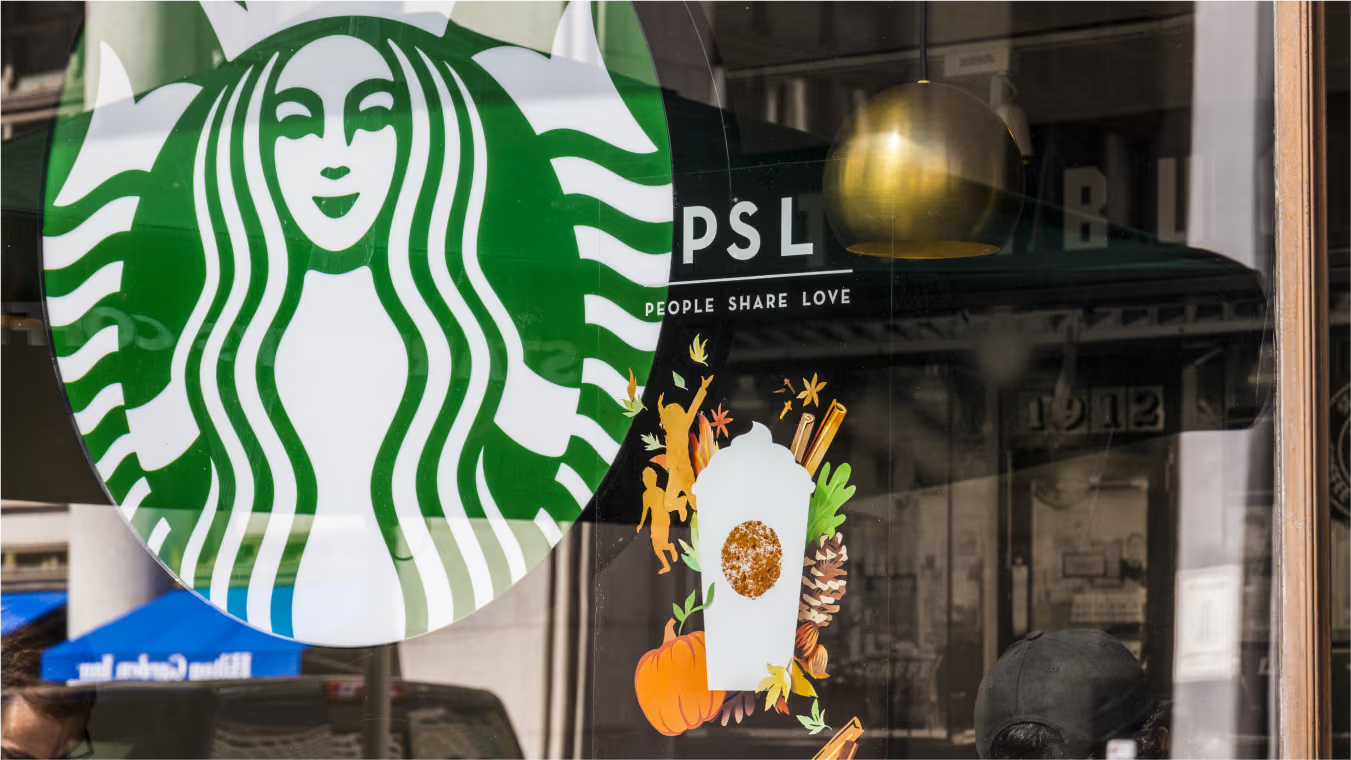
Starbucks launched its latest fall menu on August 26th, 2025, which included the fan-favorite Pumpkin Spice Latte (PSL). How did the return of the anticipated beverage impact visits this year? We dove into the data to find out.
More Than Two Decades In, PSL and Fall Menu Continue to Resonate
The fall menu launch and PSL return drove significant visit spikes to Starbucks, as shown in the chart below. And traffic on this year's PSL launch was nearly identical to 2024 levels – highlighting the remarkable consistency of the seasonal offering that has now become a cultural staple. The ability of the PSL to drive traffic at scale – even after two decades – underscores its unique role in Starbucks' playbook.
Where is the Pumpkin Spice Latte Most Popular?
While the PSL's appeal is coast-to-coast, enthusiasm varies geographically.
The map below plots the increase in Starbucks visits on the launch of the fall menu compared to each state's pre-fall menu launch daily average. The Mountain region emerged as this year's PSL epicenter: Utah led the nation with a traffic surge of over 40% above its daily average, with neighboring states like Colorado, Idaho, and Nevada also showing exceptional gains. The Midwest and Appalachia, including West Virginia and Kentucky, followed with their own impressive double-digit increases.
By contrast, increases were more muted in the Northeast and Southeast, with single-digit visit growth in Louisiana, Mississippi, Georgia, New York, Vermont, and New Hampshire. Together, these patterns reveal both the universal draw of Starbucks’ seasonal offerings and the regional nuances that shape consumer response.
How Does the Fall Menu Launch at Dunkin' and Dutch Bros. Stack Up to Starbucks?
While competitors like Dunkin' and Dutch Bros. also leverage seasonal menus to attract customers, their launch-day boosts don't match the scale of the PSL phenomenon, as shown in the chart below. Starbucks has successfully transformed a menu update into a highly anticipated cultural moment that competitors struggle to replicate.
This data suggests that Starbucks' fall launch doesn't just boost its own traffic – it sets the benchmark for the entire industry. The brand’s ability to blend product innovation with cultural relevance reinforces its position as the undisputed leader in the seasonal beverage market.
Starbucks' Fall Menu Still a Reliable Traffic Driver
The data from the 2025 fall menu launch suggests that the Pumpkin Spice Latte is far more than a seasonal beverage; it is one of Starbucks' most reliable and defensible strategic assets. The popular LTO provides a predictable traffic and revenue anchor, transforming the fall menu and the PSL at its center into a reliable financial instrument that widens the company's competitive advantage.
Ultimately, the enduring success of the PSL highlights Starbucks' mastery in transforming a product into a cultural tradition, proving that the most powerful driver of consumer behavior isn't just the product itself, but the anticipation and ritual built around it.
For more data-driven insights, visit placer.ai/anchor

Dollar General and Dollar Tree have grown significantly in recent years, upending the competitive dynamics in the wider retail landscape. Can these chains continue to grow? Or are they beginning to reach their saturation point? We dove into the data to find out.
Focus on Dollar Tree Banner Delivers Growth
Dollar Tree recently completed the sale of the Family Dollar brand, allowing management to dedicate its efforts to "Dollar Tree's long-term growth, profitability and returns on capital."
The strategic refocus appears to be already paying off. As the chart below shows, year-over-year (YoY) overall and same-store visits to the chain have surged in recent months, indicating strong organic performance amplified by fleet expansion.
Dollar General Still Growing – At a Slower Pace
Meanwhile, Dollar General is also experiencing traffic growth – though momentum has cooled slightly. After posting a robust 12.2% visit increase between July 2023 and July 2024, growth has decelerated to 2.9% year-over-year in July 2025.
Still, although Dollar General's growth has slowed while Dollar Tree's growth has picked up, Dollar General remains the significantly larger chain. In H1 2025, 58.7% of combined visits to the two retailers went to Dollar General, compared to 41.3% of visits to Dollar Tree. And just because Dollar General's growth has slowed somewhat does not mean that the company has reached its saturation point.
Geographic Analysis Reveals Expansion Opportunities
Even though both chains have been growing for several years, geographic data reveals that domestic expansion opportunities for both retailers still exist.
The map below shows the share of combined visits to Dollar General and Dollar Tree going to each chain by DMA. Dollar Tree receives a majority of visits in the yellow DMAs, which are heavily concentrated in the Western United States. In contrast, Dollar General receives the majority of visits in the purple DMAs which cover most of the Midwest and South.
This distinct geographic segmentation indicates that rather than competing head-to-head, each chain has built regional strongholds – creating significant white space opportunities for cross-regional expansion. Dollar Tree's renewed focus and accelerating traffic position it well to build up its position in the South and Midwest – Dollar General's traditional markets. Conversely, Dollar General's established operational scale and proven rural market penetration strategy could drive significant growth for the chain in Dollar Tree's Western strongholds.
Dollar Tree & Dollar General's Growth Potential
Dollar Tree’s sharpened focus and accelerating traffic growth signal strong long-term potential, while Dollar General’s scale ensures it remains a formidable player despite cooling momentum. With distinct geographic strongholds, both retailers still have significant white space for expansion – setting the stage for continued growth rather than saturation.
For the most up-to-date superstore visit data, check out Placer.ai's free tools.

Expansions, Rising Demand Drive Visits Growth For Five Below & Ollie’s
Value-oriented retailers Ollie's Bargain Market (OLLI) and Five Below (FIVE) continue their impressive growth trajectory, with Q2 2025 visits surging 18.3% and 14.3% year-over-year, respectively.
Both chains are aggressively expanding their footprints – Ollie's acquired around 40 Big Lots leases and opened 25 of its projected 75 new stores by May 2025, while Five Below plans to add 150 locations this year after opening hundreds in 2024. Critically, the expansions are not coming at the expense of existing stores. Same-store visits grew 9.4% at Ollie's and 5.9% at Five Below, meaning individual locations are actually busier now than last year – despite the larger fleet size.
These positive traffic trends underscore the strong consumer appetite for value-oriented discretionary retail in today's economic environment and highlight the growth potential of the two chains.
Increased Cross-Visitation Highlights Segment's Growth Potential
Five Below and Ollie's positive visit trends demonstrate that growth doesn't have to be zero-sum. Rather than cannibalizing each other's traffic, both chains are successfully growing in parallel, as their increased store presence and busier locations expand the overall value-oriented discretionary retail market.
This growth can also be seen from the cross-visitation data in the chart below. H1 2025 saw the largest share of Ollie's shoppers visiting Five Below and the largest share of Five Below shoppers visiting Ollie's in recent years. (The cross-visitation from Ollie's to Five Below was likely significantly higher than the reverse due to Five Below's much larger physical footprint.)
This rising cross-visitation between the two chains validates the expanding market opportunity for value-oriented discretionary retail, as consumers increasingly embrace multiple value-oriented shopping destinations to meet their needs.
Broad Appeal In the Bargain Space
The strong performance of Five Below and Ollie's in Q2 2025 demonstrates the resilience and growth potential of the discount retail sector during challenging economic times.
Visit Placer.ai/anchor for the latest data-driven retail insights.
Traffic to wholesale clubs is on the rise, with Q2 2025 visits to Costco, BJ's Wholesale Club, and Sam's Club up 3.2%, 5.0%, and 1.6%, respectively, compared to Q2 2024. Same-store visits also increased slightly, with 1.2%, 1.3%, and 1.7% same-store visit growth for Costco, BJ's Wholesale Club, and Sam's Club, respectively.
Last year, Costco and BJ's drove growth through expansion while Sam's Club focused on increasing visits to its existing store fleet. But the Walmart-owned wholesale club is now beginning to expand as well. How might this strategic shift impact traffic to the segment? We dove into the data to find out.
Similar Growth Trajectory For Costco & BJ's
BJ's (BJ) and Costco (COST) are leaning on expansions to drive visit growth, with overall traffic to both chains growing faster than same-store visits, as seen in the chart below. And even with the increased store count, same-store visits to the chains are largely positive – indicating that new stores are not cannibalizing shoppers from existing locations, and that the consumer appetite for membership-based wholesale clubs remains strong.
The companies' traffic growth followed similar trajectories in the first half of 2025: Costco posted slightly stronger numbers in Q1 for both overall and same-store visits, while BJ's outperformed in Q2. July's results reflected this parallel trajectory, with BJ's achieving stronger overall traffic growth (4.7% vs. 3.2%) and Costco seeing better same-store performance (1.9% vs. 1.0%).
Sam's Club's Joins the Expansion Game
While Costco and BJ's expand aggressively, Sam's Club (WMT) has (so far) emphasized store optimization over growth, reflected in the close correlation between overall and same-store visit trends in the chart below. Despite this restrained growth strategy, the Walmart-owned banner has sustained positive year-over-year traffic throughout most of 2025 – demonstrating strong organic growth at existing locations.
Now, the chain appears to be taking a page out of its competitors' expansion strategy book. The company had initiated its strategic pivot in early 2023, with plans to open 30 new stores – but Walmart recently shared plans for a more aggressive expansion of 15 new clubs a year on top of the 30 locations initially announced. With this new strategy, Sam's Club appears to be embracing the expansion-driven growth model that has proven successful for its competitors.
Regional Segmentation Reduced Competition – Until Now
Diving into the visit share distribution between the three analyzed wholesale chains by DMA sheds light on the potential impact of Sam's Club's expansion on the wider wholesale club segment.
Costco and Sam's Club are the larger of the three players: In July 2025, 54.3% of combined visits to the three wholesale clubs went to Costco, and 36.0% went to Sam's Club. (The remaining 9.7% of visits went to BJ's Wholesale Club.)
The maps below shows each chain's regional visit share (by DMA) and highlights the geographic segmentation in the space, which has historically allowed each chain to maintain strong regional footholds with limited direct competition. Costco dominates the West, Sam's Club enjoys the majority visit share in much of the Midwest and South, and BJ's Wholesale Club is popular in the northeast.
But now, as the three chains are expanding beyond their traditional strongholds, the industry may see increased competition for local market share. A new Sam's Club store is slated to open in Arizona where Costco controlled 67.3% of the combined visit share as of July 2025, while a new Costco store recently opened in Texas, where 63.0% of the combined visit share in July 2025 went to Sam's Club. BJ's has also announced plans to expand into Texas and grow its fleet in several other southern states.
As these chains venture beyond their historical strongholds, success will hinge on each operator's ability to adapt their proven regional strategies to new demographics while securing optimal locations before competitors.
For more data-driven retail insights, visit placer.ai/anchor.
Discretionary Pull-Back Impacts Kohl's (KSS) Traffic
Kohl's (KSS) brick-and-mortar stores continue to play in the company's overall business strategy. During the company's first fiscal quarter (ending May 3rd, 2025), in-store comparable sales declined 2.6% year-over-year – aligning closely with the 2.8% same-store visit decline between February and April 2025 – while digital sales fell 7.7%. And while the visit gap has widened slightly since – between May and July 2025, same-store visits declined 3.4% YoY – in-store traffic trends continue to outperform Kohl’s full-year guidance, which anticipated a 4.0% to 6.0% drop in comparable store sales.
The recent softness can be partially attributed to a sector-wide slowdown in June retail traffic, as shoppers who had pulled forward purchases to avoid anticipated tariff-driven price hikes reduced their shopping activity in June. The wider macroeconomic uncertainty also appears to be hitting mid-market discretionary retailers like Kohl's particularly hard, as many middle-income shoppers continue to trade down to value-forward chains and high-income shoppers gravitate to luxury brands.
Macy's (M) Portfolio Performance Highlights Bifurcated Consumer Spending
Macy's (M) reported a 2.0% YoY decline in comparable sales on an owned basis for its first quarter of 2025 (ending May 3rd 2025) – consistent with the 2.2% YoY decline in combined same-store visits at its three major banners (Macy's, Bloomingdale's, and Bluemercury) between February and April 2025.
Like for Kohl's, Macy's same-store visit gap widened in recent months, with combined visits to the three banners down 4.0% YoY between May and July 2025. The company's namesake banner, Macy's, saw the largest traffic declines, while visits to its luxury banners Bloomingdale's and Bluemercury generally increased YoY between May and July 2025. This likely reflects the different economic pressures facing visitors to the Macy's brand: The chain serves a more budget-conscious demographic, with a median household income of $87.7K in H1 2025 in its trade areas, while Bloomingdale's and Bluemercury attract higher-income shoppers with median household incomes of $126.5K and $123.0K, respectively.
This divergence highlights how economic uncertainty is creating a tale of two retails – where luxury resilience and mass market vulnerability are impacting competitive dynamics across Macy's portfolio as well as in the wider retail space.
The softer visit trends at Kohl's and the performance gap between Macy's luxury banners and its namesake brand highlights the challenges faced by mid-market discretionary banners in 2025. As discretionary spending continues to face pressure, retailers serving the middle market may need to adapt their strategies to compete for increasingly budget-conscious consumers.
To see up-to-date department store visit trends, try Placer's free Industry Trends tool.
HomeGoods Leads Same-Store Visit Growth At TJX
Same-store visit growth at TJX chains in recent months exceeded the company's official guidance of 2-3% same-store sales growth for Q2 FY26 (May 4 - August 2, 2025), aligning with analyst expectations for an earnings beat.
The largest growth in same-store visits went to HomeGoods, which continues to be a key growth engine for TJX, with its outperformance stemming from a multi-faceted competitive edge. Its consistent lead over the core apparel banners, T.J. Maxx and Marshalls, may be due to its more defensible position in the less-crowded off-price home category. And when compared to its sister brand, Homesense, HomeGoods' superior performance may be attributed to its significant brand maturity and a merchandise mix centered on higher-frequency, smaller-ticket items. This positions the banner effectively to capture discretionary spending from consumers seeking affordable indulgences in the current economic environment.
Unpacking the Sierra & Homesense Expansion Strategy
All banners experienced YoY growth in overall traffic, but the strongest growth went to the latest newest additions to the company's U.S. portfolio – Homesense and Sierra, suggesting that both brands have a long runway for unit potential.
Sierra is engineered to capture a significant share of the lucrative outdoor and active lifestyle market, a space that critically lacks a dominant, national, off-price competitor, giving it a clearer and more defensible runway for explosive growth. In contrast, while Homesense plays the vital role of deepening TJX's penetration in the home category with larger-scale items like furniture, it enters a more contested field and must contend with established competition from other discount and value-oriented furniture retailers.
Both expansions are ultimately underpinned by TJX's core competency: leveraging its world-class buying organization and real estate expertise to dominate new off-price segments and capture a larger share of total consumer discretionary spending.
Capturing Market Share in Rural & Semirural America
This push into new product categories is happening in parallel with a push into new markets. Year-over-year analysis reveals TJX has systematically expanded its rural and semi-rural household penetration across all banners – aligning with management's stated focus on "smaller markets and smaller footprint stores" as identified growth opportunities. With TJX planning around 130 net new stores in 2025, this rural expansion strategy provides a credible pathway for continued domestic growth in an increasingly competitive retail landscape.
For more data-driven retail insights, visit placer.ai/anchor.
The information, data, analyses and opinions presented herein do not constitute investment advice; are provided solely for informational purposes and therefore are not an offer to buy or sell a security; and are not warranted to be correct, complete or accurate. By means of this publication, Placer Labs Inc. (“Placer”) is not rendering accounting, business, financial, investment, legal, tax or other professional advice or services. This publication is not a substitute for such professional advice or services, nor should it be used as a basis for any decision or action that may affect your business. Before making any decision or taking any action that may affect your business, you should consult a qualified professional advisor.
Placer shall not be responsible for any loss sustained by any person who relies on this publication. The opinions and data presented are as of the date written and are subject to change without notice. The information contained herein is the proprietary property of Placer and may not be reproduced, in whole or in part, or used in any manner, without the prior written consent of Placer.

