.png)
.png)

.png)
.png)


After a slow start to 2025, both Gap and Urban Outfitters are seeing visits pick up again ahead of the holidays. Traffic gains in Q3 signal improving consumer appetite, positioning both brands for a stronger finish to the year.
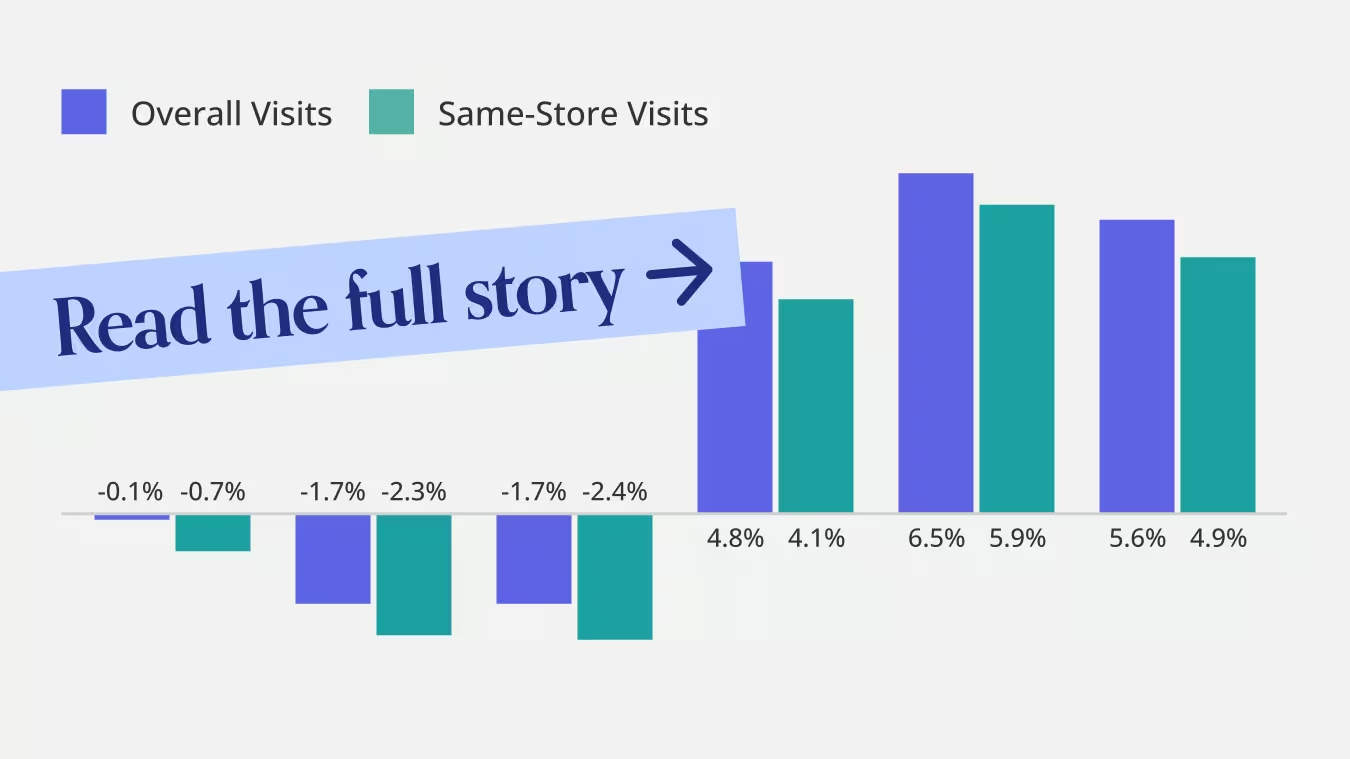
Visits to Gap showed a sluggish start in Q1 2025, with traffic down 2.7% year-over-year, likely influenced by a tough February (a leap day and inclement weather keeping shoppers at home). But momentum turned in Q2 (1.4%) and Q3 (also 1.4%), indicating that the retailer is regaining traction heading into the holiday season.
Monthly traffic trends reinforce that this improvement was driven by improved visit trends in most months, with August seeing the strongest visit growth of 5.1%. September visits took a slight downturn before climbing to a respectable 4.8% in October, likely the result of new campaigns and improved merchandising.
Gap has spent the past few years focusing on a turnaround strategy that saw the apparel brand reintroduce classic styles, bring in new creative directors, and collaborate with brands like Dôen and celebrities such as Katseye and Tyla. And these efforts seem to be paying off, both in terms of elevated foot traffic and in Gap’s earnings: net sales increased 5% in the first quarter (ending on May 31, 2025) and 1% in Q2 2025.
Gen-Z focused Urban Outfitters experienced a similar recovery arc. Visits to the chain were down in both Q1 and Q2 2025, but rebounded in Q3, with foot traffic elevated by 2.4% YoY. and diving into the monthly visits highlights that, for the most part, visit declines were modest, with a marked pickup from August onward, ending October with a 5.8% increase in foot traffic. This foot traffic pull-up also aligned with Urban Outfitter’s robust financials, with Q2 net sales up 4.2%.
This increase in visits aligns closely with back-to-school shopping, and Urban Outfitters’ focus on college-age consumers likely helped reenergize in-store activity after a softer first half.
Diving into the demographic data for both brands provides additional context for recent foot traffic trends. Gap’s captured audience earns well above the nationwide median – $99.0 versus $79.6 – while its potential market skews lower, at $84.1K. This indicates that Gap's recent gains are being driven primarily by higher-income households, who may be more insulated from inflation fatigue and attracted to the brand’s premium collaborations. It also highlights an opportunity for Gap to broaden its appeal among mid-income shoppers who remain part of its potential audience.
Urban Outfitters, by contrast, saw a captured median HHI that trailed its potential market ($89.9 compared to $92.0), perhaps owing to its popularity among “Young Professionals” – a segment which is overrepresented in its captured market. The strength in this segment also may help contextualize the Q3 lift, given that the Young Professional category includes college students – a cohort that Urban Outfitters is particularly invested in, both through its product mix and its experiential initiatives.
Looking forward, Gap and Urban Outfitters seem primed to succeed this holiday season. For Gap, a combination of successful renewal efforts, increasing foot traffic, and a wealthier customer base position it to continue driving visits. For Urban Outfitters, continued focus on core engagement and higher-value customer acquisition will determine how strongly it closes out 2025.
For more data-driven retail insights follow Placer.ai/anchor.
Placer.ai leverages a panel of tens of millions of devices and utilizes machine learning to make estimations for visits to locations across the US. The data is trusted by thousands of industry leaders who leverage Placer.ai for insights into foot traffic, demographic breakdowns, retail sale predictions, migration trends, site selection, and more.

As the retail calendar approaches its most pivotal stretch, we took a closer look at foot traffic trends across superstores and warehouse clubs to see how these key players are performing.
Warehouse clubs – Costco, Sam’s Club, and BJ’s Wholesale – continued to post visit gains in recent months, extending the momentum that has defined the segment for much of the past year. Their consistent performance reinforces the appeal of the wholesale model among value-driven shoppers navigating inflationary pressures and tighter budgets.
However, within the broader mass merchandise sector, October marked a clear turning point. Walmart saw its strongest year-over-year (YoY) visit gains of the last six months, while Target’s traffic shifted from negative to positive growth for the first time during the same period. The October surge coincided with the superstores' early early holiday sales events, signaling that the early holiday season has evolved into a pivotal retail moment.
Costco led foot traffic growth among mass merchants in September and October 2025. And some of that momentum may stem from the chain’s new early opening hours for Executive Members, which appears to have eased peak-hour congestion and enhanced the overall shopping experience.
As a reminder, Costco Executive Members pay almost twice as much as standard Gold Star members and account for over 74% of the chain’s sales, so it makes sense that Costco would look to add value and additional perks to its premium memberships.
But since extending its hours to open an hour early for Executive Members, Costco has likely enhanced the overall shopping experience for all visitors.
The graph below shows that between July and October 2025, after the introduction of early openings, the extended morning hours reduced Costco’s traffic at peak times compared to 2024, spreading visits more evenly throughout the day – which means less crowding for everyone.
Earlier openings also affect how Costco shoppers shop. Since the new hours took effect, the share of Costco visits lasting 30 to 45 minutes has increased, while the share of 45- to 60-minute visits has declined. This shift suggests that with lighter crowds and easier navigation, Costco shoppers are more purposeful and efficient.
Meanwhile, the share of Costco visits lasting less than 30 minutes also fell during the July to October period, suggesting that in a more streamlined environment, some shoppers feel comfortable taking extra time to browse – and perhaps add a few more items to their baskets – rather than rushing through a crowded store.
As the main holiday season approaches and consumer sentiment reaches new lows, value-forward warehouse clubs appear to remain in a strong position. Meanwhile, superstores’ success with early sales events demonstrates that shoppers remain highly responsive to promotions, an encouraging sign heading into the peak shopping period.
By offering early access to Executive Members, Costco is both recognizing its most valuable shoppers and alleviating crowding for everyone during typical rush periods – a move that could give the retailer an edge during the busy holiday season.
How will these retailers close out the holiday season? Visit Placer.ai/anchor to find out.
Placer.ai leverages a panel of tens of millions of devices and utilizes machine learning to make estimations for visits to locations across the US. The data is trusted by thousands of industry leaders who leverage Placer.ai for insights into foot traffic, demographic breakdowns, retail sale predictions, migration trends, site selection, and more.

The home improvement sector continues to face challenges in 2025, and category leaders Lowe’s and The Home Depot continue to navigate shifting demand. Yet signs of resilience are beginning to emerge as both brands report strength across key mid-range categories and identify opportunities to drive the next phase of growth.
We dove into the data for The Home Depot and Lowe’s to find out what location analytics reveals about their performance and evolving strategy.
In their recent Q2 2025 reportings, both Lowe’s and The Home Depot underscored an important dynamic – while comparable sales and average ticket size increased, comparable transactions declined. Both retailers attributed this pattern to a shift in the mix of projects. Although the quarter saw notable strength in seasonal items, repair and maintenance supplies, and some bigger-ticket items, consumers continued to defer large discretionary renovation projects that typically require financing. This aligns with both retailer’s modest YoY traffic declines during most months since November 2024, since larger projects tend to require more store visits than smaller upgrades or repair projects.
Yet, both companies remain cautiously optimistic. Since July 2025, YoY visits to The Home Depot and Lowe’s have remained near, and in some cases exceeded, 2024 levels – which should bode well for the companies’ upcoming reportings. The nation’s housing stock is older than ever and underlying demand for new construction remains strong. Meanwhile, many homeowners have deferred larger discretionary renovations in recent years, creating a buildup of latent demand. Once economic conditions improve and financing becomes more accessible, that pipeline of major projects is poised to reopen, driving a new wave of growth for the home improvement sector.
Another source of future home improvement demand may come from Gen Z, a cohort that is quickly growing within the renter and homeowner populations. As this generation enters new life stages – moving into first apartments, buying starter homes, and taking on their own improvement projects – its influence on the category will expand.
Both Lowe’s and The Home Depot are already positioning for this shift. Each recently launched creator programs designed to highlight how their brands can empower the next generation of DIYers and design enthusiasts, while tapping into the reach and authenticity of influencers’ online communities.
As shown in the chart below, both the Home Depot and Lowe’s currently see smaller shares of visits from the Spatial.ai: PersonaLive segments “Adulting” and “College” within their captured markets, compared to national benchmarks. This suggests a significant opportunity for both retailers to capture untapped demand from younger consumers living independently. If the brands’ creator initiatives succeed in driving greater engagement with Gen Z, their shares of these segments could grow in the years ahead.
The home improvement sector remains in transition in 2025, as Lowe’s and The Home Depot adapt to shifting consumer priorities. Still, both retailers are finding bright spots – from solid performance in mid-range categories to fresh opportunities that could drive the next phase of growth.
For more data-driven retail insights, visit Placer.ai/anchor.
Placer.ai leverages a panel of tens of millions of devices and utilizes machine learning to make estimations for visits to locations across the US. The data is trusted by thousands of industry leaders who leverage Placer.ai for insights into foot traffic, demographic breakdowns, retail sale predictions, migration trends, site selection, and more.

Off-price apparel chains are entering the holidays from a position of strength. In a year defined by elevated prices and economic uncertainty, many consumers are trading down to value-driven retailers, and treasure-hunt favorites like TJX, Burlington, and Ross Dress for Less are reaping the rewards.
Between July and October 2025, TJX’s HomeGoods division (HomeGoods + Homesense) saw year-over-year visit growth ranging from 5.6% to 14.3%, while Marmaxx (T.J. Maxx + Marshalls + Sierra) climbed 6.3% to 10.8%. These strong traffic gains align with TJX’s most recent quarterly report, where comparable sales rose and transaction volumes increased across every division.
Burlington also maintained its upward trajectory following a strong Q2 FY25 earnings beat that included 5% comp sales growth. And Ross, which reported a 2% comp sales increase last quarter, saw visits trend strongly upward through late summer and early fall – a welcome sign following its withdrawal of full-year guidance earlier this year amid tariff uncertainty.
Visitation trends from last year’s holiday season show just how important this period is for off-price retailers – while Black Friday doesn't tend to bring the massive visit spikes seen at other apparel chains, the holidays are still a significant time for the segment.
In December 2024, visits to Burlington surged 62.5% above the chain’s full-year monthly average, while T.J. Maxx and Marshalls saw increases of 54.0% and 53.4%, respectively. Ross posted a more modest 38.3% increase, but still outperformed the broader non-off-price apparel segment. Meanwhile, HomeGoods and Homesense also exceeded the wider home-furnishings category’s December benchmarks.
This outperformance likely stems in part from off-price retailers’ limited e-commerce presence – with Burlington and Ross operating entirely offline and TJX maintaining only a small digital footprint across select banners. But it also reflects the ongoing strength of a category that gives shoppers a low-cost, high-delight way to browse and indulge during the holiday season.
All signs point to a standout season for off-price giants like TJX, Burlington, and Ross – but just how high can their holiday cheer climb this year?
Follow Placer.ai/anchor to find out.
Placer.ai leverages a panel of tens of millions of devices and utilizes machine learning to make estimations for visits to locations across the US. The data is trusted by thousands of industry leaders who leverage Placer.ai for insights into foot traffic, demographic breakdowns, retail sale predictions, migration trends, site selection, and more.
.png)
If you grew up in the 1980s or 1990s, the idea of a milkman was more folklore than lived experience. You saw it in cartoons or black-and-white sitcoms – a man in uniform carrying glass bottles to a doorstep. It felt like a relic of a bygone era. Surely it would never return.
Fast forward to today, and not only is milk back on the doorstep, but so is everything else in your refrigerator. Technology has made it seamless to order groceries, household essentials, and even ready-to-cook meals, delivered daily with a few taps on your phone. The milkman is back – he just drives an Instacart-branded Prius or an Amazon Fresh van.
This isn’t nostalgia. It’s a cycle. Technology often appears to propel us forward, but in reality, it bends us back to practices we once thought obsolete. The form changes, but the function remains strikingly familiar.
Take grocery delivery. In the 1950s, home delivery was a necessity – fewer households had multiple cars, and local dairies were tightly woven into community life. Today, we have more cars than ever, but also less time. Digital platforms fill that gap, mirroring the personal convenience of the past while scaling it through logistics and data.
Another example comes from the general store. In the 1820s, shopping meant telling an attendant what you wanted, who then gathered items from the back. It wasn’t until the early 1900s that “self-service” emerged, with baskets, aisles, and eventually barcodes.
We now find ourselves swinging back with Buy Online, Pick Up In-Store (BOPIS) and curbside services that mimic that early model: Customers order in advance, then pick up a neatly packed bag from the counter. The shopper no longer roams aisles – the retailer does it for them.
And this is borne out by data: Placer.ai data on Target, Walmart, and Kroger shows spikes in short-duration visits – customers spending less than 10 minutes inside. That is the digital general store in action: efficient, pre-bundled, and familiar in its service, though powered by algorithms instead of store clerks.
Urban planning, too, is entering a similar loop. America’s postwar suburbs were built for cars – seas of parking lots, wide arterials, and drive-through convenience. Yet when you walk in the old towns of Europe – San Sebastián, Florence, Prague – the scale is human, not automotive. Streets are narrow, plazas are alive, and walkability is the default.
Autonomous vehicles may bend us back toward that human-centric design. If fewer people need to own cars, or if vehicles can drop off passengers and then disappear into shared fleets, parking loses its primacy. The city grid can prioritize people again.
For retail, this shift is profound. Shopping centers that once maximized asphalt for parking may repurpose land for dining, green space, or entertainment. Placer.ai’s visitation metrics already show the power of “experience-first” environments: centers with strong dining and social elements draw visitors who stay longer and come more often.
Education is another domain where technology is looping us back. A century ago, one-room schoolhouses educated children ages 6 to 16 under a single teacher, with individualized pacing as much as possible. Then industrialized schooling standardized the process – grade levels, subject blocks, and centralized curricula.
Artificial Intelligence could return us to the one-room model, but at scale. A teacher might become less of a “lecturer” and more of a coach in learning. AI tutors can adapt to each child’s needs, while the teacher provides human guidance, empathy, and context. It’s both cutting-edge and old-fashioned: personal learning, locally grounded, supported by technology rather than limited by it.
Perhaps the most intriguing cycle will be around authenticity. Global commerce has delivered incredible convenience, but also a flattening of experience. Walk down a high street in London, São Paulo, or Bangkok, and you’ll find the same Starbucks, H&M, and McDonald’s.
Even shops that feel “local” often sell merchandise sourced from the same global factories. Authenticity has become scarce – and scarcity, as any economist will tell you, creates value.
Placer.ai’s data often highlights how unique, local experiences can outperform national chains. Look at the night markets in Asia, where a single fried chicken vendor with a 50-year tradition can attract lines that rival global QSR brands. Or U.S. examples like Franklin Barbecue in Austin, Joe’s Pizza in New York – or even entertainment-focused Casa Bonita in Lakewood, CO, where one location is enough to generate pilgrimage-level demand.
The lesson for retail landlords is clear: the future is not only about digital convenience but also about curating hyper-local authenticity. A shopping center that balances national anchors with unique regional tenants can capture both predictability and excitement.
Placer.ai location analytics underscore this trend. Centers with a strong mix of “only-here” brands often see stronger visitation and longer dwell times. Customers aren’t just coming for errands – they’re coming for identity and discovery.
Brands that cater to local tastes are also succeeding, driving loyalty and repeat visits. Barnes & Noble, for example, has made a remarkable comeback with a strategy focused on local curation and community connection, eschewing the cookie-cutter feel of many national chains. Store managers now have the freedom to shape selections around neighborhood interests from regional authors to niche genres – creating spaces that feel personal rather than programmed. In an age dominated by algorithms, this human touch has become a competitive advantage.
So, what does all this mean for the future of shopping centers? It means history is not linear. Technology doesn’t only push us forward; it often bends us back to models we once knew, reshaped to fit today’s context.
The milkman is now a grocery delivery app. The general store clerk is now BOPIS. The European plaza is reborn through autonomous vehicles. The one-room schoolhouse reappears through AI tutors. And authenticity – once assumed, now rare – is becoming the most valuable commodity in commerce.
As landlords and investors, the opportunity is to recognize these patterns early. Instead of asking, “What’s new?” we might ask, “What’s old that technology will make new again?”
Where are people choosing speed over browsing? Where are they trading scale for authenticity? Where are they staying longer because the environment is built for people, not cars?
These are not just data points. They are clues to the future – a future that looks surprisingly familiar.
For more data-driven retail insights, follow Placer.ai/anchor.
Placer.ai leverages a panel of tens of millions of devices and utilizes machine learning to make estimations for visits to locations across the US. The data is trusted by thousands of industry leaders who leverage Placer.ai for insights into foot traffic, demographic breakdowns, retail sale predictions, migration trends, site selection, and more.

Grocery stores aren’t usually top of mind when it comes to holiday retail. But as families prepare for their annual feasts, supermarkets gear up for their busiest stretch of the year – a season marked by crowded aisles, overflowing carts, and soaring sales.
How do grocery stores and other food-at-home purveyors, from superstores to dollar stores, experience the holidays? Is “Turkey Wednesday” – the day before Thanksgiving – the only key milestone that matters, or are there other moments that drive performance? And which segments and brands stand to benefit most this season?
Thanksgiving is about gratitude and family – but it’s also about good food. And as families prepare their feasts, grocery stores nationwide buzz with activity.
During Turkey Wednesday last year, grocery store visits soared 74.5% above the daily average, making it the busiest day of the past 12 months for the category – followed by December 23rd and Christmas Eve. Other food-at-home retailers, such as dollar stores and superstores, also experienced elevated traffic before Thanksgiving, but their largest surges came in the lead-up to Christmas, as shoppers stocked up on gifts, decorations, and non-food essentials alongside their groceries.
The contrast underscores how deeply Thanksgiving belongs to grocery retail. When the meal itself is the main event, consumers prioritize fresh ingredients, pantry staples, and those all-important last-minute items – areas where supermarkets lead the charge. But the data also shows there’s plenty of room for multiple formats to shine during the season, with each experiencing its own distinct holiday peak.
Within the grocery industry, Black Friday and December 23rd stand out as the two busiest shopping days of the year across segments, though the intensity of the surges varies.
Traditional supermarkets – think Kroger, Safeway, and H-E-B – dominate the pre-thanksgiving rush, as shoppers on the hunt for holiday-specific items gravitate towards their broader assortments. In 2024, visits to this segment jumped 77.9% above a 12-month daily average on Turkey Wednesday, with a smaller uptick on the day before Christmas Eve. Value grocers followed a similar trajectory, though with more modest boosts.
Meanwhile, specialty and fresh-format grocers reached their traffic peak on December 23rd, reflecting their focus on premium, seasonal, and gift-oriented products that align more with December entertaining and gifting than with Thanksgiving meal prep.
Still, within grocery segments there remains significant variation between brands. ShopRite saw one of the biggest Turkey Wednesday spikes last year, with visits nearly doubling compared to the daily average. Kroger and Food Lion also outperformed the traditional grocery average.
Meijer, by contrast, followed a different rhythm. As a supercenter hybrid that straddles grocery and general merchandise, its biggest surge came not before Thanksgiving but in the days before Christmas, mirroring broader patterns for stores that serve “everything under one roof” missions.
Trader Joe’s also peaked closer to Christmas, though its busiest day of the past year was May 10th 2025, when the chain’s seasonal line-up of flowers, sweets, and small gift items helped drive an 82.1% jump in visits ahead of Mother’s Day. The pattern reflects Trader Joe’s focus on curated staples and seasonal specialties rather than the wide selections typical of larger supermarkets.
As Thanksgiving approaches, traditional grocers once again look poised to dominate Turkey Wednesday, while value, specialty, superstore, and dollar store formats each find their own seasonal spotlights. How will shopping patterns play out across these segments this year?
Follow Placer.ai/anchor to find out.

Commercial real estate in 2026 is characterized by differentiated performance across markets and asset types. Office recovery trajectories vary meaningfully by metro, retail performance reflects format-specific resilience, and domestic migration patterns continue to influence long-term demand fundamentals.
Many higher-income metros continue to trail 2019 benchmarks but drive the strongest Year-over-year gains, signaling a potential inflection in office utilization trends.
• Sunbelt markets along with New York, NY are closest to pre-pandemic office visit levels, while many coastal gateway and tech-heavy markets trail 2019 benchmarks.
• Many of the metros still furthest below pre-pandemic levels are now posting the strongest year-over-year gains.
• Leasing velocity may accelerate in coastal markets – particularly in high-quality assets – even if full recovery remains distant. The expansion of AI-driven firms and innovation-focused employers could support incremental demand in these ecosystems, reinforcing a bifurcation between top-tier buildings and the broader office inventory.
• Higher-income metros such as San Francisco show deeper structural gaps vs 2019, perhaps due to their higher concentration of hybrid-eligible workers – yet those same metros are driving the strongest YoY recovery in 2025.
• Accelerating growth in 2025 suggests that shifting employer policies, workplace enhancements, or broader labor dynamics may be beginning to drive increased in-office activity.
• Office performance in higher-income markets will increasingly depend on workplace quality and policy alignment. Assets that support premium amenities, modern design, and tenants implementing clear in-office expectations are likely to influence sustained office visits and leasing velocity in these metros.
Retail traffic is broadly improving across states, though performance varies by region and format.
• Retail traffic growth is broad-based, with the majority of states showing year-over-year gains in shopping center traffic in 2025.
• Still, even as many states are posting gains, pockets of softer performance remain – specifically in parts of the Southeast and Midwest.
• Broad-based traffic gains indicate consumer demand is more durable than anticipated. In growth states, operators can shift from defensive stabilization to capturing upside – pushing rents, upgrading tenant quality, and accelerating leasing while momentum holds. In softer markets, the focus should remain on protecting traffic through strong anchors and necessity-driven tenancy.
• Convenience-oriented formats are leading traffic growth, with strip/convenience centers materially outperforming all other shopping center types, and neighborhood and community centers also posting gains. This reinforces the strength of proximity-driven, daily-needs retail.
• Destination retail formats, including regional malls and factory outlets, continue to lag, while super-regional malls were essentially flat. Larger-format, discretionary-driven centers are not capturing the same momentum as convenience-based formats.
• The data suggests that consumer behavior continues to favor convenience, frequency, and necessity over destination-based shopping. Operators should lean into service-oriented and daily-needs tenancy in strip and neighborhood formats, while mall operators may need to further reposition assets toward experiential, mixed-use, or non-retail uses to stabilize traffic.
Domestic migration continues to reshape state-level demand, with gains clustering in select growth corridors.
• Domestic migration drove population gains in parts of the Southeast and Northern Plains, while several Western and Northeastern states show flat or negative migration.
• Some previously strong in-migration states in the South and West, including Texas and Utah, are showing softer movement, while other established migration leaders such as Florida and the Carolinas continue to attract net inbound residents.
• Migration flows are shifting relative to prior years. Operators should temper growth assumptions in states where inflows are slowing and prioritize markets where inbound demand remains strong.
• Florida dominates metro-level migration growth, with eight of the top ten U.S. metros for net domestic migration are in Florida.
• The markets with the strongest domestic migration-driven population gains are not major gateway cities but smaller, often retirement- or lifestyle-oriented metros, suggesting that migration-driven demand is increasingly flowing to secondary markets.
• CRE operators should prioritize expansion, leasing, and site selection in high-growth secondary metros where population inflows can directly translate into retail spending, housing absorption, and service demand.

1. Expanded grocery supply is increasing overall category engagement. New locations and deeper food assortments across formats are bringing shoppers into the category more often, rather than fragmenting demand.
2. Grocery visit growth is being driven by low- and middle-income households. Elevated food costs are leading to more frequent, budget-conscious trips, reinforcing grocery’s role as a non-discretionary category.
3. Short, frequent trips are a major driver of brick-and-mortar traffic growth. Fill-in shopping, deal-seeking, and omnichannel behaviors are pushing visit frequency higher, even as trip duration declines.
4. Scale is accelerating consolidation among large grocery chains. Larger retailers are using their size to invest in value, assortment, private label, and execution, allowing them to capture longer and more engaged shopping trips.
5. Both large and small grocers have viable paths to growth. Large chains are winning by competing for the full grocery list, while smaller banners can grow by specializing, owning specific missions, or offering compelling value that earns them a place in shoppers’ routines.
While much of the retail conversation going into 2026 focused on discretionary spending pressure, digital substitution, and higher-income consumers as the primary drivers of growth, grocery foot traffic tells a different story.
Rather than being diluted by new formats or eroded by e-commerce, brick-and-mortar grocery engagement is expanding. Visits are rising even as grocery supply spreads across wholesale clubs, discount and dollar stores, and mass merchants. At the same time, growth is being powered not by affluent trade areas, but by low- and middle-income households navigating higher food costs through more frequent, targeted trips. Shoppers are showing up more often and increasingly splitting their trips across retailers based on value, availability, and mission – pushing grocers to compete for portions of the grocery list instead of the full weekly basket.
The data also suggests that the largest grocery chains are capturing a disproportionate share of rising grocery demand – but the multi-trip nature of grocery shopping in 2026 means that smaller banners can still drive traffic growth. By strengthening their value proposition, specializing in specific products, or owning specific shopping missions, these smaller chains can complement, rather than compete with, larger one-stop destinations.
Ultimately, AI-based location analytics point to a clear set of grocery growth drivers in 2026: expanded supply that increases overall engagement, more frequent and mission-driven trips, and continued traffic concentration among large chains alongside new opportunities for smaller banners.
One driver of grocery growth in recent years is simply the expansion of grocery supply across multiple retail formats. Wholesale clubs are constantly opening new locations and discount and dollar stores are investing more heavily in their food selection, giving consumers a wider choice of where to shop for groceries. And rather than fragmenting demand, this broader availability appears to have increased overall grocery engagement – benefiting both dedicated grocery stores and grocery-adjacent channels.
Grocery stores continue to capture nearly half of all visits across grocery stores, wholesale clubs, discount and dollar stores, and mass merchants. That share has remained remarkably stable thanks to consistent year-over-year traffic growth – so even as grocery supply increases across categories, dedicated grocery stores remain the primary destination for food shopping.
Meanwhile, mass merchants have seen a decline in relative visit share as expanding grocery assortments at discount and dollar stores and the growing store fleets of wholesale clubs give consumers more alternatives for one-stop shopping.
While much of the broader retail conversation heading into 2026 centers on higher-income consumers carrying growth, the trend looks different in the grocery space. Recent visit trends show that grocery growth has increasingly shifted toward lower- and middle-income trade areas, underscoring the distinct dynamics of non-discretionary retail.
For lower- and middle-income shoppers, elevated food costs appear to be translating into more frequent grocery trips as consumers manage budgets through smaller baskets, deal-seeking, and shopping across retailers. In contrast, higher-income households – often cited as a key growth engine for discretionary retail – are contributing less to grocery visit growth, likely reflecting more stable shopping patterns or a greater ability to consolidate trips or shift spend online.
This means that, in 2026, grocery growth is not being propped up by high-income consumers. Instead, it is being fueled by necessity-driven shopping behavior in lower- and middle-income communities – reinforcing grocery’s role as an essential category and suggesting that similar dynamics may be at play across other non-discretionary retail segments.
Another factor driving grocery growth is the rise in short grocery visits in recent years. Between 2022 and 2025, the biggest year-over-year visit gains in the grocery space went to visits under 30 minutes, with sub-15 minute visits seeing particularly big boosts. As of 2025, visits under 15 minutes made up over 40% of grocery visits nationwide – up from 37.9% of visits in 2022.
This shift toward shorter visits – especially those under 15 minutes – is driven in part by the continued expansion of omnichannel grocery shopping, as many consumers complete larger stock-up orders online and rely on in-store trips for order collection or quick, fill-in needs. At the same time, the rise in short visits paired with consistent YoY growth in grocery traffic points to additional, behavior-driven forces at play – consumers' growing willingness to shop around at different grocery stores in search of the best deal or just-right product.
Value-conscious shoppers – particularly consumers from low- and middle-income households, which have driven much of recent grocery growth – seem to be increasingly shopping across multiple retailers to secure the best prices. This behavior often involves making targeted trips to different stores in search of the strongest deals, a pattern that is contributing to the rise in shorter, more frequent grocery visits. At the same time, other grocery shoppers are making quick trips to pick up a single ingredient or specialty item – perhaps reflecting the increasingly sophisticated home cooks and social media-driven ingredient crazes. In both these cases, speed is secondary to getting the best value or the right product.
So while some shorter visits reflect a growing emphasis on efficiency – as shoppers use in-store trips to complement primarily online grocery shopping – others appear driven by a preference for value or product selection over speed. Despite their differences, all of these behaviors have one thing in common – they're all contributing to continued growth in brick-and-mortar grocery visits. Grocers who invest in providing efficient in-store experiences are particularly well-positioned to benefit from these trends.
As early as 2022, the top 15 most-visited grocery chains already accounted for roughly half of all grocery visits nationwide. And by outpacing the industry average in terms of visit growth, these chains have continued to capture a growing share of grocery foot traffic.
This widening gap suggests that scale is increasingly enabling grocers to reinvest in the factors that attract and retain shoppers. Larger chains are better positioned to invest in broader and more differentiated product selection, stronger private-label programs that deliver quality at accessible price points, competitive pricing, and operational excellence across stores and omnichannel touchpoints. These capabilities allow top chains to serve a wide range of shopping missions – from quick, convenience-driven trips to more intentional visits in search of the right product or ingredient.
Consolidation at the top of the grocery category is reinforcing a virtuous cycle: scale enables better value, selection, and experience, which in turn draws more shoppers into stores and supports continued grocery traffic growth.
In 2025, the top 15 most-visited grocery chains accounted for a disproportionate share of visits lasting 15 minutes or more, while smaller grocers captured a larger share of the shortest trips. As shown above, larger grocery chains, which tend to attract longer visits, grew faster than the industry overall – but short visits, which skew more heavily toward smaller chains, accounted for a greater share of total traffic growth. Together, these patterns show that both long, destination trips and short, targeted visits are driving grocery traffic growth and creating viable paths forward for retailers of all sizes.
Larger chains are more likely to serve as destinations for fuller shopping missions, competing for the entire grocery list – or a significant share of it. But smaller banners can grow too by competing for more short visits. By specializing in a specific product category, owning a clearly defined shopping mission, or delivering a compelling value proposition, smaller grocers can earn a place in shoppers’ routines and become a deliberate stop within a broader grocery journey.
As grocery moves deeper into 2026, growth is being driven by the cumulative effect of how consumers are navigating food shopping today. Expanded supply has increased overall engagement, higher food costs are driving more frequent and targeted trips, and shoppers are increasingly willing to split their grocery list across retailers based on value, availability, and mission.
Looking ahead, this suggests that grocery growth will remain resilient, but unevenly distributed. Retailers that clearly understand which trips they are best positioned to win – and invest accordingly – will be best placed to capture that growth. Large chains are likely to continue benefiting from scale, consolidation, and their ability to serve full shopping missions, while smaller banners can grow by earning a defined role within shoppers’ broader grocery journeys. In 2026, success in grocery will be less about winning every trip and more about consistently winning the right ones.

To optimize office utilization and surrounding activity in 2026, stakeholders should:
1. Plan for continued, but slower, office recovery. Attendance continues to rise and has reached a post-pandemic high, but moderating growth suggests the return-to-office may progress at a more gradual and incremental pace than in prior years.
2. Account for growing seasonality in office staffing, local retail operations, and municipal services. As office visitation becomes increasingly concentrated in late spring and summer, offices, downtown retailers, and cities may need to plan for more predictable peaks and troughs by adjusting hours, staffing levels, and local services accordingly, rather than relying on annual averages.
3. Align leasing strategies with seasonal demand. Stronger attendance in Q2 and Q3 suggests these quarters are best suited for leasing activity, while softer Q1 and Q4 periods may be better used for renovations, repositioning, and targeted activation efforts designed to draw workers in.
4. Design hybrid policies around midweek anchor days. With Tuesdays and Wednesdays consistently driving the highest office attendance, employers can maximize collaboration and space utilization by concentrating meetings, programming, and in-office expectations midweek.
5. Reduce early-week commute friction to support attendance. Monday office attendance appears closely correlated with commute ease, suggesting that reliable and efficient transportation may be an important factor in early-week office recovery.
6. Prioritize proximity in leasing and development decisions. Visits from employees traveling less than five miles to work have increased steadily since 2019, reinforcing the value of centrally located offices and housing near employment hubs.
2025 was the year of the return-to-office (RTO) mandate. Employers across industries – from Amazon to JPMorgan Chase – instituted full-time on-site requirements and sought to rein in remote work. But the year also underscored the limits of policy. As employee pushback and enforcement challenges mounted, many organizations turned to quieter tactics such as “hybrid creep” to gradually expand in-office expectations without triggering outright resistance.
For employers seeking to boost attendance, as well as office owners, retailers, and cities looking to maximize today’s visitation patterns, understanding what actually drives employee behavior has become more critical than ever. This reports dives into the data to examine office visitation patterns in 2025 – and explore how structural factors such as weather, commute convenience, and workplace proximity have emerged as key differentiators shaping how and when, and how often workers come into the office.
National office visits rose 5.6% year over year in 2025, bringing attendance to just 31.7% below pre-pandemic levels and marking the highest point since COVID disrupted workplace routines. At the same time, the pace of growth slowed compared to 2024, signaling a possible transition into a steadier phase of recovery.
With new return-to-office mandates expected in 2026, and the balance of power quietly shifting towards employers, additional gains remain likely. But the trajectory suggested by the data points toward gradual progress rather than a return to the more rapid rebounds seen in 2023 or 2024.
Before COVID, “I couldn’t come in, it was raining” would have sounded like a flimsy excuse to most bosses. But today, weather, travel, and individual scheduling are widely accepted reasons to stay home, reflecting a broader assumption that face time should flex around convenience.
This shift is visible in the growing seasonality of office visitation, which has intensified even as overall attendance continues to rise. In 2019, office life followed a relatively steady year-round cadence, with only modest quarterly variation after adjusting for the number of working days. In recent years, however, greater seasonality has emerged. Since 2024, Q1 and Q4 have consistently underperformed while Q2 and Q3 have posted meaningfully stronger attendance – a pattern that became even more pronounced in 2025. Winter weather disruptions, extended holiday travel, and the growing normalization of “workations” appear to be pulling some visits out of the colder, holiday-heavy months and concentrating them into late spring and summer.
For employers, office owners, downtown retailers, and city planners, this emerging seasonality matters. Staffing, operating budgets, and programming decisions increasingly need to account for predictable soft quarters and peak periods, making quarterly planning a more useful lens than annual averages. Leasing activity may also convert best in Q2 and Q3, when districts feel most active. Slower quarters, meanwhile, may be better suited for renovations, construction, or employer- and city-led programming designed to give workers a reason to show up.
The growing premium placed on convenience is also evident in the persistence of the TGIF workweek – and in the factors shaping its regional variability.
Before COVID, Mondays were typically the busiest day of the week, followed by relatively steady attendance through Thursday and a modest drop-off on Fridays. Today, Tuesdays and Wednesdays have firmly established themselves as the primary anchor days, while Mondays and Fridays see consistently lower activity. And notably, this pattern has remained essentially stable over the past three years – despite minor fluctuations – as workers continue to cluster their in-office time around the days that offer the most perceived value while preserving flexibility at the edges of the week.
At the same time, while the hybrid workweek remains firmly entrenched nationwide, its contours vary significantly across regions – and the data suggests that convenience is once again a key differentiator.
Across major markets, a clear pattern emerges: Cities with higher reliance on public transportation tend to see weaker Monday office attendance, while markets where more workers drive alone show stronger early-week presence. While industry mix and local office culture still matter, the data points to commute hassle as another factor potentially shaping Monday attendance.
New York City, excluded from the chart below as a clear outlier, stands as the exception that proves the rule. Despite nearly half of local employees relying on public transportation (48.7% according to the Census 2024 (ACS)), the city’s extensive and deeply embedded transit system appears to reduce perceived friction. In 2025, Mondays accounted for 18.4% of weekly office visits in the city, even with heavy transit usage.
The contrast highlights an important nuance: Where transit is fast, frequent, and integrated into daily routines, it can support office recovery, offering a potential roadmap for other dense urban markets seeking to rebuild early-week momentum.
Another powerful signal of today’s convenience-first mindset shows up in commute distances. Since 2019, the share of office visits generated by employees traveling less than five miles has steadily increased, largely at the expense of mid-distance commuters traveling 10 to 25 miles.
To be sure, this metric reflects total visits rather than unique visitors, so the shift may be driven by increased visit frequency among workers with shorter, simpler commutes rather than a change in where employees live overall. Still, the pattern is telling: Workers with shorter commutes appear more likely to generate repeat in-person visits, while longer and more complex commutes correspond with fewer trips. Over time, this dynamic could shape office leasing decisions, residential demand near employment centers – whether in urban cores or in nearby suburbs – and the geography of the workforce.
Taken together, the data paints a clear picture of the modern return-to-office landscape. Attendance is rising, but behavior is no longer driven by mandates alone. Instead, workers are making rational, convenience-based decisions about when coming in is worth the effort.
For cities, the implication is straightforward: Ease of access matters. Investments in transit reliability, last-mile connectivity, and housing near employment centers can all play a meaningful role in shaping how consistently people show up. For employers, too, the lesson is that the path back to the office runs through convenience, not just compulsion, as attendance gains are increasingly driven by how effectively organizations reduce friction and increase the perceived value of being on-site.