Skip to Main Content
Thank you! Your submission has been received!
Oops! Something went wrong while submitting the form.
0
0
0
0
----------
0
0
Articles
Article
The Reinvention of the Breakfast-First Restaurant Category
R.J. Hottovy
May 5, 2026
4 minutes

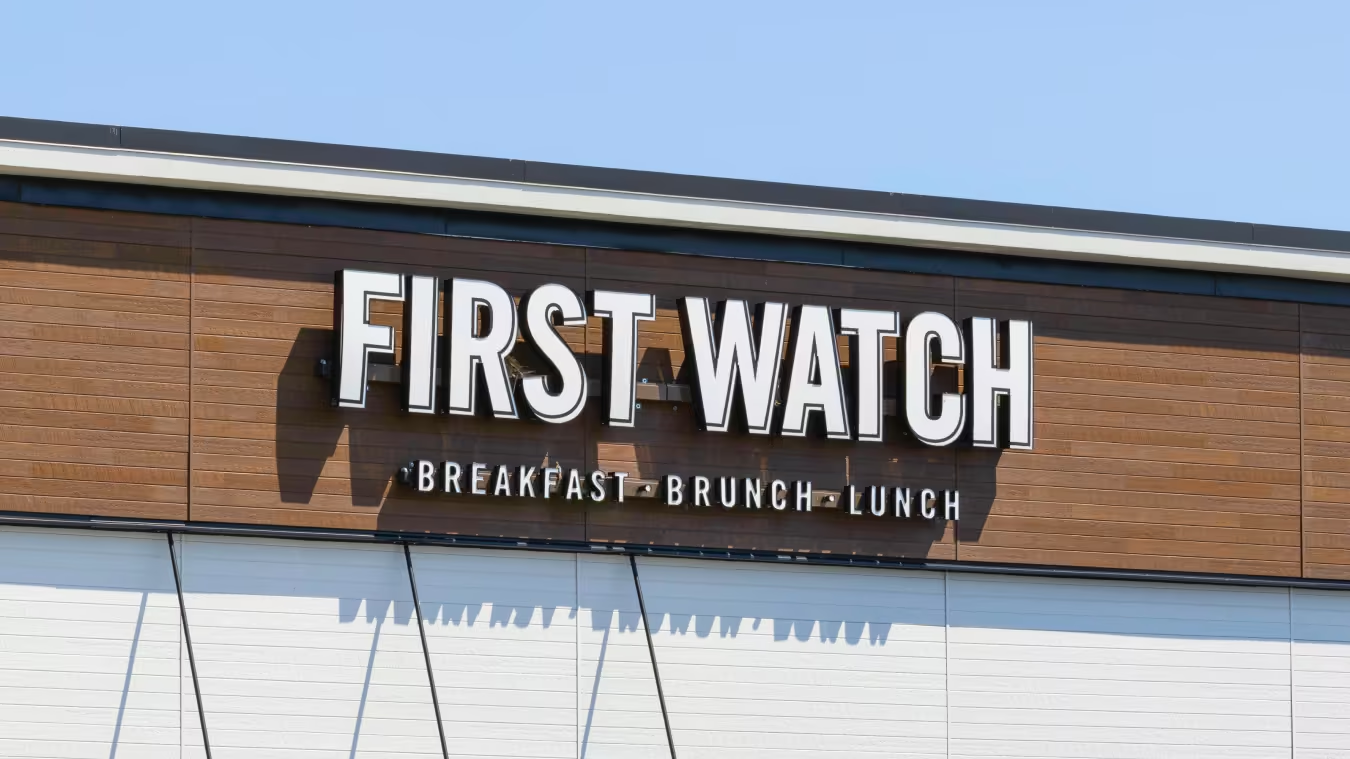
The U.S. restaurant industry navigated a challenging first quarter in 2026, marked by macroeconomic headwinds, unfavorable weather, and cautious consumer spending. Yet, within the breakfast-first sector, a clear narrative is emerging: The era of the traditional legacy diner is fading, making way for premium, experience-driven concepts. And at the forefront of this shift is First Watch. Armed with a differentiated culinary menu, rapid but disciplined expansion, and a highly resilient consumer base, the brand is not only defying broader casual dining trends but is fundamentally rewriting the playbook for daytime dining.

The Breakfast Divide: How Premium Concepts Are Outpacing Legacy Diners

Over the past few years, the breakfast-first restaurant category has bifurcated into two distinct camps: premium and experience-driven concepts capturing visit share, and legacy diner-style chains, many of which are struggling to keep up. While Q1 2026 proved to be a tighter traffic environment overall amid macroeconomic uncertainty and unfavorable weather conditions across the U.S., several experience-focused brands and resilient fan-favorites continued growing their footprints – and their audiences. 

First Watch led the pack in overall visit growth as it continued expanding its store count, while average visits per location held steady – demonstrating its ability to scale without diluting demand at existing locations – while Snooze saw a 1.1% increase in visits per location.

Conversely, the steepest laggards in the segment were legacy diner chains IHOP, Denny’s, and Huddle House, all of which saw overall visits decline as they continued rightsizing their footprints, with visits per location also modestly down. These brands are increasingly tracking closer to casual dining peers like Applebee’s and Outback Steakhouse, which have faced significant headwinds in recent months.

Still, among legacy diners, Waffle House stood out as a clear outperformer in Q1 2026, likely due in part to its status as a regional institution across much of the South. And the chain’s operational resilience may have also played a role: While Winter Storm Fern pushed the so-called “Waffle House Index” into the red across much of the region in late January, the brand’s unique disaster-readiness appears to have enabled some locations to reopen quickly or avoid closure entirely.

Ultimately, despite a challenging macroeconomic environment, brands that leverage a differentiated culinary menu, high-touch customer service, or fierce brand loyalty are successfully navigating the highly fragmented daypart much better than their traditional diner counterparts. 

Sustained Momentum: The Power of First Watch’s Unit Growth and Model Portability

While several premium concepts have successfully carved out a lucrative niche in breakfast-first dining, First Watch has redefined the category. By blending the elevated, chef-driven culinary experience of a localized brunch spot with the operational efficiency of a national powerhouse, First Watch has created a model that sees success across multiple regions of the U.S. This unique positioning provides the brand with a massive structural advantage, fueling a physical growth trajectory that far outpaces its competitors.

Importantly, visitation data also reinforces that First Watch’s restaurant classes from 2024 and 2025 have consistently kept pace with the maturity curve of recent openings. An analysis of visit-per-location trends for First Watch locations opened in 2024 and 2025 versus the chain’s nationwide fleet reveals that the class of 2024 outpaced nationwide trends, while the 2025 cohort – even when factoring in the high volume of openings that took place in Q3 2025 – has also kept pace. These are incredibly positive indicators for a brand rapidly scaling its national footprint.

First Watch has set a long-term goal of reaching more than 2,200 restaurants across the United States – an ambitious target that would more than triple its current size. Reaching this milestone is achievable, but it will require the brand to meaningfully deepen its penetration in large coastal and Sun Belt metros, where it remains under-penetrated relative to its proven suburban strongholds. Placer.ai foot traffic data across more than 100 Core Based Statistical Areas (CBSAs) reveals that First Watch's unit economics are remarkably consistent, confirming the model works across multiple geographies. While newer markets like New York, Chicago, Boston, and Las Vegas currently generate lower visits per capita than the chain's core Sun Belt and Midwest suburban markets, there are significant opportunities for expansion. First Watch's breakfast-first model, strong unit-level economics, and growing brand recognition give it a credible platform to aggressively capture market share in these new territories.

Looking Ahead: Redefining Leadership in Daytime Dining

Despite slowing early-spring trends, First Watch remains well-positioned to hit its 2026 same-store sales growth target of 1% to 3%. This confidence is rooted in a few key factors. First, the brand benefits from a resilient core consumer who is materially less sensitive to macroeconomic pressures than the traditional diner customer, providing a much higher floor for baseline traffic. Second, First Watch leverages reliable pricing power, as its premium positioning and highly anticipated seasonal menu rotations consistently drive check growth. Finally, the company's commitment to operational excellence through its company-owned model ensures that execution remains strong and the guest experience is uncompromised, even during slower traffic periods. By driving outsized performance from its newest units and maintaining a highly loyal customer base, the brand is not merely surviving the breakfast category's headwinds; it is actively redefining what leadership in daytime dining looks like.

For more data-driven dining insights, follow Placer.ai/anchor.

Placer.ai leverages a panel of tens of millions of devices and utilizes machine learning to make estimations for visits to locations across the US. The data is trusted by thousands of industry leaders who leverage Placer.ai for insights into foot traffic, demographic breakdowns, retail sale predictions, migration trends, site selection, and more.

Article
Diverging Paths: What the Data Reveals About CAVA and Sweetgreen
R.J. Hottovy
May 4, 2026
3 minutes

CAVA Building Momentum in the Premium Fast-Casual Space

The fast-casual sector has long been defined by its sweet spot within the restaurant industry, combining the convenience of fast food and the quality of casual dining. For years, CAVA and sweetgreen have stood as the standard-bearers of the health-forward movement, expanding their store footprint while building fiercely loyal followings among affluent consumers. However, Q1 2026 foot traffic data suggests that these two brands are now on diverging trajectories. While overall visits to both chains grew – thanks in part to ongoing expansions – CAVA saw its average visits per venue grow as well, while sweetgreen's per-location traffic remained flat YoY. 

Same-Store Visit Trends Diverge 

The contrast between same-store visit trends is even more striking. Over the past six months, same-store visits to CAVA have been uniformly positive – and 2026 traffic was particularly strong. Meanwhile, sweetgreen has seen consistently negative same-store visit declines, with March 2026 same-store visits down 7.6% compared to CAVA's 6.8% increase. This represents a meaningful spread between two brands competing for the same premium consumer.

CAVA’s Menu Strategy Expands Appeal and Strengthens Value Perception

This divergence is the result of structural differences in menu mix and value perception. Over the past six months, CAVA has rolled out strategic menu enhancements designed to reengage with middle-income consumers who may have turned away from fast-casual options in recent months and elevate its overall value perception. 

Leaning heavily into its warm, protein-forward architecture, the brand has introduced additions like premium glazed salmon as a protein option alongside new variations of its highly successful spicy chicken and steak offering. Alongside these protein upgrades, CAVA has refreshed its seasonal roasted vegetable lineups and also introduced smaller items like harissa pita chips, sides, and dips. This ensures that the menu remains dynamic enough to drive incremental visits and avoid customer fatigue while maintaining the highly customizable, assembly-line efficiency that protects its strong unit economics. The diversity of CAVA’s menu – both in terms of innovation and pricing – have helped to drive down the chain’s captured trade area median household income the past four quarters, according to data from STI: Popstats combined with Placer data.

Sweetgreen Expands into New Formats to Strengthen Value Perception

To close this widening gap, Sweetgreen has also planned several menu changes in 2026 focused on operational simplicity, value perception, and a major new category expansion. The brand kicked off the year by highlighting its health-forward roots through a limited-time menu collaboration with Dr. Mark Hyman that utilized existing ingredients, followed by the launch of the seasonal Winter Harvest Bowl and the highly requested return of shredded cheese to the core menu. However, the most significant news is Sweetgreen's planned mid-2026 rollout of wraps. 

Currently undergoing rigorous stage-gate testing in Los Angeles, the Midwest, and Manhattan, the wrap platform – featuring accessible price points starting at $10.95 and capping below $15 for in-store pickup – is designed to aggressively target consumer value sensitivity. Management noted that wraps are intended to build upon their 2025 efforts (which included increased protein portions and $12 Daily Greens) to prove to budget-conscious, quality-driven diners that Sweetgreen can deliver a compelling, high-value meal without compromising its premium brand identity.

An Inflection Point in the Premium Fast-Casual Landscape

Ultimately, the Q1 2026 data serves as a critical inflection point. CAVA is actively gaining share in a contracting category by mastering geographic diversification, daypart breadth, and perceived value. Sweetgreen has the brand identity, the affluent customer base, and the regional runway to recover, but the strategic decisions made over the next 12 to 18 months will dictate whether this current slump is a temporary setback or a permanent competitive reality.

For more data-driven dining insight, visit placer.ai/anchor 

Placer.ai leverages a panel of tens of millions of devices and utilizes machine learning to make estimations for visits to locations across the US. The data is trusted by thousands of industry leaders who leverage Placer.ai for insights into foot traffic, demographic breakdowns, retail sale predictions, migration trends, site selection, and more.

Guest Contributor
Inside New Orleans’ Event-Driven Economy 
Jeremy Cooker
May 1, 2026
4 minutes

Events are foundational to New Orleans’ identity and economic model. From the Sugar Bowl to Jazz Fest and Mardi Gras, to conferences, conventions, exhibitions and meetings of all sizes, the city operates on a year-round cycle of large-scale gatherings that drive consistent visitor inflows. Over the past 12 months, 64.6% of weekend visitors to New Orleans’ downtown, including the French Quarter, Central Business District (CBD), and Arts District, were domestic tourists coming from more than 250 miles away. And as travel behavior continues to evolve post-COVID – making it more difficult to predict attendance patterns from prior-year trends – the complexity of hosting at scale requires increasingly sophisticated, data-driven operational coordination.

Mardi Gras’ Growing, Regional Pull 

Perhaps no event demonstrates this model – and this need – more clearly than Mardi Gras. Running from January 6th through Mardi Gras Day, the carnival season culminates in a surge of parades and celebrations that bring major crowds downtown (French Quarter, CBD, Arts District) and all along the uptown parade route. 

Crucially, many of those visitors come from within Louisiana, making the festival a powerful vehicle for strengthening ties between the city and surrounding communities: During the final 12 days of Mardi Gras 2026, 54.2% of them came from within Louisiana, compared to 23.5% during the rest of the year.  

And despite an uncertain macroeconomic environment, Mardi Gras’ audience continues to expand. From the Krewe of Cleopatra on February 6 through Mardi Gras Day on February 17, out-of-market visits to downtown New Orleans (French Quarter, CBD, Arts District) increased 10% year over year, reaching their highest level since 2020. 

Something for Everyone 

Data also shows that Mardi Gras draws a surprisingly diverse audience. To be sure, young revelers are a big part of the story – on Mardi Gras Day, the French Quarter sees an influx of “Contemporary Households”, a young-skewing segment that includes singles, couples without children, and non-family households. The median household income of the Quarter’s trade area also declines on the big day, as students and early-career professionals crowd into the neighborhood to party. 

But some of the season's more family-friendly parades – like the Krewe of Bacchus which took place this year on Sunday, February 15th – have a decidedly different vibe.  

On the day of the parade, families gather early along St. Charles Avenue, setting up tents and picnic tables and sharing traditional local food ahead of the evening procession. And surrounding neighborhoods such as the Garden District experience a measurable rise in affluent family segments and median household income, highlighting Mardi Gras’ broad and diverse appeal. 

Data as Essential Infrastructure 

Of course, managing an event of this magnitude requires coordination across agencies, stakeholders, and neighborhoods. And in a post-pandemic environment where past attendance patterns cannot always serve as reliable benchmarks, data has become a critical tool for decision-making. 

Audience insights now play a central role in operational planning – identifying where visitors congregate, estimating crowd volumes, and informing preparation by law enforcement, city officials, and other city stakeholders. When large gatherings are anticipated in specific corridors or blocks, recent visitation trends provide actionable context that helps partners allocate resources efficiently and prepare accordingly. 

A Blueprint for Hosting at Scale 

Few cities are as synonymous with celebration as New Orleans. And by combining tradition, diversity, and data-driven operational precision, the city has built the capacity to host complex, high-volume gatherings with consistency and coordination year after year. 

Article
GLP-1 Drugs and the Rise of the Health-Conscious Shopper
Lila Margalit
Apr 30, 2026
4 minutes

With roughly one in eight Americans now using GLP-1 medications for weight loss, their rapid adoption is shaping up to be one of the most consequential behavioral shifts in recent memory – with wide-ranging implications for businesses tied to how people spend their time and money. 

We analyzed the data to understand how GLP-1 usage may be influencing real-world retail and dining foot traffic. How is grocery store visitation changing? What’s happening in limited-service dining? And which other categories are gaining from a heightened focus on health and wellness – further accelerating trends that began to take hold after the pandemic?

Groceries Get a Health Makeover

Research from Cornell University shows that GLP-1 users reduce household grocery spending by an average of 5.3% within six months of starting a medication, with the most significant pullbacks concentrated in calorie-dense, processed categories. At the same time, a handful of health-oriented foods – including yogurt, fresh fruit, nutrition bars, and meat snacks – are seeing increased spend. 

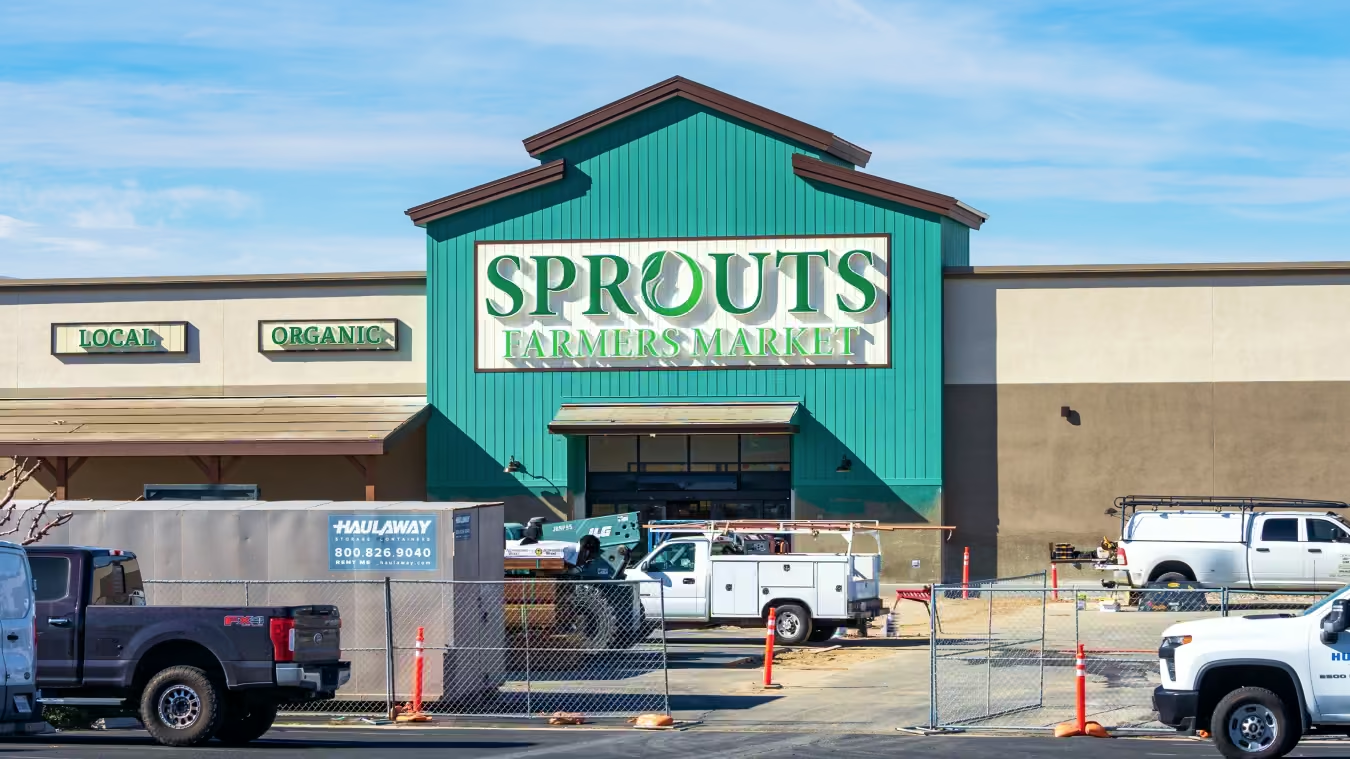
And foot traffic data points to a parallel shift in where consumers are shopping, with a growing share of grocery visits flowing toward fresh-format stores like Trader Joe’s and Sprouts Farmers Market that emphasize high-quality perishables, curated health-oriented assortments, and an elevated in-store experience. While this pivot has been underway for several years, reflecting a broader post-pandemic focus on health and wellness, its recent acceleration coincides with the rise in GLP-1 use.

From Q1 2022 to Q1 2026, these chains steadily expanded their share of overall grocery foot traffic, with momentum accelerating beginning in Q1 2024, even as some experienced per-store softness amid a challenging consumer environment. Over the same period, the median household income within fresh-format chains’ captured markets, which had remained largely stable through early 2024, began to decline. This trend suggests a broadening customer base, as households across income brackets increasingly prioritize higher-quality food and allocate a larger share of their grocery trips to fresh formats.

Dining Traffic Realigns Around Health

The reallocation of spending also extends beyond the grocery aisle. Foot traffic data points to a meaningful reordering of food-away-from-home visits over the past three years, with healthier dining segments outperforming more indulgent ones – underscoring a broader shift toward more nutritious options that GLP-1 adoption may be helping to reinforce.

Frozen yogurt chains outpaced ice cream shops in year-over-year visit growth in both 2024 and 2025, as consumers gravitated toward lighter frozen treats. Smoothie and juice chains also captured growing demand, buoyed by expanding footprints from brands like Tropical Smoothie Cafe, Smoothie King, and Playa Bowls, while fast-casual similarly pulled ahead of QSR. 

Gym Visits Are Getting More Frequent

Fitness participation has been on the rise since the pandemic, and the data suggests gym habits are becoming more consistent over time – a trend that GLP-1 users, who often incorporate structured exercise into their routines, may be helping to reinforce.

Between Q1 2023 and Q1 2026, the share of visitors to leading gyms stopping by at least three times in an average month rose from 44.8% to 46.8%, while the share visiting at least four times rose from 37.3% to 39.1%. For a growing segment of the population, going to the gym has become a regular part of the weekly routine – with implications for fitness brands and the broader ecosystem of health-oriented businesses competing for this newly routine-driven consumer.

Apparel Pulls Away From Discretionary Retail

As consumers deepen their focus on health and fitness, the body transformations associated with GLP-1 use are also reshaping apparel demand. Alongside a growing need for wardrobe replenishment, GLP-1 users are investing more in their appearance and rediscovering the experience of shopping for clothes.

And this trend aligns with recent foot traffic data. Even as discretionary spending continues to face headwinds in a challenging macroeconomic environment, clothing retailers are seeing consistent year-over-year visit growth, driven in large part by the off-price sector – with each year outpacing the broader discretionary retail category by a widening margin. Apparel is pulling away from the pack, likely driven in part by a consumer whose relationship with their body – and with shopping – has fundamentally changed.

A Behavioral Shift Worth Watching

The GLP-1 era is still in its early stages – but as programs like Amazon’s new GLP-1 management program expand access, these drugs are likely to continue reshaping shopping behavior in the months and years ahead. The data points to a consumer who is eating differently, moving more, and spending in ways that reflect a new set of priorities, further amplifying the focus on health and wellness that has emerged over the past several years.

For more data-driven retail and dining insights, visit Placer.ai/anchor

Article
Sprouts Same-Store Visits Slow in Q1 2026 Amid Tough Comparisons and Softening Consumer Demand
Lila Margalit
Apr 29, 2026
2 minutes

Lapping a Strong Q1 2025

Sprouts Farmers Market entered 2026 expecting a challenging quarter – and Q1 foot traffic trends bore that out. Against a Q1 2025 comparison where comps surged 11.7% year over year (YoY), the company guided Q1 2026 comparable sales to decline between -3.0% and -1.0%, citing both the tough lap and continued pressure on grocery shoppers from elevated food prices. And same-store visits also dropped, falling between -3.0% and -6.0% YoY in Q1.

Still, overall foot traffic rose 1.8%, supported by the 37 stores opened in fiscal 2025 and additional locations added in early 2026, which helped offset softness at existing stores.

The Road Ahead

Against this backdrop, Sprouts is making several forward-looking investments that could support a traffic recovery later this year. Continued expansion, a new loyalty program launched in 2025, and ongoing merchandising innovation – alongside its transition to self-distribution for fresh meat – all position the company to compete on both quality and value as macro conditions evolve.

Will Sprouts return to same-store visit growth in Q2? 

Visit Placer.ai/anchor to find out.

Placer.ai leverages a panel of tens of millions of devices and utilizes machine learning to make estimations for visits to locations across the US. The data is trusted by thousands of industry leaders who leverage Placer.ai for insights into foot traffic, demographic breakdowns, retail sale predictions, migration trends, site selection, and more.

Article
Chipotle’s "Recipe for Growth" Shows Early Gains, Fueled by LTOs and Viral Marketing
Shira Petrack
Apr 28, 2026
3 minutes

Chipotle's Recipe for Growth May Already be Working 

In February 2026, Chipotle unveiled its "Recipe for Growth" plan to reverse declining sales by improving operations, boosting marketing, and refreshing its menu. And though the plan has only been in place for a couple of months, traffic data suggests that it may already be having a positive impact on foot traffic to the chain. 

After three consecutive quarters of year-over-year declines in average visits per location, Chipotle's foot traffic trends are showing signs of recovery. In Q1 2026, average visits per location were nearly flat (-0.2% YoY), while overall visits grew 5.8% – the strongest growth seen over the past year.

The Return of Chicken al Pastor Delivers Strong February Traffic 

Several branding and menu innovations likely contributed to Chipotle's traffic recovery, including the high protein menu launched in late December 2025 and partnerships with athletes and sporting events. The biggest single driver, however, appears to have been the return of Chicken al Pastor on February 10, 2026 – a fan-favorite protein that had generated more social media requests for its comeback than any other LTO in the chain's history. In the month of its launch, overall visits rose 10.1% YoY and same-store visits grew 5.1%.

Can Rotating LTOs Sustain Momentum? 

Still, the following month, overall visits were up just 3.6% and same-store visits were flat – suggesting that popular menu items can generate meaningful visit spikes, but those spikes may not automatically translate into lasting traffic bumps.

Chipotle appears to be leaning into this dynamic rather than fighting it. Starting April 28, the chain is rotating out Chicken al Pastor in favor of Honey Chicken – its best-performing LTO ever – effectively betting that a steady drumbeat of novelty and scarcity can sustain traffic where any single item cannot.

Viral Promotions Fuel Brand Relevance

Another pillar of the company's "Back to Growth" plan entailed creating "new occasions that drive demand into our restaurants" – and Chipotle seems to have accomplished just that with its successful "Tatted Like a Chipotle Bag" BOGO promotion. 

On March 13, 2026, from 3 to 4 PM local time, Chipotle offered an in-store BOGO entrée to any customer sporting a tattoo – real, temporary, or hand-drawn – a nod to the iconic tattoo-style graphics on a Chipotle bag. The one-hour activation drove a 55.3% spike in visits above the year-to-date average, with the highest daily visit count recorded since Placer.ai began tracking Chipotle's traffic in 2018. Chipotle also reported March 13th 2026 as the highest daily sales day in the chain's history. 

That a single one-hour, in-store promotion could shatter the chain's all-time sales record speaks to the power of Chipotle's brand equity and the effectiveness of leaning into what makes it culturally distinct.

The early results suggest that Chipotle's 'Recipe for Growth' is already working – Q1's traffic recovery was built on a potent mix of menu innovation, viral activations, and renewed cultural relevance. But while the chain's strategy of cycling LTOs and engineering shareable moments has clearly rekindled consumer excitement – whether this delivers consistent same-store visit growth will be the real measure of "Recipe for Growth" success. 

For more data-driven dining insights, visit placer.ai/anchor 

Reports
INSIDER
Los Angeles Office Trends in 2024
Discover the state of office recovery in the Los Angeles metro area – and explore key trends shaping the return to office in some of LA's major business districts.
July 7, 2024
6 minutes

A Return-to-Office Overview 

Return-to-office (RTO) trends have been closely watched over the past few years, with relevant stakeholders trying to puzzle out the impact remote and hybrid work have had on business operations and worker performance. And while visits to office buildings, overall, remain below pre-pandemic levels, office recovery varies from city to city – reflecting the complex and nuanced nature of regional economic trends, workforce preferences, and industry-specific needs.

This white paper harnesses location analytics to explore office recovery in the country’s second-largest economy – Los Angeles. The first part of the report is based on an analysis of foot traffic data from Placer.ai’s Los Angeles Office Index – an index comprising 100 office buildings in LA (including several in the greater metro area). The second part of the report broadens the lens to analyze visits by local employees to points of interest (POIs) corresponding to four major LA-area office districts: Century City, Downtown LA, Santa Monica, and Culver City. The white paper examines the impact that return-to-work mandates have had on visits to office buildings, discovers which demographic groups are driving the RTO, and explores the connection between commute time and return-to-office rates.

LA’s Cubicle Comeback 

Slow But Steady Wins The Race

The return to office in Los Angeles has consistently lagged behind other major cities, underperforming nationwide recovery levels since the pandemic ground in-office work to a virtual halt. Still, the city’s office buildings are seeing a steady increase in visits, with foot traffic tending to spike at the beginning of each year. This indicates that even though office visits in LA are still below national averages, they are on a steady growth trajectory – a promising sign for stakeholders in the city.

A closer examination of Los Angeles office buildings also shows that despite the overall lag, some top-performing buildings in the LA metro area are defying the odds. Visits to the 20 local office buildings with the narrowest Q2 2024 post-COVID visit gaps were down just 8.7% in June 2024 compared to January 2019 – significantly outperforming the nationwide average.

So while overall office recovery in the city is still behind nationwide trends, these top-performing buildings indicate an optimistic outlook for the city’s office spaces.

From Zooms To Office Rooms

Diving into the demographics of visitors to LA’s top-performing office buildings reveals an important insight: these buildings are attracting younger workers. This cohort has shown a stronger preference for in-person work compared to their older colleagues.

Analyzing the buildings’ captured markets with psychographics from AGS: Panorama reveals that these buildings are attracting visitors from areas with larger shares of "Emerging Leaders" and "Young Coastal Technocrats" than the broader metro area.

"Emerging Leaders'' – upper-middle-class professionals in early stages of their careers – make up 20.3% of households in the trade areas feeding visits to these top-performing buildings, compared to 14.9% in the broader LA CBSA. Similarly, "Young Coastal Technocrats," young and highly educated professionals in tech and professional services, account for 14.7% of households driving visits to the top-performing buildings, compared to only 12.1% in the broader area.

The trend suggests that companies in these high-performing office buildings employ many early-career professionals eager to accelerate their careers and work in-person with colleagues and mentors. This is a positive sign for the future of the office market in the LA metro area, indicating that it is attractive to key demographic groups that are likely to drive future growth and innovation.

Mandates in Action

Over the past few years, the debate regarding return-to-office mandates has been a heated one. Will employees follow return-to-office requirements? Can companies enforce the return to office after offering remote and hybrid work options? Recent location analytics data suggests that, at least in the Los Angeles metro area, some return-to-office mandates have been effective. 

Three major tech companies – Activision Blizzard, TikTok, and SNAP Inc. – recently made their return-to-office policies stricter. Activision mandated a full return to the office in January 2024. TikTok has also intensified its return-to-office policy while seeking to expand its office presence in the greater Los Angeles area. And SNAP Inc. required employees to return to the office earlier this year as a condition of continued employment. 

Visitation patterns at each of these companies' respective headquarters suggest that their policies have directly impacted visit frequency. Since the beginning of the year, the share of repeat office visits (defined as two or more visits per week) has increased for all three locations. Activision saw its share of repeat office visits grow from 52.1% in H1 2023 to 61.4% in the same period of 2024. TikTok’s repeat visits grew from 49.5% to 61.0%, and SNAP’s repeat visits increased from 36.6% to 42.8%.

These numbers highlight how return-to-office policies can lead to noticeable changes in office visit patterns and offer a blueprint to other businesses looking to foster a stronger in-office workforce.

A Regional Office Revival 

Business Districts Bounce Back

Los Angeles is the second-largest metro area in the country, with several distinct business districts across its sprawling landscape. And a closer look at four major office hubs in the greater LA area – Century City, Downtown LA, Santa Monica, and Culver City – highlights how the office recovery can vary, not just by city or demographic, but on a neighborhood level. 

Weekday visits by local employees to all four analyzed business districts have rebounded significantly since 2020 – though each area has followed its own particular trajectory.

Culver City, home to major businesses including Sony Pictures and Disney Digital Network, saw the least pronounced drop in employee visits during the early days of the pandemic. And in Q2 2024, weekday visits by local workers were down just 18.4% compared to Q1 2019.

Century City, on the other hand, saw the most marked drop in local employee foot traffic as the pandemic set in. But the district’s recovery trajectory has also been the most dramatic – with a Q2 2024 visit gap of just 28.5%, smaller than Downtown LA’s 29.7% visit gap. Perhaps capitalizing on this momentum, Century City is expanding its business district with the addition of a major new office building, set to be completed in 2026 and serve as the headquarters for Creative Artists Agency. Santa Monica, for its part, finished off Q2 2024 with a 23.3% visit gap. 

Commuter Chronicles in Century City

Century City stands out within the Los Angeles metropolitan area for its dramatic decline and subsequent resurgence in local employee foot traffic. And looking at another metric of office recovery – employee commute distance – further underscores the district’s remarkable comeback.

The share of employees commuting to Century City from three to seven miles away has nearly returned to pre-COVID levels – suggesting a normalization of commuting patterns by local workers living in the area. In H1 2019, 33.5% of workers in Century City commuted between 3 and 7 miles to work; in 2022, that number had dropped to 29.8%. But by 2024, the share of visitors making that commute had grown to 32.5% – much closer to pre-COVID numbers. 

Similarly, the region’s trade area size, which had contracted significantly in the wake of the pandemic, bounced back significantly in 2024. This serves as another indication of Century City’s rebound, cementing Century City’s status as a key business hub within the Los Angeles metropolitan area.

Back In Business

Five years after the upheaval caused by the pandemic, office spaces are still changing. Although the Los Angeles area has taken longer to recover than other major cities, analyzing local visitation data shows significant potential for the city’s business areas. With young employees leading the return-to-office charge, the city is poised to keep driving its strong economy and adjust to an evolving office environment. 

INSIDER
Advantages of New Players in the Retail Media Space
Discover the unique brick-and-mortar advertising potential of Costco's and Wawa's new retail media networks - and how advertisers can best leverage this opportunity.
June 27, 2024

Retail Media: The Wave of the Present

Retail media networks (RMNs) have cemented their roles as the future – and present – of advertising. These networks enable advertisers to promote products and services through a retailer’s online properties and physical stores, when consumers are close to the point-of-purchase and primed to buy.  

Today, we take a closer look at two newcomers to the retail media space: Costco Wholesale and Wawa. Both chains have an online presence – but both also excel at in-store experiences, offering unique opportunities for consumer engagement and exposure to new products.

This white paper dives into the data to explore some of the key advantages Costco and Wawa bring to the retail media table –  and examine how the retailers’ physical reach can best be leveraged to help advertising partners find new audiences. 

The Costco and Wawa Brick-and-Mortar Opportunity

Wawa and Costco, the latest additions to the growing number of companies with retail media networks, exhibit significant advertising potential. Both brands boast a wide reach and diverse customer base, and both have access to troves of customer data through membership and loyalty programs. 

Foot traffic data confirms the robust offline positioning of the two retailers. In Q1 2024, year-over-year (YoY) visits to Costco and Wawa increased 9.5% and 7.5% respectively – showing that their in-store engagement is on a growth trajectory. 

And since consumers tend to spend a lot more time in-store than they do on retailers’ websites, Costco’s and Wawa’s strong brick-and-mortar growth positions them especially well to help advertisers reach new customers. In Q1 2024, the average visits to Costco’s and Wawa’s physical stores lasted 37.4 and 11.4 minutes respectively – compared to just 6.7 and 4.6 minutes for the chains’ websites. These longer in-store dwell times can be harnessed to maximize ad exposure and offer partners more extended opportunities for meaningful interactions with customers. Partners can also analyze the behavior and preferences of the two chains’ growing visitor bases to craft targeted online campaigns.  

Costco Enters the Wholesale Club RMN Space

RMN Potential Nationwide 

Costco’s retail media network will tap into the on- and offline shopping habits of its staggering 74.5 million members to inform targeted advertising by partners. And the retailer’s tremendous reach offers a significant opportunity to engage customers in-store. 

But while Costco is dominant in some areas of the country, other markets are led by competitors like Sam’s Club and BJ’s Wholesale Club. And advertisers looking to choose between competing RMNs or hone in on the areas where Costco is strongest can analyze Costco's performance and visit share – on a local or national level – to determine where to focus their efforts.

An analysis of the share of visits to wholesalers across the country reveals that Costco is the dominant wholesale membership club in much of the Western United States. But Costco also captures the largest share of wholesale club visits in many other major population centers, including important markets like New York, Chicago, Phoenix, and San Antonio. Costco’s widespread brick-and-mortar dominance offers prospective advertising partners a significant opportunity to connect with regional audiences in a wide array of key markets.  

Longer, More Frequent Visits

Another one of Costco’s key advantages as a retail media provider lies in its highly loyal and engaged audience. In May 2024, a whopping 41.4% of Costco’s visitors frequented the club at least twice during the month – compared to 36.6% for Sam’s Club and 36.0% for BJ’s Wholesale. 

Moreover, Costco led in average visit duration compared to its competitors. In May 2024, customers spent an average of 37.1 minutes at Costco – surpassing even the impressive dwell times at Sam’s Club and BJ’s Wholesale Club.

YoY visits per location to Costco, too, were the highest of the analyzed wholesalers, all three of which saw YoY increases. These metrics further establish the wholesaler’s position as an effective retail media provider. 

Unique Audience Preferences and Characteristics 

Even when foot traffic doesn't show a brand’s clear regional dominance, location analytics can reveal other metrics that signal its unique potential. Take the Richmond-Petersburg, VA, designated market area (DMA), for example. In May 2024, BJ’s Wholesale Club led the DMA with 41.2% of wholesale club visits, while Costco was a close second with 37.3% of visits.

But despite BJ’s lead in visit share, Costco's Richmond audience was more affluent. Costco's visitors came from trade areas with a median household income (HHI) of $93.2K/year, compared to $73.1K/year for Sam’s Club and $89.5K/year for BJ’s. Additionally, Costco drew a higher share of weekday visits than its counterparts. 

Analyzing shopper habits and preferences across chains on a local level can provide crucial context for strategists working on media campaigns. Advertisers can partner with the brands most likely to attract consumers interested in their offerings, and identify where – and when – to focus their advertising efforts. 

Wawa Debuts Retail Media

Convenience stores, or c-stores, are emerging as destinations in and of themselves – and their rising popularity among a wider-than-ever swath of consumers opens up significant opportunities in the retail advertising space. 

A C-Store RMN Advantage

Wawa is a relative newcomer to the world of retail media, after other c-stores like 7-Eleven and Casey’s launched their networks in 2022 and 2023. But despite coming a bit late to the party, the potential for Wawa’s Goose Media Network is significant – thanks to a cadre of highly loyal visitors who enjoy the physical shopping experience the c-store chain offers.

In May 2024, Wawa’s share of loyal visitors (defined as those who visited the chain at least twice in a month) was 60.1%. In contrast, other leading c-store chains operating in Wawa’s market area – QuickTrip and 7-Eleven, for example – saw loyalty rates of 56.0% and 47.9%, respectively, for the same period. 

Additionally, Wawa visitors browsed the aisles longer than those at other convenience retailers. In May 2024, 39.9% of Wawa visitors stayed in-store for 10 minutes or longer, compared to 29.6% at QuickTrip and 25.7% at 7-Eleven.

Wawa's loyal customer base and longer visit durations make it a strong contender in the retail media space. By harnessing this high level of customer engagement, Wawa can draw in advertisers and develop targeted marketing strategies that resonate with its dedicated shoppers.

Doubling Down on Miami

Wawa has been on an expansion roll over the past few years, with plans to open at least 280 stores over the next decade in North Carolina, Tennessee, Georgia, Alabama, Ohio, Indiana, and Kentucky. The chain has also been steadily increasing its footprint in Florida – between January 2019 and April 2024, Wawa grew from 167 Sunshine State locations to 280, with more to come.

And analyzing changes in Wawa’s visit share in one of Florida’s biggest markets – the Miami-Ft. Lauderdale DMA – shows how successful the chain’s local expansion has been. Between January 2019 and April 2024, Wawa more than doubled its category-wide visit share in the Miami area (i.e. the portion of total c-store visits in the DMA going to Wawa) – from 19.0% to nearly 40.0%. 

A Growing and Evolving Audience

A look at changes in Wawa’s Miami-Ft. Lauderdale trade area shows that the chain’s growing visit share has been driven by an expanding market and an increasingly diverse audience. 

In April 2019, there were some 55 zip code tabulation areas (ZCTAs) in the Miami-Ft. Lauderdale DMA from which Wawa drew at least 3,000 visits per month. By April 2021, this figure grew to 96 – and by April 2024, it reached 129. 

Over the same period, the share of “Family Union” households in Wawa’s local captured market – defined by the Experian: Mosaic dataset as families comprised of middle-income, blue collar workers – nearly doubled, growing from 7.4% in April 2019 to 14.4% in April 2024.  

Final Thoughts

Retail media networks that make it easier to introduce shoppers to products and brands that are closely aligned with their preferences and habits offer a win-win-win for retailers, advertisers, and consumers alike. And Costco and Wawa are extremely well-positioned to make the most of this opportunity. 

INSIDER
Brewing Success: Winning Strategies for Coffee Chains
Dive into the data to explore foot traffic trends in the coffee space – and uncover factors driving visits to Starbucks, Dunkin’, and other leading chains.
June 20, 2024

Coffee on the Rise

Everybody loves coffee. And with some 75% of American adults indulging in a cup of joe at least once a week, it’s no wonder the industry is constantly on an upswing.

In early 2024, year-over-year (YoY) visits to coffee chains increased nationwide – with every state in the continental U.S. experiencing year-over-year (YoY) coffee visit growth.

The most substantial foot traffic boosts were seen in smaller markets like Oklahoma (19.4%), Wyoming (19.3%), and Arkansas (16.9%), where expansions may have a more substantial impact on statewide industry growth. But the nation’s largest coffee markets, including Texas (10.9%), California (4.2%), Florida (4.2%), and New York (3.5%), also experienced significant YoY upticks. 

Expanding to Meet Growing Demand

The nation’s coffee visit growth is being fueled, in large part, by chain expansions: Major coffee players are leaning into growing demand by steadily increasing their footprints. And a look at per-location foot traffic trends shows that by and large, they are doing so without significantly diluting visitation to existing stores. 

On an industry-wide level, visits to coffee chains increased 5.1% YoY during the first five months of 2024. And over the same period, the average number of visits to each individual coffee location declined just slightly by 0.6% – meaning that individual stores drew just about the same amount of foot traffic as they did in 2023. 

Drilling down into chain-level data shows some variation between brands. Dutch Bros., BIGGBY COFFEE and Dunkin’ all saw significant chain-wide visit boosts, accompanied by minor increases in their average number of visits per location. 

Starbucks, for its part, which reported a YoY decline in U.S. sales for Q2 2024, maintained a small lag in visits per location. But given the coffee leader’s massive footprint – some 16,600 stores nationwide – its ability to expand while avoiding more significant dilution of individual store performance shows that Starbucks’ growth is meeting robust demand. 

What is driving the coffee industry’s remarkable category-wide growth? And who are the customers behind it? This white paper dives into the data to explore key factors driving foot traffic to leading coffee chains in early 2024. The report explores the demographic and psychographic characteristics of visitors to major players in the coffee space and examines strategies brands can use to make the most of the opportunity presented by a thriving industry.

Starbucks Visits Fueled by RTO

One factor shaping the surge in coffee visit growth is the slow-but-sure return-to-office (RTO). Hybrid work may be the post-COVID new normal – but RTO mandates and WFH fatigue have led to steady increases in office foot traffic over the past year. And in some major hubs – including New York and Miami – office visits are back to more than 80.0% of what they were pre-pandemic.

A look at shifting Starbucks visitation patterns shows that customer journeys and behavior increasingly reflect those of office-goers. In April and May 2022, for example, 18.6% of Starbucks visitors proceeded to their workplace immediately following their coffee stop – but by 2024, this share shot up to 21.0%. 

Over the same period, the percentage of early morning (7:00 to 10:00 AM) Starbucks visits lasting less than 10 minutes also increased significantly – from 64.3% in 2022 to 68.7% in 2024. More customers are picking up their coffee on the go – many of them on the way to work – rather than settling down to enjoy it on-site.

Short Visits Driving Success at Dunkin’

Dunkin’ is another chain that is benefiting from consumers on the go. Examining the coffee giant’s performance across major regional markets – those where the chain maintains a significant presence – reveals a strong correlation between the share of Dunkin’ visits in each state lasting less than five minutes and the chain’s local YoY trajectory. 

In Wisconsin, for example, 50.9% of visits to Dunkin’ between January and May 2024 lasted less than five minutes. And Wisconsin also saw the most impressive YoY visit growth (5.9%). Illinois, Ohio, Maine, and Connecticut followed similar patterns, with high shares of very short visits and strong YoY showings. 

On the other end of the spectrum lay Tennessee, Alabama, and Florida, where very short visits accounted for a low share of the chain’s statewide total – under 40.% – and where visits declined YoY. 

Dunkin’s success with very short visits may be driven in part by its popular app, which makes it easy for harried customers to place their order online and save time in-store. And this is good news indeed for the coffee leader – since customers using the app also tend to generate bigger tickets. 

Dutch Bros. Appealing to Singles

Dutch Bros.’ meteoric rise has been fueled, in part, by its appeal to younger audiences. Recently ranked as Gen Z’s favorite quick-service restaurant, the rapidly-expanding coffee chain sets itself apart with a strong brand identity built on cultivating a positive, friendly customer experience. 

And Dutch Bros.’ people-centered approach is resonating especially well with singles – including young adults living alone – who may particularly appreciate the chain’s community atmosphere.

Analyzing the relative performance of Dutch Bros.’ locations across metro areas – focusing on regions where the chain has a strong local presence – shows that it performs best in areas with plenty of singles. Indeed, the share of one-person households in Dutch Bros.’ local captured markets is very strongly correlated with the coffee brand’s CBSA-level YoY per-location visit performance. Areas with higher concentrations of one-person households saw significantly more YoY visit growth in the first part of 2024.  (A chain’s captured market is obtained by weighting each Census Block Group (CBG) in its trade area according to the CBG’s share of visits to the chain – and so reflects the population that actually visits the chain in practice). 

The share of one-person households in Dutch Bros.’ Tucson, AZ captured market, for example, stands at 33.4% – well above the nationwide baseline of 27.5%. And between January and May 2024, Tucson-area Dutch Bros. saw a 6.0% increase in the average number of visits per location. Tulsa, OK, Medford, OR, and Oklahoma City, OK – which also feature high shares of one-person households (over 30.0%) – similarly saw per-location visit increases ranging from 3.6% - 7.0%. On the flip side, Fresno, CA, Las Vegas-Henderson-Paradise, NV, and San Antonio-New Braunfels, TX, which feature lower-than-average shares of single-person households, saw YoY per-location visit declines ranging from 1.5%-9.5%. 

As Dutch Bros. forges ahead with its planned expansions, it may benefit from doubling down on this trends and focusing its development efforts on markets with higher-than-average shares of one-person households – such as university towns or urban areas with lots of young professionals.

BIGGBY COFFEE: Pressing the Suburban Advantage  

Michigan-based BIGGBY COFFEE is another java winner in expansion mode. With a growth strategy focused on emerging markets with less brand saturation, BIGGBY has been setting its sights on small towns and rural areas throughout the Midwest and South. Though the chain does have locations in bigger cities like Detroit and Cincinnati, some of its most significant markets are in smaller population centers.

And a look at the captured markets of BIGGBY’s 20 top-performing locations in early 2024 shows that they are significantly over-indexed for suburban consumers – both compared to BIGGBY as a whole and compared to nationwide baselines. (Top-performing locations are defined as those that experienced the greatest YoY visit growth between January and May 2024).

“Suburban Boomers”, for example – a Spatial.ai: PersonaLive segment encompassing middle-class empty-nesters living in suburbs – comprised 10.6% of BIGGBY’s top captured markets in early 2024, compared to just 6.6% for BIGGBY’s overall. (The nationwide baseline for Suburban Boomers is even lower – 4.4%.) And Upper Diverse Suburban Families – a segment made up of upper-middle-class suburbanites – accounted for 9.6% of the captured markets of BIGGBY’s 20 top locations, compared to just 7.2% for BIGGBY’s as a whole, and 8.3% nationwide. 

Coffee for Everyone

Coffee has long been one of America’s favorite beverages. And java chains that offer consumers an enjoyable, affordable way to splurge are expanding both their footprints and their audiences. By leaning into shifting work routines and catering to customers’ varying habits and preferences, major coffee players like Starbucks, Dunkin’, Dutch Bros., and BIGGBY COFFEE are continuing to thrive.

Loading results...
We couldn't find anything matching your search.
Browse one of our topic pages to help find what you're looking for.
For more in-depth analyses on a variety of subjects, explore Reports.
The Anchor Logo
INSIDER
Stay Anchored: Subscribe to Insider & Unlock more Foot Traffic Insights
Gain insider insights with our in-depth analytics crafted by industry experts
— giving you the knowledge and edge to stay ahead.
Subscribe