.png)
.png)

.png)
.png)


The beauty industry’s reign over specialty retail may be slowly coming to an end in 2025. In the post-pandemic retail economy, beauty had been an outlier as it continued to grow visitation despite declines in other discretionary categories and a general pullback in retail demand. Beauty retailers were primed for the interaction of mass and prestige beauty growth; brands at both the low and high end benefited as consumers' appetite for make up and skincare exploded.
But in 2024, consumers began to shift their focus away from beauty and back towards other discretionary categories, such as apparel and home furnishings. At the same time, we’ve also observed more caution amongst consumers surrounding all discretionary demand. Beauty tends to do well during times of economic uncertainty; items are small and generally less expensive than other discretionary purchases like shoes or accessories.
However, the category’s sustained success over the past few years may have run out, even as consumers look for value and small indulgences. Beauty executives warned of these headwinds in early 2024, and Placer’s visit trends have corroborated the softening of trends across the industry.
2024 visits to beauty and self care retail chains grew 1.5% versus the previous year, compared to 18% growth in 2023 and 17% growth in 2022. There was a true shift in momentum of this industry over the last year, and the deceleration of growth is in stark contrast to the industry’s flourishing in the immediate post-pandemic years.
When we put this into the context of broader discretionary retail, the trends in beauty counter those of apparel and home furnishings, who accelerated their rebounds throughout last year. There are a myriad of reasons for these changes in 2024, but major beauty brands have shared a drop-off in demand and waning sales, signs that point to changing consumer behavior instead of a shift in channel preference from physical to digital.
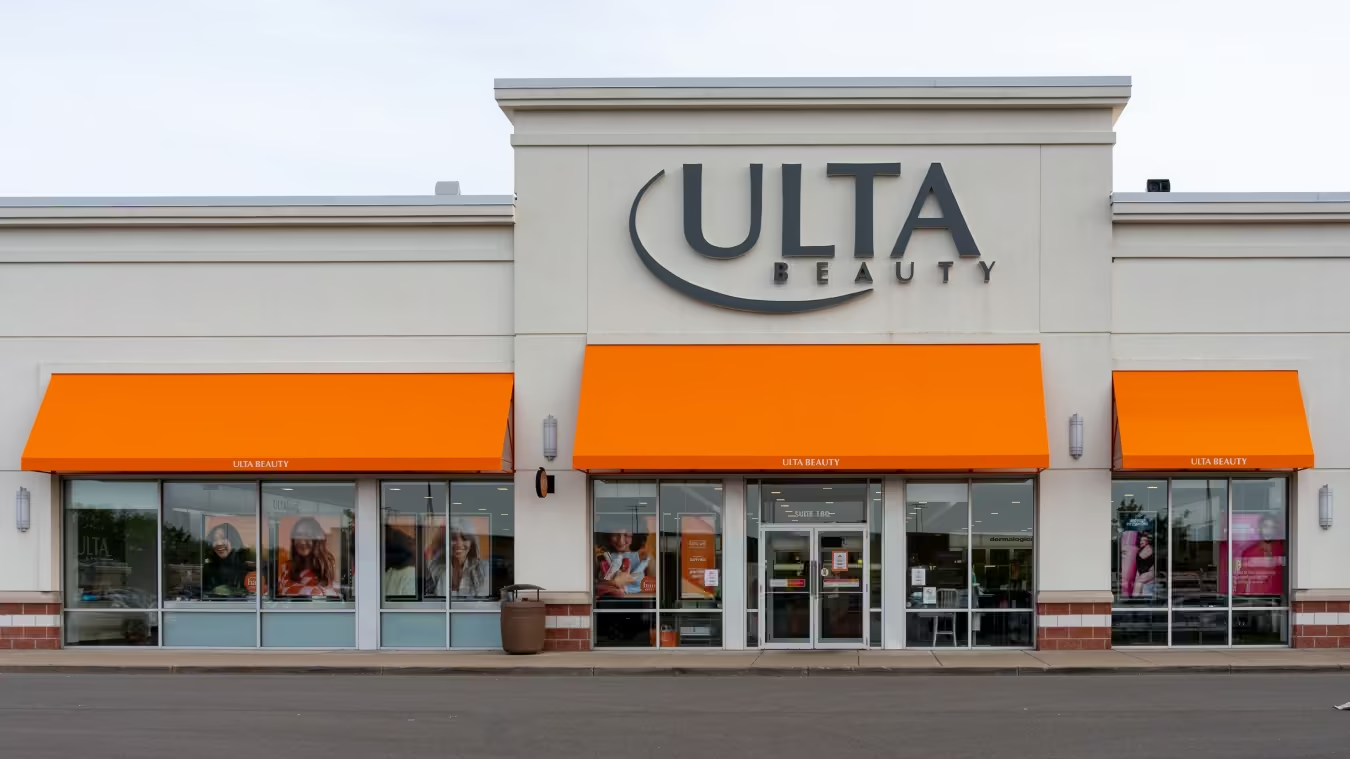
Ulta Beauty had been driving much of the growth of the beauty industry, due to its positioning as a destination for both mass and prestige beauty products. This business model, which served it well over the past few years, also exposed some potential hurdles as demand decelerated in 2024. Ulta’s visit growth in 2024 was just 1.9% year-over-year (2.5% YoY growth for Q4 2024), which surpassed other beauty chains, but slowed dramatically compared to previous trends.
A potential source of Ulta’s visit growth declaration could be one of its greatest opportunities over the past few years; its shop-in-shop partnership with Target. The two chains attract similar consumer demographics and align in their value offerings to shoppers. Looking at Placer’s cross visitation analysis, among visitors to Ulta Beauty, those who also visited Target increased from 86.9% in 2022 to 90.1% in 2024. Ulta visitors may be choosing to visit an Ulta outpost in Target more frequently than in the past, due to the convenience. But, that increase in visits to Target may be cannibalizing visit frequency to standalone Ulta Beauty locations.
Another change to Ulta Beauty’s overall visitation comes from the distribution of visitors to the retail chain. There were declines in the share of visits to Ulta from wealthier, suburban, and younger consumer segments, which account for the largest consumer bases for the retailer. There have been slight increases in the share of visits by Blue Collar Families and diverse shopper segments, but those consumers are likely to be more constrained in purchasing power than Ulta’s core shoppers.
Overall, the beauty space’s journey in 2024 is likely an indicator of what’s to come, especially for the larger chains. One retailer that has been the exception to the rule is Bluemercury, which Placer selected as a 10 Top Brands to Watch in 2025. For the remainder of the industry, retailers must find their reason for consumers to visit, despite a potential decline in demand for the category.

Two of the biggest sporting events of the year – the Super Bowl and the Daytona 500 – took place in February 2025. We dove into the location analytics and demographic characteristics of visitors for both events to find out who attends the Big Game and the Great American Race.
Super Bowl tickets aren’t cheap, and combined with elevated travel costs, attending the game comes with a hefty price tag. So it may be no surprise that “Ultra Wealth Families” – Spatial.ai: Personalive segment for the nation’s wealthiest households – are consistently the largest segment within the stadiums’ captured markets* on game day. The same trend persists for NFL’s conference championships, indicating that regardless of the region in which the biggest games are played, fans in attendance come from relatively similar, affluent households.
*A venue’s captured market is derived by the census block groups (CBGs) from which the venue draws its visitors, weighted by the share of visits from each, and thus reflects the population that actually visits the venue.
Visitors to the Daytona 500, it seems, are a more diverse cohort. Although the race is the most prestigious in NASCAR, tickets are available at price-points that suit a variety of budgets. And analyzing the visitor base of Daytona International Speedway on race day in 2025 reveals that the event’s relative affordability seemed to have attracted visitors from all walks of life: The venue’s trade area included a wide range of psychographic segments – ranging from the wealthiest families to retirement-age folks on a budget – demonstrating the diversity of the audience in attendance.
Analysis of the 2025 Super Bowl and Daytona 500’s trade areas, which reflect the regions from which the venues received visitors on the day, reveals other key differences between the events’ attendees.
As was the case for previous Super Bowls, the 2025 Super Bowl at the Caesars Superdome in New Orleans, LA drew visitors from the country’s major metro areas – and from some of the wealthiest – including New York City, Los Angeles, San Francisco, and Miami. The trade area also revealed elevated attendance from the teams’ home regions – Kansas City, MO and Philadelphia, PA – likely by the squads’ die-hard fans, and robust visitation from the host region (the New Orleans area), as local football fans appeared to take advantage of the opportunity to attend a Super Bowl close to home.
The 2025 Daytona 500's trade area, however, revealed a more tilted regional distribution of visitors. Although the event did draw fans from all over the country, most of the Daytona International Speedway attendees came from the Eastern United States, and Florida in particular – which hosts the race every year. This suggests that while the Daytona 500 attracts visitors from all over the country, the event is particularly popular among locals.
Want more data-driven event insights? Visit Placer.ai.

Wondering why Dave's Hot Chicken is reportedly in talks to sell itself to Roark Capital for $1 billion? One key reason is its strong growth potential. In 2024, chicken chains outpaced the broader QSR category in both new restaurant openings and increased visits per location. Dave's Hot Chicken stands out among them, with Placer's data showing it was one of the top performers in visit-per-location growth among chains with more than 100 locations last year.

The Kroger Company is one of the largest grocery retailers in the U.S, and the company continues to play a key role in the supermarket industry in 2025. We dove into traffic data for the company as a whole and for its leading banners to understand what 2025 may hold in store for the corporation.
Kroger and its variety of banners play a key role in the U.S. grocery landscape, with the company receiving around 16% of all visits to grocery stores nationwide (excluding non-traditional grocers such as superstores and wholesale clubs). And although Kroger’s visit share varies by state, the company receives more than a quarter of all grocery visits in 18 states, including four states – West Virginia, Utah, Colorado, and Kentucky – where Kroger receives more than half of the state’s grocery visits.
It seems, then, that the company is positioned to continue having a major impact on the U.S. grocery market in 2025 – even without the addition of Alberstons’ grocery portfolio.
The company’s recent visit performance also highlights Kroger’s ongoing resilience within an evolving grocery landscape. Traffic data shows that overall visits to Kroger chains held steady in 2024, with yearly visits just 1.3% lower than in 2023.
And the visit stability continued into 2025, with year-over-year (YoY) visits up every week in January 2025 just slightly below 2024 levels in February 2025 – indicating that shoppers are remaining loyal to Kroger’s chains amidst the inflationary environment.
Kroger operates a variety of banners, each catering to different regional markets and consumer segments. And analyzing 2024 visit data for Kroger’s largest chains shows overall stability across the portfolio – although some banners experienced slightly stronger growth while others did post minor visit gaps.
California-based Food 4 Less led the way with a 2.5% YoY visit increase in 2024, and Colorado-based King Soopers posted YoY visit growth as well. Smith’s, which operates in most of the West, Ralphs in California, and Harris Teeter in the Southeast and Mid-Atlantic stayed within one percentage point of their 2023 visit performance. Arizona-based Fry’s and the company’s namesake banner Kroger also remained close to their 2023 traffic levels, while Fred Meyer and Pick ‘n Save saw minimal YoY visit gaps.
Kroger’s steady foot traffic highlights its strong consumer loyalty and adaptability. And as the grocery sector continues to shift, the company’s ability to maintain its stable performance across its portfolio and regions of operations will ensure it maintains its status as a grocery giant in 2025 and beyond.
For more data-driven retail insights, visit placer.ai.

Walmart’s recent acquisition of the Pittsburgh, PA-area Monroeville Mall signals a new chapter for the retail giant, creating opportunities for both Walmart and the mall itself. Why did Walmart choose this particular property, what makes it such an appealing prospect – and what might the company do with the space?
We dove into the data to find out.
Unsurprisingly, shoppers also interact differently with malls – including the Monroeville Mall purchased by Walmart – than they do with Walmart. In 2024, for example, 39.4% of indoor mall visits nationwide took place on weekends, compared to just 33.6% for Walmart. Mall shoppers were also more likely to travel further for their visits and stay longer, partly due to the entertainment and dining options malls typically offer. (Monroeville Mall, for instance, is home to a Cinemark movie theater). By moving into the mall space, Walmart stands to reach a new kind of shopper, both demographically and behaviorally.
Why did Walmart choose to begin its foray into malls with the Monroeville Mall? Foot traffic data points to a unique balance here: The Monroeville Mall audience is different enough to expand Walmart’s reach, yet still similar in ways that could make it easier to convert new shoppers.
Analyzing Walmart’s trade areas with demographic data from STI: PopStats, for example, reveals that, on average, indoor mall shoppers tend to be more affluent than Walmart shoppers. In 2024, the median household income (HHI) of Walmart’s captured market was $64.5K – noticeably below the indoor mall median of $88.5K. But Monroeville Mall’s captured market had a median HHI of $62.8K – slightly below that of local Walmarts in the Pittsburgh, PA CBSA. Monroeville shoppers were also more likely to visit Walmart than shoppers at other malls, suggesting a natural overlap between the two visitor bases.
At the same time, Monroeville Mall offers Walmart access to new audience segments. In 2024, Monroeville Mall’s captured market showed significantly higher proportions of “Singles and Starters” and “Suburban Style” visitors (the latter encompassing middle-aged, suburban families with upscale incomes). Meanwhile, its share of the older “Autumn Years” segment – though still high – was smaller than that of Walmart’s base, highlighting the opportunity to engage a wider range of demographics.
Walmart has yet to announce specific plans for its new acquisition – though some have speculated that its partnership with Cypress Equities to “reimagine” the space signals a mix of retail, entertainment, and other amenities. Location analytics hint at several potential directions Walmart might pursue.
As consumers have changed their shopping habits, many malls have doubled down on experiential offerings – including on-site gyms, which deliver regular, repeat visits. And location analytics show that adding a fitness club to the Monroeville property may be especially beneficial for Walmart. Over the past year, Monroeville visitors were more likely to visit leading gym chains like Planet Fitness, Anytime Fitness, and LA Fitness compared to the average mall-goer nationwide.
And examining some of Monroeville Mall’s successful tenants highlights additional potential strategies for Walmart. Malls have faced considerable headwinds in recent years, and the downturn appears to have impacted the Monroeville Mall as well, with overall foot traffic dipping somewhat year over year (YoY) in 2024. But some tenants – including Barnes & Noble and Harbor Freight Tools – saw YoY visit upticks.
Visits to entertainment-focused offerings also increased, with the complex’s Full Throttle Adrenaline Park logging a 6.1% YoY foot traffic boost. And taking a broader look at the consumer habits of Monroeville visitors reveals an affinity for eatertainment: In 2024, 14.3% of Monroeville Mall-goers frequented a Dave & Busters, compared to just 7.4% for indoor mall visitors nationwide.
While Walmart’s ultimate intentions for Monroeville Mall remain under wraps, location analytics reveal a world of possibilities. And as retail continues to shift, Monroeville Mall may stand as a powerful case study of how a traditional big-box brand can successfully bridge into the mall space, capturing new audiences and invigorating a retail property ready for reinvention.
For more data-driven retail insights, visit Placer.ai.

In February 2024, Gap Inc. hired Zac Posen as Creative Director, tasking the designer with revitalizing the companies’ portfolio of brands. A year later, we analyzed the data to understand where the company stands today and uncover untapped opportunities for growth.
In 2024, visits to most Gap brands declined slightly compared to 2023, with the company’s four banners collectively experiencing a year-over-year (YoY) traffic dip of 3.5%.
Athleta outperformed the other three brands as well as the overall apparel (excluding off-price and department stores) average, with yearly visits up 0.2% and positive quarterly traffic growth for two of the four quarters. Old Navy came in second, starting the year strong with a 4.2% YoY increase in Q1 visits and ending 2024 with Q4 visits down just 2.4% – outperforming the industry’s YoY dip of 3.3%. And though Gap did lag slightly behind the overall apparel average, the brand managed to stay relatively close to its 2023 visit levels, indicating that its performance is stabilizing.
Meanwhile, Banana Republic experienced the sharpest visit declines with 2024 traffic down 9.6% YoY – indicating that the brand continues to face significant challenges.
Banana Republic’s 2024 performance continues a multi-year trend of declining traffic, despite the brand’s relatively affluent consumer base – an audience that, in theory, should have positioned the brand to weather the current inflationary environment more effectively.
But the brand may be positioning itself for a comeback. Last year, Banana Republic underwent a leadership change, with Gap Inc. CEO Richard Dixon stating that “2024 will be about getting back to the basics.” The brand has been redesigning select stores and leaning into influencer marketing with the goal of “reestablishing the brand to thrive in the premium lifestyle space.”
And as return to office mandates continue to roll in – reinvigorating the long dormant demand for business casual and office wear – the chain is well positioned for a comeback.
Location intelligence analysis also reveals an additional growth opportunity. Banana Republic is the only Gap banner without a dedicated sportswear line. Athleta specializes in athletic wear, Gap offers GapFit, and Old Navy’s activewear line has been a core component of the banner’s success in recent years.
But the data indicates that Banana Republic shoppers are just as active as visitors of the other Gap banners – in fact, cross-visit data suggests that those who shop at Banana Republic frequent fitness chains at similar rates as Athleta customers.
Analyzing cross-visitation to leading sporting goods retailers also indicates high demand for sportswear among Banana Republic shoppers: Consumers who visit Banana Republic visit Dick’s Sporting Goods and Academy Sports + Outdoors at higher rates than Gap Shoppers, and visit lululemon and REI at higher rates than both Gap and Old Navy visitors. This data strongly suggests that Banana Republic customers would likely embrace an expanded product mix that includes premium athleisure and sportswear.
While Gap Inc. already offers premium women’s activewear through its Athleta brand, none of Gap Inc.’s existing brands cater to the growing demand for premium men’s athletic wear. Expanding Banana Republic’s offerings to include a high-end athleisure line – with a specific focus on menswear – could help the brand carve out a niche in this fast-growing segment while leveraging its existing customer base’s interest in performance apparel.
Beyond product expansion, this move could align with Banana Republic’s broader repositioning efforts, reinforcing its identity as a premium lifestyle brand that caters to both professional and active lifestyles. Given the increasing overlap between workwear and athleisure, a thoughtfully designed sportswear line could also strengthen Banana Republic’s appeal to younger, fashion-conscious consumers who seek versatility in their wardrobes.
As Gap Inc. navigates its next phase under Zac Posen’s creative leadership, identifying and leveraging untapped opportunities—such as Banana Republic’s athleisure potential—will be critical for reinvigorating the company’s portfolio. By strategically diversifying its offerings, Gap Inc. can not only address shifting consumer preferences but also carve out a more competitive position in an evolving retail landscape.
For more data-driven retail insights, visit placer.ai/blog.

The COVID-19 pandemic – and the subsequent shift to remote work – has fundamentally redefined where and how people live and work, creating new opportunities for smaller cities to thrive.
But where are relocators going in 2024 – and what are they looking for? This post dives into the data for several CBSAs with populations ranging from 500K to 2.5 million that have seen positive net domestic migration over the past several years – where population inflow outpaces outflow. Who is moving to these hubs, and what is drawing them?
The past few years have seen a shift in where people are moving. While major metropolitan areas like New York still attract newcomers, smaller cities, which offer a balance of affordability, livability, and career opportunities, are becoming attractive alternatives for those looking to relocate.
Between July 2020 and July 2024, for example, the Austin-Round Rock-Georgetown, TX CBSA, saw net domestic migration of 3.6% – not surprising, given the city of Austin’s ranking among U.S. News and World Report’s top places to live in 2024-5. Raleigh-Cary, NC, which also made the list, experienced net population inflow of 2.6%. And other metro areas, including Fayetteville-Springdale-Rogers, AR (3.3%), Des Moines-West Des Moines, IA (1.4%), Oklahoma City, OK (1.1%), and Madison, WI (0.6%) have seen more domestic relocators moving in than out over the past four years.
All of these CBSAs have also continued to see positive net migration over the past 12 months – highlighting their continued appeal into 2024.
What is driving domestic migration to these hubs? While these metropolitan areas span various regions of the country, they share a common characteristic: They all attract residents coming, on average, from CBSAs with younger and less affluent populations.
Between July 2020 and July 2024, for example, relocators to high-income Raleigh, NC – where the median household income (HHI) stands at $84K – tended to hail from CBSAs with a significantly lower weighted median HHI ($66.9K). Similarly, those moving to Austin, TX – where the median HHI is $85.4K – tended to come from regions with a median HHI of $69.9K. This pattern suggests that these cities offer newcomers an aspirational leap in both career and financial prospects.
Moreover, most of these CBSAs are drawing residents with a younger weighted median age than that of their existing residents, reinforcing their appeal as destinations for those still establishing and growing their careers. Des Moines and Oklahoma City, in particular, saw the largest gaps between the median age of newcomers and that of the existing population.
Career opportunities and affordable housing are major drivers of migration, and data from Niche’s Neighborhood Grades suggests that these CBSAs attract newcomers due to their strong performance in both areas. All of the analyzed CBSAs had better "Jobs" and "Housing" grades compared to the regions from which people migrated. For example, Austin, Texas received the highest "Jobs" rating with an A-, while most new arrivals came from areas where the "Jobs" grade was a B.
While the other analyzed CBSAs showed smaller improvements in job ratings, the combination of improvements in both “Jobs” and “Housing” make them appealing destinations for those seeking better economic opportunities and affordability.
Young professionals may be more open than ever to living in smaller metro areas, offering opportunities for cities like Austin and Raleigh to thrive. And the demographic analysis of newcomers to these CBSAs underscores their appeal to individuals seeking job opportunities and upward mobility.
Will these CBSAs continue to attract newcomers and cement their status as vibrant, opportunity-rich hubs for young professionals? And how will this new mix of population impact these growing markets?
Visit Placer.ai to keep up with the latest data-driven civic news.

Convenience stores, or c-stores, have been one of the more exciting retail categories to watch over the past few years. The segment has undergone significant shifts, embracing more diverse offerings like fresh food and expanded dining options, while also exploring new markets and adapting to changing consumer needs. We looked at the recent foot traffic data to see what this category's successes reveal about the current state of brick-and-mortar retail.
Convenience stores are increasingly viewed not only as places to fuel up, but as affordable destinations for quick meals, snacks, and other necessities. And analyzing monthly visits to the category shows that it is continuing to benefit from its positioning as a stop for food, fuel, and in some cases, tourism.
Despite lapping a strong H1 2023, visits to the category either exceeded last year’s levels or held steady during all but one of the first eight months of 2024 – highlighting the segment’s ongoing strength. Only in January 2024 did C-stores see a slight YoY dip, likely reflecting a weather-induced exaggeration of the segment’s normal seasonality.
Indeed, examining monthly fluctuations in visits to c-stores (compared to a January 2021 baseline) shows that foot traffic to the category tends to peak in summer months – perhaps driven by summer road trips and vacations – and slow down significantly in winter. Given summer’s importance for convenience stores, the category’s August YoY visit bump is a particularly promising indication of c-stores’ robust positioning this year.
While some C-store chains, like 7-Eleven, have a nationwide presence, others are concentrated in specific areas of the country. But as the popularity of C-stores continues to grow, regional chains like Wawa, Buc-ee’s, and Sheetz are expanding into new territories, broadening their reach.
Wawa, a beloved brand with roots in Pennsylvania, has become synonymous with its fresh sandwiches, coffee, and a highly loyal customer base. Wawa has been a major player in the c-store space in recent years, with a revamped menu driving ever-stronger foot traffic to its Mid-Atlantic region stores. Between January and August 2024, YoY visits to the chain were mostly elevated. And the chain is now venturing into states like Florida – where its store count has grown significantly over the past few years – as well as Georgia and Alabama.
Meanwhile, Texas favorite Buc-ee’s, though known for its enormous stores and mind boggling array of dining options, has a relatively small footprint – but that might be changing. The chain, which also outpaced its already-strong 2023 performance this year, is opening locations in Arkansas and North Carolina, further building on its reputation as a destination for travelers. And Sheetz, another regional chain with a strong presence in Pennsylvania, is also expanding, with plans to open locations in Southern states like North Carolina and Tennessee.
This trend toward regional expansion offers significant opportunities for growth, not only by increasing store count, but also by reaching new consumer bases and target audiences. Customer behavior differs between markets – and by expanding into new areas, c-stores can tap into unique local visitation patterns.
One metric that highlights local differences in consumer behavior is dwell time, or the amount of time a customer spends inside a convenience store per visit. In some regions, visitors tend to move in and out quickly, while in others, customers linger for longer periods of time.
Analyzing convenience store dwell times by state highlights substantial differences in visitor behavior. During the first eight months of 2024, coastal states (with the exception of Oregon) tended to see shorter average dwell times (between 7.5 and 11.8 minutes). On the other hand, in states like Wyoming, Montana, and North Dakota, average dwell times ranged between 21.2 and 28.2 minutes.
Interestingly, the states with the longest dwell times also have some of the highest percentages of truck traffic on interstate highways – suggesting that these longer stops are perhaps made by long-haul truckers looking for a place to shower, relax, and grab a bite to eat.
Even as regional favorites expand their reach, nationwide classic 7-Eleven is taking steps to further cement its growing role as a prime grab-and-go food and beverage destination. And like other dining destinations, the chain relies on limited-time offers (LTOs) to fuel excitement – and visits.
One of the most iconic, and beloved c-store LTOs is 7-Eleven’s Slurpee Day, which falls each year on July 11th. The event, during which all 7-Eleven locations hand out free slurpees, tends to drive significant upticks in foot traffic – and this year was no exception. Visits to the convenience store jumped by a whopping 127.3% on July 11th, 2024 relative to the YTD daily visit average – proving that good deals will bring customers in the door.
The convenience store sector continues building on the impressive growth seen in 2023. As many chains double down on expanding both their regional presence and their offerings, will they continue to drive growth in the coming years?
Visit Placer.ai to keep up with the latest data-driven convenience store updates.
Grocery chains in the United States are increasingly investing in on-site healthcare clinics, transforming their stores into hubs for both food and wellness. While grocery stores have long featured pharmacies and some basic healthcare services like vaccinations, recent years have seen a shift towards more extensive healthcare offerings.
Today, many grocery stores offer a range of services – from primary and urgent care to dental and mental health care. In addition to providing an important community service, grocery-anchored healthcare clinics can boost foot traffic at chains, help health providers reach more patients, and allow shoppers to manage their health and home needs in one convenient trip.
This white paper examines the impact these in-store clinics have on grocery chain visitation patterns and trade area characteristics. Are shoppers more or less likely to make repeat visits to grocery stores with healthcare services? And how does the addition of a clinic affect the demographic profile of a grocery store’s captured market? The report examines these questions and more, offering insights for stakeholders across the grocery and healthcare industries.
Analyzing foot traffic to grocery stores with and without in-store clinics shows the positive impact of these services: Across chains, locations with on-site healthcare offerings drew more visits in H1 2024 than their chain-wide averages.
The Kroger Co., which operates numerous regional banners as well as its own eponymous chain, has been a leader in in-store healthcare services since the early aughts. The company introduced its in-store medical center, The Little Clinic in 2003 – and today operates over 225 Little Clinic locations across its Kroger banner, as well as regional chains Dillons, Jay C Food Stores, Fry’s, and King Soopers.
And in H1 2024, the eight Dillons locations with clinics saw, on average, 93.0% more visits per location than the chain’s banner-wide average. Jay C, which offers two in-store clinics, also saw visits to these venues outpace the H1 2024 banner-wide average by 92.9%. For both chains, relatively small overall footprints may contribute to their outsize visit differences: Indiana-focused Jay C operates just 22 locations, all in the Hoosier State, while Kansas-based Dillons has some 64 locations.
But similar patterns, if somewhat less pronounced, could be observed at Kroger (43.0%), Fry’s (19.2%), and King Soopers (16.5%) – as well as at H-E-B (14.5%), which boasts its own expanding network of in-store clinics.
Analyzing the trade areas of grocery stores with healthcare clinics shows that these services tend to draw more affluent visitors from within the stores’ trade areas.
For some chains, including King Soopers, H-E-B, and Jay C, the clinics are positioned to begin with in areas serving higher-income communities. The median household income (HHI) of King Soopers’ in-store clinic’s potential markets, for example, came in at $92.3K in H1 2024 – significantly above the chain’s overall potential market median HHI of $88.1K. Similarly, the potential markets of H-E-B and Jay C Food Stores with clinics had higher median HHIs than the chains’ overall averages.
And for all three chains, stores with clinics tended to attract visitors from captured markets with even higher median HHIs – showing that within these affluent communities, it is the more well-to-do customers that tend to frequent these venues. (A chain or store’s potential market is obtained by weighting each CBG in its trade area according to the size of the population – thus reflecting the general composition of the community it serves. A chain or store’s captured market, on the other hand, is obtained by weighting each CBG according to its share of visits to the business in question – and thus represents the population that actually visits it in practice.)
Other brands, including Fry’s, Kroger, and Dillons, have positioned clinics in stores with potential market median HHIs slightly below chain-wide averages. But within these markets, too, it is the more affluent consumers that are visiting these stores, pushing up the median HHI of their captured markets.
These patterns highlight that, for now, grocery store clinics tend to attract consumers on the upper ends of local income spectrums. This information can be utilized by healthcare professionals and grocery store owners to pinpoint neighborhoods that may be open to grocery-anchored clinics, or to take steps to increase penetration in other areas.
Supermarket giant Kroger is a major player in the world of grocery-anchored healthcare, offering visitors access to pharmacies, clinics, and telehealth options via its grocery stores. What impact has the company’s embrace of healthcare had on visits and loyalty?
An analysis of household compositions across the potential and captured markets of Kroger-owned stores with and without Little Clinic offerings suggests that families with children are extremely receptive to these services.
In H1 2024, Kroger, King Soopers, Fry’s, Jay C, and Dillons all featured captured markets with higher shares of STI: PopStats’ “Households With Children” segment than their potential ones – highlighting the chains’ appeal for families. But the share of parental households in those stores with Little Clinics jumped significantly higher for all five banners.
The share of families with children in King Soopers’ overall captured market stood at 28.3% in H1 2024, higher than the 27.2% in its potential one. But the households with children in the captured markets of King Soopers locations with Little Clinics was significantly higher – 30.6% – and similar patterns emerged at Jay C, Dillons, Kroger, and Fry’s.
This special draw is likely linked to the clinics' focus on family health services like physicals, nutrition plans, and vaccines. The convenience of being able to take care of healthcare, grocery shopping, and pharmacy needs all in one go makes these stores particularly attractive to parents. And this jump in foot traffic shows the strategic advantage of incorporating healthcare services into the retail environment.
Providing essential healthcare services at the supermarket can establish a grocery chain as a crucial part of a shopper's daily life, enhancing visitor loyalty, and helping nurture long-term customer relationships. Indeed, in-store clinics offer a unique opportunity for grocery providers to connect with customers on a level that extends beyond the transactional.
An analysis of several Kroger-branded locations in the Cincinnati metro area showcases the profound impact in-store clinics can have on customer loyalty. In H1 2024, stores with Little Clinics had significantly higher shares of repeat visitors – defined as those making six or more stops at the store during the analyzed period – than those without.
For instance, 36.4% of visitors to a Kroger Marketplace store with an in-store clinic in Harrison, Ohio, frequented the location at least six times during the first half of 2024. But over the same period, only 29.0% of visitors stopped by at least six times to a nearby Kroger location in Cleves, Ohio – just ten miles away. Similarly, 30.7% of visitors to the Beechmont Ave. Kroger Food & Drug location with a clinic visited at least six times in H1 2024, compared to 23.0% for the nearby Ohio Pike Kroger store.
This trend was consistent across the analyzed locations, with those offering in-store clinics attracting significantly higher shares of loyal visitors. These metrics support the value of offering additional services as a draw for frequent visitors, while also providing the clinics themselves with the visitor volume needed to operate profitably.
Texan grocery chain H-E-B is beloved across the state – and though the chain isn’t new to the healthcare scene, it has been doubling down on wellness. In 2022, H-E-B launched H-E-B Wellness, a healthcare platform that offers patrons a variety of medical services, including – as of today – some 12 primary care clinics, many of them inside stores.
H-E-B stores with primary care clinics are helping to cement the grocer’s role as a convenient one-stop for local residents – allowing them to drop in to a nearby location for both daily grocery needs and wellness care.
H-E-B has always placed a premium on community, stepping up to help local residents in times of need. And though the chain as a whole draws an overwhelming majority of its visitors from nearby areas, those with clinics do so even more effectively. In H1 2024, some 83.6% of visitors to H-E-B came from less than 10 miles away. But for locations with primary care clinics, this share increased to 88.0%.
This suggests that wellness services are particularly appealing to nearby residents, strengthening H-E-B’s connection with local consumers even further. And for a grocery store centered on community engagement, the integration of health services into its offerings is proving to be a winning strategy.
H-E-B has been steadily expanding its primary care offerings since it launched the Wellness concept, adding two primary clinics at locations in Cypress, TX and Katy, TX in June 2023. Following the opening of these clinics – which operate Mondays through Fridays – both locations saw marked increases in the share of “Urban Cliff Dwellers” in their weekday captured markets. This STI: Landscape segment group encompasses families both with and without children, earning modest incomes and enjoying middle-class pleasantries.
Between June 2022 - May 2023, the share of “Urban Cliff Dwellers” in the weekday captured markets of the Cypress and Katy locations stood at 9.5% and 7.2%, respectively. But once the stores had clinics in place, those numbers jumped to 12.4% and 11.0%, respectively.
This increase in the stores’ reach among “Urban Cliff Dwellers” immediately following the clinics’ openings suggests that in addition to more affluent consumers, middle-class families also harbor considerable interest in these services. As more retailers continue making inroads into the healthcare sector, they may find similar success in attracting diverse groups of convenience-seeking shoppers.
As grocery stores lean into healthcare, they are transforming into multifaceted hubs that offer both essential health services and everyday shopping needs. Retailers like Kroger and H-E-B are reaping the benefits of boosted foot traffic, higher-income visitors, and strengthened community ties – while offering their shoppers convenience that helps streamline their daily routines.