.png)
.png)

.png)
.png)


Commercial real estate’s reputation as a technology laggard is not entirely undeserved. At its core, CRE is a see-touch-and-feel industry, as much art as science. Local knowledge, intuition, and long-standing relationships continue to shape how deals get done, and that reality isn’t likely to change. Boots on the ground matter, as firsthand market insight and trust between brokers, landlords, and tenants, remain central to the business.
That context is essential when thinking about technology’s role in CRE. Tech can support and enhance decision-making, but it cannot replace the fundamentals. AI, for example, can make processes faster and more efficient, but it will not change the core of how CRE works. It will never be the tool that says, “I know a landlord who’s about to bring this space to market, and I’m getting the first look because of our relationship.”
That said, technology does have an important role to play. During COVID, when activity slowed dramatically, many organizations finally had the time to look inward and ask how technology could support faster, more resilient decision-making once the market returned. As the industry continues to invest in digital tools, three principles stand out.
Technology delivers the most value when it is guided by well-defined questions. One of the most persistent challenges in CRE’s use of technology is data fragmentation and fatigue. The industry generates enormous amounts of data, much of it spread across spreadsheets, emails, platforms, and institutional knowledge. And without knowing what you want to accomplish, that volume can quickly become overwhelming.
As shown in the chart above, for example, even when a national trend appears relatively modest, the underlying regional variation can be significant. Without a clear question guiding the analysis, it’s easy to walk away with a generic conclusion that misses where performance is actually diverging. Framed correctly, the same data becomes a tool for understanding where demand is strengthening, where it’s softening, and how strategy should differ by market.
Once the right questions are defined, the next challenge is selecting the right tools. Here again, clarity matters. There is no universal technology stack for commercial real estate. Organizations operate across different markets, asset types, and strategies, and technology needs to reflect those differences.
Thinking in terms of a recipe provides a more useful framework. The questions define the goal, and technology becomes a set of ingredients chosen to achieve it. Some tools add context, others improve precision, and others help scale insights across teams by surfacing distinct metrics and perspectives. The objective is not to find a single solution or data point that does everything, but to assemble the right combination that supports how the organization actually works.
The graph below highlights the value of layering multiple signals to understand performance. Topline visit trends offer a baseline, but adding context around visitor profile and travel patterns helps clarify what’s actually driving change. When analyzed together, these signals move analysis beyond surface-level conclusions and toward insight that can inform real decisions.
The technology best positioned to help CRE is shaped by how people actually use it. Companies that consistently learn from their users, refine inputs, expand data sets thoughtfully, and stay focused on real decision-making are far more likely to deliver lasting value.
The true test of any technology is whether it helps professionals make better decisions faster and with greater confidence while reducing risk. When insights surface quickly and are paired with on-the-ground experience and market context, data reinforces what CRE professionals already see and understand. Used this way, technology becomes a decision-support tool that facilitates de-risking and enables organizations to act at the right speed without losing sight of the fundamentals.
When analyzing mall properties, for instance, sustained weekday and weekend visit growth, paired with a broadening and increasingly family-oriented audience, can signal traffic that is more likely to endure. Identifying these deeper patterns in visit behavior helps validate assumptions, align strategy, and move forward with greater confidence, especially when paired with local market context.
As technology adoption continues, CRE leaders face an additional challenge: distinguishing between tools that meaningfully support these principles and those that generate attention without lasting value. Some technologies – like foot traffic and demographics – will become table stakes, while others will struggle to move beyond experimentation.
One area to watch is Virtual AI, including remote site visits and digital building tours. These tools may streamline early-stage evaluation and expand access, even as final decisions continue to rely on boots on the ground. Ultimately, their impact will depend on whether they reinforce the fundamentals of CRE – clear questions, practical workflows, and faster paths to confident decisions.

Since taking the reins in 2023, Gap Inc. CEO Richard Dickson has pursued a turnaround strategy aimed at reinvigorating the legacy apparel retailer, with promising results so far. Did that positive momentum carry through the end of the year? And what can location analytics reveal about the role of each of Gap Inc.’s largest banners in powering the company’s recovery?
Recent foot traffic data points to solid traffic momentum at Gap Inc. With the exception of a brief dip in December – likely driven by holiday demand pulling forward into November, along with one fewer Sunday compared to 2024 – year-over-year (YoY) company-level visits remained consistently positive over the past six months.
Throughout the period, same-store visits slightly outpaced total traffic, reflecting a more optimized fleet following the closure of several underperforming stores over the past year. Gap Inc’s robust traffic patterns also align with recent earnings commentary showing positive company-level in-store comparable sales in Q3 2025 and improving execution across Gap’s leading brands, as the company continues its strategic reset.
Looking at the company’s two largest brands shows that each is contributing to the company’s rebound in a different way. In Q4 2025, Gap slightly outperformed Old Navy on a quarterly basis, with banner-level traffic up 1.6% YoY, compared with 1.2% at Old Navy. However, Old Navy delivered more consistent monthly gains throughout the analyzed period – including in September, when Gap experienced a modest decline.
Gap’s traffic trends were notably more variable, with a stronger YoY lift in November, likely reflecting the brand’s greater sensitivity to seasonal storytelling and early holiday demand. This responsiveness was especially apparent on Black Friday, when Gap visits surged 504.4% above its 2025 daily average, compared with a still-robust but more measured 436.4% increase at Old Navy.
Old Navy’s smoother monthly performance likely reflects its role as the portfolio’s stability engine, with value-driven and replenishment trips supporting steady traffic throughout the year. Gap, on the other hand, appears to fulfill a more discretionary function, with visits responding more sharply to merchandising, marketing, and holiday timing.
Visitor behavior data for Gap and Old Navy further reinforces the two brands’ distinct positionings. Old Navy attracts longer, more frequent visits that skew toward weekdays, signaling habitual shopping tied to browsing, value-seeking, and building everyday wardrobe essentials. Gap, meanwhile, sees shorter, less frequent visits that are more likely to occur on weekends – consistent with more discretionary trips tied to seasonal needs, inspiration, or occasional splurges.
These differences between the two banners may help shape how Gap Inc. approaches its next phase of growth. In January 2026, the company leaned into “fashiontainment” with the appointment of former Paramount executive Pam Kaufman as Chief Entertainment Officer. At the same time, it has begun expanding into beauty and accessories, including the launch of Beauty Co. at 150 Old Navy locations nationwide.
As these strategies roll out, allowing them to express themselves differently across Gap and Old Navy could help maximize the strengths of each banner. At Gap, fashiontainment may lend itself to high-impact cultural moments and narrative-driven campaigns that tap into the brand’s strengths in nostalgia and storytelling – such as last year’s Better in Denim campaign featuring Katseye. At Old Navy, the same idea may be most effective through large-scale, family-friendly partnerships that reinforce its role as a dependable, mass-market destination – like the Disney collaboration launched last May. A similar dynamic could emerge in beauty, with Old Navy’s Beauty Co. supporting frequent, routine visits, and beauty at Gap reinforcing fashion authority and cultural relevance rather than driving habit.
For more insights into the consumer patterns shaping retail strategy, follow Placer.ai/anchor.
Placer.ai leverages a panel of tens of millions of devices and utilizes machine learning to make estimations for visits to locations across the US. The data is trusted by thousands of industry leaders who leverage Placer.ai for insights into foot traffic, demographic breakdowns, retail sale predictions, migration trends, site selection, and more.

The home improvement space has faced sustained pressure from macroeconomic headwinds – including persistent inflation and a cooling housing market – prompting many consumers to delay major projects and defer big-ticket purchases. But is a category turnaround in the works? An AI-powered foot traffic analysis of the sector’s largest players – The Home Depot and Lowe’s – offers insight into whether momentum has shifted and a period of growth is on the horizon.
Both The Home Depot and Lowe's reported sales growth alongside an uptick in big-ticket purchases in fiscal Q3 2025, indicating that consumers were investing in significant upgrades despite many bigger renovations remaining on the back-burner. And the latest foot traffic data suggests that this momentum likely carried forward into the subsequent months.
In November 2025, both chains saw visit and same-store visit growth of roughly 3% year-over-year (YoY) – a sign of meaningful Black Friday traffic and a healthy start to the holiday shopping season.
And while December 2025 saw modest visit gaps, these likely stemmed in part from tough YoY comparisons to December 2024’s storm-related demand.
Traffic to both chains rebounded in the new year, with preparations ahead of Storm Fern likely accounting for some of January 2026’s YoY visit gains.
Overall, the past several months of foot traffic data paint a picture of continued positive momentum for The Home Depot and Lowe’s through fiscal Q4.
Large-scale projects may not yet be at hoped-for levels, but the data suggests consumers are still investing in their homes. And with mortgage rates trending lower, housing activity showing early signs of a turnaround, and the potential for abundant home equity to fund renovations, the home improvement sector appears poised for continued growth.
Will the home improvement space build on its successes in 2026? Visit Placer.ai/anchor to find out.
Placer.ai leverages a panel of tens of millions of devices and utilizes machine learning to make estimations for visits to locations across the US. The data is trusted by thousands of industry leaders who leverage Placer.ai for insights into foot traffic, demographic breakdowns, retail sale predictions, migration trends, site selection, and more.

E-commerce distribution centers outpaced brick-and-mortar retail chains in year-over-year (YoY) foot traffic growth throughout the 2025 holiday stretch. This pattern aligns with broader holiday-season data showing that e-commerce sales growth exceeded brick-and-mortar growth in 2025.
Still, physical retail continued to account for the majority of total holiday spending, and in-store visits also saw steady, positive YoY growth throughout the season. The data points to a retail environment where digital and physical channels are not competing for relevance but operating in parallel, each capturing different dimensions of consumer demand. That dynamic carried into the new year as well: January 2026 visits remained above year-ago levels for both e-commerce distribution centers and brick-and-mortar retail, rising 2.6% and 1.8% YoY, respectively.
Visits to Placer.ai’s Industrial Manufacturing Index, on the other hand, softened in January 2026, following stronger YoY momentum in December. At first glance, this decline may seem surprising: January marked a clear improvement in manufacturing sentiment, with the ISM Manufacturing PMI rising to 52.6% – its first expansionary reading in at least a year – and the Production sub-index also improving. While the ISM captures month-over-month shifts in sentiment rather than year-over-year change, a sharply improving outlook may seem inconsistent with such a steep YoY decline following a positive month.
But a closer look at the weekly data helps explain the divergence. Sentiment surveys capture outlook, orders, and expectations, while foot traffic reflects physical, on-site activity. Winter Storm Fern, which caused widespread disruptions late in the month, weighed heavily on manufacturing visits and pulled down the overall January figure. Weather events like this can meaningfully suppress foot traffic even as underlying sentiment improves – and they tend to register far more clearly in mobility data than in survey-based indicators.
Calendar effects likely contributed as well. January 2026 had one fewer working day than January 2025, a difference that can have an outsized impact on visit-based measures tied to operational and industrial activity.
Overall, the data points to an economy that ended 2025 with solid momentum across consumer-facing channels, even as early-2026 manufacturing activity reflected short-term disruption. As weather normalizes, will on-the-ground industrial activity rebound?
Follow Placer.ai/anchor for more data-driven insights into the trends shaping retail, logistics, and manufacturing.
Placer.ai leverages a panel of tens of millions of devices and utilizes machine learning to make estimations for visits to locations across the US. The data is trusted by thousands of industry leaders who leverage Placer.ai for insights into foot traffic, demographic breakdowns, retail sale predictions, migration trends, site selection, and more.
%20(1).avif)
Traditional department stores aren’t going anywhere. But over the past several years, the balance of power has shifted decisively toward retailers like off-price chains with the clearest value story. The latest signal of that shift came as Saks Global – parent of Saks Fifth Avenue, Neiman Marcus, and Bergdorf Goodman – filed for bankruptcy and began closing stores.
How wide has the gap between department stores and off-price really become? And what lies in store for the two categories in 2026?
The chart below shows just how dramatically the category split has changed since 2019. Pre-COVID, department stores held a slight edge, capturing just over half of visits to the two segments. But by 2025, that relationship had fully reversed, with off-price claiming a remarkable 62.9% share of visits. As consumers grow more price-sensitive and the retail landscape becomes more bifurcated, traditional department stores have struggled to articulate a clear competitive edge – while off-price continues to benefit from a straightforward, discovery-driven model.
Year-over-year data reinforces the structural strength of the off-price model. In Q4, the segment once again delivered solid gains, extending a winning streak that’s become harder for traditional department stores to match.
Notably, all four major off-price players expanded their footprints over the past year, and in each case overall visit growth outpaced per-location gains. Ross Dress for Less led the group with per-location visit growth ranging from 11.5% to 7.5% between October 2025 and January 2026. Some of that strength reflects easier baseline comparisons, but the scale of the gain still signals durable demand. Burlington delivered 9.4% overall visit growth even as per-location visits were essentially flat at -0.3%, a pattern consistent with rapid store expansion paired with steady interest at existing locations.
Meanwhile, T.J. Maxx and Marshalls turned in low single-digit gains while lapping a strong prior year: T.J. Maxx grew 2.1% per-location and 2.8% overall, while Marshalls rose 1.6% and 3.3%, respectively.
Department stores, by contrast, faced a more challenging traffic environment, with several chains continuing to shrink their footprints. Yet even within the category, performance was mixed. And the brands with the clearest identities – whether rooted in regional loyalty or premium, service-led positioning – continued to thrive.
Regional players led the traditional segment, with Von Maur seeing the most pronounced and consistent per-location growth during the analyzed period. Repeatedly ranked “America’s Best Department Store” by Newsweek, the chain has built its reputation on a differentiated, service-first in-store experience. Boscov’s, another regional operator with a loyal customer base, delivered a solid Q4 as well, even though per-location traffic dipped slightly YoY in December and January.
Among national banners, several higher-end brands also showed relative strength. Nordstrom – long associated with standout customer service – grew per-location visits by 4.2% YoY in Q4, even as overall traffic slipped 0.6% amid store closures. Bloomingdale’s posted 1.9% per-location growth. And while Saks Fifth Avenue has faced well-publicized corporate headwinds, its traffic declines remained comparatively modest in Q4.
The pressure was most visible among mid-market chains without a sharply defined value or experiential proposition. Kohl’s saw per-location visits fall 3.2%, with overall traffic down 5.0%, while JCPenney declined 3.8% and 5.5%, respectively. Macy’s, meanwhile, saw overall traffic drop as it continued rightsizing – though per-location visits held relatively steady, suggesting its turnaround strategy is beginning to bear fruit.
The Q4 data underscores a defining theme in department store and off-price retail: Consumers are rewarding clarity. Off-price is winning on value and discovery, regionals are winning on loyalty, and premium banners are holding up where the experience is distinct. In a bifurcated retail environment, the middle is the toughest place to be.
For more data-driven retail insights, follow Placer.ai/anchor.
Placer.ai leverages a panel of tens of millions of devices and utilizes machine learning to make estimations for visits to locations across the US. The data is trusted by thousands of industry leaders who leverage Placer.ai for insights into foot traffic, demographic breakdowns, retail sale predictions, migration trends, site selection, and more.
.avif)
The success of the dollar store category hadn’t been all too surprising in 2025. However, the ability for the category to shine so brightly during the holiday season was unexpected. Traffic to dollar and discount chains was up 4.5% year-over-year in the fourth quarter, mirroring the growth of categories like off-price and wholesale clubs and overperforming compared to traditional holiday staples like apparel, department stores, beauty, consumer electronics, and home.
The retail industry doesn't traditionally think of dollar stores as a holiday shopping destination, but 2025 proved that the definition might need to change in coming years. Dollar stores have done a fantastic job at expanding their assortments and becoming a staple in consumers’ weekly shopping rotation.
Each of the major retailers saw strong traffic trends during the elongated holiday timeframe. In particular, Five Below had a strong same store visit trend over the holidays, focusing on gifting categories, holiday decor, and wrapping supplies. Dollar Tree and Five Below tend to skew their assortments towards more discretionary items, which benefitted both chains over the holidays.
The inherent value proposition of dollar stores has built trust with consumers and aided retailers in winning with shoppers whose holiday budgets might have been more constrained last year, especially with lower income households. The median household income of the largest dollar chains is lower than the average across total retail visitors, indicating that despite higher economic concerns of lower income shoppers, consumers still wanted to ensure that their holidays weren’t impacted. Brands focusing on more discretionary items like stocking stuffers and smaller gift items helped price conscious consumers to round out their holiday shopping without having to abstain from gifting all together.
For more data-driven insights, visit placer.ai/anchor.
Placer.ai leverages a panel of tens of millions of devices and utilizes machine learning to make estimations for visits to locations across the US. The data is trusted by thousands of industry leaders who leverage Placer.ai for insights into foot traffic, demographic breakdowns, retail sale predictions, migration trends, site selection, and more.

Placer.ai observes a panel of mobile devices in order to extrapolate and generate visitation insights for a variety of locations across the U.S. This panel covers only visitors from within the United States and does not represent or take into account international visitors.
Professional sports are big business – the industry is valued at nearly $1 billion in the United States alone. And beyond the economic impact of actual ticket sales and stadium and sponsorship gains, major sporting events can have significant impacts on local industries such as tourism, dining, and hospitality. Cities hosting sports events tend to see influxes of visitors who boost tourism, spend money at restaurants and hotels, and create ripple effects that benefit entire local economies.
The 2024 Copa América, typically held in South America but hosted in the United States this year, provides a prime example of the effect sports tourism can have on local economies. The games kicked off in Atlanta, Georgia on June 20th, 2024, before moving on to other host cities and boosting hospitality traffic along the way.
This white paper dives into the data to see how the games impacted hotel visits in cities across America – and especially in Atlanta. The report uncovers the hotel tiers and brands that saw the largest visit boosts and explores visitor demographics to better understand the audiences drawn to the event.
The Copa América took place in June and July 2024, with fourteen cities – mainly across the Sunbelt – hosting games. Thousands of fans attended each event, driving up demand in local hotel markets.
Arlington, TX, saw the largest hotel visit bump during the week it hosted the games, with hospitality traffic up 23.0% compared to the metro area's weekly January to September 2024 visit average. Orlando, FL, too, enjoyed a significant visit spike (22.1%), followed by Kansas City, KS-MO (17.4%).
The Atlanta metropolitan area, for its part, also saw a significant 11.0% increase in hotel visits during its hosting week compared to the city’s weekly visit average.
The Copa América games attracted fans from across the country – from as far away as Washington State and New Hampshire, as well as from neighboring states like Florida. On the day the tournament began, 26.1% of the domestic visitors to Atlanta’s Mercedes-Benz Stadium came from over 250 miles away, up from an average of 19.7% during the rest of the year (January to September 2024). These out-of-towners likely had a significant impact on Atlanta’s local economy – through spending on accommodations, dining, and entertainment.
During the week of the Copa América game, all of the analyzed hotel types in Atlanta received a visit bump. And while some of these visits were likely unrelated to the game, the massive scale of the event means that a significant share of the visit growth was likely driven by out-of-town soccer fans. Analyzing these patterns Atlanta can provide valuable insights for hospitality stakeholders looking to attract attendees of major sporting events.
Upper Midscale hotels saw the biggest boost during the week of the event, with visits 20.8% higher than the weekly visit average between January and September 2024. Midscale and Upscale hotels also experienced significant visit increases of 15.8% and 14.0%, respectively. During the same period, visits to Luxury hotels grew by 9.0% and Economy Hotel visits rose by 7.0% compared to the January to September 2024 weekly average. Meanwhile Upper Upscale Hotels received the smallest boost, with visits up by 2.9%.
Judging by these travel patterns, it appears that most Copa América spectators prefer to stay at Midscale, Upper Midscale, or Upscale hotels during the trip.
While Upper Midscale Hotels in the Atlanta-Sandy Springs-Alpharetta metro area generally experienced the biggest visit boost during the Copa América, visit performance varied somewhat from chain to chain. TownePlace Suites and Fairfield Inn, both Upper Midscale Marriott properties, saw increases of 27.5% and 25.3%, respectively, compared to their January to September 2024 weekly averages. Other chains in the tier also enjoyed visit boosts – visits to Home2 Suites by Hilton and Hampton Inn – both Hilton chains – jumped by 17.3% and 17.4%, respectively, during the same period.
The popularity of these Upper Midscale hotels may be driven by a multitude of factors. Some, like TownePlace Suites and Home2 Suites offer kitchenettes, something that may appeal to visitors looking to save by preparing their own meals. Others, such as Fairfield Inn and Hampton Inn which offer more locations closer to the stadium may attract visitors that prioritize convenience.
Layering the STI: PopStats dataset onto Placer.ai’s captured market can provide insights into Copa América attendees by revealing the demographic attributes of census block groups (CBGs) contributing visitors to the Mercedes-Benz Stadium. (The CBGs feeding visitors to a chain or venue, weighted to reflect the share of visitors from each one, are collectively referred to as the business’ captured market.)
During the Copa América opener,Mercedes-Benz Stadium drew visitors from CBGs with a median household income (HHI) of $90.0K – well above the national median of $76.1K and similar to the median HHI during the Taylor Swift concert ($90.6K). The stadium’s trade area median HHI was even higher during the Super Bowl ($117.9K).
This visitor profile suggests that Copa América attendees – along with guests of other major cultural and sporting events – often have the means to splurge on comfortable, mid-range hotels for their stays. As Atlanta gears up to host the College Football National Championship in January 2025, the 62nd Super Bowl in February 2028, and the MLB All Star Game in July 2025, along with a host of smaller-scale events – the city can draw on historical data from past events, including the Copa América, to better understand the needs and preferences of stadium visitors and plan accordingly.
And although Upper Upscale hotels generally experienced relatively subdued growth during the Atlanta Copa América opener, some Upper Upscale properties – including Marriott’s Autograph Collection Twelve Downtown, saw visits jump. Visits to the hotel were up 19.7% during the week of the Copa América compared to the January to September 2024 weekly average.
The Twelve Downtown has become a popular lodging choice for major events in the city, likely due to its proximity to Mercedes-Benz Stadium. (The hotel is located just over a mile away from the stadium). During the Super Bowl LIII five years ago, the Twelve Downtown drew 27.9% more visits than its weekly average for January to September 2019. And during the 2023 Taylor Swift concert, the hotel saw a 25.5% visit bump.
A closer look at the median HHI of the hotel’s captured market during the three periods reveals that, despite each event attracting visitors from varying income brackets, the median HHI of visitors to the Twelve Downtown remained stable. Visitors to the hotel between January and September 2024 came from trade areas where the median HHI was $76.2K, not far off from the median HHI during the 2019 Super Bowl ($75.4K), Taylor Swift’s 2023 concert ($80.6K) and the Copa América ($76.7K).
This stability suggests that, regardless of the event, hotels attract a specific visitor base. And understanding the similarities within the demographic profiles of likely hotel visitors during different events will be key for hotels at all levels seeking to capitalize on the economic opportunities created by major local events.
The Mountain region offers employment opportunities, affordable housing, outdoors recreation, and a relatively low cost of living – which could explain why these states are emerging as major domestic migration hubs. Idaho, Nevada and Wyoming in particular have consistently attracted inbound domestic migration in recent years, as Americans continue leaving higher density regions in search of greener – and calmer – pastures.
This report uses various datasets from the Placer.ai Migration Trends Report to analyze domestic migration to Idaho, Nevada, and Wyoming. Where are people coming from? And how is recent migration impacting local population centers in these states? Keep reading to find out.
Idaho emerged as a domestic migration hotspot over the pandemic, as many Americans freed from the obligation of in-person work relocated to the Gem State. Between June 2020 and June 2024, Idaho saw positive net migration of 4.7%, more than any other state in the U.S. (This metric measures the number of people moving to a state minus the number of people leaving – expressed as a percentage of the state’s total population.) And between 2023 and 2024, Idaho remained the nation’s top domestic migration performer (see map above).
Diving into the data reveals that though people moved to Idaho from across the U.S., most of Idaho’s influx over the past four years came from neighboring West Coast and Mountain States – especially California. Former residents of the Golden State accounted for a whopping 58.1% of inbound migrants to Idaho over the analyzed period.
California’s position as the top feeder of relocators to Idaho during the analyzed period may come as no surprise, given the state’s recent population outflow and the many former California residents who have settled in the Mountain region. But Washington, Oregon, and Nevada – where inbound and outbound migration remained relatively even in recent years – have also been seeing shifts to Idaho.
Idaho has a lower tax burden, robust employment opportunities, and greater overall affordability than its top four feeder states. So some of the recent relocators likely moved to the Gem State to enjoy better economic opportunities while staying relatively close to their states of origin. And these recent Idahoans may be reshaping Idaho’s demographic and economic landscape in the process.
Most inbound migration to Idaho is concentrated in the state’s metro areas, with Boise – the capital of Idaho and the major city closest to California – consistently absorbing the highest share of net inbound migration.
But recently, other CBSAs have emerged as key destinations for new Idahoans. The location of two emerging domestic relocation hubs in particular suggests that many new Idaho residents may be looking to stay close to their areas of origin: Coeur d’Alene, located near the border with Washington, attracts its largest contingent of new residents from the Spokane, WA metro area, while Twin Falls’ top feeder area is the Elko CBSA in northern Nevada.
Twin Falls in southern Idaho has a strong job market – and has received a substantial share of inbound domestic migration over the past three years. Coeur d’Alene is also flush with economic opportunities, and after declining steadily for several years, the share of relocators heading to the metro area increased to 20.7% between June 2023 and 2024.
The chart above also reveals that the share of inbound migration heading to Boise declined slightly between June 2023 and June 2024 – following a period of consistent growth between June 2020 and June 2023 – even as the share of migration to Coeur d’Alene ballooned. This may mean that, although the state’s largest metro area may have reached its saturation point, other areas in the state are still primed to receive inbound migration.
While Nevada is losing some of its population to nearby Idaho, the Silver State is also gaining new residents of its own: Between September 2020 and September 2024, the Silver State experienced positive net migration of 3.3%. And the data indicates that many new Nevadans are choosing to settle in the state's rapidly growing suburban centers.
Zooming into the Las Vegas-Henderson CBSA reveals that much of the growth is concentrated outside the main city of Las Vegas. Instead, the more suburban cities of Enterprise, Henderson, and North Las Vegas received the largest migration bump – with Henderson and North Las Vegas’ population now surpassing that of Reno. And while year-over-year migration trends suggest that the growth is beginning to stabilize, Enterprise and Henderson are still growing significantly faster than the CBSA as a whole – indicating that the suburbs continue to draw Nevada newcomers.
Analyzing the inbound domestic migration to Enterprise – one of the fastest growing areas in the country – may shed light on the aspects of suburban Las Vegas that are driving population growth.
Many new Enterprise residents moved to the city from elsewhere in Nevada, while most out-of-state newcomers came from California or Hawaii – mirroring the migration patterns for Nevada as a whole. And according to the Niche Neighborhood Grades dataset, Enterprise is a good fit for retirees and young professionals alike, with the city ranking higher than its feeder areas with regard to a range of factors – from jobs and commute to weather.
Like with migration to the rest of the Mountain region, domestic migration to Nevada – particularly to suburban areas like Enterprise and Henderson – is likely driven by newcomers looking for more economic opportunities along with higher quality of life.
Wyoming – currently the least populous state in the country – is another Mountain region state where inbound migration is driving up the population numbers. But in the Cowboy State, urban areas – as opposed to suburban ones – seem to be the main magnets for population growth.
The Cheyenne, Wyoming CBSA – home to Wyoming’s capital – is the largest metro area in the state. And analyzing the CBSA’s population trends over the past six years reveals a recent shift in Wyoming’s inbound migration patterns.
Cheyenne’s population is mostly suburban, and the CBSA’s suburban areas remain popular with newcomers – suburban Cheyenne has also seen steady population growth since January 2018. But when the CBSA became a popular relocation destination over the pandemic, many newcomers to the Cheyenne region chose to move to metro area’s more rural areas: By April 2022, Cheyenne’s rural population had jumped by 10.8% compared to a January 2018 baseline, compared to a 5.9% and 3.9% increase in the CBSA’s suburban and urban populations, respectively.
As the country opened back up, however, the number of rural Cheyenne residents dropped back down – and by September 2024, Cheyenne’s rural population was only 0.1% bigger than it had been in January 2018. The population growth in suburban Cheyenne also slowed down, with the September 2024 suburban population numbers more or less on par with the April 2022 figures.
Now, Cheyenne’s urban areas have overtaken both rural and suburban areas in terms of population growth: In September 2024, Cheyenne’s urban population was 9.4% bigger than in January 2018, compared to 5.2% and 0.1% growth for the suburban and urban areas, respectively.
Despite the growth in Cheyenne’s urban population, the suburbs still remain the most populous – as of September 2024, 71.2% of the CBSA’s population resided in suburban areas. But the continued growth of Cheyenne’s urban population may reflect a rising demand among Wyomingites for amenities and economic opportunities unavailable elsewhere in the state, mirroring the trend in Idaho’s urban CBSAs such as Boise and Coeur d'Alene.
Cheyenne’s urban growth could be partially due to shifts in migration patterns. At the height of the pandemic, most newcomers to Cheyenne were coming from out of state, perhaps drawn by the quiet and spaciousness of rural Wyoming. But since 2022, the share of migration to Cheyenne from within Wyoming has grown – coinciding with the population increase in its urban areas and suggesting that Cheyenne's amenities are attracting more residents statewide.
This growing intra-state migration to Cheyenne’s urban areas underscores the city’s evolving role as a hub within Wyoming, appealing not just to newcomers from outside the state but increasingly to Wyoming residents seeking the benefits of a more urban lifestyle relative to the rest of the state.
The Mountain States are solidifying their status as key migration hubs in the U.S., driven by economic opportunities, affordable living, and lifestyle appeal. Between September 2023 and September 2024, Idaho, Nevada, and Wyoming all experienced significant population growth due to inbound domestic migration. In Idaho, newcomers from neighboring states are boosting the population of the Gem State’s major metro areas. Meanwhile the Cheyenne, Wyoming, CBSA is emerging as a focal point for intra-state migration, with urban Cheyenne seeing particularly pronounced growth. And in Nevada, suburban hubs like Henderson and Enterprise are welcoming new arrivals seeking a balance of suburban comfort and economic potential. With the cost of living continuing to increase – and the Mountain region offering something for everyone through its various states – Idaho, Nevada, and Wyoming are likely to remain top migration destinations in 2025 and beyond.
2024 has been another challenging year for retailers. Still-high prices and an uncertain economic climate led many shoppers to trade down and cut back on unnecessary indulgences. Value took center stage, as cautious consumers sought to stretch their dollars as far as possible.
But price wasn’t the only factor driving consumer behavior in 2024. This past year saw the rise of a variety of retail and dining trends, some seemingly at odds with one another. Shoppers curbed discretionary spending, but made room in their budgets for “essential non-essentials” like gym memberships and other wellness offerings. Consumers placed a high premium on speed and convenience, while at the same time demonstrating a willingness to go out of their way for quality or value finds. And even amidst concern about the economy, shoppers were ready to pony up for specialty items, legacy brands, and fun experiences – as long as they didn’t break the bank.
How did these currents – likely to continue shaping the retail landscape into 2025 – impact leading brands and categories? We dove into the data to find out.
Bifurcation has emerged as a foundational principle in retail over the past few years: Consumers are increasingly gravitating toward either luxury or value offerings and away from the ‘middle.’ Add extended economic uncertainty along with rapid expansions and product diversification from top value-oriented retailers, and you have an explosion of visits in the value lane.
But we are seeing a ceiling to that growth – especially in the discount & dollar store space. Throughout 2023 and the first part of 2024, visits to discount & dollar stores increased steadily. But no category can sustain uninterrupted visit growth forever. Since April 2024, year–over-year (YoY) foot traffic to the segment has begun to slow, with September 2024 showing just a modest 0.8% YoY visit increase.
Discount & dollar stores, which attract lower-income shoppers compared to both grocery stores and superstores, have also begun lagging behind these segments in visit-per-location growth. In Q3, the average number of visits to each discount and dollar store location remained essentially flat compared to 2023 (+0.2%), while visits per location to superstores and grocery stores grew by 2.8% and 1.0%, respectively. As 2024 draws to a close, it is the latter segments, which appeal to shoppers with incomes closer to the nationwide median of $76.1K, which are seeing better YoY performance.
The deceleration doesn’t mean that discount retailers are facing existential risk – discount & dollar stores are still extremely strong and well-positioned with focused offerings that resonate with consumers. The visitation data does suggest, however, that future growth may need to focus on initiatives other large-scale fleet expansions. Some of these efforts will involve moving upmarket (see pOpShelf), some will focus on fleet optimization, and others may include new offerings and channels.
Return of the middle anyone?
Still, in an environment where consumers have been facing the compounded effects of rising prices, value remains paramount for many shoppers. And brands that have found ways to let customers have their cake and eat it too – enjoy specialty offerings and elevated experiences without breaking the bank – have emerged as major visit winners this year.
Trader Joe’s, in particular, has stood out as one of the leading retail brands for innovative value in 2024, a trend that is expected to continue into 2025.
Trader Joe’s dedicated fan base is positively addicted to the chain’s broad range of high-quality specialty items. But by maintaining a much higher private label mix than most grocers – approximately 80%, compared to an industry average of 25% to 30% – the retailer is also able to keep its pricing competitive. Trader Joe’s cultivates consumer excitement by constantly innovating its product line – there are even websites dedicated to showcasing the chain’s new offerings each season. In turn, Trader Joe’s enjoys much higher visits per square foot than the rest of the grocery category: Over the past twelve months, Trader Joe’s drew a median 56 visits per square foot – compared to 23 for H-E-B, the second-strongest performer.
Casual dining chain Chili’s has also been a standout on the disruptive value front this past year – offering consumers a full-service dining experience at a quick-service price point.
Chili’s launched its Big Smasher Burger on April 29th, 2024, adding the item to its popular ‘3 for Me’ offering, which includes an appetizer, entrée, and drink for just $10.99 – lower than than the average ticket at many quick-service restaurant chains. The innovative promotion, which has been further expanded since, continues to drive impressive visitation trends. With food-away-from-home inflation continuing to decelerate, this strategy of offering deep discounts is likely to continue to be a key story in 2025.
Convenience is king, right?
Well, probably not. If convenience truly were king, visitors would orient themselves to making fewer, longer visits to retailers – to minimize the inconvenience of frequent grocery trips and spend less time on the road. But analyzing the data suggests that, while consumers may want to save time, it is not always their chief concern.
Looking at the superstore and grocery segments (among others) reveals that the proportion of visitors spending under 30 minutes at the grocery store is actually increasing – from 73.3% in Q3 2019 to 76.6% in Q3 2024. This indicates that shoppers are increasingly willing to make shorter trips to the store to pick up just a few items.
At the same time, more consumers than ever are willing to travel farther to visit specialty grocery chains in the search of specific products that make the visit worthwhile.
Cross visitation between chains is also increasing – suggesting that shoppers are willing to make multiple trips to find the products they want – at the right price point. Between Q3 2023 and Q3 2024, the share of traditional grocery store visitors who also visited a Costco at least three times during the quarter grew across chains.
Does this mean convenience doesn’t matter? Of course not. Does it indicate that value, quality and a love of specific products are becoming just as, if not more, important to shoppers? Yes.
The implications here are very significant. If consumers are willing to go out of their way for the right products at the right price points – even at the expense of convenience – then the retailers able to leverage these ‘visit drivers’ will be best positioned to grow their reach considerably. The willingness of consumers to forego convenience considerations when the incentives are right also reinforces the ever-growing importance of the in-store experience.
So while convenience may still be within the royal family, the role of king is up for grabs.
Convenience may not be everything, but the drive for quicker service has emerged as more important than ever in the restaurant space. Diners want their fast food… well, as fast as possible. And to meet this demand, quick-service restaurants (QSRs) and fast-casual chains have been integrating more technology into their operations. Chipotle has been a leader in this regard, unveiling the “Autocado” robot at a Huntington Beach, California location last month. The robot can peel, pit, and chop avocados in record time, a major benefit for the Tex-Mex chain.
And the Autocado seems to be paying off. The Huntington Beach location drew 10.0% more visits compared to the average Chipotle location in the Los Angeles-Long Beach-Anaheim metro area in Q3 2024. Visitors are visiting more frequently and getting their food more quickly – 43.9% of visits at this location lasted 10 minutes or less, compared to 37.5% at other stores in the CBSA.
Are diners flocking to this Chipotle location to watch the future of avocado chopping in action, or are they enticed by shorter wait times? Time will tell. But with workers able to focus on other aspects of food preparation and customer service, the innovation appears to be resonating with diners.
McDonald’s, too, has leaned into new technologies to streamline its service. The chain debuted its first (almost) fully automated, takeaway-only restaurant in White Settlement, TX in 2022 – where orders are placed at kiosks or on app, and then delivered to customers by robots. (The food is still prepared by humans.) Unsurprisingly, the restaurant drives faster visits than other local McDonald’s locations – in Q3 2023, 79.7% of visits to the chain lasted less than 10 minutes, compared to 68.5% for other McDonald’s in the Dallas-Fort Worth-Arlington, TX CBSA. But crucially, the automated location is also busier than other area McDonald’s, garnering 16.8% more visits in Q3 than the chain’s CBSA-wide average. And the location draws a higher share of late-night visits than other area McDonald’s – customers on the hunt for a late-night snack might be drawn to a restaurant that offers quick, interaction-free service.
Changing store formats is another key trend shaping retail in 2024. Whether by reducing box sizes to cut costs, make stores more accessible, or serve smaller growth markets – or by going big with one-stop shops, retailers are reimagining store design. And the moves are resonating with consumers, driving visits while at the same improving efficiency.
Macy’s, Inc. is one retailer that is leading the small-format charge this year. In February 2024, Macy’s announced its “Bold New Chapter” – a turnaround plan including the downsizing of its traditional eponymous department store fleet and a pivot towards smaller-format Macy’s locations. Macy’s has also continued to expand its highly-curated, small-format Bloomie’s concept, which features a mix of established and trendy pop-up brands tailored to local preferences.
And the data shows that this shift towards small format may be helping Macy’s drive visits with more accessible and targeted offerings that consumers can enjoy as they go about their daily routines: In Q3 2024, Macy’s small-format stores drew a higher share of weekday visitors and of local customers (i.e. those coming from less than seven miles away) than Macy’s traditional stores.
Small-format stores are also making inroads in the home improvement category. The past few years have seen consumers across the U.S. migrating to smaller suburban and rural markets – and retailers like Harbor Freight Tools and Ace Hardware are harnessing their small-format advantage to accommodate these customers while keeping costs low.
Harbor Freight tools and Ace Hardware’s trade areas have a high degree of overlap with some of the highest growth markets in the U.S., many of which have populations under 200K. And while it can be difficult to justify opening a Home Depot or Lowe’s in these hubs – both chains average more than 100,000 square feet per store – Harbor Freight Tools and Ace Hardware’s smaller boxes, generally under 20,000 square feet, are a perfect fit.
This has allowed both chains to tap into the smaller markets which are attracting growing shares of the population. And so while Home Depot and Lowe’s have seen moderate visits declines on a YoY basis, Harbor Freight and Ace Hardware have seen consistent YoY visit boosts since Q1 2024 – outperforming the wider category since early 2023.
Are smaller stores a better bet across the board? At the end of the day, the success of smaller-format stores depends largely on the category. For retail segments that have seen visit trends slow since the pandemic – home furnishings and consumer electronics, for example – smaller-format stores offer brands a more economical way to serve their customers. Retailers have also used smaller-format stores to better curate their merchandise assortments for their most loyal customers, helping to drive improved visit frequency.
That said, a handful of retailers, such as Hy-Vee, have recently bucked the trend of smaller-format stores. These large-format stores are often designed as destination locations – Hy-Vee’s larger-format locations usually offer a full suite of amenities beyond groceries, such as a food hall, eyewear kiosk, beauty department, and candy shop. Rather than focusing on smaller markets, these stores aim to attract visitors from surrounding areas.
Visit data for Hy-Vee’s large-format store in Gretna, Nebraska indicates that this location sees a higher percentage of weekend visits than other area locations – 37.7% compared to 33.1% for the chain’s Omaha CBSA average – as well as more visits lasting over 30 minutes (32.9% compared to 21.9% for the metro area as a whole). For these shoppers, large-format, one-stop shops offer a convenient – and perhaps more exciting – alternative to traditionally sized grocery stores. The success of the large-format stores is another sign that though convenience isn’t everything in 2024, it certainly resonates – especially when paired with added-value offerings.
Many retail brands have entrenched themselves in American culture and become an extension of consumers' identities. And while some of these previously ubiquitous brands have disappeared over the years as the retail industry evolved, others have transformed to keep pace with changing consumer needs – and some have even come back from the brink of extinction. And the quest for value notwithstanding, 2024 has also seen the resurgence of many of these (decidedly non-off-price) legacy brands.
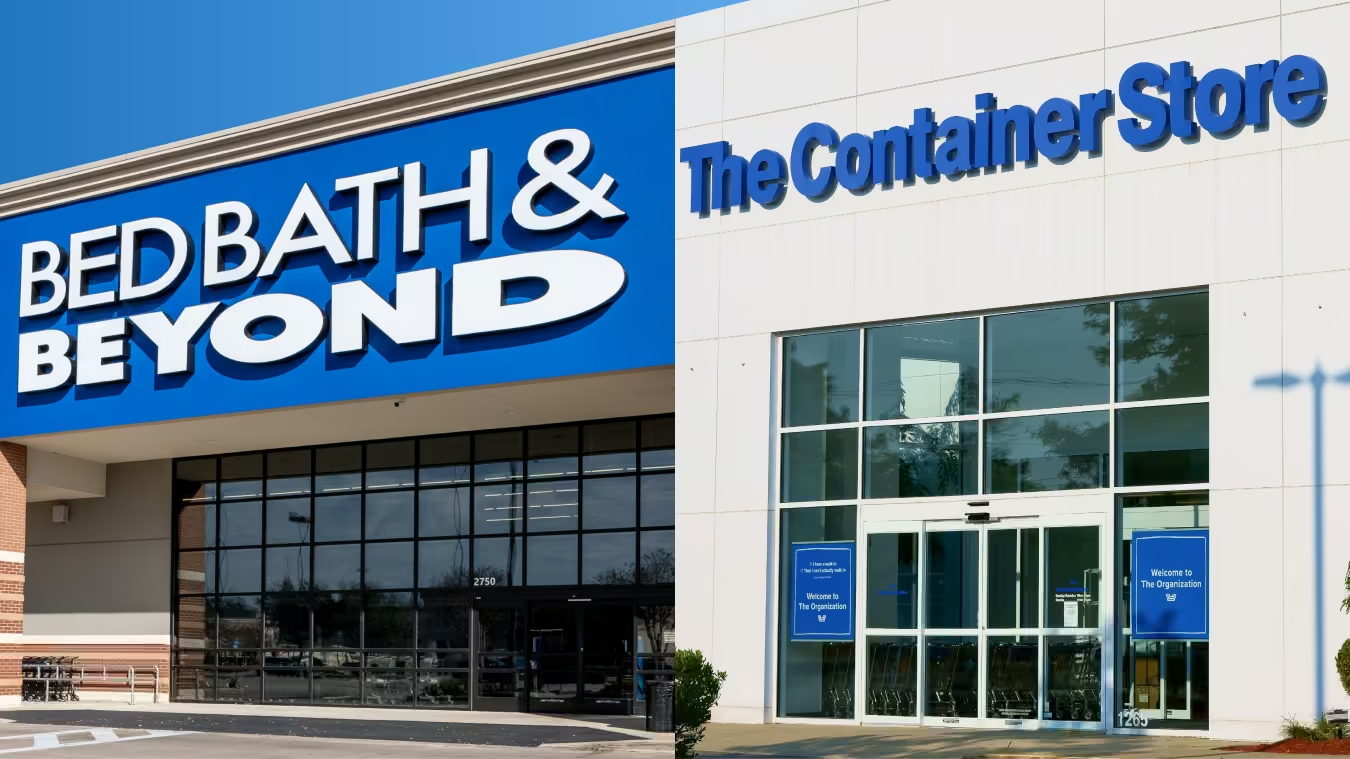
In apparel specifically, Gap and Abercrombie & Fitch – two brands that dominated the cultural zeitgeist of the 1990s and early 2000s before seeing their popularity decline somewhat in the late aughts and 2010s – may be staging a comeback. Bed Bath & Beyond, a leader in the home goods category, is also making a play at returning to physical retail through partnerships.
Anthropologie, another legacy player in women’s fashion and home goods, is also on the rise. Anthropologie’s distinctive aesthetic resonates deeply with consumers – especially women millennials aged 30 to 45. And by capturing the hearts of its customers, the retailer stands as a beacon for retailers that can hedge against promotional activity and still drive foot traffic growth.
And visits to the chain have been rising steadily. In Q4 2023, the chain experienced a bigger holiday season foot traffic spike than pre-pandemic, drawing more overall visits than in Q4 2019. And in Q3 2024, visits were higher than in Q3 2023.
And speaking of the 35 to 40 set – the generation that all retailers are courting? Millennials. Does that sound familiar? Yes, because this is the same generational cohort that retailers tried to target a decade ago. As millennials have aged into the family-formation stage of life, their retail needs have evolved, and the industry is now primed to meet them.
From the revival of nostalgic brands like the Limited Too launch at Kohl’s to warehouse clubs expanding memberships to younger consumers as they move to suburban and rural communities, there are myriad examples of retailers reaching out to this cohort. And Sam’s Club offers a prime example of this trend.
Over the past few years, millennials and Gen-Zers have emerged as major drivers of membership growth at Sam’s Club, drawn to the retailer’s value offerings and digital upgrades – like the club’s Scan & Go technology. Over the same period, Sam’s Club has grown the share of “Singles and Starters” households in its captured market from 6% above the national benchmark in Q3 2019 to 15% in Q3 2024. And with plans to involve customers in co-creating products for its private-label brand, Sam’s Club may continue to grow its market share among this value-conscious – but also discerning and optimistic – demographic.
Millennials are also now old enough to wax nostalgic about their youth – and brands are paying attention. This summer, Taco Bell leaned into nostalgia with a promotion bringing back iconic menu items from the 60s, 70s, 80s, and 90s – all priced under $3. The promotion, which soft-launched at three Southern California locations in August, was so successful that the company is now offering the specials nationwide. The three locations that trialed the “Decades Menu” saw significant boosts in visits during the promotional period compared to their daily averages for August. And people came from far and wide to sample the offerings – with a higher proportion of visitors traveling over seven miles to reach the stores while the items were available.
Hot on the heels of a tumultuous 2023, 2024’s retail environment has certainly kept retailers on their toes. While embracing innovative value has helped some chains thrive, other previously ascendant value segments, including discount & dollar stores, may have reached their growth ceilings. Consumers clearly care about convenience – but are willing to make multiple grocery stops to find what they need. At the same time, legacy brands are plotting their comeback, while others are harnessing the power of nostalgia to drive millennials – and other consumers – through their doors.