.png)
.png)

.png)
.png)

Migration to the Mountain States, named for the sprawling Rocky Mountain range that runs through the region, has been on an upward trend in recent years. And one state in particular – Utah – has received an impressive influx of new residents.
Which areas are experiencing the most growth? And what is driving migration to the Beehive State? We take a closer look.
Utah, with its iconic national parks and burgeoning tech industry, is growing fast. According to Placer.ai’s Migration Trends Report, Utah experienced an 5.5% rise in population between January 2020 and January 2024, partially driven by inbound domestic migration: 1.8% of the state’s January 2024 population moved in between January 2020 and January 2024.
Utah has a relatively young population – the median age in Utah (according to the 2021 ACS 5-Year Projection dataset) is 31. But relocators to the state seem to be coming from older states – the weighted median age in the states of origins of newcomers moving to Utah over the past four years was 38.
But although Utah’s median age is lower than the median age in the states of origin, the median HHI in the Beehive State is higher than in its feeder states. Between January 2020 and January 2024, the weighted median HHI in the states feeding migration to Utah was $71K/year, lower than the Utah median of $79K/year (although higher than the national average of $69.0K/year).
.avif)
Although Utah as a whole has seen positive net migration over the past four years, the new residents are not evenly distributed across the state’s major metropolitan areas. Inbound domestic migration was particularly strong in the Provo-Orem and Ogden-Clearfield CBSAs (core-based statistical areas), with both states also seeing significant increases in their population (10.7% and 5.1%, respectively) over the past four years. But during the same period, the migrated share of the population of Utah’s largest CBSA – Salt Lake City – has declined, and the overall population in the Salt Lake City CBSA grew by just 1.0%. So what is driving migration to Provo-Orem and Ogden-Clearfield?
.png)
January 2020 to January 2024 migration data reveals that relocators to Provo and Ogden come from CBSAs with a lower median age and HHI compared to those moving to Salt Lake City: Newcomers to the Provo-Orem and Ogden-Clearfield CBSAs came from CBSAs with a weighted median HHI of $73K and $72K, respectively, compared to a $75K median HHI for CBSAs feeding migration to the Salt Lake City CBSA. And the weighted median age in the CBSAs of origin for Provo-Orem and Ogden Clearfield was 25 and 32, respectively, compared to 33 in the CBSAs of origin for Salt Lake City.
The movement of younger people from lower-HHI areas to these CBSAs may indicate that many of those relocating to Utah to benefit from the state’s robust economy are specifically choosing the Provo-Orem and Ogden-Clearfield metro areas.
.avif)
Niche’s Neighborhood Grades – available in the Placer.ai Marketplace – assigns grades to various types of regions based on a variety of factors, including job opportunities. And comparing the Niche rating for “Jobs” assigned to Utah’s three largest CBSAs with the aggregate “Jobs” grade assigned to the CBSAs of origin also suggests that Provo and Ogden’s economic opportunities are driving migration to these smaller metro areas.
All three Utah CBSAs analyzed received a higher “Jobs” grade than their CBSAs of origin – indicating that the employment opportunities in all three metro areas are likely drawing newcomers. But while Salt Lake City only got a “B+” in “Jobs” – just one grade up from the aggregate grade assigned to its areas of origin – Provo-Orem and Ogden-Clearfield got a “Jobs” grade of “A-”, or two notches up from the “Jobs” grade in their CBSAs of origin. The highly robust job markets in these smaller CBSAs may explain why newcomers seem to prefer Provo-Orem and Ogden-Clearfield to Salt Lake City.
.avif)
Utah’s population growth makes it one of the most exciting states to watch, and the state’s promising employment opportunities seems to be a major draw for newcomers to the state.
Will Utah continue to experience population growth?
Visit placer.ai to keep up with the latest migration trends.
This blog includes data from Placer.ai Data Version 2.0, which implements improvements to our extrapolation capabilities, adds short visit monitoring, and enhances visit detection.

In a world where convenience is key and online shopping reigns supreme, many brands are turning to experiential retail to draw visitors into brick-and-mortar stores. We take a look at three companies with different types of experiential offerings – Michaels, DICK’S, and Lowe’s Home Improvement – to understand what experiential retail can look like in 2024.
Some retailers are encouraging consumers to engage fully in their brand by dedicating entire brick-and-mortar venues entirely to immersive experience. Sporting goods brands in particular, including Lululemon with its yoga studios and Nike and its training studios, have employed this strategy to directly engage with their core audience. And perhaps the best example of this is the DICK’S House of Sport concept, launched in 2021 by sporting goods retailer DICK’S.
DICK’S currently operates 12 House of Sports locations where visitors can repair their bikes, pick out a golf club, use a climbing wall or batting cage. The concept has been highly successful, especially as more people engage in some form of recreational sports or fitness activities, and the chain is looking to add at least 100 more of these experiential stores in the next five years.
Quarterly foot traffic patterns suggest that the new locations will be met with enthusiasm. Visits to the three longest-running House of Sports stores in Q4 2023 were 7.2% higher than they were in Q4 2022, while visits to DICK’S Sporting Goods stores nationwide were 2.3% lower for the same period. Psychographic data also reveals that House of Sport visitors also tend to be slightly older and more established than visitors to DICK’S nationwide – and this older audience may be more inclined to spend more than their younger counterparts.
%20(1).avif)
By creating an immersive athletic experience that taps into the growing popularity of personal fitness, House of Sport can continue to draw in visitors and foster community – and serve as a model for other sporting goods retailers looking to expand their experiential offerings.
Retailers who don’t want to devote an entire location to their experiential offering can also leverage their regular venues to offer visitors hands-on engagement with their products on certain days or time slots. Rising costs have led more people than ever to turn to DIY – and meeting that demand, leading home improvement retailer Lowe’s has introduced a DIY workshop on Saturdays and Sundays at 100 locations across the country. Visitors heading to participating Lowe’s stores will be able to participate in workshop stations and take advantage of all-day demos – with no registration required. The company also runs a family-friendly Weekending at Lowe’s program, which allows visitors to register to free workshops focused on child-friendly activities, such as creating a butterfly biome or a tabletop basketball game
Providing people with a hands-on, practical approach to home repairs may help Lowe’s expand its customer base as more people embrace DIY concepts. Participants in the DIY workshops may feel more confident in tackling new projects at home. They are also more likely to choose Lowe’s products due to familiarity with the store and its offerings — a win for the company.
Comparing year-over-year (YoY) visits at Lowe’s locations with DIY workshops to the foot traffic performance of the chain as a whole indicates that the DIY venue, while experiencing the effects of the ongoing retail headwinds, are managing to perform better than Lowe’s stores overall. And analyzing locations using the Spatial.ai: PersonaLive dataset reveals that Lowe’s DIY stores are particularly popular among rural segments, with more "Rural Average Income" and "Rural Low Income" segments in their captured markets than their potential market*.
*A chain’s potential market refers to the population residing in a given trade area, where the Census Block Groups (CBGs) making up the trade area are weighted to reflect the number of households in each CBG. A chain’s captured market weighs each CBG according to the actual number of visits originating to the chain from that CBG.
.png)
Lowe’s can harness this data if it seeks to expand the DIY concept further to help it capitalize on its success among rural audiences – and other retailers can take note of the demand for hands-on workshops from this segment.
A third model for experiential retail empowers the customer to take the reins and decide when to schedule the in-store event – and who to add to the guest list. Craft chain Michaels, which has long emphasized child-friendly experiences like summer camps and free classes, recently introduced store-hosted birthday parties for kids up to age 13.
Demographic data from both potential and captured trade areas suggest that this focus on kids activities is succeeding in attracting the family households in its trade area. Michaels attracts a larger share of married couples with children in its captured market than in its potential market, and has a captured market household size of 2.6, slightly larger than its potential market household size. The share of households in Experian: Mosaic’s “Suburban Style,” “Flourishing Families”, and “Family Union” segments were also all higher in Michaels captured market than in its potential market.
.avif)
Michael’s seems to be positioning itself as a one-stop shop for crafters of all ages, and focusing on children’s events may help the chain attract more family segments to its stores. This serves as a reminder of the draw that quality children’s entertainment can provide and offers a blueprint for retailers wishing to attract more families to their locations.
These three chains prove that there are plenty of ways to attract people into brick-and-mortar stores. By offering workshops, events, and in-store attractions, the three chains are building brand awareness and increasing their foot traffic.
Will experiential retail continue to dominate in 2024?
Visit placer.ai/blog to stay up-to-date on the latest retail trends.
This blog includes data from Placer.ai Data Version 2.0, which implements improvements to our extrapolation capabilities, adds short visit monitoring, and enhances visit detection.

One of the major stories of 2023 was the rise in food prices, with costs up roughly 25% since 2020 – and the increasing costs of food and other goods have helped discount grocers thrive.
We checked back in with two grocery chains known for their bargain prices and private labels – Aldi and Lidl – to see how they’re doing.
Aldi offers prices that rival those of discount grocers, making it a major player in the discount grocery segment. And these attractive prices have helped the company see significant visit growth over the past few years. Year-over-year (YoY) monthly visits to Aldi were up throughout 2023 and into 2024, with some of the growth due to the chain’s aggressive expansion. And the company plans to grow even further – Aldi has announced plans to open another 800 stores over the next few years.
Lidl – another German-based grocer – opened its first location in Virginia in 2017. The chain currently has around 170 locations in the country, primarily on the East Coast, and is also expanding – albeit at a slower pace. Between February 2023 and February 2024, YoY visits to Lidl were up almost every month with only a slight dip in January 2024 – perhaps due to the unseasonal cold – a promising sign for the discount grocer as more consumers than ever choose low-cost food options.

Although both Lidl and Aldi are German-owned discount grocers, examining the demographics for the two brands' trade areas nationwide sheds light on the differences between the two chain’s consumer bases.
Analyzing the trade area median HHI reveals that Lidl attracts a higher-income clientele than Aldi: The median household income (HHI) in Aldi’s trade area was slightly lower than the the nationwide median, with the median HHI in the chain’s captured market even lower than the median HHI in its potential market. This indicates that Aldi locates its stores in areas that are accessible to the average consumer and succeeds in attracting also the slightly lower income segments within its potential trade area.
Meanwhile, Lidl’s potential market median HHI stood at $78.8K/year in 2023, and the median HHI in its captured market was even higher – $88.1K/year – indicating that Lidl stores are located in more affluent areas, and that the company caters to the wealthier households within those neighborhoods.
The share of households with children in Aldi’s potential and captured market was also almost identical to the nationwide average – indicating once again Aldi’s success in reaching the average U.S. grocery shopper. Lidl, on the other hand, saw more households with children in both its captured and potential markets, with the share of households with children in its captured market around two percentage points higher than the share of households with children nationwide. So while Aldi and Lidl do share some similarities in terms of origins, preference for private label, and pricing, the trade area analysis points to major differences between the two chains’ audiences.
*A chain or venue’s potential market refers to the people that reside in its trade area, based on the business’ True Trade Area and weighted by census block group (CBG) within the trade area according to the size of its population. Captured markets represent the population that visits the business in practice, and the data is obtained by weighting each CBG according to its share of visits to the chain or venue in question.
.png)
Diving into the psychographic data for Aldi and Lidl adds another dimension to the trends revealed by the demographic data. While both brands are popular among suburban audiences – Aldi tends to attract a more blue-collar customer, while Lidl is frequented by a wealthier suburban segment. The share of visitors falling into the “Small Town Low Income” category was 7.5% for Aldi compared to 0.9% for Lidl. Conversely, Lidl saw 16.7% of its visitors falling into the “Upper Suburban Diverse Families” segment, while Aldi had 10.6% of its consumers in that category.
And while Aldi and Lidl have a hold on different suburban segments, the chains’ expansion strategies seem geared to grow each chain’s reach outside the other’s orbit. Lidl has been opening stores in big cities along the East Coast, including New York City’s tony Chelsea neighborhood, perhaps in a bid to reach more of the wealthier customers that favor the brand. Aldi, meanwhile, recently acquired grocery chains Winn-Dixie and Southeast Grocers, brands that typically attract a more price-sensitive consumer. This acquisition will significantly expand Aldi’s presence and will likely appeal to value-oriented shoppers, a segment already receptive to its offerings.
.png)
The past few years have seen the grocery space adapting to an increasingly value-oriented consumer, and Aldi and Lidl have benefitted from this shift. As inflation cools and both companies expand their footprints, will they continue on their upward trajectory?
Follow Placer.ai’s data-driven retail analyses to find out.
This blog includes data from Placer.ai Data Version 2.0, which implements improvements to our extrapolation capabilities, adds short visit monitoring, and enhances visit detection.

Since COVID, millions of Americans have relocated from major population centers in California, New York, and Illinois (among others) to other regions of the country. Whether in search of job opportunities, affordable housing, or simply a change of scenery, thousands of people have decamped to places like Tampa, Florida, Bozeman, Montana, and Portland, Maine. And the great state of Texas – with its wide open spaces and relatively affordable cost of living – has emerged as a favored destination.
So with 2024 underway, we dove into the data to explore domestic migration trends in the Lone Star State. How much has the population of Texas grown as a result of domestic migration over the past several years – and which metro areas (CBSAs) are attracting new residents? Are people moving to major cities like Dallas, Houston, Austin, and San Antonio, or are they heading out to the suburbs?
Between December 2019 and December 2023, Texas’ population grew by 4.3% – with nearly a third of this increase driven by new residents hailing from elsewhere in the U.S.
Perhaps unsurprisingly, many of these new arrivals made a bee-line to Texas’ four most populous metropolitan areas – Austin-Round Rock-Georgetown, San Antonio-New Braunfels, Dallas-Fort Worth-Arlington, and Houston-The Woodlands-Sugar Land. During this time period, each of these CBSAs experienced positive net migration (meaning that more people moved to these areas than away from them) ranging from 0.4% to 3.4%.
.avif)
But a deeper analysis of foot traffic trends reveals that, even as the CBSAs as a whole added new residents, the primary cities anchoring the CBSAs often lost more domestic migrants than they gained. Austin proper lost 6.1% of its population to relocation, while Dallas, Houston, and San Antonio lost 4.2%, 3.9%, and 3.2%, respectively. Only Fort Worth – Texas’ fifth-most-populous city – experienced positive net migration over the past four years.
.png)
Why are major metropolitan areas seeing population influxes, even as their central urban hubs experience outflows? Drilling down even deeper into zip-code level location intelligence provides a striking snapshot of what’s actually happening on the ground.
In all four CBSAs, zip codes belonging to the metro area’s flagship city were more likely to experience negative net migration – while those in further-away suburbs and towns were more likely to see positive inflow.

The relative growth experienced by Fort Worth can be understood against this backdrop: Fort Worth may be one of Texas’ biggest cities, but it is smaller – and less expensive – than Dallas, which dominates the metro area.
Suburban life offers residents many of the benefits of proximity to major urban centers, without some of the drawbacks – like smaller homes. And with more Americans free today to live further away from the office, many appear to be choosing suburban chill over big-city hassle.
Home to the Alamo, a premier state fair, and arguably one of the cultiest grocery chains in the country (H-E-B, of course), Texas has become a key destination for Americans seeking greener (and cheaper) pastures. And though major metropolitan centers in the Lone Star State have seen significant positive net migration over the past four years – much of that growth has taken place outside of the state’s biggest cities.
How will Texas’ population continue to evolve over the next months and years? Will big cities make a comeback – or are suburbs and smaller towns poised to remain the main drivers of growth?
Follow Placer.ai’s data-driven domestic migration analyses to find out.
This blog includes data from Placer.ai Data Version 2.0, which implements improvements to our extrapolation capabilities, adds short visit monitoring, and enhances visit detection.

Brands like M&Ms, Hershey’s, and Jelly Belly are redefining what it means to be as happy as a “kid in a candy store.” With their life-size M&M characters on a flagship in Orlando, FL, a chocolate Statue of Liberty sculpted out of 800 pounds of Hershey’s chocolate on the Las Vegas Strip, or a working jellybean factory tour in Fairfield, CA, manufacturers are literally bringing their brands to life. M&M’s World in Orlando, FL posted particularly impressive year-over-year visits in the second half of 2023.
Recently, Hollywood darling Timothee Chalamet starred in the fantastical movie Wonka, grossing $600M+ worldwide. In other headline news, the “tried to jump on the wagon but failed miserably” fiasco of the unauthorized Willy’s Chocolate Experience in Scotland reveals that the appetite for sweets and chocolate is insatiable. Never fear, if you missed the Candytopia pop-up a few years ago, you can head over to Dylan’s Candy Bar for an experience right out of Charlie and the Chocolate Factory. It’s clear that demand peaks in the summer, probably due to locations that see summer tourists. The holidays are another popular season for buying sweets.
At Hershey’s Chocolate World, one can be immersed in all-things chocolate, from creating your own candy to taking a selfie with a life-size Reese’s peanut butter cup. The dessert options are limited only by your imagination. That tower of S’mores sure looks tempting!

Many visitors also opt to visit the Hershey Story Museum or stay at Hershey Lodge or the Hotel Hershey.

If you prefer your sweets in liquid form, there are three Coca-Cola Stores--in Atlanta, Las Vegas, and Orlando--to satisfy your cravings. Here, you can buy a Coke plushie, flout the famous “Enjoy Coca-Cola” slogan shirt in a variety of languages, or dress yourself head-to-toe in comfy Coke PJs. One of the coolest options is an international tasting flight that lets you try out Coca-Cola beverages from around the world, with flavors like sparberry from Zimbabwe.

At the Coca-Cola Store in Orlando, FL, visitation jumps during vacations like Spring Break, summer, and Christmas holidays.
Another beloved brand that has made its way into brick-and-mortar is King’s Hawaiian. Founded in 1950, they were famous for their round loaves of sweet and fluffy Hawaiian bread. Fast forward three-quarters of a century later, and they have added new options like savory dinner rolls or pull-apart pans of bread. One can experience gastronomic delights made with Hawaiian bread at their Torrance-based King’s Hawaiian Bakery and Restaurant.
The restaurant menu includes breakfasts featuring their famous King’s Hawaiian Sweet Bread as French toast, lunch and dinner options like Macadamia Nut Onion Rings, Chicken Katsu Curry Loco Moco, and Saimin noodles, but it’s the bakery that literally takes the cake. The Paradise Delight Cake has three layers of chiffon cake in enticing flavors like guava, passionfruit, and lime. It is then topped with layers of fresh strawberries, peaches, and kiwis. One can also choose from chocolate, coconut, pineapple, raspberry cakes, and more.

With Placer's ranking of "Breakfast, Coffee, Bakeries, and Dessert Shops" indicating that King's is in the top 1% nationwide and statewide, it looks like they've found a sweet recipe for success.


The Waldorf Astoria and Ritz-Carlton hotels are two of the most recognizable names in luxury lodging. Both opened in New York City – the Waldorf Astoria in 1893 and the Ritz-Carlton in 1911 – and are owned by two major hotel corporations: the Waldorf Astoria is part the Hilton Hotels & Resorts portfolio of brands, while the Ritz-Carlton is part of Marriott International, Inc’s portfolio.
Who is most likely to visit each brand? What are the similarities – and differences – between the two hotels’ guest segmentations? We take a closer look at the demographic and psychographic data to find out.
Analyzing the demographic makeup of the Waldorf Astoria and Ritz-Carlton’s trade areas by layering the STI: Popstats dataset onto captured market trade areas revealed that the Waldorf Astoria’s trade area has a higher share of households with children compared to that of the Ritz-Carlton (25.6% compared to 23.6%). But both chains had a smaller share of households with children in their trade areas relative to the nationwide average (27.6%). It seems, then, that singles or empty nesters may be more likely to book a luxury getaway than consumers with heavier parenting responsibilities.
Unsurprisingly, the chains also attract a particularly high-income clientele: The median household income (HHI) in both brands’ trade areas is over 50% higher than the nationwide median ($108.4K and $104.5K for the trade areas of the Waldorf Astoria and Ritz Carlton, respectively, compared to a nationwide median of $69.5K). The data also showed that Waldorf Astoria’s trade area is slightly more affluent than that of the Ritz-Carlton – perhaps due in part to the Ritz-Carlton’s recent attempts to court younger guests.
.avif)
Leveraging the Spatial.ai: PersonaLive dataset to explore the psychographic composition of the hotel chains’ trade area further supports the distinctions between the brands highlighted in the demographic analysis.
The psychographic analysis showed that the Waldorf Astoria had more family segments in its trade area than the Ritz-Carlton, while the Ritz-Carlton catered to more single and empty-nester households – as expected given the demographic composition of the chains’ trade areas.
.avif)
Luxury hotels are known for their impeccable service – and to curate the ideal guest experience, these brands need to accurately predict their visitors' dining and leisure preferences. Hoteliers can leverage the Placer.ai Marketplace and combine trade area data with various datasets – including data on consumers’ social media activity with tools like the Spatial.ai: FollowGraph dataset – to pinpoint their guests’ tastes and preferences.
Analyzing the preferences for certain types of foods or entertainment within the hotel chains’ trade areas revealed – once again – similarities and differences between the brands. Both chains’ trade areas included larger shares of “Farm-to-Table Cooking Enthusiasts”, “Asian Food Enthusiasts”, and “Craft Coffee At-Home Enthusiasts,” as well as more “Opera Lovers” and “Salsa Music Fans” than the nationwide average. But the foodie segments were slightly more over-indexed within the Waldorf’s trade area, while residents of the Ritz-Carlton’s trade area seemed a little more keen on Opera and Salsa. These hotel chains can leverage this data to determine the type of dining or entertainment options that will set these brands apart from the competition and best attract their specific audience.
.avif)
The Waldorf Astoria and Ritz-Carlton continue to define luxury lodging in the country while attracting some of the nation's most discerning guests. Understanding the demographic and psychographic guest segmentation of each chain can help inform your loyalty strategy.
For more data-driven travel & leisure insights, visit placer.ai/blog.
This blog includes data from Placer.ai Data Version 2.0, which implements improvements to our extrapolation capabilities, adds short visit monitoring, and enhances visit detection.
The grocery industry has navigated unprecedented challenges in recent years – from pandemic-driven shifts in consumer behavior and supply chain disruptions to rising costs, labor shortages, and increased operational demands. In the face of these hurdles, the category has been pushed to innovate, adapting everything from product selections to shopping formats to meet changing consumer expectations.
But within the grocery industry, some segments resonate particularly strongly with the 2024 consumer. This white paper dives into the data to explore two segments that have been leading category-wide visit growth for some time: specialty and fresh format stores, which focus on produce, organic foods, and culturally specific items (think Trader Joe’s, Sprouts Farmers Market, and H Mart, to name a few), and value grocery chains like Aldi, WinCo Foods, and Grocery Outlet Bargain Market. Location analytics show shoppers are increasingly drawn to these two grocery store types, a shift that has the potential to reshape the grocery landscape.
How did value and specialty grocery chains perform in Q3 2024 in comparison to traditional supermarkets like Kroger, Albertsons, and H-E-B? How does visitor behavior vary between the three grocery segments, and what differences can be observed in the demographic and psychographic make-ups of their trade areas? The report explores these questions and more below.
The grocery industry has performed well over the past few months, with steady weekly year-over-year (YoY) visit increases throughout Q3 2024. During the week of July 1st, the segment saw a 4.6% YoY foot traffic boost, likely driven by shoppers loading up on ingredients for Independence Day barbecues and picnics. And after tapering somewhat in early August, visits picked up again in September, with YoY increases ranging from 2.0% to 2.9% throughout the month. This positive growth is a good sign for the segment – which has experienced more than its fair share of challenges over the past few years.
Though the grocery category as a whole is thriving, a closer look at different segments within the industry reveals that some are seeing more significant growth than others.
Indeed, digging deeper into grocery visits throughout Q3 2024 reveals that much of the industry’s growth is being driven by specialty and fresh format stores and value grocery chains. The two segments offer markedly different shopping experiences: Specialty chains tend to emphasize harder-to-find ingredients and fresh produce – sometimes even at higher price points than traditional grocery stores – while value grocery stores focus on affordability. But both categories are experiencing outsize visit growth in 2024, highlighting consumers’ dual interest in both quality and value.
In July and August 2024, traditional supermarkets, specialty grocers, and value chains all experienced positive YoY visit growth. But while traditional grocery stores saw a 3.1% increase in July and just a 0.9% uptick in August, value and specialty chains saw YoY growth ranging from 4.7% to 7.7% during the two months. In September 2024, YoY visits to traditional grocery stores fell by 0.5%, while value and specialty chains saw 5.0% and 5.2% increases, respectively. For today’s consumer, it seems, savings are key – but specialty offerings also resonate strongly.
Today’s grocery shoppers are increasingly embracing specialty grocery options – and analyzing consumer driving habits to grocery stores shows that they are willing to go the extra mile to reach them.
Breaking down grocery visits by distance traveled reveals that just 18.5% of visits to specialty and fresh format grocery chains came from less than one mile away in Q3 2024 – compared to 23.9% for traditional grocery stores and 23.2% for value chains. Similarly, 31.3% of visits to specialty and fresh format grocery stores originated from one to three miles away, compared to 34.7% and 34.5% for the other analyzed segments.
On the flip side, some 26.4% of visits to specialty and fresh format stores were made by people traveling at least seven miles to do their shopping – compared to 22.7% and 21.4% for traditional and value chains, respectively. Specialty grocery operators can account for this difference, locating stores in areas accessible to geographically dispersed audiences eager to shop their unique offerings.
And a look at changes in visitor behavior at three key specialty chains – Trader Joe’s, Sprouts Farmers Market, and Great Wall Supermarket – shows that even as these brands expand their footprints, customers are increasingly willing to travel the distance to visit them. Between 2019 and 2024, all three chains saw a marked increase in the share of visitors traveling over seven miles to shop their offerings. .
Asian grocery chain Great Wall Supermarket, a relatively small regional chain with some 22 locations across eight states, saw the most significant increase in visits from afar over the analyzed period. In Q3 2024, 32.3% of visits to the chain originated from seven or more miles away, up from 28.3% in Q3 2019. Ranked America’s Best Supermarket by Newsweek in 2024, the chain’s wide selection of everything from seafood to fresh produce has made it a hit among Asian food aficionados – and as the supermarket’s reputation grows, so does its draw among customers living further away from its venues.
Consumer favorite Trader Joe’s and organic grocery chain Sprouts Farmers Market also grew their shares of long-distance visits between 2019 and 2024 – no small feat for the two chains, given their expansion over the past several years.
This travel distance snapshot serves as a reminder of the unique role played by specialty grocery stores that offer their customers unique shopping experiences, premium or organic products, and culturally specific items. Shoppers will go out of their way to travel to these stores – and even as they expand and become more readily accessible, their growing popularity makes them ever-more attractive destinations for customers coming from further away.
While visitors to specialty grocery chains often travel long distances for unique offerings, cost-conscious consumers at value stores exhibit other behaviors that differentiate them from traditional and specialty grocery shoppers.
The rising cost of living has pushed the discount retail segment into overdrive – and value grocery chains are also benefiting. The category has flourished in recent years, with many bargain-oriented grocery chains adding new stores at a rapid clip to meet burgeoning consumer demand.
Like visitors to specialty grocery chains, value grocery shoppers demonstrate segment-specific behaviors that reflect their preferences and habits. And perhaps most strikingly, foot traffic data reveals that these shoppers tend to stay longer in-store than visitors to traditional and specialty grocery chains.
In Q3 2024, 26.5% of visits to value grocery chains lasted longer than 30 minutes, compared to 23.4% for traditional grocery chains and 23.7% for specialty and fresh format chains. This suggests that these stores attract shoppers who take their time and carefully consider price points, looking for the best value for their dollar – a need that the chains they frequent seem to be meeting.
Given the tremendous success of the value grocery space in recent years, it may come as no surprise that some traditional supermarkets are getting in on the action by opening or expanding discount banners of their own. How do such off-shoot banners impact these grocers’ reach?
Cult-favorite Texas grocery chain H-E-B opened the first branch of its value banner, Joe V’s Smart Shop, in 2010. The discount arm currently includes 11 stores – mainly in the Houston area – with several new stores opening, or in planning stages, in Dallas.
And foot traffic data shows that Joe V's attracts mission-driven shoppers who make less frequent but significantly longer trips than visitors to traditional grocery stores. In Q3 2024, the average visit duration at Joe V’s was 37.8 minutes, compared to just 26.8 minutes at H-E-B – a full 11 minute difference. At the same time, while 38.5% of Q3 visits to H-E-B were made by customers frequenting the chain, on average, at least four times a month, just 11.8% of visits to Joe V’s were made by visitors reaching that threshold.
Joe V’s is also more likely than H-E-B to attract parental households, with 36.8% of its captured market made up of households with children – significantly higher than H-E-B’s 32.0%.
Together, these data points paint a picture of the average Joe V’s shopper: cost-conscious, likely to have children, and inclined to carefully plan shopping trips to maximize savings and cut down on grocery runs. This suggests that they are mission-driven and focused on stocking up rather than running out to grab ingredients as the need arises.
Major grocery store operators often operate a variety of store types at different price points to appeal to as many shoppers as possible, and Hy-Vee is no exception. The regional grocery favorite launched a discount chain, Dollar Fresh, in 2018 and currently operates 25 stores under that banner, aiming to attract middle-class, cost-conscious shoppers.
Using Experian’s Mosaic dataset to analyze Dollar Fresh’s trade area reveals that the chain’s captured market features significantly higher shares of lower-middle-class family consumers than its potential one – highlighting its special draw for these shoppers. (A chain’s potential market is obtained by weighting each Census Block Group (CBG) in its trade area according to population size, thus reflecting the overall makeup of the chain’s trade area. A business’ captured market, on the other hand, is obtained by weighting each CBG according to its share of visits to the chain in question – and thus represents the profile of its actual visitor base. Comparing a chain’s captured market to its potential one can serve as a helpful gauge of the brand’s success at attracting key audience segments.)
In Q3 2024, the “Pastoral Pride” family segment represented 11.4% of Dollar Fresh’s captured market, compared to just 5.3% of its potential market. This over-representation of lower-middle-class consumers from small towns in Dollar Fresh’s captured market indicates that the chain is especially effective at drawing customers that belong to this segment. Though Hy-Vee’s captured market also boasted a higher share of this demographic than its potential one in Q3, the difference was much smaller – and the chain’s overall reach among these consumers was more limited.
In contrast, Hy-Vee excels at attracting “Flourishing Families” – affluent, middle-aged families and couples – who made up 10.3% of the supermarket’s captured market in Q3 2024. Dollar Fresh’s captured market, on the other hand, featured a smaller share of this segment than its potential one – showing that the discount chain is of less interest to these consumers. So while Hy-Vee tends to appeal to higher-income families with more spending flexibility, value-conscious shoppers have been making their way to Dollar Fresh.
This audience segmentation analysis shows how value offerings help grocery chains attract wider audiences – and highlights the advantage of operating multiple store types to appeal to a broader range of shoppers.
People will always need access to a variety of fresh foods – ensuring that grocery stores and supermarkets continue to play a vital role in in the retail landscape. And while the category as a whole has continued to thrive even in today’s challenging environment, specialty and value grocery chains resonate particularly strongly with the 2024 consumer. As grocery retailers diversify their formats, those aligning with consumer preferences for affordability, uniqueness, and quality are well-positioned for continued growth.
Malls have come a long way since their introduction to the world in the 1950s. These gleaming retail hubs promised shoppers a taste of the American dream, offering a third place for teens, families, and everyone in between to shop, socialize, and hang out.
And though malls have faced challenges in recent years, as e-commerce and pandemic-induced store closures led to shifts in consumer habits, the outlook is brightening. Malls have embraced innovation, incorporating enhanced entertainment, dining, and experiential offerings that attract a diverse range of visitors and redefine their purpose.
This white paper takes a look at the recent location intelligence metrics to gain an understanding of the changes taking place at malls across the country – including both indoor malls and open-air shopping centers. The report explores questions like: Why do malls experience foot traffic bumps during the summer months? How much of an impact do movie theaters have on mall visits, and what can mall operators learn from the Mall of America and American Dream malls’ focus on experiential entertainment?
Mall visitation is highly seasonal, with strikingly consistent monthly visitation patterns. Each year, visits decline somewhat in February, pick up in March, and begin to trend upward again in May – before peaking again in August. Then, after a slower September and October, foot traffic skyrockets during the holiday season, spiking dramatically in December.
And while these trends follow similar patterns every year, comparing monthly visits throughout 2019, 2023, and 2024 (YTD) to each year’s own January baseline shows that this seasonality is growing more pronounced - especially for indoor malls.
Following a lackluster 2023, visits to both indoor malls and open-air shopping centers peaked higher in March 2024 than in 2019. And this summer, indoor malls in particular saw a much larger visit boost than in previous years. In August 2024, for example, visits to indoor malls were 27.3% higher than in January 2024 – a substantially higher baseline jump than that seen either in August 2019 (17.0%) or in August 2023 (12.0%). And though open-air shopping centers experienced a smaller summer visit boost, they too saw a bigger bump this year than in 2019 or in 2023.
But malls aren’t just seeing larger visit spikes this year relative to their January baselines – they are also drawing bigger crowds than they did in 2023.
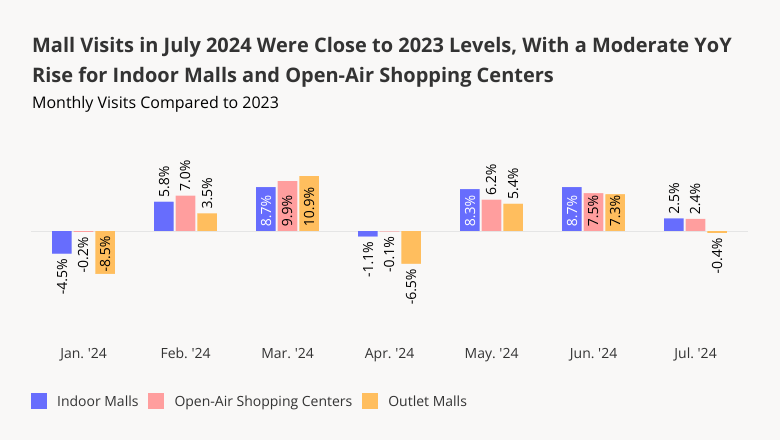
Between June and August 2024, indoor malls and open-air shopping centers both experienced year-over-year (YoY) visit growth. Indoor malls saw the largest YoY foot traffic boost (3.7%) – perhaps owing in part to 2024’s record-breaking heat, which led many patrons to seek refuge in air conditioned spaces. Still, open-air shopping centers, which feature plenty of air conditioned stores and restaurants, also enjoyed a YoY visit boost of 2.8% during the analyzed period.
Malls’ strong summer baseline and YoY foot traffic growth built upon the strong performance seen during most of 2024 so far, leading to the question: What is driving malls’ positive momentum? We delve into some of the factors propelling these changes below.
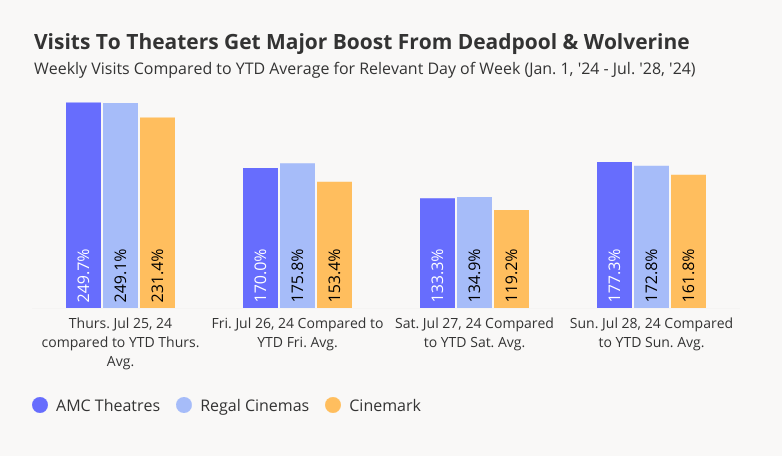
One offering that continues to play a significant role in driving foot traffic to malls is on-site movie theaters. Summer blockbuster releases, in particular, help attract crowds to theaters, in turn boosting overall visits to malls.
Much like malls, movie theaters have also proven their resilience over the past few years. While pundits fretted about the theater’s impending death, production houses were busy releasing blockbuster after blockbuster and shattering box-office records at an impressive clip. And while 2023 was certainly a banner year for blockbuster summer releases, 2024 has had its fair share of stunning box-office successes, leading to major visit boosts at theaters across the country.
Analyzing visits to malls with and without movie theaters highlights the impact of these summer Hollywood hits. Between June and August 2024, malls with theaters saw bigger visit boosts compared to a monthly year-to-date (YTD) average than malls without – an effect observed both for indoor malls and for open-air shopping centers.
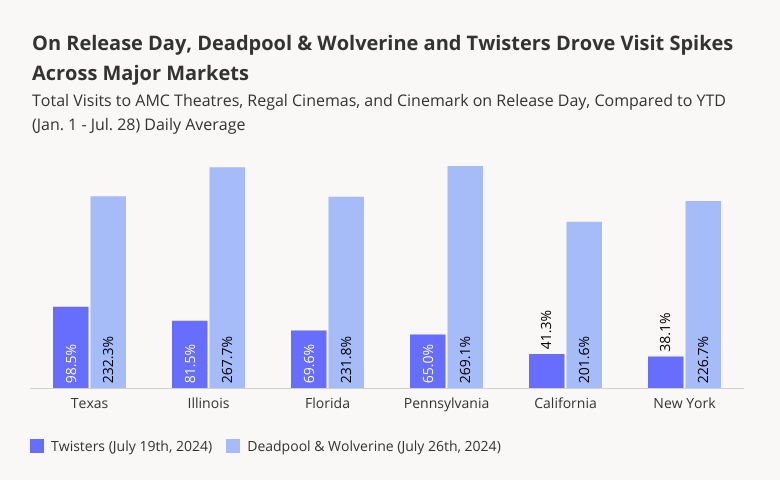
For both mall types, the gap between centers with and without movie theaters was most pronounced in July 2024, likely owing to the release of Inside Out 2 in mid-June as well as the July releases of Deadpool & Wolverine and Twister. But in June and August 2024, too, centers with movie theaters sustained particularly impressive visit boosts – a solid sign that movie theaters and malls remain a winning combination.
Malls with movie theaters also drew higher shares of evening visits (7:00 PM - 10:00 PM) this summer than those without. Between June and August 2024, for example, evening outings accounted for 22.9% of visits to open-air shopping centers with movie theaters – compared to 18.2% of visits to centers without theaters. Indoor malls with theaters also saw a larger share of evening visits than those without – 18.1% compared to 15.0%.
This increase in evening traffic is likely driven by major summer movie releases and the flexibility of summer schedules, with many visitors – including families – taking advantage of late-night outings without the concern of early wakeup calls. These summer visitation trends benefit both theaters and malls, opening up opportunities for increased sales through concessions, promotions, and evening deals that attract a more relaxed and engaged crowd.
Analyzing the demographics of malls’ captured markets also reveals that centers with movie theaters are more likely to attract certain family-oriented segments than those without. (A mall’s captured market consists of the mall’s trade areas – the census block groups (CBGs) feeding visitors to the mall – weighted according to each CBG’s actual share of visits to the mall.)
Between June and August 2024, for example, 14.2% of the captured markets of open-air shopping centers with movie theaters were made up of “Wealthy Suburban Families” – compared to 9.7% for open-air shopping centers without theaters.
Indoor malls saw a similar pattern with regard to “Near-Urban Diverse Families”: Middle class families living in and around cities made up 9.0% of the captured markets of indoor malls with movie theaters, compared to 7.1% of the captured markets of those without.
This increase in foot traffic from middle-class and wealthy family segments can be a boon for malls and retail tenants – driving up food court profits and bolstering sales at stores with kid-friendly offerings.
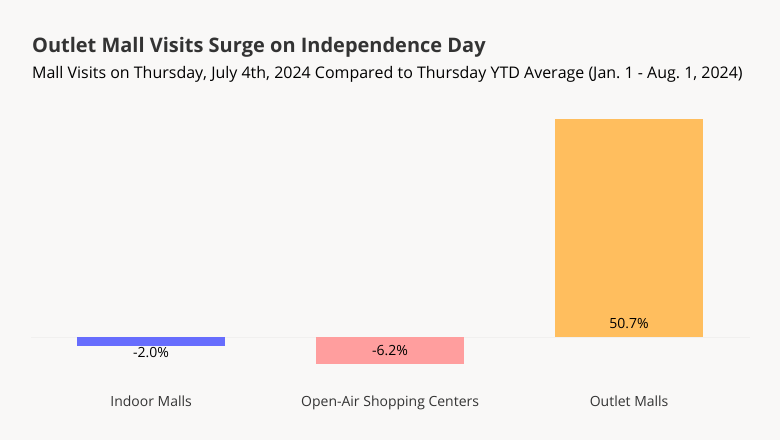
Malls have long positioned themselves as destinations for summer entertainment as well as retail therapy, holding – in addition to back to school sales – events like Fourth of July celebrations and even indoor basketball and arena football games. And during the summer months, malls attract visitors from further away.
Between June and August 2024, indoor malls drew 18.2% of visitors from 30+ miles away – compared to just 16.7% during the first five months of the year. Similarly, open-air shopping centers drew 19.6% of visits from 30+ miles away during the summer, compared to 17.1% between January and May.
Extended daylight hours, summer trips away from home, and more free time are likely among the contributors to the summer draw for long-distance mall visitors. But in addition to their classic offerings – from movie theaters to stores and food courts – malls have also invested in other kinds of unique experiences to attract visitors. This next section takes a look at two mega-malls winning at the visitation game, to see what sets them apart.
The Minneapolis-based Mall of America opened in 1992, redefining the limits of what a mall could offer. The mall boasts hundreds of stores, games, rides, and more – and is constantly expanding its attractions, cementing its status as a top destination for retail and entertainment.
Between June and August 2024, Mall of America experienced a 13.8% YoY visit increase, far outperforming the 3.7% visit boost seen by the wider indoor mall space. And as a major tourist attraction – the mall hosted a series of Olympic-themed events throughout the summer – it also drew 41.6% of visits from 30+ miles away. This share of distant visitors was significantly higher than that seen at the mall during the first five months of 2024, and more than double the segment-wide summer average of 18.2%.
The Mall of America also seems to be attracting more upper-middle-class families during the summer than other indoor malls: Between June and August 2024, some 18.0% of Mall of America’s captured market consisted of “Upper Suburban Diverse Family Households” – a segment including upper-middle-class suburbanites – compared to just 11.1% for the wider indoor mall segment. The increased presence of these families at the Mall of America may be driven by the variety of events offered during the summer.
In 2019, the American Dream Mall in New Jersey opened and became the second-largest mall in the country. Since the mall opened its doors, it has also focused on blending retail and entertainment to draw in as wide a range of visitors as possible – and summer 2024 was no exception.
The mall hosted the Arena Football League Championship, ArenaBowl XXXIII, on Friday, July 19th. The event successfully attracted a higher share of visitors traveling from 30+ miles away compared to the average summer Friday – 35.4% compared to 25.7%.
Visits to the mall on the day of the championship were also 13.6% higher than the Friday visit average for the period between June and August 2024, showcasing the mall’s ability to draw in crowds by hosting major events.
Malls – both indoor and open-air – continue to evolve while playing a central role in the American retail landscape. Increasingly, malls are emerging as destinations for more than just shopping – especially during the summer – driving up foot traffic and attracting visitors from near and far. And while much is often said about the impact of holiday seasons on mall foot traffic, summer months offer another opportunity to boost mall visits. Malls that can curate experiences that resonate with their clientele can hope to see foot traffic growth – in the summer months and beyond.
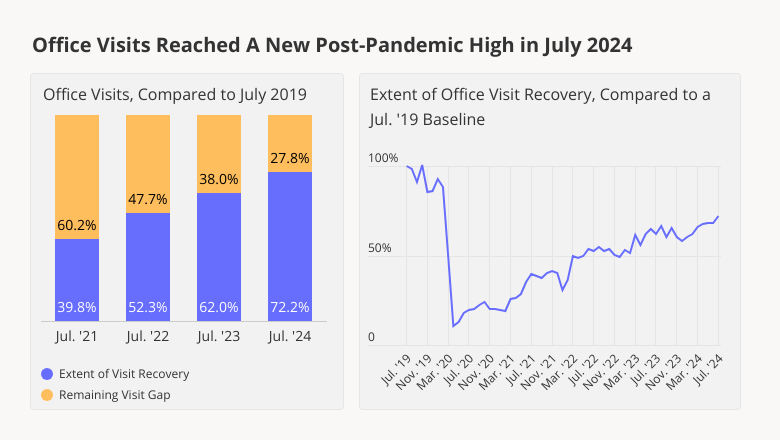
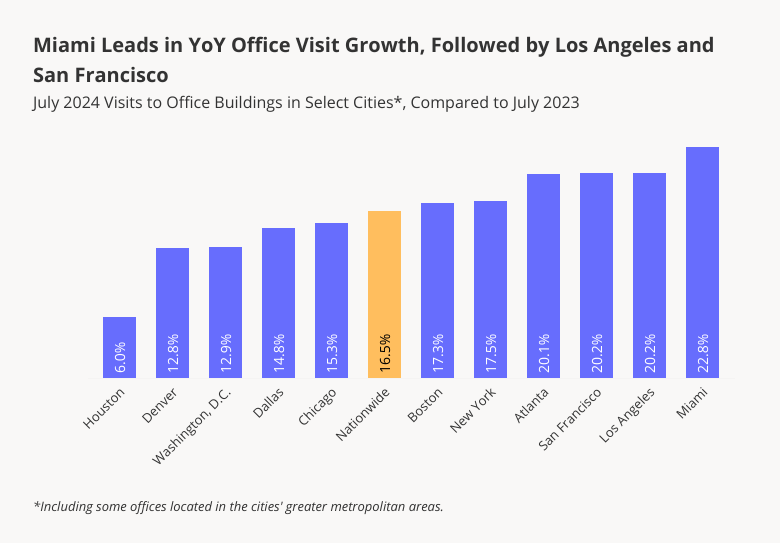
New York City is one of the world’s leading commercial centers – and Manhattan, home to some of the nation's most prominent corporations, is at its epicenter. Manhattan’s substantial in-office workforce has helped make New York a post-pandemic office recovery leader, outpacing most other major U.S. hubs. And the plethora of healthcare, service, and other on-site workers that keep the island humming along also contribute to its thriving employment landscape.
Using the latest location analytics, this report examines the shifting dynamics of the many on-site workers employed in Manhattan and the up-and-coming Hudson Yards neighborhood. Where does today’s Manhattan workforce come from? How often do on-site employees visit Hudson Yards? And how has the share of young professionals across Manhattan’s different districts shifted since the pandemic?
Read on to find out.
The rise in work-from-home (WFH) trends during the pandemic and the persistence of hybrid work have changed the face of commuting in Manhattan.
In Q2 2019, nearly 60% of employee visits to Manhattan originated off the island. But in Q2 2021, that share fell to just 43.9% – likely due to many commuters avoiding public transportation and practicing social distancing during COVID.
Since Q2 2022, however, the share of employee visits to Manhattan from outside the borough has rebounded – steadily approaching, but not yet reaching, pre-pandemic levels. By Q2 2024, 54.7% of employee visits to Manhattan originated from elsewhere – likely a reflection of the Big Apple’s accelerated RTO that is drawing in-office workers back into the city.
Unsurprisingly, some nearby boroughs – including Queens and the Bronx – have seen their share of Manhattan worker visits bounce back to what they were in 2019, while further-away areas of New York and New Jersey continue to lag behind. But Q2 2024 also saw an increase in the share of Manhattan workers commuting from other states – both compared to 2023 and compared to 2019 – perhaps reflecting the rise of super commuting.
Commuting into Manhattan is on the rise – but how often are employees making the trip? Diving into the data for employees based in Hudson Yards – Manhattan’s newest retail, office, and residential hub, which was officially opened to the public in March 2019 – reveals that the local workforce favors fewer in-person work days than in the past.
In August 2019, before the pandemic, 60.2% of Hudson Yards-based employees visited the neighborhood at least fifteen times. But by August 2021, the neighborhood’s share of near-full-time on-site workers had begun to drop – and it has declined ever since. In August 2024, only 22.6% of local workers visited the neighborhood 15+ times throughout the month. Meanwhile, the share of Hudson Yards-based employees making an appearance between five and nine times during the month emerged as the most common visit frequency by August 2022 – and has continued to increase since. In August 2024, 25.0% of employees visited the neighborhood less than five times a month, 32.5% visited between five and nine times, and 19.2% visited between 10 and 14 times.
Like other workers throughout Manhattan, Hudson Yards employees seem to have fully embraced the new hybrid normal – coming into the office between one and four times a week.
But not all employment centers in the Hudson Yards neighborhood see the same patterns of on-site work. Some of the newest office buildings in the area appear to attract employees more frequently and from further away than other properties.
Of the Hudson Yards properties analyzed, Two Manhattan West, which was completed this year, attracted the largest share of frequent, long-distance commuters in August 2024 (15.3%) – defined as employees visiting 10+ times per month from at least 30 miles away. And The Spiral, which opened last year, drew the second-largest share of such on-site workers (12.3%).
Employees in these skyscrapers may prioritize in-person work – or have been encouraged by their employers to return to the office – more than their counterparts in other Hudson Yards buildings. Employees may also choose to come in more frequently to enjoy these properties’ newer and more advanced amenities. And service and shift workers at these properties may also be coming in more frequently to support the buildings’ elevated occupancy.
Diving deeper into the segmentation of on-site employees in the Hudson Yards district provides further insight into this unique on-site workforce.
Analysis of POIs corresponding to several commercial and office hubs in the borough reveals that between August 2019 and August 2024, Hudson Yards’ captured market had the fastest-growing share of employees belonging to STI: Landscape's “Apprentices” segment, which encompasses young, highly-paid professionals in urban settings.
Companies looking to attract young talent have already noticed that these young professionals are receptive to Hudson Yards’ vibrant atmosphere and collaborative spaces, and describe this as a key factor in their choice to lease local offices.
Manhattan is a bastion of commerce, and its strong on-site workforce has helped lead the nation’s post-pandemic office recovery. But the dynamics of the many Manhattan-based workers continues to shift. And as new commercial and residential hubs emerge on the island, workplace trends and the characteristics of employees are almost certain to evolve with them.