Skip to Main Content
Thank you! Your submission has been received!
Oops! Something went wrong while submitting the form.
0
0
0
0
----------
0
0
Articles
Article
We're All Mad for March Madness: NCAA Women's Basketball is Breaking All Sorts of Records
Caroline Wu
Apr 12, 2024

This year’s March Madness really lived up to its name, buoyed by the star power of Caitlin Clark, Angel Reese, Paige Bueckers, and Juju Watkins driving viewership to new heights. For the first time in history, the NCAA women’s basketball title drew  more viewers than the men’s at 18.9M for the women’s and 14.8M for the men’s, per Nielsen.

Tickets to the Final Four cost $532 on average, an 82% increase over last year, and for the championship game, Rocket Mortgage Fieldhouse Stadium in Cleveland, OH was packed to the gills.

In the days leading up to the women’s final, nearby hotels saw visits increase as well.  

Article
Restaurants: Where Do We Stand After Q1 2024
R.J. Hottovy
Apr 12, 2024

Last week, we took a look at where the retail sector stood after Q1 2024, with a focus on superstores, home improvement, athletic footwear and apparel, and beauty. This week, to mark the release of short visit data with Placer’s Data Version 2.0 (which better captures visits that lasted 1 minute or longer for QSR/drive-thru locations) and the publishing of our latest dining whitepaper (The QSR Dining Advantage), we thought we’d take closer look at where the restaurant sector stands after Q1 2024.


When we looked at the restaurant category in January, most chains were reporting that visits were down on a year-over-year basis (which was partly a byproduct of inclement weather across much of the country) but that there was a sense of optimism about 2024. Looking at trends by category, we see that operators were justified in this optimism, as visit trends have increased on a year-over-year basis for most categories since late January. After adjusting for calendar shifts for both Valentine’s Day and Easter, we also see strong fine dining visits for these holidays, indicating that consumers remain motivated by holiday and events (a theme we called out several times last year).

We’ve also been fielding several questions about daypart shifts given that the Placer.ai Nationwide Office Building Index (an index of data from some 1,000 office buildings across the country) continued to show an uptick in visits during March 2024 and now stands at about 67.3% of March 2019 visits. Below, we show the percentage of visits by daypart for quick-service restaurant (QSR) and full-service restaurant chains. Given the lift in office visits, it’s not surprising that we continue to see improvement in early morning (6:00 AM-9:00 AM) visits, but it’s notable that we continue to see strength in late morning (9:00 AM-12:00 PM) and afternoon (3:00 PM-6:00 PM) visits. We’ve already seen many QSR chains test new menu items that better address consumer preferences in these dayparts–McDonald's CosMc’s is just one example--and we’d expect more in the months ahead. We also continue to see strength in late night QSR visits, something that we’ve called out in the past. On the full-service dining front, we see 2023 visits still down compared to 2019 levels, but with improvement versus 2021 in most cases. Here, it’s interesting that the afternoon visits to full-service dining chains in 2023 is down only slightly compared to 2019, while the gap during the evening daypart is much wider. This reinforces some of our previous analyses on earlier dining times

With our Data Version 2.0 update, we can now more accurately monitor dwell time by restaurant channel. After bottoming-out in Q2 2020 as most chains shifted to a largely takeout model, we’ve seen dwell time steadily increase across most restaurant channels the past several years. The QSR and fast casual categories remain below pre-pandemic levels, which isn’t a surprise given an increase in drive-thru and takeout orders compared to 2019 levels. Still, some of the operators we’ve spoken to have indicated that drive-thru bottlenecks have become more of an issue in recent quarters, which may reflect in the increase in dwell times for the QSR category the past 4-5 quarters. On the other side of the spectrum, dwell time for casual dining chains has fully recovered. We believe this has been helped by the continued popularity of eatertainment concepts, which have almost twice the average dwell time as most casual dining chains. We also see that fine dining dwell time now exceeds pre-pandemic levels, which may be the result of consumers’ aforementioned focus on holiday/event dining, which tends to drive dwell times higher.

Restaurant chains still face obstacles–the spread between food at home (grocery prices) and food away from home (restaurant prices) remains high and the $20 minimum wage for QSR workers recently went into effect in California (our data does not indicate major visit changes going into effect as it may be too recent for behavioral changes to be noticeable). However, March and early April visitation trends help the optimism that many restaurant operators felt at the beginning of the year. With Panera (and other chains) evaluating a possible IPO and many other brands finally accelerating growth plans (with an increased emphasis on higher-growth markets in the Southern/Southeastern U.S.), we’d expect visitation trends to remain positive on a year-over-year basis in the months to come.

Article
Market Spotlight: How New Mexico Highlights its Cultural and Arts Scene to Drive Business and Leisure Tourism
Caroline Wu
Apr 12, 2024

Say the word New Mexico and one might picture the stunning cliff dwellings at Bandelier Monument, rich troves of Native American Pueblo culture, or the stunning artworks of Georgia O’Keefe. This vibrant state’s largest city is Albuquerque, but Santa Fe also lays claim to fame by being the oldest state capital in the United States.  

In Albuquerque, a large development is taking place centered around the Indian Pueblo Cultural Center. While one may be a bit surprised at its location, which is within an outdoor shopping center, it serves as a perfect anchoring point for a convention or a leisure trip. The museum features insights into 19 Pueblo cultures, and also hosts an authentic Indian kitchen where one can try indigenous favorites such as red chile beef stew, calabacitas, and assorted fruit pies. There is a Holiday Inn Express & Suites and a Towneplace Suites by Marriott just across the street for those who need accommodations. Meetings, parties, and events can be held onsite with particularly memorable experiences to be had in the outdoor arena and fire pit. One can even hold a wedding at the venue. And in a sign of the convenience store trend we are seeing towards localization, Four Winds offers a walk-in humidor with cigar selection, the ability to fill a growler with local craft beers, and an assortment of food, beer, wine, liquor, and tobacco.  

Further afield, an hour away in Santa Fe, visitors flock to the galleries galore, restaurants and bars like Coyote Cantina, or simply enjoy an ice cream while people watching at Santa Fe Plaza. One of the highlights for opera lovers around the world is coming to Santa Fe Opera House during its season, which runs from the end of June to the end of August. Here, one can enjoy the unique open-air aspect of the opera house while sobbing along to the sad fate of Violetta in La Traviata.

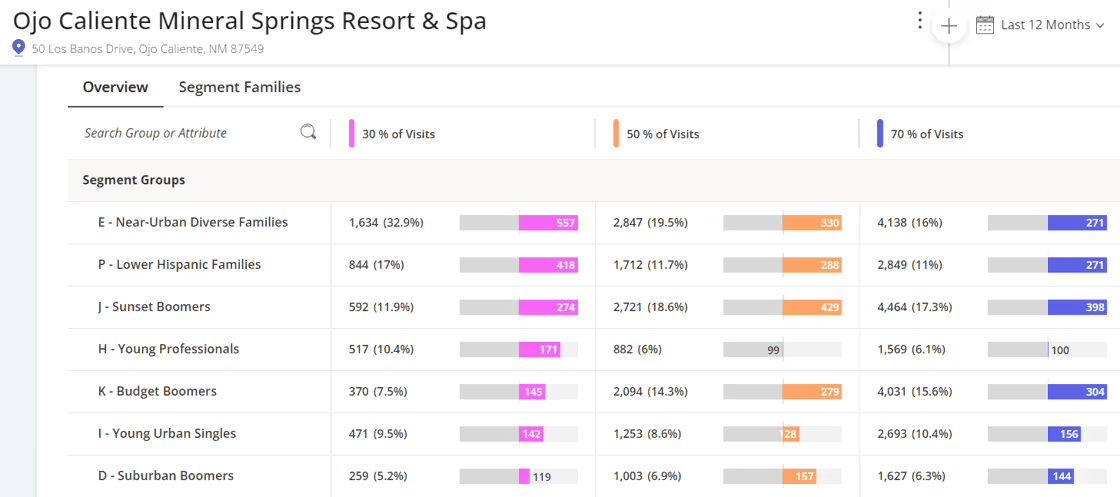
Junior Rangers might enjoy exploring Carlsbad Caverns, Aztec Ruins National Monument, or venture to Petroglyph National Monument. Adults seeking R&R can ski the day away in Taos or opt for a therapeutic visit to Ojo Caliente Mineral Springs Resort & Spa. A review of the resort describes it as “Just you, the blue New Mexico sky, peace and quiet.” Add to that a massage or spa treatment, and it sounds like just what the doctor ordered.

Ojo Caliente

One of the major employers in New Mexico is Los Alamos National Laboratory. A visit to the National Historic Park there will take you on an intriguing journey of key sites that were relevant to the Manhattan Project. Between last summer’s Oppenheimer blockbuster and current global sensation The Three-Body Problem fanning interest in cutting-edge science, this is a must-see location.

Article
Exploring Albertsons Companies’ Grocery Growth
Albertsons Companies is one of the largest grocers in the country, with around 20 grocery banners and stores in 34 states. We examine visit trends to some of the brands' main banners, the top-performing chains by state, and the demographics of the company's two biggest markets.
Bracha Arnold
Apr 11, 2024
3 minutes

Albertsons Companies is one of the largest grocers in the country, with around 20 grocery banners in its portfolio boasting around 2,200 stores in 34 states. Aside from its eponymous brand, Albertsons, the company owns major chains like Safeway and Vons, as well as smaller regional banners. 

With Q1 2024 under wraps, we take a closer look at visit trends to some of Albertsons Companies’ main banners, examine the top-performing chains by state, and dive into the demographics in the company’s two largest markets. 

Key Takeaways

  • Albertsons Companies’ largest banners have enjoyed strong foot traffic growth since the start of 2023. 
  • Albertsons and Safeway are popular in the West, and the company’s smaller chains play a significant role in the Midwest, South, Northeast, and Mid-Atlantic.
  • Albertsons Companies reaches shoppers from a variety of trade areas thanks to its different banners.

Quarterly Visit Growth in 2023 

Diving into 2023’s visits shows that the company’s eight major banners – Albertsons, Safeway, Vons, Jewel-Osco, ACME Markets, Shaw's Supermarket, United Supermarkets, and Tom Thumb – enjoyed year-over-year (YoY) visit growth during every quarters of the year. Visits to Jewel-Osco, and Shaw’s Supermarket were particularly elevated, with Q4 2023 visits YoY up 5.8%, and 5.9%, respectively. 

bar graph: albertsons companies' largest banners see growth every quarter of 2023

Strong Performance Continues In 2024

Albertsons Companies’ positive performance has continued in 2024. Visits to most of the chains remained positive YoY in January despite the chilling retail impact of early 2024’s arctic blast, and all banners saw significant growth in February and March. 

bar graph: albertsons companies' largest banners enjoy visit growth n 2024

Regional and Local Favorites

Albertsons Companies is headquartered in Boise, Idaho, and its eponymous banner is highly popular in the western United States. But the company has also gained a foothold in the South, Midwest, Mid-Atlantic, and Northeast – and solidified its dominance in the West – through several successful mergers.  

The company’s strategy of acquiring regional channels means that most states now have an Albertsons Companies’ banner catering to local grocery shoppers. Nationwide, the company’s most visited chains are Albertsons and Safeway – likely due to the sheer number of locations – but regional chains like Tom Thumb in Texas and Jewel-Osco in the Midwest are still the reigning Albertsons Companies banners in their areas.

map: albertsons and safeway are the most visited albertsons companies' banners overall; regional chains dominate in certain areas

California and Texas: Household Income Variances

California and Texas, the country's two most populous states, also boast the highest number of Albertsons Companies-owned grocery chains. Analyzing the demographic differences between the trade areas of the top three Albertsons Companies banners in each of the two states shows how the company leverages its banner variety to reach a larger audience. 

According to the STI:Popstats 2023 dataset, the median household income (HHI) in Texas is $75.9K. Two of the top three Albertsons Companies’ banners in the state had a trade area median HHI below the Texas statewide median – United Supermarkets at $58.7K/year, and Albertsons at $68.3K/year – while Tom Thumb drew visitors from neighborhoods with a median HHI of $99.5K. And in California, although all three most visited Albertsons Companies banners drew visitors from neighborhoods with a median income above the statewide median, the trade area HHI also exhibited a range – from $99.2K/year for Albertsons to $115.0K/year for Safeway. 

The variance in median HHI by banner and state highlights the benefit of operating grocery banners that can attract a range of shoppers from all along the income scale. By offering shopping options that cater to shoppers of all kinds, Albertsons Companies can hope to maximize its market reach and attract a diverse array of consumers.  

bar graphs: albertsons companies reaches a wider audience thanks to its banner variety

Checkout Time 

Albertsons Companies has set up shop across the country and offers a wide range of shoppers multiple grocery experiences across regions and price points. Will its grocery banners continue to see elevated foot traffic into 2024? 

Visit placer.ai to stay on top of the latest grocery developments. 

This blog includes data from Placer.ai Data Version 2.0, which implements improvements to our extrapolation capabilities, adds short visit monitoring, and enhances visit detection.

Article
Placer.ai Mall Index: March 2024 Recap – Malls Rise Again
Shopping centers are making a comeback, with visits increasing year-over-year in February and March 2024. We take a closer look at some of the shifting mall visitation patterns here.
Shira Petrack
Apr 10, 2024
3 minutes

About the Mall Index: The Index analyzes data from 100 top-tier indoor malls, 100 open-air shopping centers (not including outlet malls) and 100 outlet malls across the country, in both urban and suburban areas. Placer.ai leverages a panel of tens of millions of devices and utilizes machine learning to make estimations for visits to locations across the country. 

Key Takeaways: 

  • Year-over-year visits to Indoor Malls, Open-Air Shopping Centers, and Outlet Malls continue to grow. 
  • Fewer visitors across all three formats are treating malls as a one-stop-shop – which may actually serve as a positive indicator of malls’ resilience in 2024.  

Visits to Malls Up for Second Month in a Row 

Shopping centers are making a comeback. Following an unusually cold January that impacted retail visit trends across the country, mall visits increased year-over-year (YoY) in February 2024 and rose even higher in March: Last month, traffic to Indoor Malls, Open-Air Shopping Centers, and Outlet Malls was up 9.7%, 10.1%, and 10.7% respectively, compared to March 2023. 

The positive visitation trends along with the rising consumer sentiment numbers capping off the first quarter of 2024 bode well for retail in general and discretionary categories in particular – and may signal the end of the retail challenges that plagued much of 2022 and 2023.

bar graph: visits to malls positive across formats for second month in a row

Comparison to Pre-Pandemic Highlights Mall Comeback 

Comparing Q1 visits to malls in 2021, 2022, 2023, and 2024 to Q1 2019 further highlights the positive trajectory of the ongoing mall recovery. The data reveals that the pre-pandemic visit gap has been steadily narrowing over the past four years across all shopping center formats. And in Q1 2024, visits to Open-Air Shopping Centers even exceeded 2019 levels for the first time since the lockdowns – indicating that retail has not yet fully settled into a “new normal” and the post-COVID recovery story is still being written. 

bar graph: mall recovery is getting stronger by the year

Fewer Consumers Treat Malls Like a One-Stop-Shop 

But even as mall visit numbers may be returning to pre-pandemic levels, analyzing the visitor journey for malls in Q1 2019 and Q1 2023 – which looks at where mall visitors were directly before and after their mall visit – indicates that some mall-based shopping habits have shifted. 

Between Q1 2019 and Q1 2024, the share of shoppers coming to a mall directly from home or returning home directly following the mall visit decreased. And during the same period, the share of mall visitors coming from or going to dining venues or other retail locations before or after a mall visit generally increased across mall formats. The change in visitor journey between 2019 and 2024 indicates that more consumers are now visiting malls as one of multiple stops within a larger outing. 

The fact that consumers are still visiting malls, even if they are no longer treating shopping centers like a one-stop-shop can be seen as another testament of malls’ resilience: Despite the string of big-name retailers expanding off-mall in recent years, shoppers continue incorporating malls into their shopping and dining routines – even as they expand their outing to add stops to off-mall shopping or dining locations as well. 

bar graphs: fewer visitors treating malls as one-stop-shop

Consumers Still Want Malls 

Despite the years of mall apocalypse predictions, consumer behavior continues to showcase the central role that malls play in the U.S. retail landscape. And even as consumer habits change, top shopping centers have proven capable at adapting their offerings to current consumer appetites to maintain their relevance in 2024 and beyond. 

For more data-driven retail insights, visit our blog at placer.ai

This report includes data from Placer.ai Data Version 2.0, which implements improvements to our extrapolation capabilities, adds short visit monitoring, and enhances visit detection.

Article
Placer.ai Office Index: March 2024 Recap
In March, location intelligence indicated that the office recovery needle was starting to move once again. But what’s happened since then? Has the momentum worn off, or is RTO still trending on the ground? 
Lila Margalit
Apr 9, 2024
3 minutes

The Placer.ai Nationwide Office Building Index: The office building index analyzes foot traffic data from some 1,000 office buildings across the country. It only includes commercial office buildings, and commercial office buildings with retail offerings on the first floor (like an office building that might include a national coffee chain on the ground floor). It does NOT include mixed-use buildings that are both residential and commercial.

Is return-to-office picking up steam? 

Last month, location intelligence indicated that the office recovery needle was starting to move once again. Whether due to stricter corporate mandates – especially in the finance sector – or to employees seeking to reap the rewards of in-person collaboration and mentoring, office activity appeared to be on an upswing.

But what’s happened since then? Has the momentum worn off, or is RTO still trending on the ground? 

Key Takeaways

  • In March 2024, nationwide office visits were just 32.7% below March 2019 levels – and higher than nearly every other month since COVID. 
  • Miami and New York held onto their regional post-pandemic recovery leads, with impressively small respective visit gaps (compared to March 2019) of 14.1% and 17.2%.
  • Though San Francisco still had the biggest visit gap versus Pre-COVID (~50.0%), the city continued to lead other major hubs in year-over-year (YoY) office visit growth – perhaps reflecting the upswing in demand for office space that has observers bullish about local market prospects.

Office Visits Trending Upwards

Hybrid work may be here to stay – but the situation on the ground remains very much in flux. Last month, office visits nationwide were just 32.7% below what they were in March 2019 (pre-pandemic). This represents a significant narrowing of the visit gap in relation to March 2022 and March 2023 – when visits were down 48.2% and 36.3%, respectively.

And comparing monthly visits to a March 2022 baseline shows that visits last month were among the highest they’ve been since COVID. Only August 2023 (which had two more working days than March) and October 2023 featured higher visitation rates.

graphs: visits to office buildings nationwide got another boost in March 2024

Miami and New York Continue to Lead The Recovery 

Drilling down into the data for eleven major cities nationwide shows that Miami and New York are holding firmly onto their regional RTO leads – with less than a 20% visit gap compared to pre-pandemic levels. And RTO appears likely to continue apace in both cities, driven by tech companies in Miami and finance firms in the Big Apple. Indeed, in Miami, visits to office buildings in March 2024 were the highest they’ve been in four years. Washington, D.C., Dallas, Atlanta, and Denver also outperformed the nationwide baseline compared to pre-COVID, while Chicago, Boston, Houston, Los Angeles, and San Francisco lagged behind.

bar graph: Miami and New York Maintain their post-COVID office recovery lead

A San Francisco Turnaround?

But despite bringing up the rear for overall post-COVID office recovery, San Francisco has been experiencing outsize YoY office visit growth for some time now. And in March 2024, the city continued to lead the regional YoY visit recovery pack – tied for first place with Washington, D.C.

bar graph: San Francisco and Washington DC lead in YoY office visit growth

Given San Francisco’s stubbornly large post-COVID visit gap, it may come as no surprise that the city’s office vacancy rate is higher than it’s ever been. But demand for office space in San Francisco is back on the rise, leading market observers to conclude that bright times may be ahead for the local market. 

San Francisco’s strong YoY office visit performance may be a reflection of this increased demand, providing another sign of good things to come in the Golden Gate city.  

A Work (Still) in Progress

Remote work carries plenty of benefits, but a variety of factors – from Gen Z work-from-home fatigue to the better wages and opportunities available to on-site employees – are driving increased office attendance. And if March 2024 data is any indication, further shifts in the RTO/WFH balance may yet be in the cards. 

For more data-driven return-to-office updates, follow Placer.ai.

This blog includes data from Placer.ai Data Version 2.0, which implements improvements to our extrapolation capabilities, adds short visit monitoring, and enhances visit detection. ‍

Reports
INSIDER
Report
What High-Growth Brands Know About Picking the Right Location
Explore key signals guiding data-driven site selection from brands actively expanding their brick-and-mortar footprints.
May 21, 2026

Predicting The Next Best Location

Across segments, retail and dining expansions converge on a common set of priorities, including identifying markets with strong demand, ensuring alignment with target audiences, and leveraging local consumer behavior to drive synergy. Using AI-powered location intelligence, we analyzed five expanding brands and segments to uncover the core principles driving successful site selection.

1. Identifying Sustainable Growth in an Increasingly Saturated Market

Nationwide visits to coffee chains are up in 2026, with established brands and newcomers alike seeing their traffic increase as consumer headwinds lead some to shift their discretionary spend towards more affordable indulgences. But past visit growth does not necessarily indicate future opportunity – it may instead signal market saturation. Relying solely on overall visit trends to guide expansion could lead chains into highly competitive markets where existing supply already meets demand. 

For example, analyzing traffic trends in 10 major metro areas where coffee visits increased  year-over-year (YoY) in Q1 2026 reveals significant gaps between overall traffic trends and per-location demand. In some CBSAs, overall traffic growth significantly outpaced per-location traffic trends – suggesting that supply is already meeting (or exceeding) demand and limiting room for new coffee locations despite overall category growth. But in other metro areas, where overall visit growth appears smaller, per-location traffic is actually booming – indicating that the underlying demand is resilient enough to support additional coffee concepts. 

These patterns highlight the importance of looking beyond topline growth to identify where true whitespace still exists.

Strategic Takeaways: 

  • Relying solely on aggregate category performance can obscure regional white space. A market-level view may reveal opportunities for stronger returns in areas where consumer demand is gaining momentum.
  • Combining overall visit and visits per location data offers a more complete view of where demand is both strong and sustainable.

2. Ensuring Demographic Alignment on the Hyperlocal Level

Effective site selection matches both regional and local demographics to a brand’s target customer, supporting performance and reinforcing positioning. But even in well-aligned metros, results depend on site-level precision – locations where the trade area visitor profile most closely reflects the brand’s core audience are best positioned to drive incremental upside.

An analysis of Alo locations in the DC area suggests that the company is adopting this strategy. Within the already high-income metro area of Washington-Arlington-Alexandria, individual Alo Yoga stores are placed in centers that draw even more affluent visitors – maximizing the revenue potential of each location.

In fact, Alo's newest stores in the metro area – One Loudoun and Bethesda Row – drive traffic from households with higher median incomes than even the established area locations. This signals a clear focus on premium retail corridors and affluent consumer segments, which reinforces the brand’s positioning while capturing higher-spending customers at the site level.

Strategic Takeaways:

  • Beyond traffic potential, effective site selection requires a clear understanding of both regional and hyperlocal demographics, as well as the brand’s target audience.
  • As brands expand, aligning locations with core customer bases can drive success while reinforcing brand positioning.

3. Finding Retail Nodes With Complementary Visitation Patterns

Beyond driving traffic potential and demographic alignment, site selection should also ensure that a brand’s identity and operating model are well matched to the visitation patterns of prospective locations. Barnes & Noble offers a clear example. The company’s ongoing resurgence has relied in part on repositioning itself as a local cultural and social hub, with a stronger emphasis on local curation and community-driven events.

And analyzing Barnes & Noble’s 2026 openings shows a clear tilt toward centers with a higher share of local traffic than the chain average – supporting its shift away from a purely transactional retail model toward a more community-centric experience built around local curation, events, and repeat visitation. By prioritizing locally driven centers, the company’s site selection strategy not only captures relevant traffic but also reinforces its broader repositioning as a neighborhood-oriented brand.

Strategic Takeaways: 

  • Site selection strategy should look to align a brand’s identity and operating model with real-world visitation patterns at prospective locations.
  • For brands leaning into local curation, choosing centers with predominantly nearby visitors may be the key to performance and preserving brand identity.

4. Understanding the Benefits of Competitor Proximity

Effective site selection recognizes that proximity to competitors can function as a demand driver, amplifying traffic rather than diluting it.

In practice, this often takes the form of clustering – deliberately locating near similar or complementary concepts to capture shared demand. Shake Shack provides a clear example. Analyzing the chain's store fleet shows that many locations sit near other QSR and fast-casual concepts, creating opportunities to capture dining-based traffic. At the same time, strong cross-visitation patterns indicate that these co-located brands share a common customer base, positioning the brand closer to consumers who are already likely to visit. And, at least for Shake Shack, this strategy appears to be working – traffic to the chain increased 19.9% YoY in Q1 2026.

Strategic Takeaways:

  • As in retail, co-tenancy in the restaurant space can be mutually beneficial – establishing a center as a dining destination, driving incremental traffic, and increasing a brand’s opportunities to win share-of-stomach. 
  • Incorporating cross-visitation analysis into site selection helps pinpoint locations where target customers are already visiting nearby brands. Centers that already attract a brand’s overlapping customer base provide a stronger foundation for incremental growth.

5. Balancing Growth and Cannibalization Risk 

Incorporating trade area analysis into site selection can also help determine whether a new location will generate new traffic or risk cannibalizing existing demand. Aldi, a rapidly expanding grocery chain, offers a relevant example. 

The company opened a fourth Las Vegas store on S Decatur Blvd in October 2025, positioned between existing locations on W Craig Rd and S Rainbow Blvd, approximately eight miles from each. And analyzing the core trade area of each of the four Las Vegas locations indicated limited visitor cannibalization over the last six months, despite the stores’ close proximity. Only 6.2% and 7.6% of the S Decatur Blvd store’s trade area overlapped with the W Craig Rd and S Rainbow Blvd stores’ trade areas, respectively. 

These findings show that there is no one-size-fits-all approach to store spacing – it varies by brand, category, and market. Analyzing a company’s existing store network alongside competitor density and overall demand can help determine how closely locations can be placed without hurting performance. In many cases – especially in high-frequency categories like grocery – markets can support stores that are closer together than expected.

Strategic Takeaways: 

  • Site selection strategy needs to take into account local demand and visitation behavior typical of the category as a whole and of existing locations in particular.
  • Trade area analysis can reveal where a market allows for network densification without significant risk of visit cannibalization.
INSIDER
Report
Physical Retail in 2026: How the Giants Are Winning
Read the report to find out how Walmart, Target, Costco Wholesale, and Dollar General are performing in 2026 – and what their trajectories reveal about broader retail trends.
May 11, 2026

Physical retail is increasingly defined by a small group of dominant players – Walmart, Target, Costco Wholesale, and Dollar General – that span grocery, essentials, and discretionary categories at a scale no other retailers can match. These chains serve as bellwethers of consumer behavior, revealing where Americans are spending, how often they shop, and what drives their decisions. And understanding their visitation patterns sheds light on the key dynamics shaping both their performance and the broader blueprint for retail success in 2026. 

1. Physical Retail is Consolidating

Retail giants Walmart, Target, Costco Wholesale, and Dollar General continue to capture a growing share of brick-and-mortar visits nationwide.

Major Insight:

• The share of physical retail traffic captured by these giants rose from 16.8% in 2019 to 17.5% in Q1 2026, signaling continued sector consolidation.

• The scale advantage enjoyed by retail giants is increasingly self-reinforcing: Larger players benefit from superior data, stronger vendor leverage, and operational efficiencies that in turn further widen the gap. 

Strategic Takeaways: 

• As these advantages compound, direct competition becomes less viable. Instead, smaller retailers should focus on owning specific trip missions – such as convenience, fill-in, or discovery – where format, assortment curation, and in-store experience can more directly shape consumer choice.

• For CRE operators, the growing dominance of these retail giants increases reliance on top-tier anchors, potentially driving performance gaps between centers with strong national tenants and those without.

• For CPG companies, the consolidation in the offline retail space heightens channel concentration, making success with a handful of large retailers critical while increasing those retailers’ negotiating leverage.

2. Costco Wholesale and Dollar General Charge Ahead

Traffic trends across the four giants reveal meaningful divergence in performance.

Major Insights:

• Costco and Dollar General are driving the strongest visit growth, supported by both substantial fleet expansions and rising visits per location. In 2025, visits per store exceeded pre-pandemic levels by 18.1% for Costco and 10.2% for Dollar General, with both brands also seeing steady increases in their share of total brick-and-mortar retail chain visits.

• Walmart remains the largest player by far, accounting for 9.7% of traffic to major brick-and-mortar chains in 2025. And though the behemoth’s share of visits declined slightly in the immediate aftermath of the pandemic, it has held steady over the past three years. 

• Target’s visit share has remained relatively flat over the past three years, reflecting stalled momentum. Still, early 2026 trends point to emerging signs of recovery – with Q1 visits up 8.3% compared to Q1 2019.

Strategic Takeaways:

• Value retail is winning, but in more specialized forms: Dollar General (extreme value + convenience) and Costco (bulk value + loyalty) are driving the strongest traffic growth and rising visits per store, while Walmart’s broad “everyday value” remains steady with slower growth. Target, for its part, is lagging – likely a reflection of the broader bifurcation in retail which has left middle-market players caught between consumers trading down to value and those trading up to quality. 

• For retailers and CPG companies, the broader lesson is that value perception is becoming more nuanced. It’s no longer just about offering low prices at scale, but about how value is delivered – whether through small packs vs. bulk, or quick trips vs. stock-up missions. Success increasingly depends on prioritizing these distinct value formats and investing in channels where store-level productivity is improving.

• For CRE operators, the outperformance of retailers with clearly defined value propositions underscores the importance of mission-driven tenant mix. As shoppers visit with increasingly specific missions in mind, retailers that cater to those missions are outperforming. Tenant strategies should reflect this shift, ensuring complementary offerings that reinforce a cohesive shopping mission.

3. Beyond Walmart, Multiple Winners Emerge Across Markets and Segments

Walmart remains the dominant brick-and-mortar retailer nationwide and across all fifty states. Still, the data suggests there is room for multiple runners-up to succeed across geographies and customer segments.

Major Insights:

• Dollar General, Target, and Costco each attract distinct audience segments. Dollar General attracts a disproportionately high share of the “Mature and Retired Living” segment, while Costco leads among family households, with Target also over-indexing with this group. Among younger “Contemporary Households,” meanwhile – a segment encompassing singles, married couples without children, and non-family households – Target commands the highest share, slightly over-indexing compared to the nationwide baseline. 

• Regional strengths vary significantly, with Dollar General concentrated in the South, Costco dominant in the Northwest, and Target showing more dispersed areas of strength.

• Despite similar overall visit share, Dollar General leads in more states (26 vs. 17 for Target), reflecting broader geographic dominance.

Strategic Takeaways:

• For retailers, the data suggests that growth opportunities are increasingly shaped by localized demographic and geographic dynamics – meaning that targeted, market-specific strategies may be more effective than uniform national approaches.

• Younger “Contemporary Households” remain less locked-in than older demographics, representing a key battleground for future growth.

• For CPG companies, this data highlights that channel strategy is really about building the right mix of retailers, since even large national players reach different types of consumers. 

• CRE operators should ask "which anchor is right for this trade area" rather than "which anchor is strongest," as mismatched tenants can underperform even if they’re nationally dominant.

4. Walmart Sees Broad-Based Growth Across Nearly All Markets

After remaining essentially flat in 2025, average visits per location to Walmart grew 3.5% YoY in Q1 2026. And the retailer’s solid Q1 performance across the U.S. underscores its unique ability to resonate across income levels, geographies, and shopping missions.

Major Insights:

• Walmart posted year-over-year visit growth across nearly all U.S. markets in Q1 2026, reinforcing its role as a universally relevant retailer. 

• The giant’s comparative softness in small parts of the Northeast suggests an opportunity to double down on region-specific assortments, urban-friendly formats, or partnerships to better match local shopping behaviors. 

Strategic Takeaways:

• Walmart’s broad-based growth shows that even as consumers are increasingly willing to visit multiple retailers to get what they want, its Superstore model has solidified its role as a primary stop on the American shopping journey – making it a uniquely reliable anchor for CRE operators.

• For smaller retailers, this underscores the opportunity to win the “second stop” – capturing trips through curated assortments and more tailored in-store experiences that Walmart’s scale is less optimized to deliver.

• For CPG companies, Walmart stands out as a highly attractive partner for broad, efficient reach, given its consistent traffic across markets.

5. Target Shows Early Signs of a Turnaround

Target’s recent performance suggests early momentum in reversing prior softness.

Major Insights:

• Q1 2026 visits to Target rose 5.1% year over year, marking the chain’s first positive visit growth in more than a year, and suggesting that the chain’s new turnaround strategy may be bearing fruit. 

• Gains were driven primarily by visits lasting 30 to 45 minutes, which accounted for 19.6% of overall visits to Target in Q1 2026 – pointing to stronger in-store engagement rather than quick, mission-driven stops.

Strategic Takeaways:

• Target’s return to traffic growth – driven by increases in mid-length trips – signals a sustainable recovery on the horizon, strengthening its reliability as a traffic-driving tenant for CRE operators.

• Target's turnaround shows retailers how increasing shopper engagement can generate growth by converting quick trips into higher-value, multi-category experiences.

• For CPG companies, the rise in mid-length visits indicates a more receptive in-store environment for discovery and trade-up, making Target an increasingly attractive channel for innovation, merchandising, and premium offerings.

6. Dollar General Strengthens Its Role as a Local, Habitual Destination

Dollar General is becoming embedded in consumers’ daily routines. 

Major Insights:

• Visitor frequency to Dollar General is on the rise. In Q1 2026, nearly a quarter of visitors frequented the chain at least four times in an average month, up from 21.2% in Q1 2022.

• Dollar General is becoming increasingly local in nature: As its footprint expands, more visits originate nearby, with 28.0% coming from within one mile – reinforcing its role as a neighborhood store of choice. 

Strategic Takeaways:

• Dollar General’s visitation patterns point to a growing ownership of the convenience mission. Its expanding store density is creating a self-reinforcing network effect, where proximity fuels frequency, and frequency strengthens long-term defensibility. 

• For retailers, Dollar General’s rising share of nearby and high-frequency visits shows that proximity can drive habit, making convenience a powerful lever for building repeat behavior.

• For CRE operators, the data highlights the strength of hyper-local, necessity-driven traffic, positioning Dollar General as a stable tenant that anchors consistent, repeat visitation.

• For CPG professionals, the increase in frequent trips signals a high-velocity purchase environment, favoring smaller pack sizes and products that align with regular replenishment cycles.

7. Costco Sustains Growth Following Fee Hike

Costco continues to grow and diversify its audience despite higher membership fees and stricter food court access policies, highlighting the strength of its value proposition and loyalty model. 

Major Insights:

• In September 2024, Costco raised its membership fees for the first time in seven years – and more recently tightened enforcement of member-only access to its food courts. Despite these changes, visitation has remained strong, highlighting the company’s pricing power and deep customer loyalty.

• At the same time, Costco’s shopper base is broadening, with median household income trending slightly downward while remaining relatively affluent.

Strategic Takeaways:

• Offering strong value to a relatively affluent consumer base can be a winning formula in 2026. Retailers that combine quality, trust, and perceived savings – rather than competing solely on low prices – are well positioned to drive both loyalty and sustained traffic growth.

• For CRE operators, Costco’s sustained traffic growth and broadening shopper base reinforce its value as a standalone, high-demand traffic magnet that can anchor entire trade areas and drive surrounding retail development.

• For CPG companies, the combination of high traffic and declining median HHI signals that Costco is evolving into a scaled channel reaching beyond affluent shoppers, requiring more diversified assortment and pricing strategies.

INSIDER
4 Opportunities the World Cup Will Unlock for Retail, Dining, and Stadiums
AI-powered location insights from major events reveal how the 2026 World Cup will shape audiences and consumer behavior nationwide. 
April 16, 2026

Expanding Engagement Beyond the Stadium

It’s been decades since the U.S. last hosted the World Cup, and anticipation continues to build. While the matches themselves will deliver thrilling moments for fans inside the stadium, a far broader audience is expected to engage from beyond the gates – gathering at bars, watch parties, and living rooms across the country.

Drawing on insights from recent sporting and cultural events, this analysis examines how the World Cup may impact consumer behavior and audiences across stadiums, host cities, and nationwide.

1. World Cup Audiences Will Be Unique – Even Among Major Events

There is No Typical Concert and Sports Audience 

In 2025, MetLife Stadium in East Rutherford, NJ hosted a wide range of concerts and sporting events. And an examination of three – Kendrick Lamar & SZA’s tour stop, the FIFA Club World Cup Final, and a Week 17 New York Jets matchup against division rivals and the Super Bowl-bound New England Patriots – reveals clear differences in audience composition across event types.

Trade area analysis showed that the 2025 FIFA Club World Cup Final drew the largest share of single visitors and the highest median household income (HHI) of the three events – a pattern that could reflect the premium tickets and travel typically associated with a quadrennial championship match.

With the 2026 World Cup elevating the level of global competition, stadiums set to host matches this summer – including MetLife – may see even more dramatic shifts in their audience relative to other events.

Later-stage matches will draw more affluent audiences.

While spectators attending World Cup matches are likely to differ from those drawn to other events throughout the year, audience shifts are likely to occur also within the tournament itself. As the competition progresses and the stakes rise, the visitor profile at host stadiums may trend progressively higher-income, as suggested by an analysis of Levi’s Stadium in Santa Clara, CA during the recent NFL season and Super Bowl.

During the Super Bowl, the stadium’s captured market median HHI surpassed that of every 49ers home game during the 2025-26 season – a pattern consistent with the event’s premium ticket pricing, national draw, and high levels of out-of-market travel.

And since the World Cup only takes place every four years, and necessitates international travel for die-hard fans, attendees are likely to be even more affluent than Super Bowl go-ers. Moreover, as the tournament reaches its later stages, each match becomes more significant and carries the potential to drive an even more affluent in-person audience.

2. World Cup Will Generate Significant Opportunities for Nearby Dining and Entertainment

Tailgaters Expand the Opportunity Beyond Ticketed Guests

Diving deeper into last year’s FIFA Club World Cup Final and Semifinal matches at MetLife Stadium provides further insight into the significance of the in-person audience that doesn’t make it into the stands. While FIFA generally places restrictions on tailgating, the behavior was still observed at MetLife and several other tournament venues in 2025. To put the phenomenon into perspective, location intelligence indicates that on the day of the Club World Cup final, combined visits to MetLife and its parking lots were 24.8% higher than visits to the stadium alone.

AI-powered trade area analysis further contextualizes the economic significance of this audience. During the semifinal matches, MetLife Stadium’s captured market median HHI remained nearly identical – just over $100K – with and without parking lot visitors. A similar pattern held for the Final, where median HHI for both the stadium-only and combined stadium-plus-parking visitors both rose above $115K, with the stadium-only figure only marginally higher.

This suggests that tailgaters represent a significant cohort with discretionary income to spend on the broader match-day experience, even if they opt out of spending big money on tickets.

With tailgating during the 2026 World Cup likely to remain limited due to FIFA regulations, the spending power of fans just outside the stadiums could create opportunities for alternative forms of engagement. Fan zones and other nearby hospitality events may offer effective ways to capture demand.

Strong demand for stadium-adjacent dining and entertainment.

Nearby dining and entertainment venues are among the most accessible experiences for fans in the stadium area, and these stand to benefit significantly from elevated game-day foot traffic.

Analysis of recent FIFA Club World Cup matches reveals the impact of match-day activity on local businesses. Visitor journey data from the June 25th, 2025 matchup between Inter Milan and River Plate at Seattle’s Lumen Field, and the June 28th, 2025 meeting between Palmeiras and Botafogo at Lincoln Financial Field in Philadelphia reveals that a significant share of stadium visitors also stopped at nearby dining and recreation venues on the day. Location intelligence also shows that, on the day of the match, each stadium-adjacent venue received a significant visit boost compared to its 2025 daily average.

This pattern underscores the potential impact of the World Cup on the surrounding commercial ecosystem. The stadium may anchor the experience, but fan engagement will likely spill into adjacent areas – creating opportunities for both organizers and local businesses. To take full advantage, restaurants and bars can position themselves as fan-friendly destinations through watch parties, extended hours, and even mobile or outdoor offerings in stadium corridors.

3. Host Regions Will See Broad Economic Impact

Dining demand will rise as fans converge.

Previous major sporting events – including the Super Bowl – demonstrate that the impact of large-scale sporting moments often extends beyond the immediate stadium vicinity into the broader regional economy.

In the weeks leading up to the latest Super Bowl in Santa Clara, CA on February 8th, 2026, both the San Francisco-Oakland-Berkley and San Jose-Sunnyvale-Santa Clara CBSAs saw a notable uptick in year-over-year dining traffic – outperforming the nationwide average. The timing suggests that early-arriving travellers combined with locals enjoying pre-event concerts and events helped fuel demand. In contrast, nationwide dining traffic saw a more pronounced lift the following week – likely tied to Valentine’s Day on February 14.

This pattern indicates that regions hosting – or located near – World Cup 2026 matches could experience similar pre-event dining tailwinds. As out-of-town visitors arrive and local engagement builds in the days and weeks leading up to key matches, restaurants and hospitality may benefit from elevated demand – particularly when supported by ancillary events and fan experiences.

Matches will drive high-value tourism to host cities.

Other recent examples suggest that cities hosting major events like the World Cup stand to benefit from an influx of out-of-town visitors – particularly those with higher spending power.

Since the beginning of 2025, New Orleans has hosted a series of popular events that drove significant non-local traffic. AI-powered trade area data indicates that during these periods, out-of-market visitors consistently exhibited a higher median HHI than both local residents and typical commuters into the city.

As expected, the 2025 Super Bowl generated the most pronounced spike in out-of-market visitor median HHI among the events analyzed, but the pattern extends beyond one-time spectacles. Recurring events like Mardi Gras and major music festivals also attracted high-income visitors to the city – likely benefitting the local hospitality, dining, and retail industries.

Looking ahead to the 2026 World Cup, host cities are likely to experience a similar dynamic. The tournament’s global draw will likely bring affluent travelers with discretionary dollars to the host regions – visitors that will spend not only on match tickets, but also on accommodation, dining, and shopping. By sponsoring tournament-related festivals, concerts, and experiences in or near retail corridors, cities can amplify the economic impact of the World Cup beyond the stadium.

4. The World Cup’s Impact Will Extend Nationwide

Grocery and party food chains will see repeat visit spikes.

The impact of the 2026 World Cup is unlikely to be confined to the select cities hosting matches. Major sporting events drive large-scale at-home viewership, generating ripple effects nationwide.

The Super Bowl offers a useful benchmark. In the days leading up to February 8th, 2026, visits to grocery stores and pizza chains rose above day-of-week averages for 2025, ultimately peaking on the day of the big game day as households appeared to pick up last-minute fixings and takeout for their watch parties.

This pattern indicates that the World Cup – with its extended schedule and multiple high-stakes matchups – could drive repeated waves of elevated grocery and take-out demand as fans gather together throughout the tournament.

Sports bars will experience elevated match-day traffic.

Of course, at-home viewing is just one piece of the match-day equation. Many fans opt for a more communal experience – gathering at sports bars across the country to watch the game alongside fellow supporters.

Recent highly-anticipated soccer matches offer a clear signal of this behavior. During the recent Allstate Continental Clásico, MLS Cup Final, and SheBelieves Cup Final, top sports bars in key markets like Los Angeles and Miami recorded visit spikes above day-of-week averages.

Not every World Cup fan will be able to attend in-person or travel to a host city, but previous match-day lifts in sports bar traffic demonstrate that fans nationwide will participate in the tournament experience.

One Tournament, Multiple Touchpoints

The 2026 FIFA World Cup is set to engage a wide spectrum of fans – from casual viewers at home to dedicated supporters traveling to stadiums – shaping how and where demand emerges.

As a result, the tournament’s impact will be felt across multiple layers of retail, dining, and tourism. Stadium-centered spending, activity in surrounding corridors, host-city consumer demand, and gatherings of spectators nationwide all point to a broad and interconnected World Cup effect that is likely to shape both audience composition and behavior at scale.

Loading results...
We couldn't find anything matching your search.
Browse one of our topic pages to help find what you're looking for.
For more in-depth analyses on a variety of subjects, explore Reports.
The Anchor Logo
INSIDER
Stay Anchored: Subscribe to Insider & Unlock more Foot Traffic Insights
Gain insider insights with our in-depth analytics crafted by industry experts
— giving you the knowledge and edge to stay ahead.
Subscribe